

Bedside Snapshot
- Normal Result
- Negative: no nitrite detected. Nitrite is not normally present in urine.
- Significant Result
- Positive (not graded). Adult specificity 85–98%, sensitivity 45–60%. No critical value: interpret with symptoms, LE and culture.
- Positive Suggests
- Urosepsis or pyelonephritis (with fever, flank pain)
- Cystitis (with urinary symptoms)
- Asymptomatic bacteriuria (no symptoms)
- Stale or contaminated specimen
- Negative Does Not Exclude
- UTI from Enterococcus or S. saprophyticus
- Infants under 2 years (sensitivity about 23%)
- Short bladder dwell or dilute urine
- Vitamin C, or pregnancy (screen with culture)
- Act Now If
- Positive UA plus fever, rigors, flank pain, hypotension or new confusion: treat as possible urosepsis; start sepsis protocol, send urine culture without delaying antibiotics, notify receiving/medical control
- Watch Out For
- Positive nitrite in an older or catheterized patient with confusion but no urinary symptoms or fever is usually asymptomatic bacteriuria; look for another cause before treating
Reference & Critical Ranges
Lab-specific ranges: Every lab sets its own intervals, by analyzer and population. Read the range on your report. The values below are typical.
Reference ranges
| Population | Conventional | SI | Notes |
|---|---|---|---|
| Adult | Negative | Negative | Nitrite is not normally present in urine. A positive pad means nitrate-reducing bacteria have sat in bladder urine (or in the cup). |
| Pregnancy | Negative | Negative | Same normal result. Screening for bacteriuria in pregnancy uses urine culture; a negative dipstick does not replace it. |
| Older adult | Negative | Negative | Same normal result. Positive results are common from asymptomatic bacteriuria and do not by themselves mean UTI. |
| Children | Same as adult | Same as adult | Under 2 years a negative result is unreliable (sensitivity about 23%). |
Severity & critical values
| Result grade | Approximate concentration | Meaning |
|---|---|---|
| Negative | Below the strip's detection limit (commonly about 0.06 mg/dL nitrite; strip-dependent) | No nitrite detected. Does not exclude UTI. |
| Positive | At or above the detection limit; reported only as positive, not graded | Bacteriuria with a nitrate-reducing organism is likely (adult specificity 85–98%). It is a UTI only if symptoms or systemic signs fit. |
| Critical | None defined | No laboratory panic value. Urgency comes from the patient: fever, rigors, flank pain, hypotension or new confusion. |
Critical values: None for urine nitrite. A positive urinalysis with fever, rigors, flank pain, hypotension or new confusion is a possible complicated UTI or urosepsis. Act on the patient. Not the strip.
Diagnostic accuracy by population
| Population | Sensitivity | Specificity | What it means |
|---|---|---|---|
| Adults, most settings (nitrite alone) | 45–60% | 85–98% | Good rule-in when symptoms fit; poor rule-out. |
| Pregnancy (nitrite alone) | Not quantified here | Not quantified here | Screen with urine culture; the dipstick is not a substitute. |
| Older adults | Not quantified here (see Moragas 2026) | Not quantified here (see Moragas 2026) | A positive dipstick is frequent from asymptomatic bacteriuria and does not confirm UTI. |
| Children 2 years and older | About 81% | About 99% | Coulthard 2019 pooled older children (9 studies). A positive result strongly supports UTI; confirm with culture. |
| Infants under 2 years | About 23% | About 99% | A negative result is close to useless for ruling out UTI. |
| LE and nitrite both positive | Not quantified here | Not quantified here | Nitrite is the more specific test, per AFP 2022, so a both-positive result is a strong rule-in; a both-negative result does not exclude UTI. |
Causes of Abnormal Results
Positive result
| Cause | Clue |
|---|---|
| Urosepsis | Hypotension, tachycardia, rigors, new confusion or mottling. Urine may be the source, but look for others before anchoring. |
| Pyelonephritis or other complicated UTI | Fever, flank pain or costovertebral angle tenderness, nausea or vomiting: infection beyond the bladder. |
| Catheter-associated UTI (CAUTI) | Indwelling or intermittent catheter plus fever or systemic signs with no other source. Bacteriuria alone is expected with a long-term catheter. |
| Acute cystitis | Dysuria, frequency, urgency or suprapubic pain without fever or flank pain. |
| Asymptomatic bacteriuria (ASB) | No urinary symptoms and no systemic signs. Common in older adults and in patients with catheters, diabetes or spinal cord injury. |
| Contaminated or stale specimen | Cup left at room temperature, poor clean-catch technique, mixed growth on culture. |
| Strip or drug artifact | Dipstick vial left open or expired; orange-red urine from phenazopyridine. |
Organisms and the nitrite pad
| Organism | Nitrite | Bedside clue |
|---|---|---|
| Escherichia coli | Usually positive | The most common uropathogen in community UTI. |
| Klebsiella, Proteus, Enterobacter, Citrobacter (other Enterobacterales) | Usually positive | Gram-negative rods; more frequent in complicated and healthcare-associated UTI. |
| Pseudomonas aeruginosa | Variable | Catheter-associated and complicated UTI. Do not rely on the nitrite pad. |
| Enterococcus species | Negative | Older adults, catheters, recent instrumentation. Not covered by cephalosporins: culture matters. |
| Staphylococcus saprophyticus | Negative | Cystitis in young women; LE often positive with negative nitrite. |
| Other gram-positive cocci (for example group B Streptococcus) | Usually negative | Suspect when LE or microscopy is positive and nitrite is negative. |
False positive vs true positive
- Likely true positive: A clean-catch or catheter specimen, tested fresh, with symptoms that fit. LE is often positive too. The culture grows a gram-negative uropathogen.
- Likely false positive: The specimen sat unrefrigerated, the collection was contaminated, the strip came from an open or expired vial, or phenazopyridine is colouring the pad.
- Real but not a disease: Asymptomatic bacteriuria. The nitrite is truly positive. Still, there is nothing to treat outside pregnancy or an upcoming urologic procedure that breaches the mucosa.
Bacteriuria is not a diagnosis: Take an older adult with delirium or a fall, no urinary symptoms, and no fever or hemodynamic instability. A positive nitrite usually means asymptomatic bacteriuria. Look for the real cause and observe. Don't treat the urine.
Interpretation & Bedside Approach
Step-by-step approach
- Is it real? Start with the collection method: midstream clean catch, straight catheter or the catheter sampling port. Then confirm fresh or refrigerated testing, a closed and in-date vial, and any phenazopyridine use.
- How sick is the patient? Fever, rigors, flank pain, hypotension or new confusion point to complicated UTI or urosepsis. For possible septic shock or a high likelihood of sepsis, give antimicrobials immediately, ideally within 1 hour, per the Surviving Sepsis Campaign 2026. Possible sepsis without shock: assess rapidly and treat within 3 hours if infection concern persists.
- Are there urinary symptoms? Dysuria, frequency, urgency, suprapubic or flank pain give the result its meaning. No symptoms and no systemic signs means a positive nitrite is asymptomatic bacteriuria. The IDSA 2019 guideline advises screening for and treating it only in pregnancy, and before endourologic procedures that cause mucosal trauma.
- Read nitrite with leukocyte esterase and microscopy: Use the pattern table below. In a symptomatic adult, a positive nitrite carries a positive likelihood ratio of about 13. Negative nitrite and LE together pull the likelihood down (LR− about 0.2). They still do not exclude UTI.
- Adjust for the population: A negative nitrite rules out very little in infants under 2 years or in pregnancy. In older adults, a positive dipstick is common without infection.
- Culture and disposition: Order a urine culture for suspected complicated UTI, pyelonephritis, sepsis, pregnancy, infants and children, and treatment failure. The IDSA 2025 complicated UTI guideline bases definitive therapy on culture and susceptibility. Significant growth is typically ≥10⁵ CFU/mL in an adult clean catch and ≥50,000 CFU/mL in a child's catheter specimen.
Nitrite and leukocyte esterase patterns
| Pattern | Suggests |
|---|---|
| Nitrite + / LE + | Bacteriuria with pyuria. UTI is likely when symptoms fit. |
| Nitrite + / LE − | Gram-negative bacteriuria without detected pyuria: asymptomatic bacteriuria, a stale or contaminated specimen, or UTI with a false-negative LE pad (high glucose, protein or specific gravity, vitamin C, antibiotics). |
| Nitrite − / LE + | Pyuria without nitrite: UTI with a non-reducing organism (Enterococcus, S. saprophyticus) or short bladder dwell, or non-infectious inflammation. Culture if symptoms fit. |
| Nitrite − / LE − | UTI less likely in a symptomatic adult, but not excluded, especially in infants or with classic symptoms. |
Do not let the strip delay sepsis care: In a septic patient, treat on clinical grounds, inside the timing above. With no clear source, cover the non-urinary ones too. Negative strip? The urine is still a suspect. Positive strip? That alone does not make it the source.
Special Populations
| Population | What changes | Clinical implication |
|---|---|---|
| Neonates & infants | Sensitivity about 23% under 2 years: frequent voiding, low dietary nitrate and unstable nitrite. Specificity stays about 99%. | A negative nitrite never rules out UTI in a febrile infant. AAP 2021 (well-appearing febrile infants, 8–60 days): UA and blood culture for all; urine culture by catheter or suprapubic aspiration. |
| Children & adolescents | Sensitivity about 81% from age 2; specificity about 99%. | A positive result strongly supports UTI. Confirm with culture (≥50,000 CFU/mL on a catheter specimen). |
| Pregnancy | Not quantified here. Devillé 2004 reports a high diagnostic odds ratio in pregnant women (DOR 165). | Screen for asymptomatic bacteriuria once early in pregnancy with a urine culture and treat it, per the IDSA 2019 guideline. A negative dipstick does not replace culture. |
| Older adults | Asymptomatic bacteriuria is common; a positive dipstick (LE or nitrite) is often not UTI. Pooled figures for older adults from Moragas 2026 are not quoted on this page. | Delirium or falls without urinary symptoms or systemic signs: look for other causes and observe. A 2026 meta-analysis concluded the dipstick should not be used to diagnose UTI in this group. |
| Other: catheter, spinal cord injury, diabetes, kidney transplant over 1 month | Bacteriuria is frequent and expected, especially with long-term catheters. | Per the IDSA 2019 guideline, do not screen for or treat asymptomatic bacteriuria. Diagnose CAUTI from systemic signs with no other source; spinal cord injury may present atypically. |
Specimen in infants: Bag urine can screen a stable febrile infant. Any positive LE or nitrite from a bag means a catheter or suprapubic sample goes to culture. The bag itself never does.
Interfering Factors & Pitfalls
Collection & handling
| Factor | Effect | Why | Avoid / fix |
|---|---|---|---|
| Delayed testing at room temperature | False + | Contaminating bacteria multiply and make nitrite in the cup | Test promptly or refrigerate |
| Contaminated collection | False + | Skin, perineal or vaginal flora | Midstream clean catch; straight catheter if unable |
| Sample from a catheter drainage bag | False + or misleading | Bag urine has stood and grown bacteria | Sample from the catheter's sampling port |
| Short bladder dwell (under 4 h) | False − | Too little time to convert nitrate | First morning or longest-held void where practical |
| Strip vial left open or expired | False + or unreliable | Air exposure is listed as a false-positive cause in AFP 2022; expired pads give unreliable results | Keep the vial capped; check expiry |
Medications & supplements
| Factor | Effect | Why | Avoid / fix |
|---|---|---|---|
| Vitamin C (ascorbic acid) | False − | Destabilizes nitrite and interferes with the colour reaction | Ask about supplements; culture if suspicion is high |
| Phenazopyridine | False + | Orange-red dye colours the pad | Note use; rely on culture and microscopy |
Physiologic & biologic
| Factor | Effect | Why | Avoid / fix |
|---|---|---|---|
| Non-nitrate-reducing organism | False − | No nitrate reductase (Enterococcus, S. saprophyticus) | Use LE, microscopy and culture |
| Low dietary nitrate | False − | No substrate to convert | Interpret a negative result cautiously |
| Dilute urine, polyuria, frequent voiding | False − | Dilution and short dwell | Culture if symptoms fit |
| High specific gravity | False − | Reduces nitrite pad reactivity | Culture if symptoms fit |
Common misinterpretations
- "Nitrite positive, so treat": Treat only with symptoms or systemic signs, pregnancy, or an upcoming endourologic procedure.
- "Nitrite negative, so no UTI": The test misses many UTIs. Sensitivity is 45–60% in adults and about 23% in infants.
- "Delirium plus positive urine equals UTI": With no fever, instability or urinary symptoms, look elsewhere first.
- "Both pads positive proves the urine is the sepsis source": Bacteriuria is common. Keep searching for other sources.
Physiology & Test Basics
What it measures
This page covers the nitrite (NO₂⁻) pad on the urine dipstick. It is a qualitative marker of bacteriuria with nitrate-reducing organisms. Pyuria lives on the leukocyte esterase page. Cells, casts and bacteria live on the urine microscopy page. The result is reported as positive or negative.
Physiology & regulation
- Substrate: Nitrate from the diet, mainly vegetables, is filtered into urine. Nitrite is not normally there.
- Conversion: Most Enterobacterales carry nitrate reductase. They turn nitrate into nitrite.
- Time: Bacteria need about 4 hours in bladder urine to make detectable nitrite. Less time, and the strip misses it.
- Stability: Nitrite can degrade in acidic urine, a minor effect on the pad. Vitamin C interferes with it.
- Non-reducers: Enterococcus and other gram-positive organisms don't make nitrite.
How it is measured
- Specimen: Fresh midstream clean-catch urine in a sterile cup. First morning urine is ideal. Use a catheter or suprapubic specimen for culture in infants and in patients who cannot void cleanly. Test promptly or refrigerate.
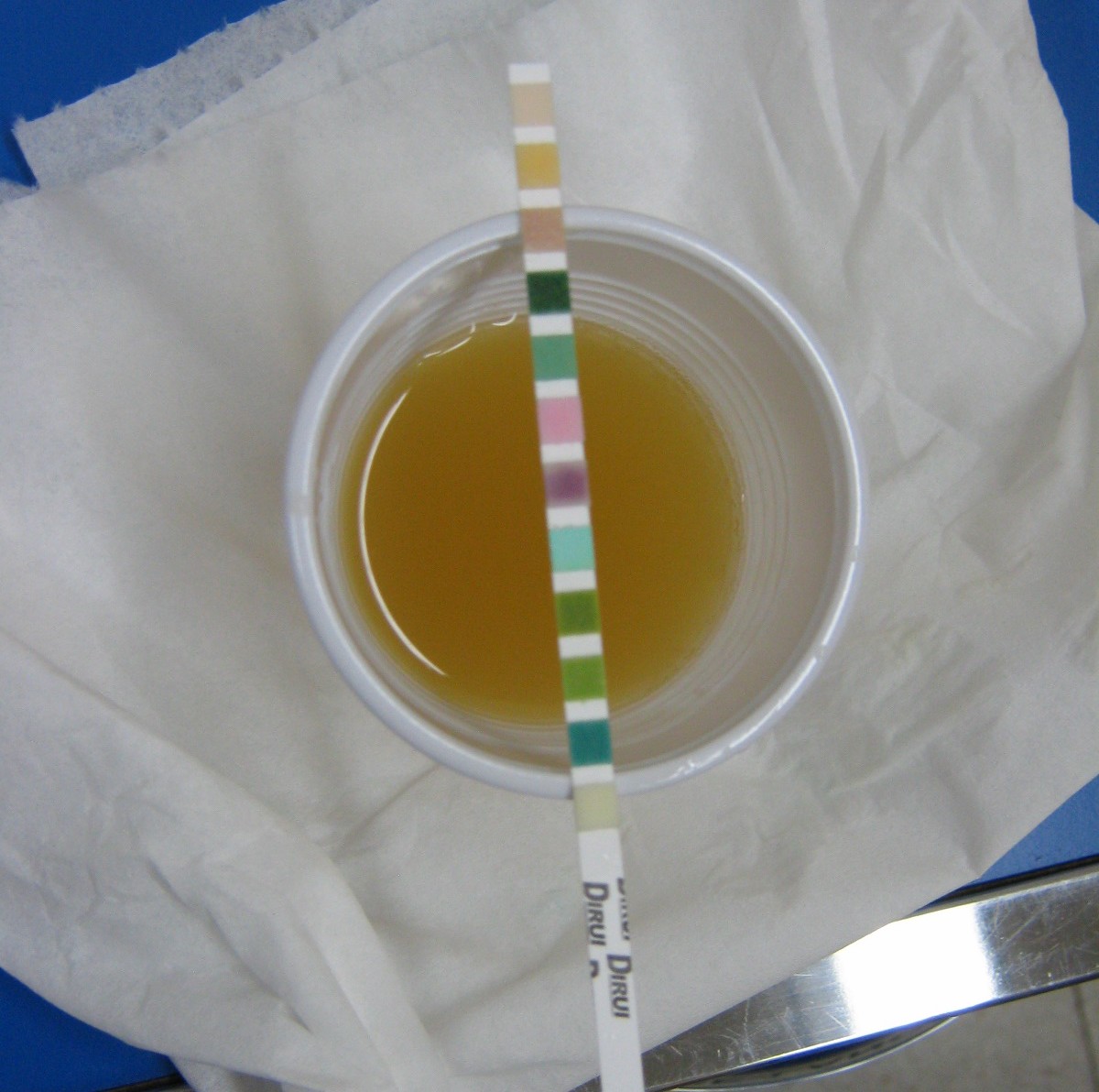
- Method: On the acid pad, nitrite reacts with an aromatic amine (for example p-arsanilic acid). That forms a diazonium compound, which couples to a dye and turns the pad pink. It is a Griess-type reaction.
- Reading: Compare the pad with the vial chart at the manufacturer's time, commonly 60 seconds. Or use an automated strip reader. The detection limit is commonly about 0.06 mg/dL.
- Turnaround: Minutes at the point of care. Urine culture is the reference standard.
Why it matters
A positive nitrite is one of the most specific bedside clues to gram-negative bacteriuria. It helps you find a urinary source in a febrile or septic patient. Sensitivity is low, and asymptomatic bacteriuria is common. So read it with symptoms, leukocyte esterase and culture. Never alone.
Clinical Pearls
Rule in, not rule out: Positive nitrite plus urinary symptoms makes UTI likely. Negative changes little. Adults: specificity 85–98%, sensitivity only 45–60%.
Negative nitrite, positive LE: Picture the organisms that never make nitrite, such as Enterococcus and S. saprophyticus. Cephalosporins miss Enterococcus, so the culture can flip your antibiotic choice.
Transport handover: EMS/Transport: A strip rarely changes what you do in the field. Hand over the catheter type and date, the urine look, urinary symptoms and any antibiotics given. Febrile and hypotensive? That is sepsis, whatever the strip says.
Nursing collection: RN: Collect from the sampling port. Never the bag. Write down the time, then test or refrigerate fast. A cup left on the counter can turn a negative into a positive.
Infants: Nitrite misses about three quarters of UTIs under 2 years. A negative strip in a febrile infant doesn't end the work-up. Culture from a catheter or suprapubic sample.
Pregnancy: The dipstick can't stand in for culture in pregnancy. Screen once, early, with a urine culture. Treat whatever bacteriuria the culture finds.
Treating asymptomatic bacteriuria causes harm: Antibiotics for a dipstick-positive urine with no symptoms (outside pregnancy and endourologic procedures) breed resistance and adverse effects. Nothing gained. Confusion or falls with no systemic signs? Find the other cause first.
References
- Nicolle, L. E., Gupta, K., Bradley, S. F., et al. (2019). Clinical practice guideline for the management of asymptomatic bacteriuria: 2019 update by the Infectious Diseases Society of America. Clinical Infectious Diseases, 68(10), e83–e110. https://doi.org/10.1093/cid/ciy1121
- Trautner, B. W., Cortés-Penfield, N. W., Gupta, K., et al. (2025). IDSA 2025 guideline update on complicated urinary tract infections. Infectious Diseases Society of America. https://www.idsociety.org/practice-guideline/complicated-urinary-tract-infections/
- Hitzeman, N., Greer, D., & Carpio, E. (2022). Office-based urinalysis: A comprehensive review. American Family Physician, 106(1), 27–35B. https://www.aafp.org/pubs/afp/issues/2022/0700/office-based-urinalysis.html
- Moragas, A., Monfà, R., García-Sangenís, A., & Llor, C. (2026). Accuracy of leukocyte esterase and nitrite tests for diagnosing bacteriuria in older adults: A systematic review and meta-analysis. Clinical Microbiology and Infection, 32(1), 19–29. https://doi.org/10.1016/j.cmi.2025.08.027
- Coulthard, M. G. (2019). Using urine nitrite sticks to test for urinary tract infection in children aged < 2 years: A meta-analysis. Pediatric Nephrology, 34(7), 1283–1288. https://doi.org/10.1007/s00467-019-04226-6
- Pantell, R. H., Roberts, K. B., Adams, W. G., et al. (2021). Evaluation and management of well-appearing febrile infants 8 to 60 days old. Pediatrics, 148(2), e2021052228. https://doi.org/10.1542/peds.2021-052228
- Surviving Sepsis Campaign (2026). Surviving Sepsis Campaign: International guidelines for management of sepsis and septic shock 2026. Critical Care Medicine. https://doi.org/10.1097/CCM.0000000000007075
- Devillé, W. L., Yzermans, J. C., van Duijn, N. P., et al. (2004). The urine dipstick test useful to rule out infections. A meta-analysis of the accuracy (landmark meta-analysis). BMC Urology, 4, 4. https://doi.org/10.1186/1471-2490-4-4
Medical Disclaimer
- For Educational Purposes Only: This content is intended for educational reference and should not be used for clinical decision-making.
- Not a Substitute for Professional Judgment: Always consult your local protocols, institutional guidelines, and supervising physicians.
- Verify Before Acting: Users are responsible for verifying information through authoritative sources before any clinical application.
AI Assistance Notice
AI was used to assist in organizing, paraphrasing, and formatting this information.