

Bedside Snapshot
- Indications
- Shoulder dystocia: head delivered, shoulder does not follow gentle traction
- Breech birth (frank, complete or footling) with birth imminent
- Cord visible at the vagina or felt below the presenting part
- Transverse, oblique or unstable lie in labor, or a limb at the vagina
- Contraindications / Abort
- No vaginal breech attempt without experienced staff and facilities
- No fundal pressure; no manual replacement of a prolapsed cord
- No traction on a breech infant, limb or prolapsed arm
- Abnormal lie in labor: usually immediate cesarean
- Critical Steps
- Shoulder dystocia: call for help, McRoberts, then suprapubic pressure
- Breech: support the body, no traction, keep warm
- Cord: minimal handling, elevate presenting part, transfer urgently
- Neonatal team present at every complicated birth
- Confirm & Monitor
- Record head-to-body time and each maneuver
- Continuous fetal heart rate monitoring where available
- Watch for postpartum hemorrhage and perineal injury
- Hand off time, presentation, maneuvers and neonatal status
Key Numbers
Obstetric emergencies are time-critical: the baby's oxygen supply depends on the cord, and a stuck shoulder or prolapsed cord can progress in minutes. Call for help first, then act.
| Parameter | Value |
|---|---|
| Shoulder dystocia trigger | Head delivered, shoulder does not deliver with gentle downward traction |
| Head-to-body interval | More than 60 seconds has been proposed as an objective marker; not routinely collected (RCOG) |
| McRoberts success (published series) | 25–61%; success depends on technique and timing |
| Brachial plexus injury in shoulder dystocia | 2.3–16% of births (RCOG) |
| Cord prolapse: presenting part elevation | Manual, or bladder fill 500–750 mL via Foley, clamped; empty before any birth attempt (RCOG) |
| Cord prolapse: cesarean | Usual mode when vaginal birth is not imminent; aim for birth within 30 min if the fetal heart rate is suspicious (RCOG, grade B) |
| Terbutaline (tocolysis, cord prolapse) | Adult: 0.25 mg subcutaneously, once |
| Breech: planned cesarean vs planned vaginal | Serious perinatal or neonatal outcome 1.6% vs 5.0% (Term Breech Trial) |
| Deferred cord clamping | At least 60 s in most newborns; immediate resuscitation takes priority when the baby is unwell |
Overview & Principles
Four complications, one rule. The baby is at risk from compression, traction or delay, so reduce those forces and get the baby out by the safest route you have. Shoulder dystocia is an anterior shoulder stuck behind the maternal pubic symphysis. Breech means a non-vertex presentation. Cord prolapse means the cord lies beside or below the presenting part with the membranes ruptured. Malpresentation covers transverse, oblique and unstable lies, and limbs at the vagina.
How It Works
- Shoulder dystocia: External maneuvers change the pelvis first, with McRoberts and suprapubic pressure. Internal maneuvers belong to the obstetric team.
- Breech: The legs and trunk come out before the head. The cord can be compressed while the head is still in the pelvis.
- Cord prolapse: Contractions squeeze the cord, and that causes fetal bradycardia and hypoxia. The longer the wait to birth, the higher the risk.
- Malpresentation: An abnormal lie in labor usually points to an immediate cesarean (RCOG).
Where It Fits
You can't predict shoulder dystocia, and you can't prevent it. Risk factors before pregnancy, during it and in labor predict it poorly. What helps is a systematic approach with simulation training, which improves outcomes and documentation (ACOG Practice Bulletin 178). Cord prolapse is uncommon. Term breech runs about 3–4% of term pregnancies (Term Breech Trial). Out in the field, that means three things: spot the problem early, avoid harm, and get the patient to a team that can deliver the baby.
Indications & Contraindications
Indications
- Shoulder dystocia: The head is out and the shoulder does not deliver with gentle downward traction.
- Breech birth: Buttocks or feet presenting in labor, with delivery imminent or already underway.
- Cord prolapse or cord presentation: Cord felt or seen below the presenting part, with ruptured membranes or suspected rupture.
- Malpresentation in labor: Transverse, oblique or unstable lie, or a limb at the vagina.
Absolute Contraindications
Nothing here is an absolute contraindication to emergency care. Do not hold up resuscitation or transfer for a planned-birth preference.
Relative Contraindications & Cautions
- Vaginal breech birth: Only with experienced staff, facilities and a neonatal team. Febrasgo 2024 limits planned vaginal breech birth to selected criteria. Those include a non-growth-restricted fetus and an experienced obstetrician.
- Fundal pressure: Do not use it in shoulder dystocia. It can make the impaction worse and risk uterine injury.
- Cord prolapse with an unwell baby: Immediate delivery comes first. Delayed cord clamping is not appropriate (RCOG).
- Tocolysis: Terbutaline should not be used for prolonged or home tocolysis. Medications has the detail.
Abort / Stop Criteria
- Breech without staff or facilities: Avoid voluntary pushing, arrange transfer, and discuss uterine relaxation per protocol. If transfer is impossible or the buttocks or legs are already being born, place the patient all-fours or squatting and apply no traction to the fetus (Febrasgo).
- Cord prolapse with a prolonged diagnosis-to-birth interval: Keep elevating and move to cesarean without delay (RCOG).
Scope & Team Roles
| Provider Level | Typical Role | Notes |
|---|---|---|
| EMT | Assists | Position, warmth, support of the body, timing, call for help; no traction |
| AEMT | Assists | Same as EMT plus IV access per protocol |
| Paramedic | Performs (protocol/credentialing required) | Not in national model: state/agency credentialing for maneuvers, tocolysis and manual cord elevation |
| RN (ED/ICU) | Performs (protocol/credentialing required) | Per facility policy and obstetric team direction |
| Critical Care Transport (CFRN / CCP-C / FP-C) | Performs (protocol/credentialing required) | Per transport program protocol; maintain elevation during transport |
| Physician / APP | Performs | Internal maneuvers, cesarean and neonatal resuscitation |
Team Roles During the Procedure
- Team leader: Directs maneuvers and sequence; typically the delivering clinician.
- Maneuver clinician: Performs McRoberts positioning and traction timing.
- Suprapubic pressure clinician: Applies pressure above the symphysis on the team leader's signal.
- Neonatal team: Present at every breech and cord prolapse birth (Febrasgo; RCOG).
- Recorder: Notes time of head delivery, time of body delivery, each maneuver and neonatal status.
Pre-Procedure Assessment
Anatomic Difficulty
| Finding | Assess | Concerning Findings |
|---|---|---|
| Presentation | Buttocks, feet or knees felt or seen; head delivery status | Non-vertex presentation with labor progressing |
| Cord | Cord at the vagina or below the presenting part | Any visible or palpable cord with ruptured membranes |
| Limbs | Arm or leg visible at the vagina | Limb prolapse or a limb presentation in labor |
| Size and risk | Previous large baby, diabetes, multiparity, prolonged labor | Known macrosomia or risk factors for shoulder dystocia (poorly predictive; ACOG 178) |
Physiologic Risk
- Fetal: Bradycardia, recurrent late or variable decelerations, or no reassuring tracing (suspicious or pathological pattern).
- Maternal: Hemorrhage, shock or hypoxemia; check SpO₂, pulse and blood pressure on arrival.
- Neonatal: Limp, apneic or bradycardic newborn; neonatal team needed at birth.
Site / Device Check
- Equipment: Confirm the delivery kit, suction, warm blankets and the neonatal resuscitation equipment are at hand before the birth.
- Transport: Confirm the destination has obstetric and neonatal teams before attempting an emergency birth.
Anatomy & Landmarks
| Problem | Best For | Key Landmark | Position | Avoid If |
|---|---|---|---|---|
| Shoulder dystocia | First-line external maneuvers | Pubic symphysis; anterior shoulder behind it | McRoberts, then suprapubic pressure | Never pull the head sideways or upward |
| Cord prolapse | Relieve cord compression | Presenting part; cord below it | Elevation, knee-chest or Sims (see the cord steps in Step-by-Step Procedure) | Do not replace the cord manually |
| Breech | Spontaneous birth with support | Buttocks or feet at the introitus | All-fours or squatting if available | No traction on the fetus |
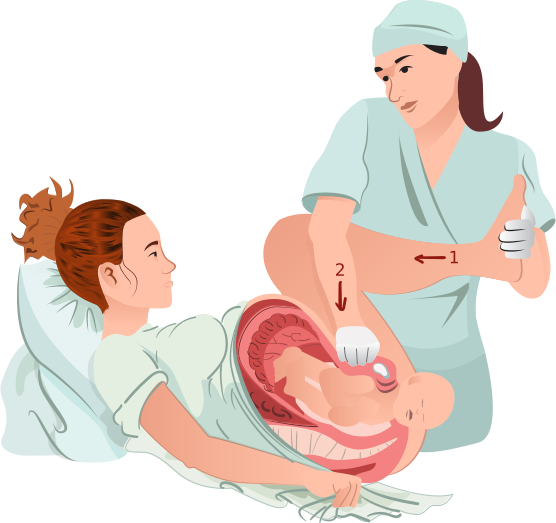
1. Shoulder Dystocia: McRoberts Position
- Flex the hips: Bring the mother's thighs firmly onto her abdomen.
- Lift the buttocks: Hyperflexion elevates the buttocks and flattens the sacrum; this rotates the symphysis.
- Apply traction at the right moment: Gentle, steady axial traction starts after the position is set, not before. Avoid sustained or excessive force, and never pull sideways or upward.
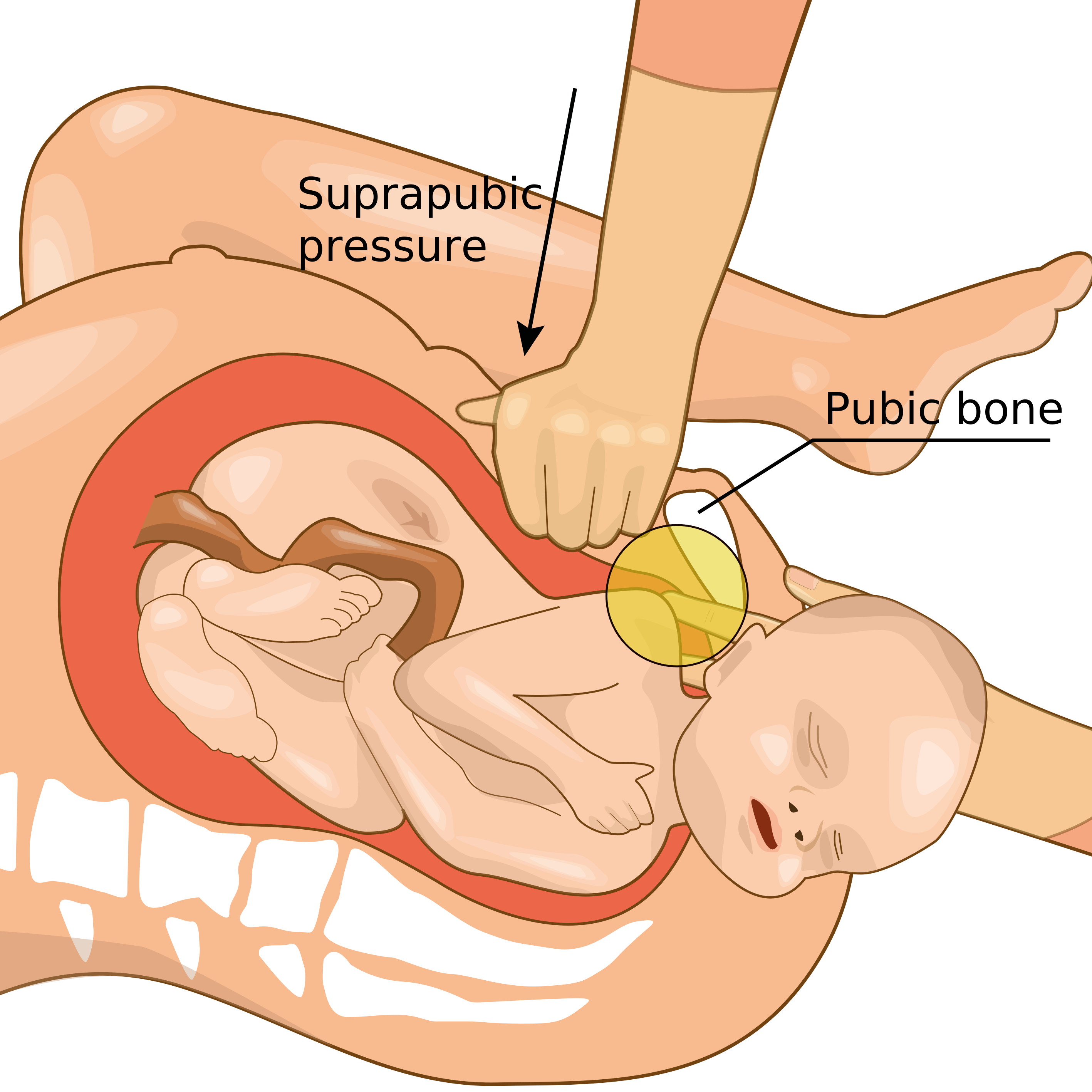
2. Shoulder Dystocia: Suprapubic Pressure
- Place the hand: Position the heel of the hand above the maternal pubic symphysis, on the anterior abdomen.
- Push down and to the side: Firm pressure reduces the bisacromial diameter and rotates the shoulders into an oblique diameter.
- Coordinate: Apply pressure on the team leader's signal, with controlled traction and maternal expulsive effort.
Pediatric
Not applicable. These maneuvers act on the mother. Neonatal concerns sit in Special Populations.
Equipment & Preparation
Equipment
- Sterile or clean delivery kit, towels and warm dry blankets
- Suction (bulb or wall) and oxygen with a mask
- Neonatal resuscitation equipment, including a bag-mask device sized for a newborn
- Foley catheter, sterile tubing and sterile saline for bladder filling, 500–750 mL (cord prolapse; RCOG 2014)
- IV access supplies and terbutaline 1 mg/mL for subcutaneous tocolysis in cord prolapse, if protocol allows (not for shoulder dystocia)
- Monitor for maternal vital signs and fetal heart rate if available
Sizing
Size neonatal equipment by weight and gestational age, per your neonatal protocol. For planned vaginal birth, Febrasgo 2024 uses an estimated weight of 2,000–4,000 g to judge breech eligibility. That threshold does not apply to a birth already underway.
Patient Positioning & Preparation
- Shoulder dystocia: Flat bed, buttocks to the edge; keep the mother's thighs free to flex.
- Cord prolapse: Elevation position (see the cord steps in Step-by-Step Procedure); avoid lying flat if a position change is safe.
- Breech: All-fours or squatting if the mother can maintain it and the team agrees (Febrasgo).
Pre-Procedure Checklist
- Call for help. Name a team leader.
- Confirm the neonatal team is coming or already here
- Confirm the destination and your transfer time
- Lay out suction, oxygen and bag-mask
- Blankets warm, infant warmer ready
- Protocol drugs and Foley ready for cord prolapse
- Write down arrival time and head-delivery time
Medications & Settings
Doses vary by protocol; follow local protocols and medical direction.
| Indication | Adult Dose | Pediatric Dose | Onset / Duration | Notes |
|---|---|---|---|---|
| Cord prolapse or persistent fetal heart rate abnormality (tocolysis) | 0.25 mg subcutaneous, once (0.25 mL of 1 mg/mL; see terbutaline) |
Not applicable (maternal drug) |
Per terbutaline reference |
Given only after mechanical steps are underway. Monitor maternal heart rate, blood pressure and ECG; watch for arrhythmia, chest pain, hypokalemia and pulmonary edema. Use only with medical direction in maternal cardiac disease, hypertension, hyperthyroidism or hypokalemia. FDA boxed warning: serious adverse reactions, including death, with prolonged tocolysis (beyond 48-72 hours) or outpatient or home use. Not for routine use in shoulder dystocia. RCOG suggests it for persistent fetal heart rate abnormalities (level 3 evidence). |
| Postpartum hemorrhage: first-line uterotonic (oxytocin) | Per local protocol (see Emergency Childbirth) |
Not applicable (maternal drug) |
Per protocol |
Given with uterine massage. Do not give methylergonovine before delivery. |
| Postpartum hemorrhage: adjunct to uterotonics | 1 g IV over 10 minutes; repeat 1 g if bleeding continues after 30 minutes or restarts within 24 hours (WOMAN trial). See tranexamic acid |
Not applicable (maternal drug) |
Start within 3 hours of birth |
Adjunct only: uterotonics, massage and source control come first. |
Step-by-Step Procedure
Phase 1: Prepare
- Call for help: Request the obstetric and neonatal teams and state the time.
- Assign roles: Name the team leader, maneuver clinician, suprapubic pressure clinician, neonatal lead and recorder.
- Set up for birth: Warm towels, suction, oxygen and bag-mask ready at the bedside.
Phase 2: Perform
- Shoulder dystocia, step 1: Use the McRoberts position and start traction only once the hips are flexed.
- Shoulder dystocia, step 2: Add suprapubic pressure on the team leader's signal, with controlled traction.
- Shoulder dystocia, step 3: Record each maneuver with time; internal maneuvers (posterior arm, rotation) belong to the obstetric team. If the shoulder has not delivered after both external maneuvers, escalate to the obstetric team immediately (see Confirmation & Monitoring).
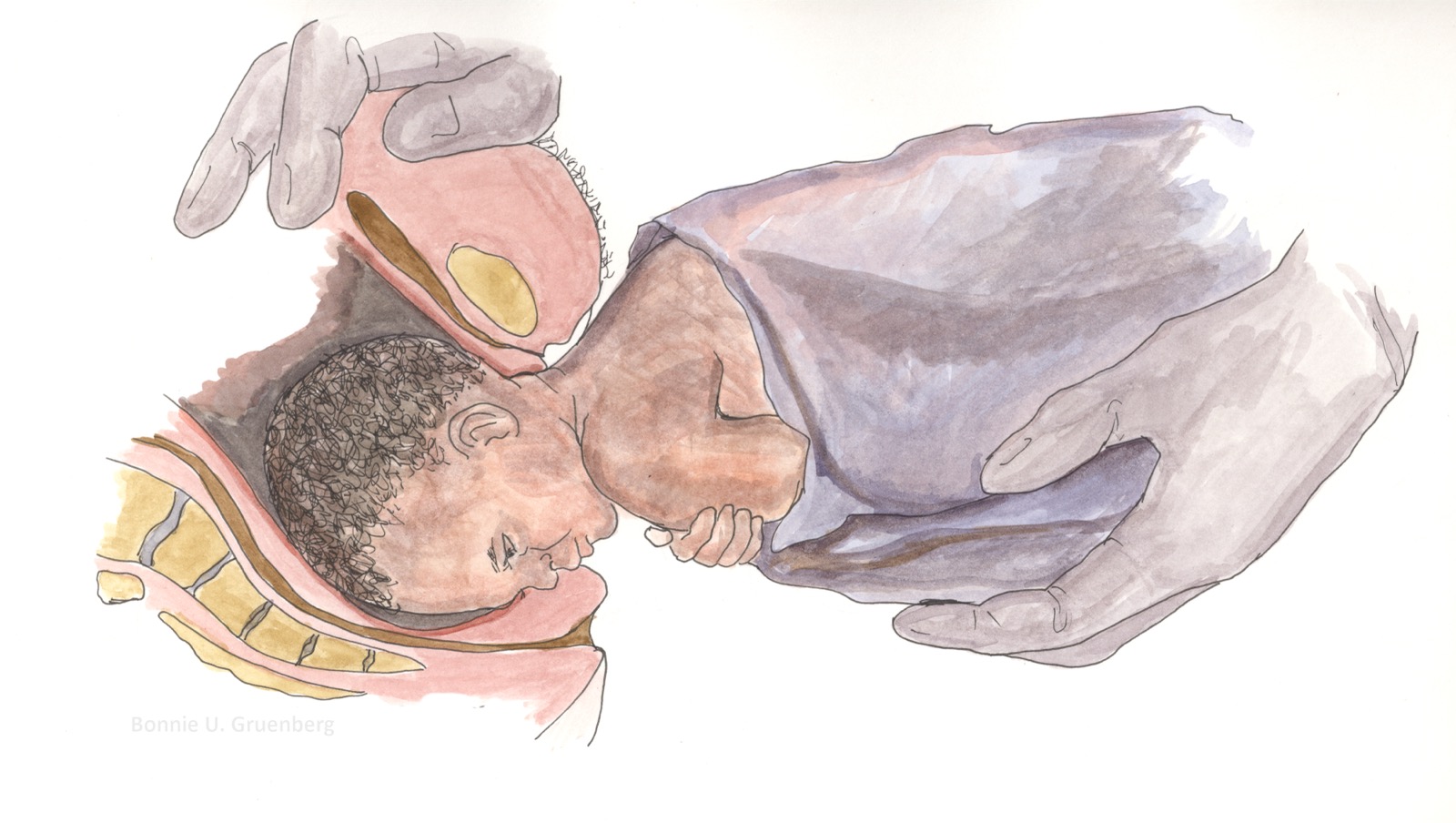
- Breech, step 1: Support the body and do not pull; allow the baby to deliver under the mother's own effort, keeping the back anterior and not holding the baby by the hips or abdomen.
- Breech, step 2: If the baby is coming and the mother can maintain it, use all-fours or squatting (Febrasgo).
- Breech, step 3: Head-entrapment maneuvers such as Mauriceau are for trained clinicians only; Febrasgo 2024 states that every professional assisting a vaginal breech birth must be trained to resolve these events. No traction on the trunk, limbs or head should be applied (Febrasgo).
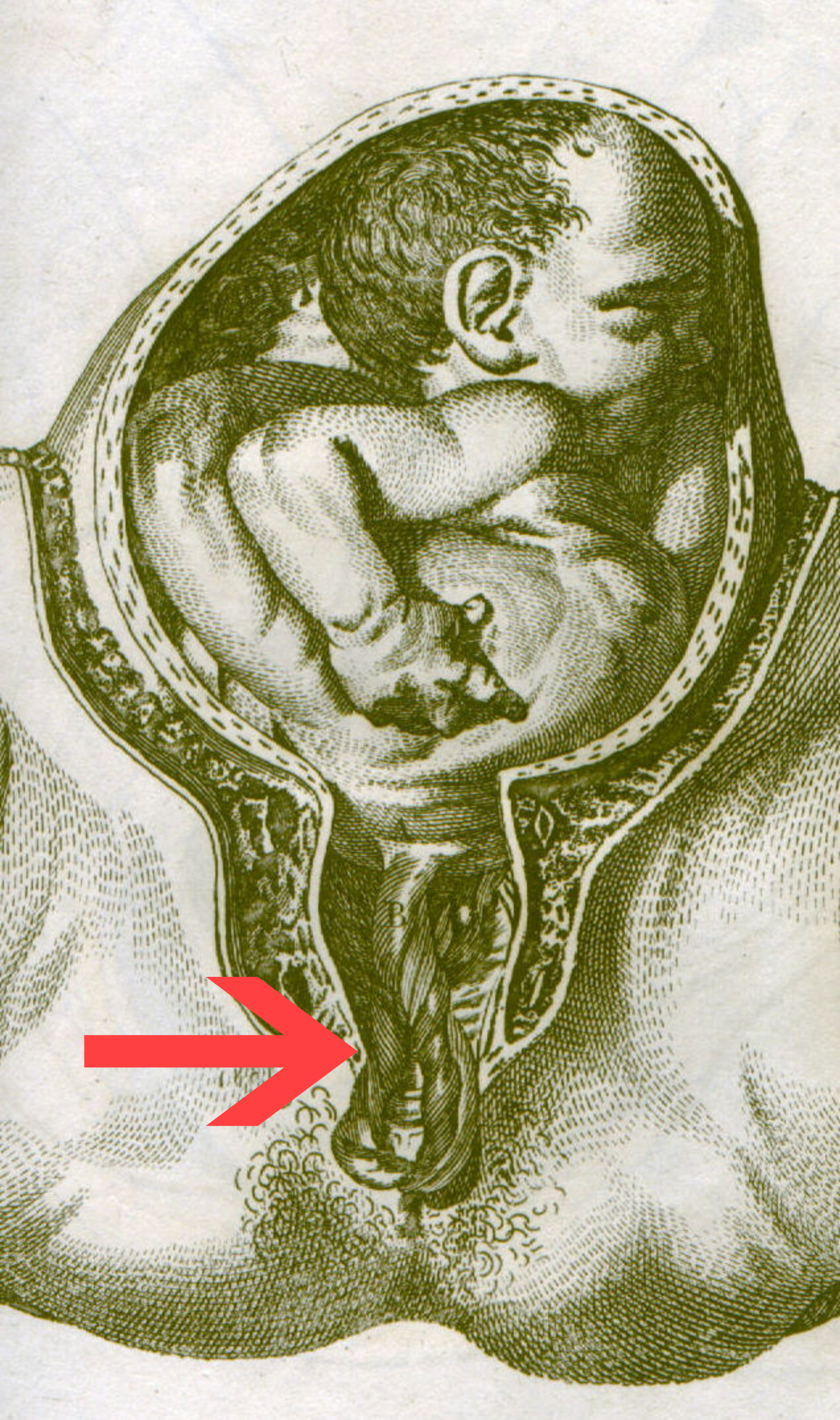
- Cord prolapse, step 1: Limit handling of the cord; manipulation can provoke vasospasm.
- Cord prolapse, step 2: Elevate the presenting part, manually or by bladder filling with 500–750 mL via a Foley, clamped; empty the bladder before any birth attempt (RCOG).
- Cord prolapse, step 3: Position as your protocol directs; for the transport position, see Post-Procedure Care & Transport.
- Cord prolapse, step 4: Transfer urgently to a unit that can perform cesarean, unless birth is imminent.
Phase 3: Confirm & Secure
- Confirm delivery: Note the time the head and body were delivered (see Confirmation & Monitoring).
- Check the newborn: Hand over immediately to the neonatal team; if the baby is unwell, resuscitation comes before cord clamping.
- Document and transfer: Record time, presentation, maneuvers and neonatal status, then transport.
Confirmation & Monitoring
Primary Confirmation
The birth counts as confirmed once the whole baby is out and breathing or being resuscitated. In shoulder dystocia, the proof is the body delivered after the maneuver. In cord prolapse, you confirm with the fetal heart rate during and after elevation.
Secondary Confirmation
- Time of head delivery and time of body delivery
- Each maneuver with start time and result
- Fetal heart rate and whether the cord pulsation is present
- Newborn color, tone, breathing and heart rate
| Finding | Success | Failure / Problem |
|---|---|---|
| Shoulder dystocia | Body delivered after McRoberts or suprapubic pressure | No delivery after both external maneuvers: escalate to the obstetric team |
| Breech | Body delivered spontaneously with support | Head not delivered or stopped descent: escalate |
| Cord prolapse | Stable fetal heart rate after elevation | Persistent bradycardia or decelerations: expedite birth |
Ongoing Monitoring
- Fetal heart rate continuously where available (Febrasgo requires continuous monitoring for planned vaginal breech birth)
- Maternal vitals and bleeding every 5 minutes during transport
- Neonatal condition continuously until handover
Troubleshooting
| Problem | Likely Cause | Fix |
|---|---|---|
| Shoulder does not deliver after McRoberts | Traction before hips flexed, or position not held | Re-set hip flexion, then add suprapubic pressure with gentle, controlled traction |
| Suprapubic pressure does not help | Pressure placed on the fundus or upper abdomen | Re-place above the symphysis; escalate to the obstetric team |
| Breech head not delivering | Trunk or limb traction, nuchal arms | Stop traction; call a trained clinician; Mauriceau only if trained |
| Cord visible or felt at the vagina | Membranes ruptured with high presenting part | Minimize handling; elevate presenting part; transfer urgently |
| Fetal bradycardia with cord prolapse | Cord compression | Maternal positioning, bladder fill, expedite birth |
| Arm or limb at the vagina | Malpresentation or cord-arm presentation | Do not pull; keep the mother positioned and transfer urgently |
| Baby limp at birth | Hypoxia from delay or cord compression | Neonatal resuscitation with the neonatal team; immediate care before cord clamping |
If It Still Fails
- Call the obstetric team: Internal maneuvers and cesarean are their calls.
- Transfer: Head to the nearest unit with obstetric and neonatal services.
- Hemorrhage: Run the postpartum hemorrhage protocol. The tranexamic acid reference has the detail.
Complications
| Complication | Recognition | Prevention | Management |
|---|---|---|---|
| Immediate: brachial plexus injury | Arm weakness or lack of movement after birth | Smooth, controlled maneuvers; no excessive traction | Neonatal assessment and referral; RCOG 2026 reports 2.3–16% of shoulder dystocia births |
| Immediate: fetal hypoxia | Bradycardia, limp or apneic newborn | Early recognition, team ready, fast transfer | Neonatal resuscitation; deferred cord clamping only when the baby is uncompromised |
| Immediate: cord compression | Fetal heart rate decelerations or bradycardia | Elevation, positioning, no delay | Expedite birth; cesarean where indicated (RCOG) |
| Delayed: postpartum hemorrhage | Bleeding, tachycardia, low blood pressure | Active management per protocol | Protocol bleeding management; RCOG 2026 reports 11% postpartum hemorrhage in shoulder dystocia |
| Delayed: perineal injury | Tear or pain after birth | Controlled birth | Assess and repair per obstetric team; RCOG 2026 reports 3.8% anal sphincter injury |
| Rare: nuchal arms | Arms extended above the head | No traction on the trunk | Obstetric team maneuvers; neonatal team present |
Immediate: Cord Prolapse With Bradycardia
- Elevate: Lift the presenting part off the cord, by hand or with bladder elevation.
- Expedite: Move her to cesarean-capable care without delay.
- Hand off: Have the neonatal resuscitation team present at birth.
Special Populations
Pediatrics
- Neonatal team: Every breech and cord prolapse birth needs a neonatal team in attendance (Febrasgo; RCOG).
- Cord clamping: For most newborns, deferred clamping of at least 60 seconds is recommended (see Neonatal Resuscitation). If the baby is unwell, resuscitation comes first (RCOG).
- Neonatal assessment: Check breathing, heart rate and tone right away. For neonatal and infant references, use Neonatal Resuscitation, Pediatric Vital Signs and Pediatric Airway.
- Brachial plexus: Arm movement should be checked after shoulder dystocia. Report any weakness to the receiving team.
Nuchal Cord
This page leaves out a nuchal cord technique on purpose, because no verified guideline text for one was retrieved. Use the nuchal cord steps in Emergency Childbirth and your protocol. Never pull on the baby to clear the cord.
Higher-Risk Presentations
- Cord prolapse risk: Multiparity, low birth weight, preterm labor, breech, transverse or unstable lie, second twin and polyhydramnios (RCOG).
- Second twin: Breech extraction is an accepted option after internal podalic version (RCOG). The obstetric team makes that call.
- Unstable lie after 37 weeks: Elective admission should be on the table (RCOG).
Physiologically Difficult Patients
- Maternal shock or hemorrhage: treat per protocol. The fetus does not change the order of resuscitation.
- Tocolysis raises maternal heart rate. Watch for pulmonary edema and arrhythmia (see Terbutaline).
Post-Procedure Care & Transport
Immediate Aftercare
- Check bleeding, uterine tone and perineum; massage and oxytocic per protocol.
- Keep the mother warm and reassess vitals every 5 minutes during transfer.
- Keep the newborn warm; transfer with the neonatal team if one is present.
Ongoing Maintenance
- Cord prolapse: keep the presenting part elevated until the team takes over, unless the bladder is already filled and the team has advised otherwise.
- Breech: keep the infant's body supported and head flexed if it is still in the birth canal.
Transport Considerations
- Position: For ambulance transfer, RCOG 2014 advises left lateral (Sims). Knee-chest gives the most lift, but it is unsafe in a moving vehicle.
- Reassessment: Check fetal heart rate and maternal vitals after every move.
- Monitors: Confirm the fetal heart rate and maternal pulse by palpation or monitor if vibration limits the display; watch for dislodgement of the bladder catheter.
- Destination: Transfer to the nearest unit with obstetric and neonatal services.
Document & Hand Off
- Arrival time, head-delivery time and body-delivery time
- Presentation, maneuvers and attempts, each with its time
- Fetal heart rate and maternal vitals, each with the time taken
- Cord prolapse: how you elevated, bladder volume and when
- Newborn condition at birth, resuscitation given and when the cord was clamped
- Medications given, with the time (for example terbutaline 0.25 mg SC)
- Bleeding, plus any tranexamic acid and its time
Clinical Pearls & Pitfalls
Pearls
- Hips first: Flex the mother's hips before any traction in shoulder dystocia. Hips come first.
- Pressure above the pubis: Suprapubic pressure works best when the team leader signals and the traction stays controlled.
- No traction on breech: Support the body, let the baby come, and keep the infant warm.
- Cord is a clock: Handle it as little as possible, elevate and transfer. Do not wait on a position change.
- Neonatal team first: In every complicated birth, the baby is the second patient.
Common Pitfalls
- Pulling the baby → support the body and wait out the next contraction.
- Shoving the cord back in → elevate the presenting part and transfer.
- Knee-chest in a moving ambulance → switch to the transport position in Post-Procedure Care & Transport.
- Calling it done when the body is out → confirm the whole baby and write down the time.
- Leaving out the neonatal team → ask for them on the first call.
Education & Skill Maintenance
Skill Maintenance
- Run shoulder dystocia drills with the full team at least once a year, with roles and timing assigned (ACOG).
- Keep a written checklist for breech and cord prolapse, so the first steps don't get skipped.
- Debrief every drill on timing, communication and documentation.
- RCOG 2014 recommends that all staff be trained in managing obstetric emergencies. Include the neonatal team.
References
- American College of Obstetricians and Gynecologists. Practice Bulletin No. 178: Shoulder Dystocia. Obstet Gynecol. 2017;129(5):e123–e133 (reaffirmed 2024). https://doi.org/10.1097/AOG.0000000000002043
- Lattey K, Winter C, Ellis V, Crofts JF, Quick T, Bourke G, Leung TY, Draycott T. Shoulder Dystocia (Green-top Guideline No. 42), 3rd edition. BJOG. 2026;133(12). https://doi.org/10.1111/1471-0528.70258
- Royal College of Obstetricians and Gynaecologists. Umbilical Cord Prolapse (Green-top Guideline No. 50), 2nd edition. London: RCOG; November 2014 (reviewed December 2024). https://www.rcog.org.uk/media/3wykswng/gtg-50-umbilicalcordprolapse-2014.pdf
- Tongsong T, Sirilert S, Luewan S. The McRoberts maneuver in shoulder dystocia: a critical reappraisal. Int J Gynaecol Obstet. 2026 (online ahead of print, October 8, 2026). https://doi.org/10.1002/ijgo.71383
- Term Breech Trial Collaborative Group (Hannah ME, Hannah WJ, Hewson SA, Hodnett ED, Saigal S, Willan AR). Planned caesarean section versus planned vaginal birth for breech presentation at term: a randomised multicentre trial. Lancet. 2000;356(9239):1375–1383 (landmark trial). https://doi.org/10.1016/s0140-6736(00)02840-3
- Federação Brasileira das Associações de Ginecologia e Obstetrícia (Febrasgo). Alves ÁLL, Nozaki AM, Polido CBA, Silva LB, Knobel R. Breech birth care: Number 1 – 2024. Rev Bras Ginecol Obstet. 2024;46. https://doi.org/10.61622/rbgo/2024fps01
- American College of Obstetricians and Gynecologists. Committee Opinion No. 745: Mode of Term Singleton Breech Delivery. Obstet Gynecol. 2018 Aug. https://doi.org/10.1097/AOG.0000000000002755
- Royal College of Obstetricians and Gynaecologists. Management of Breech Presentation (Green-top Guideline No. 20b), 4th edition. London: RCOG; reviewed 16 March 2017. https://www.rcog.org.uk/guidance/browse-all-guidance/green-top-guidelines/management-of-breech-presentation-green-top-guideline-no-20b/
Medical Disclaimer
- For Educational Purposes Only: This content is intended for educational reference and should not be used for clinical decision-making.
- Not a Substitute for Professional Judgment: Always consult your local protocols, institutional guidelines, and supervising physicians.
- Verify Before Acting: Users are responsible for verifying information through authoritative sources before any clinical application.