

Bedside Snapshot
- Indications
- Delivery imminent: head at the vulva or urge to push, with no time to transport
- Baby born before arrival: dry, warm, assess, resuscitate if needed
- Bleeding after birth: uterotonic, fundal massage, tranexamic acid per protocol
- Contraindications / Abort
- Do not pull on the cord unless a trained attendant is performing traction
- Ergometrine: never with hypertension, preeclampsia or eclampsia; IV only by medical direction
- Oxytocin: never an undiluted rapid IV bolus; confirm no second baby first
- Shock or ongoing heavy bleeding: escalate; do not wait for transport
- Critical Steps
- Check for a nuchal cord before delivering the shoulders
- Delay cord clamping at least 60 s if the baby needs no resuscitation
- Oxytocin 10 units IM after the placenta; massage the uterus until firm
- Tranexamic acid 1 g IV over 10 min within 3 hr of birth
- Confirm & Monitor
- Newborn breathing or crying, good tone, heart rate at least 100/min
- Newborn temperature 36.5–37.5 °C (97.7–99.5 °F)
- Firm uterus; blood loss and pulse rechecked repeatedly
- Magnesium: reflexes and respirations before each dose
Key Numbers
Time-critical once the head is visible or the mother has an urge to push: deliver safely, control bleeding, and start newborn care at once.
| Parameter | Value |
|---|---|
| Cord clamping | Delay at least 60 s for a baby who needs no resuscitation (2025 AHA Guidelines for CPR and ECC, Part 5: COR 1 preterm, COR 2a term) |
| Oxytocin | 10 units IM after the placenta (label). IV only as a diluted infusion (10–40 units in 1000 mL, titrated) or per medical direction; never an undiluted rapid IV bolus |
| Tranexamic acid | 1 g IV over 10 min within 3 hr of birth Repeat 1 g if bleeding continues at 30 min |
| Magnesium (eclampsia) | 4 g IV, no faster than 150 mg/min (label), then 1–2 g/hr Some protocols: 4–6 g over 20–30 min |
| Newborn compressions | Heart rate below 60/min after 30 s of effective ventilation: compressions (COR 1), coordinated 3:1 with ventilation (COR 2b) (2025 AHA Guidelines for CPR and ECC, Part 5) |
| Newborn epinephrine | 0.01–0.03 mg/kg IV/IO (0.1–0.3 mL/kg of 1:10,000) if heart rate stays below 60/min after 60 s of compressions with adequate ventilation; repeat every 3–5 min (2025 AHA Guidelines for CPR and ECC, Part 5: epinephrine COR 1, repeat doses COR 2b) |
| Resuscitative delivery (perimortem cesarean) | Indicated if circulation does not return with standard resuscitation and fundal height is at or above the umbilicus; prepare at arrest and aim for delivery by 5 min (2025 AHA Guidelines for CPR and ECC, Part 10: COR 1) |
| Newborn temperature | 36.5–37.5 °C (97.7–99.5 °F) (2025 AHA Guidelines for CPR and ECC, Part 5: COR 1) |
Overview & Principles
Some births cannot wait for the hospital. Emergency childbirth is delivery in the field, in the ED or in transport. You have three jobs. Deliver the baby safely. Control the bleeding after birth. Start newborn care at once if the baby needs it.
How It Works
- Delivery: Support the head and perineum, check for a nuchal cord, and deliver the shoulders without pulling on the baby.
- Placenta: Let the placenta deliver. Do not pull on the cord unless a trained attendant is performing controlled cord traction.
- Bleeding: A firm uterus is what stops it. Oxytocin and fundal massage come first. Tranexamic acid follows, within 3 hours of birth.
- Newborn: Dry, warm and stimulate the baby. Breathing and heart rate decide the next step. A baby who needs no resuscitation gets at least 60 seconds of deferred clamping. A baby who does still gets the initial steps during deferred clamping, but needs ventilation within 60 seconds of birth if apneic, gasping or below 100/min despite those steps.
Where It Fits
Bleeding after birth follows the FIGO postpartum hemorrhage sequence: uterotonic, uterine massage, tranexamic acid, then transport. Newborn care follows the 2025 AHA/AAP neonatal algorithm (2025 AHA Guidelines for CPR and ECC, Part 5). Maternal cardiac arrest is a different problem. With fundal height at or above the umbilicus (roughly 20 weeks or more), it needs manual left uterine displacement, and resuscitative delivery follows if circulation does not return (2025 AHA Guidelines for CPR and ECC, Part 10). That pathway is separate. See Special Populations.
Indications & Contraindications
Indications
- Delivery imminent: head visible at the vulva or an uncontrollable urge to push, with no time to reach a hospital
- Baby born before arrival: drying, warming, assessment and resuscitation if needed
- Bleeding after birth (postpartum hemorrhage): uterotonic, fundal massage and tranexamic acid per protocol
- Seizure in pregnancy or the postpartum period with severe-range blood pressure: magnesium per protocol
Absolute Contraindications
When the birth is imminent, there are none. A head that is already visible is not a reason to wait for transport.
Relative Contraindications & Cautions
- Delivery not yet imminent: transport the mother to an obstetric unit when local protocol allows
- Hypertension, toxemia, preeclampsia or eclampsia: ergometrine (methylergometrine) is contraindicated, so exclude them before use
- Cardiovascular or peripheral vascular disease, sepsis, or strong or moderate CYP3A4 inhibitors (for example, protease inhibitors, macrolides, azole antifungals): ergometrine is avoided or used with caution, per the label precautions
- Oxytocin: hypersensitivity to the drug (label)
- Expected multiple birth: call early for additional ALS or obstetric support
- Known thromboembolic event: avoid tranexamic acid unless medical direction decides otherwise (see the tranexamic acid page)
Consider an Alternative
- Stabilize and transport when the head is not visible and the mother is not in the second stage, per local protocol
- Seizure with severe-range blood pressure: magnesium sulfate per protocol, then transport to an obstetric unit
Scope & Team Roles
| Provider Level | Typical Role | Notes |
|---|---|---|
| EMT | Performs (protocol/credentialing required) | Basic delivery and newborn care per state protocol; scope varies by state. |
| AEMT | Performs (protocol/credentialing required) | Adds IV access and uterotonic or tranexamic acid administration where the protocol allows. |
| Paramedic | Performs | Oxytocin, tranexamic acid, magnesium and neonatal epinephrine per state protocol. |
| RN (ED/ICU) | Performs | Delivery in the ED or unit. Neonatal resuscitation by staff trained in the neonatal algorithm. |
| Critical Care Transport (CFRN / CTRN / FP-C / CCP-C) | Performs | Ongoing bleeding and newborn management in transit, with the handoff to obstetric and neonatal teams. |
| Physician / APP | Performs | Definitive obstetric and neonatal care, including any decision about perimortem cesarean delivery. |
Team Roles During the Procedure
- Operator: Delivers the baby and manages the perineum and the shoulders.
- Newborn lead: Dries, warms, clears the airway if needed, and runs the breathing and heart-rate checks.
- Maternal monitor: Checks the fundus, blood loss, pulse and blood pressure, and gives uterotonics per protocol.
- Recorder: Times the birth, cord clamping, placenta, drug doses and any change in the baby.
Pre-Procedure Assessment
Imminent Delivery Signs
- Head at the vulva: The baby may come with the next contraction or two.
- Urge to bear down: The pushing is involuntary, and the perineum bulges.
- Rapid progress: Contractions are close together. The mother cannot wait for transport.
- History: Gestational age, prenatal care, number of babies expected, bleeding, seizures and recent blood pressure.
Physiologic Risk
- Severe-range blood pressure: SBP ≥160 mmHg or DBP ≥110 mmHg, persistent for at least 15 min; with headache, visual change or seizure, treat as preeclampsia with severe features per protocol.
- Hemorrhage risk: Shock index above 0.9 (heart rate divided by systolic pressure), or heavy bleeding before the placenta has delivered.
- Fundal height at or above the umbilicus (roughly 20 weeks or more): A pregnant patient in arrest needs manual left uterine displacement with compressions from the start (2025 AHA Guidelines for CPR and ECC, Part 10, COR 1).
Equipment & Preparation
Equipment
| Item | Size / Spec | Notes |
|---|---|---|
| Clean delivery kit | Gloves, towels, pads, bulb or suction | Keep dry towels and a clean blanket ready for the baby. |
| Cord clamps or ties | Two clamps or ties | Clamp only when the cord timing rule is met (see Step-by-Step). |
| Oxytocin | 10 units/mL vial | Store per the product label: Pitocin 20–25 °C; some generics require 2–8 °C. Label: 10 units per mL. |
| Methylergonovine (if stocked) | Per product label | Refrigerate at 2–8 °C and protect from light (label). |
| Tranexamic acid | 1 g IV (100 mg/mL) | One vial dose; 1 g is 10 mL of the 100 mg/mL solution. |
| Magnesium sulfate | 50% concentrate (500 mg/mL) or premixed bag | Concentrate must be diluted or given per protocol; see the medication page. |
| Newborn bag-mask | Newborn-size mask, with a pop-off valve if the device has one | Pulse oximeter with a newborn probe; suction ready. |
| Epinephrine 1:10,000 | 0.1 mg/mL (1 mg in 10 mL) | Neonatal dose is set by weight: 0.1–0.3 mL/kg. |
Sizing
No time to weigh? Use the protocol's estimate. If there is time, weigh the baby. Every epinephrine volume and weight-based calculation hangs on that number. The math is on weight-based dosing and equipment sizing.
Patient Positioning & Preparation
Knees bent, mother comfortable. Have the stretcher ready to move. A second person on scene before the birth helps, if you can get one.
Pre-Procedure Checklist
- Call for ALS and obstetric support; tell the receiving facility about the birth if it is still ahead
- Gloves, towels, pads, suction and cord clamps or ties open and within reach
- Warm towels and a warm blanket for the newborn
- Oxytocin, tranexamic acid and magnesium sulfate available for the protocol
- Newborn bag-mask, suction and pulse oximeter ready
- Neonatal epinephrine 1:10,000 available and dosing weight known
- IV or IO access kit ready for the mother if bleeding starts
- Time keeper assigned to record the time of birth
Medications & Settings
These are typical adult and newborn doses, for reference. Check them against local protocol and the current drug label.
| Drug | Adult Dose | Pediatric Dose | Onset / Duration | Notes |
|---|---|---|---|---|
| Oxytocin | 10 units IM after delivery of the placenta (label). IV only as a diluted infusion (10–40 units in 1000 mL, titrated to tone) or per medical direction. Never an undiluted rapid IV bolus |
Not used for newborns in this context |
IM: uterine response in 3–5 min, lasts 2–3 hr. IV infusion: onset within minutes; stop when the uterus is firm |
High-alert No fixed repeat in the label; follow protocol. Confirm no second baby before giving |
| Tranexamic acid | 1 g IV over 10 min, within 3 hr of birth |
Not established in newborns for this indication |
IV: immediate; antifibrinolytic levels about 7–8 hr (per the tranexamic acid page) |
Repeat 1 g IV if bleeding continues at 30 min; max 2 g per episode |
| Magnesium sulfate (eclampsia) | 4 g IV loading dose, infused at no more than 150 mg/min (label; the label exception is severe eclampsia with seizures), then 1–2 g/hr IV. Some protocols use 4–6 g over 20–30 min |
Maternal indication; newborn use is not part of this page |
IV: immediate; effect lasts about 30 min |
High-alert Check reflexes and respirations before each dose. Caution in renal impairment: urine output at least 100 mL every 4 hr, frequent serum levels, and a maximum of 20 g per 48 hr with severe renal insufficiency (label). Continuous use beyond 5–7 days harms the fetus (label) |
| Ergometrine or methylergometrine | 0.2 mg IM (preferred). IV only by medical direction and only for life-threatening bleeding, given slowly over at least 60 s |
Not established in newborns |
Per FIGO; onset and duration per drug reference |
Contraindicated with hypertension, toxemia or preeclampsia. Avoid with strong or moderate CYP3A4 inhibitors. Refrigerate 2–8 °C |
| Misoprostol | 800 mcg sublingual, if injectable uterotonics are unavailable or do not work |
Not established in newborns |
Per drug reference |
Single 800 mcg dose in the FIGO treatment pathway |
| Newborn epinephrine (1:10,000) | Maternal cardiac arrest: adult ACLS per protocol. See epinephrine IV |
0.01–0.03 mg/kg IV/IO (0.1–0.3 mL/kg of 1:10,000) by rapid push |
Rapid push; per the neonatal algorithm |
Repeat every 3–5 min; no fixed maximum in the source reviewed |
Doses vary by protocol; follow local protocols and medical direction.
Step-by-Step Procedure
Phase 1: Prepare
- Call for help early: Request ALS and obstetric support, and a second provider. If transport is still possible, tell the receiving facility the delivery is under way.
- Set up the delivery: Open the clean kit, warm the newborn towels, and confirm the cord clamps or ties and suction are at hand.
- Take the history: Gestational age, number of babies, bleeding, seizures and blood pressure, then record the time.
Phase 2: Perform
- Support the head and perineum: Use a gloved hand to control the head as it delivers. Do not push on the head or pull on the baby.
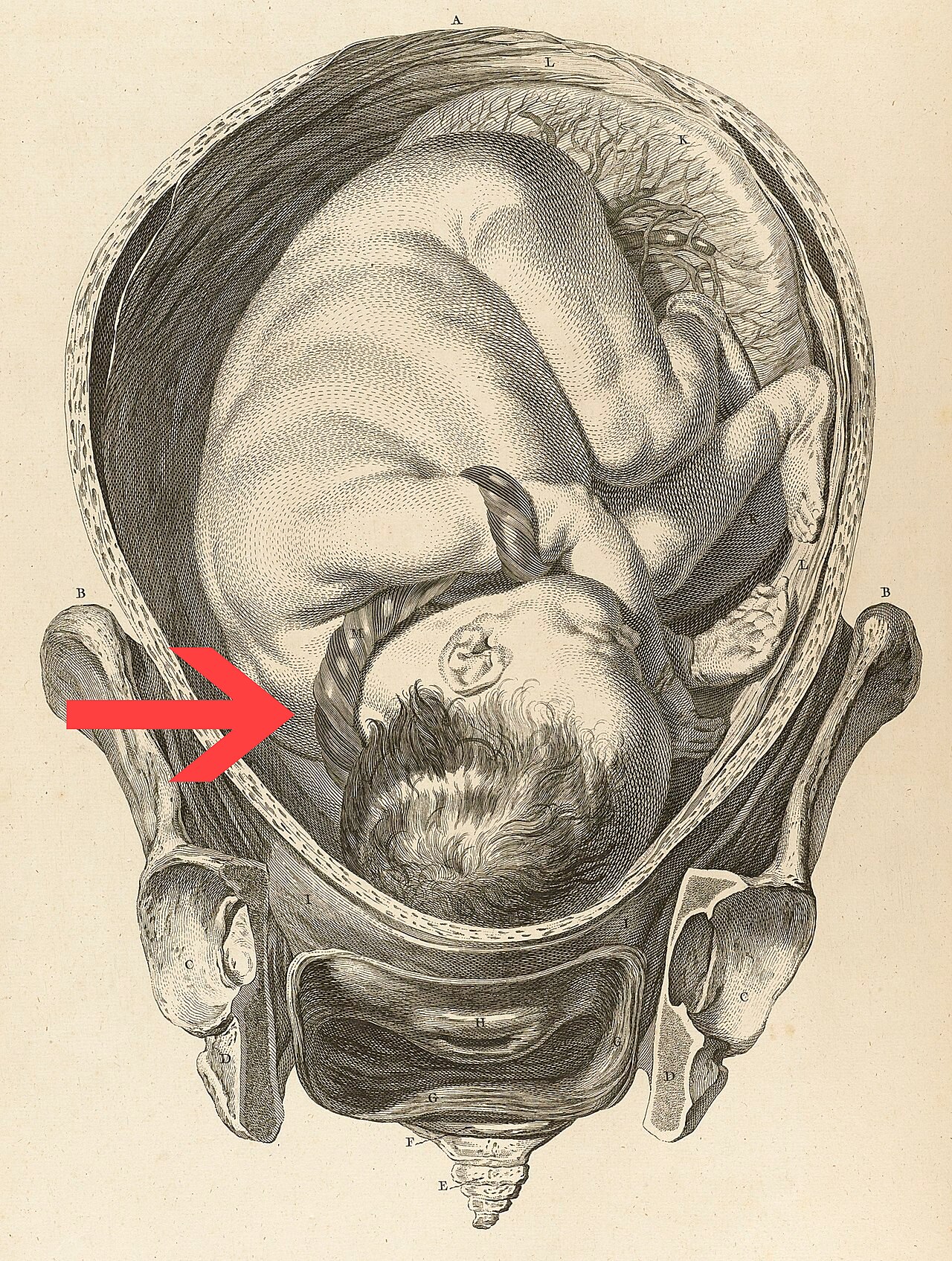
- Check for a nuchal cord: If the cord is around the neck, try to slip it over the head first. A tight cord that cannot be disengaged is clamped and cut before the rest of the delivery, per local protocol. See Figure 1.
- Deliver the shoulders: Use gentle downward traction, then gentle upward traction, to deliver the shoulders. If the shoulders do not follow, call for help and act at once: hyperflex the mother's thighs onto her abdomen (McRoberts), apply firm suprapubic pressure (not fundal pressure), and do not pull on the head. Follow local protocol and medical direction.
- Dry and warm the baby: Dry the baby, remove wet towels, and cover the head. Start the breathing and heart-rate assessment.
Phase 3: Confirm & Secure
- Time the cord clamp: If the baby is breathing and does not need resuscitation, delay clamping the cord for at least 60 seconds. Do not milk the cord in a preterm baby under 28 weeks.
- Let the placenta deliver: Do not pull on the cord. Use controlled cord traction only if a trained attendant is performing it, as FIGO advises.
- Give oxytocin: Before giving it, palpate the abdomen to confirm no second baby. Give 10 units IM after the placenta delivers, or IV only as a diluted infusion per protocol or medical direction. Never an undiluted rapid IV push. Record the time.
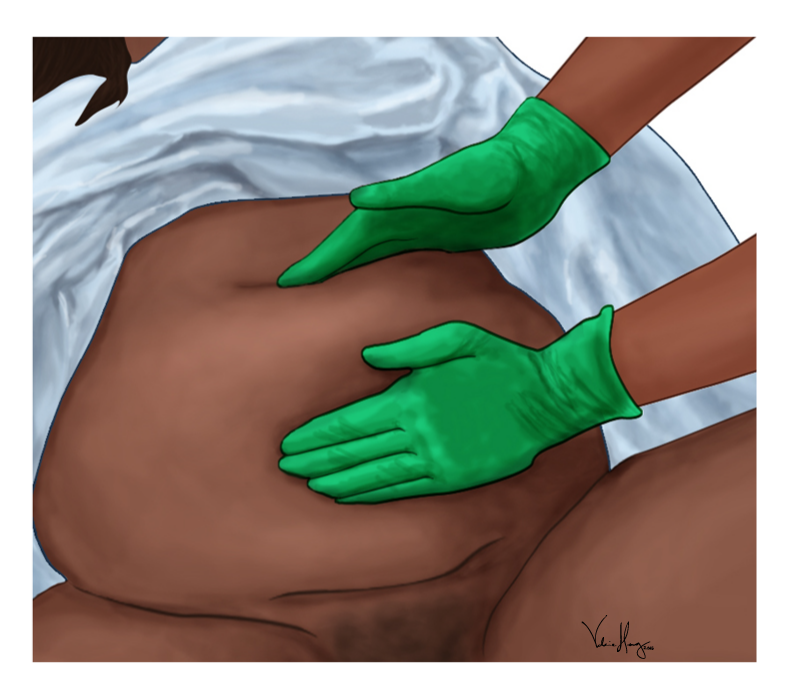
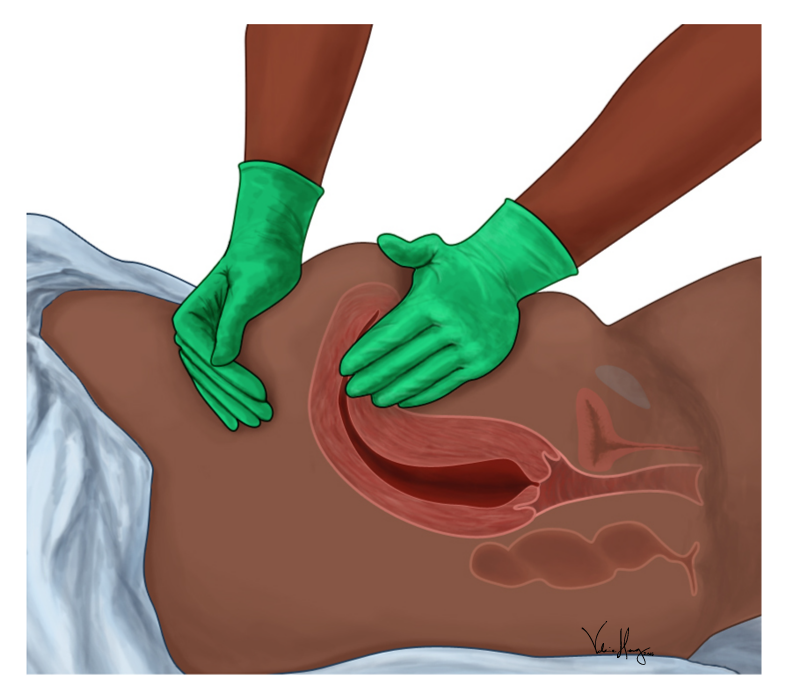
- Massage the uterus until firm: Use both hands on the fundus until the uterus is firm and the bleeding slows. If massage alone does not firm the uterus, use bimanual compression per protocol. See Figures 2 and 3.
- Give tranexamic acid if bleeding continues: 1 g IV over 10 minutes within 3 hours of birth, with a second 1 g dose if bleeding continues at 30 minutes, per protocol.
- Transport with the bleeding plan running: Keep the fundus under review, keep the newborn warm, and notify the receiving team of the birth.
Confirmation & Monitoring
Primary Confirmation
Confirmation means the baby is breathing or crying, with good tone and a heart rate of at least 100/min. The mother's uterus is firm and the bleeding is slowing. A heart rate of 60 to 99/min confirms nothing. It means the baby still needs ventilation.
Secondary Confirmation
- Placenta delivered and checked for completeness
- Blood loss estimated and the pad count recorded at each check
- Perineum checked for lacerations and bleeding
- Maternal pulse and blood pressure stable or improving
- Newborn temperature in the 36.5–37.5 °C (97.7–99.5 °F) range
| Finding | Success | Failure / Malposition |
|---|---|---|
| Uterus | Firm after massage, at or near the midline | Soft or boggy uterus with ongoing bleeding (atony) |
| Bleeding | Slowing after oxytocin and massage | Continuing heavy bleeding; repeat tranexamic acid and escalate per protocol |
| Placenta | Delivered and complete | Retained or incomplete; transport and do not pull on the cord |
| Newborn heart rate | Breathing or crying, good tone, at least 100/min | Below 100/min or apnea: ventilate. Below 60/min after 30 s of effective ventilation: compressions |
| Newborn temperature | 36.5–37.5 °C (97.7–99.5 °F) | Cold baby: dry, cover and rewarm per protocol |
Ongoing Monitoring
- Mother: Fundus, bleeding, pulse, blood pressure and mental status, repeated per protocol
- Newborn: Breathing, heart rate, colour, tone and temperature
- After magnesium: Reflexes and respirations before each dose and during infusion
Troubleshooting
| Problem | Likely Cause | Fix |
|---|---|---|
| Head delivered, shoulders do not follow | Shoulder dystocia | Call for help; McRoberts, suprapubic pressure, no fundal pressure or head traction; follow local protocol |
| Cord around the neck | Nuchal cord | Slip a loose cord over the head; a tight cord is clamped and cut per protocol |
| Heavy bleeding after birth | Uterine atony or retained tissue | Fundal massage, bimanual compression, oxytocin, tranexamic acid, transport |
| Placenta not delivered | Delayed or retained placenta | Do not pull on the cord; transport; manual removal is not an EMS task per local protocol |
| Baby not breathing well at birth | Transition or airway problem | Dry, stimulate, clear the airway if needed, then ventilate if apneic or heart rate is below 100/min; compressions if heart rate stays below 60/min after 30 s of effective ventilation |
| Seizure with severe-range blood pressure | Eclampsia or preeclampsia with severe features | Magnesium and seizure care per protocol; transport to obstetric care |
If Bleeding Still Continues
- Keep massaging and give oxytocin: Confirm the uterus is being massaged and the uterotonic has been given.
- Give tranexamic acid: Second 1 g dose at 30 minutes if bleeding continues, per protocol.
- Escalate: Request the next level of care and start a second IV or IO line for the mother.
Complications
| Complication | Recognition | Prevention | Management |
|---|---|---|---|
| Immediate: postpartum hemorrhage | Ongoing bleeding; soft uterus; signs of shock | Oxytocin at birth; early fundal checks | Massage, oxytocin, tranexamic acid, transport per FIGO sequence |
| Immediate: newborn apnea or bradycardia | No breathing; heart rate below 60/min | Warm, dry and stimulate at birth | Ventilation, then compressions at 3:1 and epinephrine 0.01–0.03 mg/kg IV/IO if HR stays below 60/min after 60 s of compressions with ventilation |
| Delayed: newborn hypothermia | Cold skin; temperature below 36.5 °C | Dry, cover and warm promptly | Rewarm per protocol; keep the baby warm in transit |
| Delayed: maternal hypotension | Falling blood pressure with rising pulse | Watch blood loss from the start | IV or IO access, fluids and transport per protocol |
| Rare: shoulder dystocia | Head delivered, body stuck | Recognize early; call for help | McRoberts, suprapubic pressure, call for help; follow local protocol and medical direction |
Maternal Cardiac Arrest (Fundal Height at or Above the Umbilicus)
- Start CPR with manual left uterine displacement: Push the uterus to the left, off the aorta and vena cava, when fundal height is at or above the umbilicus (COR 1, 2025 AHA Guidelines for CPR and ECC, Part 10). Manual displacement is preferred; a left lateral tilt compromises compression quality, so use it only if manual displacement is not possible.
- Use the standard compression position and continue standard ACLS (defibrillation and drugs) without delay.
- Prepare resuscitative delivery (perimortem cesarean) from the moment of arrest: It is indicated if circulation does not return with standard resuscitation (COR 1). An obstetrician or surgeon performs it, aiming to complete delivery by 5 minutes. Starting at 4 minutes after arrest is the long-standing timing (2025 AHA Guidelines for CPR and ECC, Part 10).
- Call the obstetric team: Decisions about perimortem delivery and team roles follow local protocol and medical direction.
Special Populations
Pediatrics
- Newborn ventilation: Ventilate within 60 seconds of birth if the baby is gasping or apneic, or the heart rate is below 100/min despite the initial steps (2025 AHA Guidelines for CPR and ECC, Part 5, COR 1).
- Compressions: If heart rate stays below 60/min after 30 seconds of effective ventilation, add chest compressions (COR 1), coordinated 3:1 with ventilation (COR 2b) (2025 AHA Guidelines for CPR and ECC, Part 5).
- Epinephrine: 0.01–0.03 mg/kg IV/IO (0.1–0.3 mL/kg of 1:10,000), repeated every 3–5 minutes, if heart rate stays below 60/min after 60 seconds of chest compressions with adequate ventilation (2025 AHA Guidelines for CPR and ECC, Part 5: intravascular epinephrine COR 1; repeat doses COR 2b).
- Cord and temperature: Delay cord clamping at least 60 seconds for a baby who does not need resuscitation (preterm COR 1; term COR 2a, 2025 AHA Guidelines for CPR and ECC, Part 5). Keep the temperature at 36.5–37.5 °C (COR 1).
- Preterm: Do not perform intact cord milking before 28+0 weeks (COR 3: Harm). From 28+0 to 36+6 weeks it may be reasonable (COR 2b) only when deferred clamping cannot be done (2025 AHA Guidelines for CPR and ECC, Part 5).
- Oxygen: At 35 weeks or more, it may be reasonable to start on room air (21%). At 32 to 34+6 weeks, start at 21 to 30%. Under 32 weeks, start at 30 to 100% and titrate to pulse oximetry targets (2025 AHA Guidelines for CPR and ECC, Part 5, COR 2b for each range).
- Warmth in preterm babies: Use a plastic bag or wrap, alone or with a radiant warmer, to prevent hypothermia (2025 AHA Guidelines for CPR and ECC, Part 5, COR 2a, LOE B-R).
- Dosing: Use weight-based dosing and pediatric vital sign ranges; see also equipment sizing.
Multiple Births
- After the first birth, check the abdomen for a second baby. Expect the second birth to need the same steps.
- Expect two cords, two newborns and possibly two placentas. Call for more help early.
- Obstetric care for a multifetal pregnancy is a transport decision. Follow local protocol.
Abnormal Presentation
- Prolapsed cord: Keep the presenting part off the cord, have the mother in knee-chest or hands-knees position, and transport immediately. Do not push the cord back in unless local protocol says so.
- Breech or other malpresentation: Do not pull on the baby. Support the body, let it deliver with gravity, and call for help. Follow local protocol and see the complicated delivery page.
Preeclampsia & Eclampsia
- Severe-range blood pressure with seizure: Treat the seizure and give magnesium sulfate per protocol: 4 g IV loading dose (rate no faster than 150 mg/min per the label, except in severe eclampsia with seizures), then 1–2 g/hr.
- Severe-range blood pressure: Magnesium prevents seizures but does not lower blood pressure. Treat with antihypertensives per protocol (see labetalol or hydralazine).
- Magnesium toxicity: Watch respirations and reflexes; stop the infusion for loss of reflexes or slow or shallow breathing. Give IV calcium per the label (10 to 20 mL of a 5% calcium solution, diluted if desirable) or per protocol. Name the salt and check the vial strength before giving: calcium gluconate is stocked as 1,000 mg per 10 mL (10%); see the magnesium sulfate page. Magnesium is not for patients with heart block or myocardial damage without medical direction.
- Ergometrine: Do not give with hypertension, preeclampsia or eclampsia (label contraindications).
Maternal Cardiac Arrest
- Manual left uterine displacement with compressions when fundal height is at or above the umbilicus (COR 1, 2025 AHA Guidelines for CPR and ECC, Part 10), started with CPR (see the emergency box in Complications).
- Standard compression hand position; airway management is prioritized (COR 1, 2025 AHA Guidelines for CPR and ECC, Part 10).
- Resuscitative delivery (perimortem cesarean) is indicated if circulation does not return with standard resuscitation (COR 1, 2025 AHA Guidelines for CPR and ECC, Part 10); an obstetric or surgical team performs it, as in the emergency box above.
- After magnesium, consider magnesium toxicity in the differential; calcium is reasonable in this setting (COR 2a, 2025 AHA Guidelines for CPR and ECC, Part 10), given per protocol.
Post-Procedure Care & Transport
Immediate Aftercare
- Keep massaging the uterus until it is firm, and check bleeding and vital signs at each stage.
- Dry and warm the newborn; keep the baby with the mother for warmth if the protocol allows.
- Check that the placenta is complete before transport.
Ongoing Maintenance
- Mother: Keep IV or IO access and the uterotonic plan running; reassess after each move.
- Newborn: Keep the temperature at 36.5–37.5 °C and watch breathing and heart rate.
Transport Considerations
- Transport to an obstetric-capable facility when local protocol allows; notify the receiving team early.
- Reassess the fundus and bleeding after each move, because bleeding can restart in transit.
- Keep the newborn warm and monitored in a moving vehicle; reassess breathing after each change.
Document & Hand Off
- Time of birth, gestational age and number of babies
- Cord clamping time and method; nuchal cord and how it was managed
- Placenta: delivered time and whether complete
- Oxytocin, tranexamic acid and magnesium: dose, time and route
- Blood loss estimate, fundal findings and vital-sign trend
- Newborn: breathing, heart rate, temperature, and each resuscitation step with its time
Clinical Pearls & Pitfalls
Pearls
- Support the head: Control the head with a gloved hand and do not push on it.
- Check the cord before the shoulders: A loose nuchal cord slides right over the head.
- Delay the clamp: A baby who needs no resuscitation gets at least 60 seconds with the cord intact.
- Massage is treatment: FIGO recommends uterine massage to treat postpartum hemorrhage.
- Count the time: Tranexamic acid is given within 3 hours of birth. Write down the birth time.
Common Pitfalls
- Pulling the cord → Let the placenta deliver unless a trained attendant is performing controlled cord traction.
- Waiting for transport while the head is out → Deliver the baby where the mother is and transport after.
- One check of the uterus → Recheck repeatedly until the handoff.
- Pink baby assumed to be fine → Check breathing and heart rate at every stage.
Education & Skill Maintenance
Skill Maintenance
- Run regular simulated deliveries with a newborn manikin, including cord clamping timing and the nuchal cord check.
- Practice the uterine massage and bimanual technique on a birthing simulator.
- Rehearse the newborn ventilation and compressions sequence with the timing of the 30-second and 60-second checkpoints.
- Use a written checklist and assign roles before each drill, then debrief the time of each event.
References
- Lee HC, Strand ML, Finan E, et al. Part 5: Neonatal Resuscitation: 2025 American Heart Association and American Academy of Pediatrics Guidelines for Cardiopulmonary Resuscitation and Emergency Cardiovascular Care. Circulation. 2025;152(16_suppl_2):S385–S423. https://doi.org/10.1161/cir.0000000000001367. Guideline text: https://cpr.heart.org/en/resuscitation-science/cpr-and-ecc-guidelines/neonatal-resuscitation
- Cao D, Arens AM, Chow SL, et al. Part 10: Adult and Pediatric Special Circumstances of Resuscitation: 2025 American Heart Association Guidelines for Cardiopulmonary Resuscitation and Emergency Cardiovascular Care. Circulation. 2025;152(16_suppl_2):S578–S672. https://doi.org/10.1161/cir.0000000000001380. Guideline text: https://cpr.heart.org/en/resuscitation-science/cpr-and-ecc-guidelines/adult-and-pediatric-special-circumstances-of-resuscitation
- Escobar MF, Nassar AH, Theron G, et al. FIGO recommendations on the management of postpartum hemorrhage 2022. Int J Gynaecol Obstet. 2022;157(suppl 1):3–50. https://doi.org/10.1002/ijgo.14116
- Kong JY, Kader KBA, Baral VR, et al. Singapore Neonatal Resuscitation Guidelines 2026. Singapore Med J. 2026;67:453–465. https://doi.org/10.4103/singaporemedj.smj-2026-278
- Silva GV, Gontijo CT, Lunguinho APC, et al. Perinatal outcomes related to the presence of a nuchal cord during delivery: a retrospective cohort study. Diagnostics (Basel). 2025;15:1197. https://doi.org/10.3390/diagnostics15101197
- Par Health USA. Pitocin (oxytocin) injection, USP: prescribing information. DailyMed label set 6e5a66fc-e507-497c-b5ce-44a8c95898ad; revised 2026. https://dailymed.nlm.nih.gov/dailymed/drugInfo.cfm?setid=6e5a66fc-e507-497c-b5ce-44a8c95898ad
- Hospira, Inc. Magnesium sulfate in water for injection: prescribing information. DailyMed label set 22ca78b4-f5a3-4144-cf89-5f633acf1e6d; revised 2026. https://dailymed.nlm.nih.gov/dailymed/drugInfo.cfm?setid=22ca78b4-f5a3-4144-cf89-5f633acf1e6d
Medical Disclaimer
- For Educational Purposes Only: This content is intended for educational reference and should not be used for clinical decision-making.
- Not a Substitute for Professional Judgment: Always consult your local protocols, institutional guidelines, and supervising physicians.
- Verify Before Acting: Users are responsible for verifying information through authoritative sources before any clinical application.