

Bedside Topline
- What It Does
- Explains how falling pressure in flight changes oxygen delivery, gas volume in closed spaces and the patient's stability, so you can plan before climbing.
- Key Settings & Targets
- SpO₂ target per the oxygen page (94–98%)
- ETT cuff pressure per protocol; check on climb and descent
- Cabin altitude up to 8,000 ft (2,438 m) on commercial aircraft
- Check Every Hour
- SpO₂ trend, work of breathing, consciousness, cuff pressure after each altitude change, oxygen supply and device settings. Stable patients: hourly per protocol; ventilated or unstable patients need closer checks.
- Top Alarm → First Move
- Falling SpO₂ at altitude → raise oxygen and check the delivery, then check the tube and cuff and look for pneumothorax.
- Never
- Climb with an untreated pneumothorax
- Let an ETT cuff drift unchecked through a climb
- Assume sea-level SpO₂ holds at altitude
- Escalate Now If
- SpO₂ stays below target despite higher FiO₂, cuff pressure rises above protocol, or a pneumothorax is suspected in flight.
Overview & How It Works
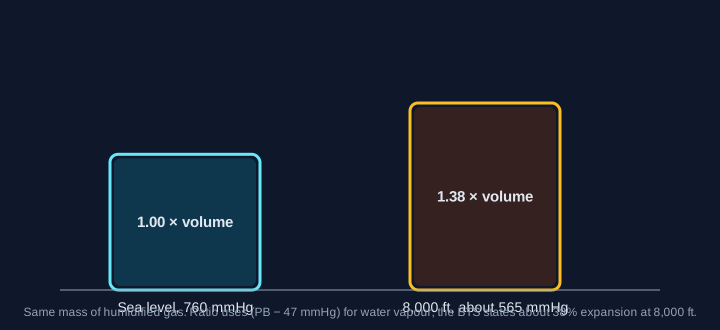
Air medical transport takes the patient through falling pressure. Gas in closed spaces expands (Boyle's law). The partial pressure of inspired oxygen falls (Dalton's law). Add noise, vibration, fatigue and motion, and both crew and patient feel it. Each change can alter oxygenation, device readings and gas-filled spaces. That is why the plan gets made before the aircraft leaves the ground.
Gas Laws That Matter in Flight
| Law | What It Says | What It Means in Flight |
|---|---|---|
| Boyle's law | At constant temperature, gas volume varies inversely with pressure. | Trapped gas expands as the aircraft climbs: an endotracheal (ETT) cuff, a pneumothorax, bullae and the middle ear and sinuses. |
| Dalton's law | Each gas exerts its own partial pressure in proportion to its share of the mixture. | Oxygen stays 21% of air, but its partial pressure falls with barometric pressure, so less oxygen reaches the alveoli. |
| Henry's law | At constant temperature, the amount of gas dissolved in a liquid is proportional to its partial pressure. Lower pressure lets dissolved gas come out of solution. | Nitrogen dissolved in body tissues can form bubbles at altitude (decompression sickness). Wait after scuba diving before flying (see Complications). |
| Charles' and Gay-Lussac's laws | At constant pressure, gas volume is proportional to absolute temperature. At constant volume, gas pressure is proportional to absolute temperature. | Cold cabins and cylinders: gas in a cold cylinder reads a lower gauge pressure, so plan oxygen supply with margin, per protocol. |
Flow Path
- Climb, or let cabin pressure fall, and barometric pressure (PB) drops. Near 18,000 ft the atmosphere weighs about half of what it does at sea level.
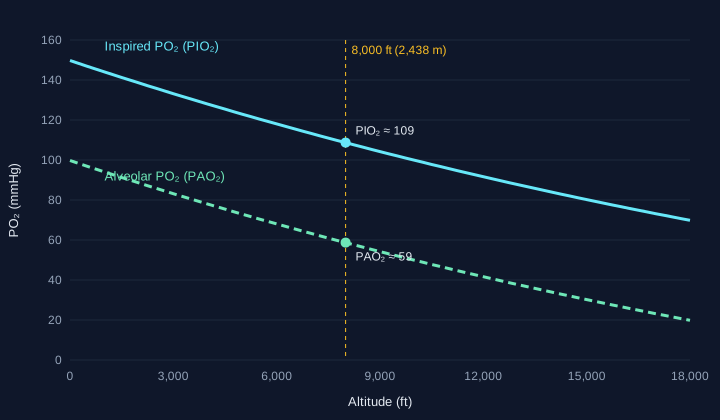
- Inspired PO₂ (PIO₂) falls in step with PB. The oxygen fraction of air stays put. Only the pressure around it falls.
- Alveolar PO₂ (PAO₂) falls further. Arterial PO₂ follows it down unless the patient ventilates more or receives a higher fraction of inspired oxygen (FiO₂).
- Gas in a sealed space, such as the ETT cuff or a pneumothorax, expands. It pushes harder against its walls.
Physiology & Core Concepts
Forms of Hypoxia
| Type | Cause | Flight Example |
|---|---|---|
| Hypoxic | Too little oxygen reaches the blood | Low PIO₂ at altitude; lung disease or airway obstruction |
| Hypemic | Blood cannot carry enough oxygen | Anemia, or hemoglobin that does not carry oxygen normally (see the hemoglobin page) |
| Stagnant | Blood flow is too low to deliver oxygen | Shock or a failing heart; excessive G-forces; cold extremities |
| Histotoxic | Cells cannot use the oxygen delivered | Alcohol, narcotics or poisons |
What Altitude Does to Healthy Oxygenation
- 8,000 ft (2,438 m): SpO₂ stays above 90% in most healthy people. This is the maximum cabin altitude regulators allow under normal operating conditions.
- 10,000 ft (3,048 m): hypoxemia becomes more prominent, and SaO₂ falls to about 89% in healthy people.
- Above 10,000 ft: symptoms worsen and time of useful consciousness (TUC) shrinks rapidly; see the table below.
Time of Useful Consciousness Without Oxygen
| Altitude | Time of Useful Consciousness |
|---|---|
| 20,000 ft | 30 minutes or more |
| 22,000 ft | 5 to 10 minutes |
| 25,000 ft | 3 to 5 minutes |
| 28,000 ft | 2½ to 3 minutes |
| 30,000 ft | 1 to 2 minutes |
| 35,000 ft | 30 to 60 seconds |
| 40,000 ft | 15 to 20 seconds |
| 45,000 ft | 9 to 15 seconds |
Values from FAA-H-8083-25C, Figure 17-1. Individuals vary. Do not count on symptoms as your warning.
Symptoms
Early hypoxia can feel like euphoria, or simply carefree. Then the signs stack up. Headache, impaired judgment, drowsiness and visual change follow. Numbness and cyanosis come as oxygen starvation builds. Symptoms vary by person, so a patient or crew member who feels fine can still be hypoxic.
Stressors of Flight
- Hypoxia: Covered above. It impairs judgment before the person notices it.
- Acceleration: Heavy G-forces can cause stagnant hypoxia.
- Hyperventilation: Breathing too hard lowers CO₂. Dizziness follows. In severe cases, the patient can lose consciousness.
- Ear and sinus gas: Middle ear and sinus problems are a known in-flight hazard.
- Low humidity: Dry cabin air is a respiratory hazard for passengers with lung disease.
- Cold, fatigue, dehydration and motion: cut circulation and performance. Motion sickness and spatial disorientation are listed flight hazards.
- Noise and vibration: The sources here do not put numbers on noise or vibration. Use the operator's guidance for hearing protection and alarm audibility.
Lines, Catheters & Equipment
The equipment risk is gas in closed spaces. As ambient pressure falls, each one swells. Each one needs a look before takeoff and again in the air.
| Gas-Filled Space | What Happens at Altitude | Action |
|---|---|---|
| ETT cuff | Cuff gas expands and cuff pressure rises. In a 2021 helicopter EMS (HEMS) cohort, median cuff pressure rose from 35 to 50 cmH₂O at maximum altitude. | Measure cuff pressure before flight and during flight; adjust to the protocol target. Do not exceed 30 cmH₂O (22 mmHg), the ceiling from a 1984 study. |
| Pneumothorax or bullae | Trapped gas expands. The BTS 2022 statement names enclosed pulmonary spaces as a hazard. | Untreated pneumothorax is a contraindication to flight. Document the pneumothorax and its treatment before transport. Treated pneumothorax: see the chest-tube row. |
| Bronchogenic cyst | Gas expansion in the cyst. Cerebral air embolism has been reported after cyst rupture in passengers. | Listed as a contraindication to air travel in the BTS 2022 statement. Discuss with medical direction. |
| Middle ear and sinuses | Gas expands on ascent and contracts on descent. | Recognized in-flight hazard in the FAA handbook. Treat symptoms per protocol. |
| IV bags, drip chambers and lines | Gas trapped in sealed containers and lines expands on climb. Air in the line is a hazard, and pressure bags and pumps need checking. | Remove air from lines before flight. Check pressure bags and pumps after each altitude change, per protocol. |
| Air splints and anti-shock garments | Air-filled splints gain volume on climb and can over-pressurize the limb. | Check splint pressure after each altitude change; deflate or adjust per protocol. |
| Stomach and bowel gas | Gas expands on climb, causing distension that can worsen breathing. | Decompress an OG or NG tube per protocol; watch for abdominal distension. |
| Chest tube (treated pneumothorax) | Air trapped in the chest is drained through the tube. Gas in any air leak expands with altitude. | Keep drainage working with a one-way valve or water-seal system. Never clamp the tube; keep the system below chest level; watch for an expanding air leak. BTS 2022 notes that manufacturers do not advise air travel with indwelling long-term drainage catheters. |
| Intra-aortic balloon pump | The balloon is helium-filled; altitude effects are device-specific. | Confirm altitude limits with the manufacturer and medical direction before flight. |
Oxygen Delivery Equipment
- Ventilators: BTS 2022 wants you to ask whether the ventilator settings need changing at altitude.
- Portable oxygen concentrators: The airline or operator must sign off before flight. Pulse-dose and continuous modes do not deliver the same flow.
- Cylinders: confirm supply duration and spare capacity for the planned flight time, as your protocol requires.
Indications, Contraindications & Evidence
Who Needs a Pre-Flight Assessment
- Severe or poorly controlled obstructive airway disease (forced expiratory volume in 1 second, FEV₁, below 50% predicted; symptoms, oxygen needs or frequent exacerbations).
- Recent (under 6 weeks) hospital treatment for a respiratory condition, or patients who need domiciliary oxygen.
- Recent (under 6 weeks) pneumothorax, or higher risk of pneumothorax such as cystic lung disease or recurrent pneumothorax.
- Recent (under 6 weeks) pulmonary embolism or deep vein thrombosis, or increased venous thromboembolism (VTE) risk.
Contraindications to Air Travel
- Untreated respiratory failure.
- Untreated pneumothorax.
- Active infection that risks others, such as TB, SARS, MERS or COVID-19.
- Bronchogenic cysts.
Hypoxic Challenge Test Thresholds (Adults)
- PaO₂ at or above 50 mmHg (6.6 kPa), or SpO₂ at or above 85%: in-flight oxygen not required.
- PaO₂ below 50 mmHg, or SpO₂ below 85%: in-flight oxygen recommended. Titrate to keep PaO₂ at or above 50 mmHg or SpO₂ at or above 85%.
Those thresholds come from passenger guidance for commercial aircraft. They are not a transport target. For a patient in an air ambulance, the medical director sets the oxygen plan.
Key Evidence
| Source | Population | Bottom Line |
|---|---|---|
| BTS clinical statement (2022) | Passengers with respiratory disease | Screening, oxygen planning and waiting periods after pneumothorax and VTE. No good-quality evidence fixes who needs a formal review. |
| Two HEMS cohorts (2017 systematic review; 2021 prospective) | Ventilated patients in helicopter transport | Cuff pressure rose during transport; the 2021 cohort found 81% above 30 cmH₂O at maximum altitude, and the authors recommend routine monitoring. |
| HEMS program study (2017) | 60 HEMS patients | Below 3,000 ft, altitude had little effect on cuff pressure. This conflicts with the larger 2021 cohort, so measure rather than assume. |
| Review of fitness to fly (2014) | Patients with lung and cardiac disease | Hypoxemia, VTE and pneumothorax risk; a thorough assessment is needed before flight. |
Setup, Leveling & Normal Values
Normal Values and Targets
| Parameter | Typical Value | Note |
|---|---|---|
| Barometric pressure | 760 mmHg at sea level; about 565 mmHg at 8,000 ft; about half of sea level at 18,000 ft | Standard atmosphere. Actual values change with weather. |
| Cabin altitude, pressurized aircraft | Up to 8,000 ft (2,438 m) under normal operating conditions | Regulatory ceiling for commercial aircraft, per the BTS 2022 statement. |
| Altitude, unpressurized helicopter | Median maximum 3,000 ft (interquartile range 2,000 to 5,000 ft) | From one HEMS service, in the 2021 prospective cohort. |
| SpO₂ target, acute illness | 94–98%; 88–92% with hypercapnia risk | Per the oxygen page. Use the order or protocol for the patient. |
| Passenger PaO₂ test threshold, adults | 50 mmHg (6.6 kPa) or higher | Passenger hypoxic challenge threshold, per the BTS 2022 statement; not a transport target. |
| In-flight SpO₂ floor, adult passengers | 85% or higher | Passenger hypoxic challenge threshold, per the BTS 2022 statement; not a transport target. |
| ETT cuff pressure | Protocol target; ceiling 30 cmH₂O (22 mmHg) | The ceiling comes from a 1984 endoscopic study of large-volume cuffs. Verify the local target before flight. Measure, do not assume. |
Before Takeoff
- Confirm whether the aircraft is pressurized and the planned maximum altitude.
- Record SpO₂ on the planned oxygen source, and on room air where the patient's order allows.
- Measure and record ETT cuff pressure after the tube is secured.
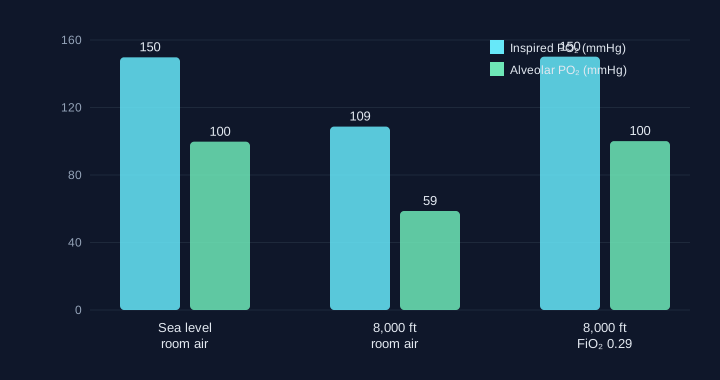
- Calculate the FiO₂ needed at the planned altitude (see Calculations & Derived Values).
- Confirm oxygen supply duration, spare cylinders and the pneumothorax plan.
- Confirm the patient is not carrying a contraindication from the list above.
Calculations & Derived Values
Two formulas explain most of the altitude effect on oxygen. Both run on barometric pressure (PB), and aircraft altitude sets that number.
PaCO₂ is arterial CO₂ tension. The 47 mmHg term is water-vapour pressure in the airway at 37°C. RQ, the respiratory quotient, is usually taken as 0.8. Hyperventilation pulls PaCO₂ down. Lower PaCO₂ raises PAO₂ in the second formula.
| Variable | Sea Level | 8,000 ft | 18,000 ft |
|---|---|---|---|
| PB (mmHg) | 760 | about 565 | about 380 |
| PIO₂ on room air (FiO₂ 0.21) | 150 | 109 | 70 |
| PAO₂ on room air (PaCO₂ 40 mmHg) | 100 | 59 | 20 |
Waveforms & Console Interpretation
Reading Trends, Not Single Numbers
- SpO₂: drops with altitude even when the patient looks well. Chart the trend across the climb and the descent.
- ETT cuff pressure: climbs as the cuff gas expands on the way up. It falls on the way down, as the gas contracts (Boyle's law).
- Ventilation: in CO₂ retainers, a rising PaCO₂ on higher oxygen is the pattern to watch.
Abnormal Patterns
| Finding | What It Suggests | First Action |
|---|---|---|
| SpO₂ falling during climb | Low inspired PO₂, circuit or cannula leak, or a developing pneumothorax | Raise FiO₂ to target, check the delivery, then examine for pneumothorax. |
| Cuff pressure above the protocol limit | Cuff gas expanding with altitude | Adjust to the protocol target and recheck on descent. |
| Drowsiness or confusion after oxygen is increased | Possible CO₂ retention | Lower FiO₂ to the lowest level that holds target, assess ventilation, and call medical direction. |
Monitoring & Ongoing Care
| When | What to Check | Action |
|---|---|---|
| Before takeoff | SpO₂ baseline, cuff pressure, oxygen supply, pneumothorax status | Plan FiO₂ and cuff checks before the climb. |
| During climb and descent | Cuff pressure, SpO₂ trend, work of breathing | Adjust cuff and FiO₂ to protocol; recheck after each change. |
| Throughout flight | SpO₂ trend, level of consciousness, oxygen supply, device settings | Interval is a protocol decision; no source sets one. Ventilated or unstable patients need closer checks. |
| After landing | Cuff pressure, SpO₂, breath sounds | Document changes and hand off to the receiving team. |
Crew Factors
- Crew hypoxia is hard to catch in yourself. The rule sits in 14 CFR 91.211(a), which covers U.S.-registered civil aircraft. Above 12,500 ft and up to 14,000 ft cabin pressure altitude, the minimum flight crew uses supplemental oxygen for any stretch longer than 30 minutes. Above 14,000 ft, they use it the entire time.
- Part 91 goes further above 15,000 ft. Each occupant must be provided with supplemental oxygen there. Section 91.211(b) adds reserve and mask rules for pressurized cabins at higher flight levels. Air ambulance operators answer to Part 135 and their own certificate rules, so confirm them.
Crew hydration, rest and oxygen use go on the same checklist as the patient's. Nobody gets a pass on it.
Key Medications & Drug Considerations
In flight, most of the drugs that matter are oxygen and passenger-level preventives. Doses vary by protocol; follow local protocols and medical direction.
| Medication | Role in Flight | Dose or Target | Notes |
|---|---|---|---|
| Oxygen | Corrects hypoxemia at altitude | Titrate to SpO₂ 94–98%; 88–92% with hypercapnia risk | Set FiO₂ for altitude; see Calculations. Oxygen page is the E3 reference. |
| Albuterol | Reliever for bronchospasm in a patient with asthma or COPD | Per order or protocol | BTS 2022: passengers should tell the crew if symptoms do not respond quickly to the inhaler. |
| Enoxaparin | VTE prevention for high-risk passengers, per the BTS 2022 statement | Passenger pre-flight suggestion only (see Note) | Not a transport order. Medical direction must approve any dose. |
Alarms & Troubleshooting
| Problem | What You See | Likely Causes | First Actions |
|---|---|---|---|
| Hypoxemia at altitude | SpO₂ below target; restlessness, confusion, cyanosis | Low PIO₂ on climb; FiO₂ too low; leak in cannula or circuit; pneumothorax | 1) Raise oxygen and check the delivery 2) Check tube position and cuff 3) Examine for pneumothorax 4) Call for help per protocol |
| Cuff overinflation | Cuff pressure above protocol limit and rising | Gas expansion on climb; cuff inflated on the ground | 1) Adjust cuff to target 2) Recheck on descent |
| Rising CO₂ on oxygen | Drowsiness, confusion, lower responsiveness | Oxygen in CO₂ retainers; hypoventilation | 1) Lower FiO₂ to target 2) Assess and support ventilation 3) Call medical direction |
| Expanding pneumothorax | Rising work of breathing, falling SpO₂, reduced breath sounds | Trapped gas expanding with altitude | 1) Decompress per protocol 2) Notify medical direction 3) Consider descent or landing per protocol |
Complications & Red Flags
| Complication | How You Recognize It | Immediate Action | Prevention |
|---|---|---|---|
| Tracheal mucosal ischemia | Cuff pressure above protocol; the HEMS literature reports pressures above the tracheal perfusion threshold | Adjust cuff to the protocol target, not above 30 cmH₂O (22 mmHg) | Measure cuff pressure before and during flight |
| Pneumothorax expansion | Rising work of breathing, falling SpO₂ | Follow protocol for decompression | Pneumothorax resolved before flight; BTS waiting period |
| Hypoxemia | SpO₂ below target despite oxygen | Increase FiO₂ and check delivery | Plan FiO₂ for altitude |
| VTE | Leg swelling, dyspnea, chest pain | Evaluate per protocol; call medical direction | Assess VTE risk before flight; BTS suggests a 2-week wait after DVT or PE |
| Sinus or middle ear barotrauma | Pain, pressure, muffled hearing | Treat symptoms per protocol | BTS 2022: after acute otitis media, passengers are usually advised not to fly for 2 weeks |
| Decompression sickness | Joint pain (the bends), itching or mottled skin, chest pain or breathlessness (chokes), or neurologic signs such as confusion, vision change or weakness | Oxygen mask at 100%; begin an emergency descent and land; keep a painful joint still; seek hyperbaric medicine evaluation | Wait at least 12 h after a dive that needs no controlled ascent, and 24 h after one that does, before flying up to 8,000 ft. Wait 24 h after any dive above 8,000 ft. |
Emergencies
Hypoxia Aloft
- Raise oxygen to restore the SpO₂ target, then check delivery and the cannula or mask seal.
- Check the airway: tube position and cuff pressure against protocol.
- Look for pneumothorax: breath sounds, work of breathing and trachea position.
- Descend or land per protocol if hypoxemia persists.
- Notify medical direction and document the SpO₂ trend.
Cardiac Arrest on Board
- Start CPR per the 2025 AHA guidelines and your protocol. Cabin space may limit CPR quality; use a mechanical CPR device only if your protocol provides one.
- Give supplemental oxygen during CPR; in a manikin study, oxygen prevented the depth loss seen in simulated cabin hypoxia.
- Check compression depth; hypoxia reduces depth even when rate is kept.
- Defibrillate per protocol.
Suspected Tension Pneumothorax at Altitude
- Recognize: worsening breathing, falling SpO₂ and reduced breath sounds on one side, using your protocol's criteria.
- Decompress per protocol. Altitude increases the volume of the trapped gas.
- Reassess after decompression and document.
- Notify medical direction and plan descent or landing.
Transport Considerations
Before You Climb
- Confirm the aircraft type and whether it is pressurized.
- Check the oxygen plan for the planned altitude.
- Measure cuff pressure and confirm the protocol target.
- Confirm equipment can run at altitude, including ventilator settings.
Helicopter and Fixed-Wing Differences
- Unpressurized helicopter: the patient sits at the altitude the aircraft flies. For one HEMS service, the median maximum was 3,000 ft.
- Pressurized aircraft: normal operation holds the cabin at or below 8,000 ft. Check the aircraft you actually get, because the operator may change aircraft.
Handoff
- Cuff pressure readings and the target used.
- SpO₂ trend and FiO₂ used at altitude.
- Pneumothorax status and the plan for it.
- Anticoagulation or VTE prophylaxis given.
Special Populations
Pediatric
Pediatric cuff management at altitude varies widely by region and organization. Children were historically moved almost always with uncuffed endotracheal tubes. They were also left out of the adult cuff studies, so pediatric evidence is thin. With a cuffed tube in place, the same Boyle's-law expansion applies. Measure cuff pressure and follow your pediatric protocol. Practice varies, including liquid cuff inflation. For tube selection, see the pediatric airway page.
BTS 2022 flags children with anemia, right-to-left heart shunts, neuromuscular disorders or lung disease as the most at risk for hypoxia.
Pregnancy
Maternal hypoxemia cuts oxygen delivery to the fetus. Set the SpO₂ target and oxygen plan with the obstetric team. Late in pregnancy, left lateral positioning relieves aortocaval compression.
Conditions That Lower Altitude Tolerance
- Anemia: the blood carries less oxygen (hypemic hypoxia, FAA-H-8083-25C).
- Carbon monoxide poisoning: CO latches onto hemoglobin and blocks oxygen transport (hypemic hypoxia, FAA-H-8083-25C).
- These sources do not cover other conditions, such as heart disease or sickle cell disease. Decide those with medical direction.
Chronic Lung and Heart Disease
- COPD: hypoxic challenge testing should be considered if resting SpO₂ is 95% or lower, Medical Research Council (MRC) dyspnea grade is 3 or higher, or SpO₂ falls below 84% on a walk test. When CO₂ retention is a concern, titration testing is advised.
- Pulmonary hypertension, New York Heart Association (NYHA) class III or IV: the usual advice is in-flight oxygen.
- Interstitial lung disease: consider testing if SpO₂ falls below 95% on exercise and resting PaO₂ is 9.42 kPa or lower, or transfer factor (TLCO) is 50% or lower.
Pneumothorax and Bullous Lung Disease
A history of pneumothorax or bullous lung disease needs a specialist assessment before flight. After full resolution on chest X-ray, the BTS 2022 statement advises waiting 7 days. Cystic lung disease raises pneumothorax risk. A pneumothorax in a patient with chronic lung disease is a significant challenge.
Bedside Pearls & Teaching Script
Systematic Walk-Through
- Altitude and aircraft type.
- Barometric pressure and PIO₂.
- FiO₂ and SpO₂ target.
- Pneumothorax and bullae.
- ETT cuff pressure and the plan for altitude.
- VTE risk and any prophylaxis ordered.
- Handoff and equipment checks.
Pearls
- Boyle's law runs backward on descent. Cuff pressure falls as the gas contracts.
- Judgment slips before the person notices the hypoxia.
- At altitude, give oxygen during CPR. Compression depth falls in hypoxia.
- The BTS 50 mmHg PaO₂ figure is a passenger test cut-off. It is not a transport target.
References
- Coker RK, Armstrong A, Church AC, et al. (2022). BTS clinical statement on air travel for passengers with respiratory disease. Thorax, 77(4), 329–350. https://doi.org/10.1136/thoraxjnl-2021-218110
- Federal Aviation Administration. (2023). Pilot's handbook of aeronautical knowledge (FAA-H-8083-25C), chapters 4 and 17. https://www.faa.gov/regulations_policies/handbooks_manuals/aviation/faa-h-8083-25c.pdf
- U.S. Code of Federal Regulations. (2026). 14 CFR § 91.211, Supplemental oxygen (current eCFR text). https://www.ecfr.gov/current/title-14/chapter-I/subchapter-F/part-91/subpart-B/section-91.211
- Conkin J. (2016). Equivalent air altitude and the alveolar gas equation. Aerospace Medicine and Human Performance, 87(1), 61–64. https://doi.org/10.3357/AMHP.4421.2016
- Delorenzo AJ, Shepherd M, Jennings PA. (2017). Endotracheal cuff pressure changes during helicopter transport: A systematic review. Air Medical Journal, 36(2), 81–84. https://doi.org/10.1016/j.amj.2017.01.003
- Delorenzo A, Shepherd M, Andrew E, Jennings P, Bernard S, Smith K. (2021). Endotracheal tube intracuff pressure changes in patients transported by a helicopter emergency medical service: A prospective observational study. Air Medical Journal, 40(4), 216–219. https://doi.org/10.1016/j.amj.2021.04.002
- Weisberg SN, McCall JC Jr, Tennyson J. (2017). Altitude-related change in endotracheal tube cuff pressures in helicopter EMS. West Journal of Emergency Medicine, 18(4), 624–629. https://doi.org/10.5811/westjem.2017.3.32078
- Schmitz J, Aeschbach D, Beccard I, et al. (2024). Chest compression quality decreases in hypoxic conditions simulating an airliner cabin at cruising altitude: A randomized, controlled, double-blind manikin study. Scientific Reports, 14, 25971. https://doi.org/10.1038/s41598-024-77149-4
- Desmond M, von Ungern-Sternberg BS. (2025). Pediatric endotracheal tube cuff management at altitude: Implications for aeromedical retrieval and other austere environments. Paediatric Anaesthesia, 35(7), 504–510. https://doi.org/10.1111/pan.15123
- Nicholson TT, Sznajder JI. (2014). Fitness to fly in patients with lung disease. Annals of the American Thoracic Society, 11(10), 1614–1622. https://doi.org/10.1513/AnnalsATS.201406-234PS
- Part 1: Executive summary: 2025 American Heart Association guidelines for cardiopulmonary resuscitation and emergency cardiovascular care. (2025). Circulation, 152, S284–S312. https://doi.org/10.1161/CIR.0000000000001372
- Seegobin, R. D., & van Hasselt, G. L. (1984). Endotracheal cuff pressure and tracheal mucosal blood flow: Endoscopic study of effects of four large volume cuffs. British Medical Journal, 288(6422), 965–968. https://doi.org/10.1136/bmj.288.6422.965
Medical Disclaimer
- For Educational Purposes Only: This content is intended for educational reference and should not be used for clinical decision-making.
- Not a Substitute for Professional Judgment: Always consult your local protocols, institutional guidelines, and supervising physicians.
- Verify Before Acting: Users are responsible for verifying information through authoritative sources before any clinical application.