

Bedside Snapshot
- Normal (Adult)
- 80–100 mmHg (10.7–13.3 kPa) on room air at sea level. Lower with age, supine position and altitude; always read with the FiO₂.
- Critical Values
- <40 mmHg (<5.3 kPa) (typical; lab-specific). No universal high critical value. Respiratory failure: <60 mmHg.
- High Suggests
- Supplemental oxygen above need (post-arrest, ventilated, transport); hyperventilation; hyperbaric oxygen; air bubble or iced plastic syringe
- Low Suggests
- V/Q mismatch: pneumonia, asthma, COPD, PE, pulmonary edema
- Shunt: ARDS, consolidation
- Hypoventilation: opioids, neuromuscular disease
- Low inspired PO₂: altitude
- Act Now If
- PaO₂ <60 mmHg, SpO₂ below target or tiring: oxygen to target, ventilate if breathing is inadequate, treat the cause; escalate to HFNC, NIV or intubation per protocol
- Watch Out For
- A normal PaO₂ does not mean normal oxygen delivery: CO poisoning, methemoglobinemia, anemia and low cardiac output all cause tissue hypoxia with a normal PaO₂.
Reference & Critical Ranges
Reference ranges
| Population | Conventional | SI | Notes |
|---|---|---|---|
| Adult, room air, sea level | 80–100 mmHg | 10.7–13.3 kPa | Typical lab range (some labs use 75–100). Healthy seated young adults run 90–110 mmHg. Supine values are about 6 mmHg lower than upright. |
| Older adult (>64 years) | 67–110 mmHg (mean 89, seated) | 8.9–14.6 kPa | Falls with age to about 70, then levels off. Healthy supine adults over 70 average 73–77 mmHg, lower limit about 60. |
| Pregnancy | About 100–105 mmHg (PaCO₂ about 28–32 mmHg) | About 13.3–14.0 kPa (PaCO₂ about 3.7–4.3 kPa) | Mildly higher PaO₂ and lower PaCO₂ than non-pregnant adults, from progesterone-driven hyperventilation. Target normoxemia and avoid the supine position after 20 weeks. |
| Altitude residents | Lower than sea level | Lower than sea level | People living above 3,000 m average about 55 mmHg (7.3 kPa) with no distress. |
| Children | Same as adult | Same as adult | Beyond the newborn period. Newborns in transition are managed by preductal SpO₂ targets, not an adult PaO₂ range. |
Severity & critical values
| Level | Conventional | SI | What it means / typical findings |
|---|---|---|---|
| Hyperoxemia | >100 mmHg on oxygen | >13.3 kPa | Above about 120 mmHg (16 kPa) hemoglobin is fully saturated, so more oxygen adds almost no content. Titrate down. |
| Normal | 80–100 mmHg | 10.7–13.3 kPa | SaO₂ about 95–98%. |
| Mild hypoxemia | 60–79 mmHg | 8.0–10.5 kPa | SaO₂ about 91–95% (flat part of the curve). Find the cause; may be normal for an older adult. |
| Respiratory failure | <60 mmHg | <8.0 kPa | SaO₂ about 90% or less, on the steep part of the curve. Type 1 if PaCO₂ is normal or low; type 2 if PaCO₂ >45 mmHg. |
| Severe hypoxemia | <45 mmHg | <6.0 kPa | SaO₂ about 80%. Mental function is impaired even in healthy people. |
| Critical | <40 mmHg | <5.3 kPa | SaO₂ about 74%; urine output and renal function fall. Consciousness is lost below about 30 mmHg (4 kPa). |
Conversion: mmHg × 0.133 = kPa (kPa × 7.5 = mmHg)
Room air at sea level with PaCO₂ 40 mmHg: PAO₂ = 0.21 × 713 − 50 ≈ 100 mmHg.
On room air, a young adult should sit under about 10 mmHg. Expect the gradient to widen with age and on supplemental oxygen.
On room air, 430 or more is normal. Do the math: PaO₂ 90 ÷ 0.21. The ARDS hypoxemia line sits at ≤300.
Causes of Abnormal Results
Low (Hypoxemia <80 mmHg)
On room air at sea level: mild is 60–79, respiratory failure is <60, severe is <45 and critical is <40 mmHg. Ventilation/perfusion (V/Q) mismatch is the one you will see most. Several often coexist.
| Mechanism | Common causes | Bedside clue |
|---|---|---|
| V/Q mismatch | Pneumonia, acute asthma, COPD exacerbation, pulmonary embolism (PE), pulmonary edema, atelectasis | Wide A–a gradient; PaO₂ rises with modest oxygen |
| Shunt (V/Q = 0) | ARDS, lobar consolidation, severe pulmonary edema, intracardiac right-to-left shunt, pulmonary arteriovenous malformation | Wide A–a gradient; little rise on 100% oxygen; PaCO₂ normal or low |
| Hypoventilation | Opioid, sedative or alcohol overdose, brainstem injury, Guillain–Barré syndrome, myasthenia gravis, chest-wall disease, obesity hypoventilation | High PaCO₂ with a normal A–a gradient; PaO₂ falls as PaCO₂ rises |
| Diffusion impairment | Interstitial lung disease, emphysema | Hypoxemia appears or worsens with exertion; corrects with oxygen |
| Low inspired PO₂ | Altitude and aircraft cabins, oxygen-depleted enclosed spaces, a wrong blender or ventilator FiO₂ | Normal A–a gradient; others exposed to the same air |
| Low mixed venous O₂ (amplifier) | Shock, low cardiac output, high oxygen consumption | Worsens hypoxemia from any shunt or low V/Q units |
High (Hyperoxemia >100 mmHg)
Hyperoxemia needs one of two things: a high inspired PO₂ or a low PaCO₂. On room air, hyperventilation lifts PaO₂ only a little. A value far above normal almost always means supplemental oxygen.
| Mechanism | Common causes | Bedside clue |
|---|---|---|
| Supplemental oxygen above need | Post-cardiac arrest, ventilated and transport patients left on high FiO₂, preoxygenation | SpO₂ 99–100% on oxygen; P/F still shows the true gas exchange |
| Hyperventilation | Anxiety, pain, early sepsis, salicylate toxicity, PE | Low PaCO₂; PaO₂ only modestly above normal on room air |
| Hyperbaric oxygen | Treatment of CO poisoning, gas embolism, decompression illness | PaO₂ far above sea-level values while in the chamber |
| Sample artifact | Plastic syringe chilled on ice; air bubble when the true PaO₂ is low | Value does not fit the patient or the SpO₂ |
Interpretation & Bedside Approach
Step-by-step approach
- Is it real and arterial? Check for air bubbles, delay, a venous or mixed sample and a chilled plastic syringe. If SpO₂ is normal but PaO₂ is very low, suspect the sample (or very high white cell or platelet counts) before treating the number.
- How sick is the patient? Look at work of breathing, mental status, SpO₂ trend, PaCO₂ and pH. Hypoxemia with a rising PaCO₂ or falling pH means ventilatory failure as well.
- Read it against the FiO₂ and support: record device, flow or FiO₂, PEEP and position. Compare with the baseline: COPD, older age and altitude residents run lower. Trend beats a single value.
- Calculate: PAO₂ and the A–a gradient (most useful on room air), P/F ratio, and SpO₂/FiO₂ (S/F) or the oxygenation index (OI) when they apply (formulas below and in Reference & Critical Ranges).
- Classify: type 1 (PaO₂ <60, PaCO₂ normal or low) or type 2 (PaCO₂ >45 mmHg) respiratory failure; mechanism from the A–a gradient, PaCO₂ and the response to oxygen; ARDS by the 2023 global definition.
- Escalate or dispose: see Management Priorities; a falling P/F, needing a nonrebreather or high FiO₂ to hold the target, or rising work of breathing calls for senior or critical care review.
Mechanism by pattern
| Pattern | Suggests |
|---|---|
| Low PaO₂, high PaCO₂, normal A–a | Pure hypoventilation (drugs, neuromuscular, central): ventilate and reverse the cause |
| Low PaO₂, wide A–a, rises with oxygen | V/Q mismatch or diffusion impairment |
| Low PaO₂, wide A–a, little rise on high FiO₂ | Shunt (ARDS, consolidation, cardiac); P/F <200 suggests a shunt fraction >20% |
| Low PaO₂, normal A–a, normal or low PaCO₂ | Low inspired PO₂ (altitude, cabin, wrong FiO₂) |
| Normal PaO₂ with low SpO₂ or co-oximetry SaO₂ | Dyshemoglobin (methemoglobin, carboxyhemoglobin) or oximeter error |
ARDS oxygenation criteria (2023 global definition)
Acute onset within 1 week of a risk factor, bilateral opacities on chest radiograph, CT or ultrasound, not fully explained by cardiac failure or fluid overload. Above 1,000 m, multiply P/F or S/F by barometric pressure ÷ 760.
| Category | P/F (mmHg) | S/F (only if SpO₂ ≤97%) |
|---|---|---|
| Nonintubated (HFNC ≥30 L/min or NIV/CPAP ≥5 cm H₂O) | ≤300 | ≤315 |
| Intubated, mild (PEEP ≥5) | >200 to ≤300 | >235 to ≤315 |
| Intubated, moderate | >100 to ≤200 | >148 to ≤235 |
| Intubated, severe | ≤100 | ≤148 |
Lower is better for OI. Pediatric ARDS severity on invasive ventilation uses OI (see Special Populations).
Management Priorities
Emergency: Hypoxemia (PaO₂ <60 mmHg or SpO₂ below target)
- Airway and breathing: open the airway, sit the patient up if possible, and ventilate with a bag-valve mask if breathing is inadequate.
- Oxygen to a target: SpO₂ 94–98% for most adults; 88–92% with hypercapnia risk (COPD, obesity hypoventilation, neuromuscular disease) until a blood gas guides you. Nonrebreather 15 L/min if SpO₂ <85%.
- Treat the cause: reverse opioid hypoventilation, decompress a tension pneumothorax, treat bronchospasm, pulmonary edema or infection.
- Escalate support (Paramedic/RN/CCT, per local protocol): high-flow nasal cannula, CPAP or NIV, then intubation for failing oxygenation, exhaustion or falling consciousness.
- Monitor & repeat: continuous SpO₂ and EtCO₂; repeat the blood gas after changes, recording FiO₂ and support each time.
Emergency: Ventilated patient with refractory hypoxemia (ARDS)
- Exclude the fixable: tube position and patency, circuit and oxygen supply, pneumothorax.
- Lung-protective ventilation: tidal volume 4–8 mL/kg predicted body weight, plateau pressure <30 cm H₂O; oxygenation goal PaO₂ 55–80 mmHg or SpO₂ 88–95% (ARDS Network protocol).
- PEEP and FiO₂: higher PEEP in moderate to severe ARDS; avoid prolonged recruitment maneuvers (PEEP ≥35 cm H₂O for >60 s).
- Prone positioning: >12 hours per day for severe ARDS (strong recommendation, moderate certainty; ATS 2024).
- Adjuncts and rescue: corticosteroids (conditional recommendation, moderate certainty; ATS 2024); neuromuscular blockade in early severe ARDS (conditional, low certainty; ATS 2024); refer early for venovenous ECMO if P/F stays <80 mmHg despite optimal care (conditional, low certainty; ATS 2024).
Medications
Doses vary by protocol; follow local protocols and medical direction.
| Drug | Adult dose | Pediatric dose (max) | Onset / key notes |
|---|---|---|---|
| Oxygen | Hypoxemia: titrate to SpO₂ 94–98% (88–92% with hypercapnia risk), INH; no fixed max. Post-ROSC: 100% until SpO₂ or PaO₂ is reliable, then titrate to SpO₂ 90–98% (PaO₂ 60–105 mmHg), avoiding both hypoxemia and hyperoxemia (2025 AHA Part 11, COR 2a) | After ROSC: wean to SpO₂ 94–99%, appropriate to the underlying condition (2025 AHA Part 8, COR 2b); otherwise titrate to the child's target, INH; no fixed max | Seconds. Recheck SpO₂ 5 min after each change. Do not titrate to SpO₂ in CO poisoning: give maximal oxygen |
| Naloxone | Opioid hypoventilation: 0.2–2 mg IV/IO/IM or 2–4 mg IN, every 2–3 min titrated to breathing; no fixed max | 0.1 mg/kg IV/IO (IN or IM per protocol), every 2–3 min (max 2 mg/dose); for children 5 years or younger or 20 kg or less. Larger children dose as adults | Ventilate first; titrate to adequate breathing, not alertness. Watch for recurrence with long-acting opioids |
Definitive care & disposition
- ICU: need for HFNC, NIV or intubation; a rising oxygen requirement; rising PaCO₂ with acidosis.
- ECMO center: early discussion for reversible severe ARDS early in its course (<7 days) with P/F <80 mmHg, or pH <7.25 with PaCO₂ ≥60 mmHg, despite optimal ventilation and prone positioning.
- Hyperbaric center: CO poisoning with serious features; a normal PaO₂ does not exclude CO poisoning (see carbon monoxide).
- Follow-up: chronic hypoxemia on discharge needs an outpatient assessment for long-term oxygen.
Doses are typical references. Follow local protocols, medical direction and institutional policy.
Field & Transport Considerations
Point-of-care testing
Cartridge analyzers return a PaO₂ within minutes. Temperature and sample limits apply, so check the device manual. Pulse oximetry gives an estimate of SaO₂, and that is not PaO₂. It cannot register anything above PaO₂ ≈120 mmHg. Carboxyhemoglobin makes it read falsely normal. Darker skin and shock can hide hypoxemia from it. Waveform EtCO₂ speaks to ventilation and says nothing about oxygenation. Earlobe capillary samples come back low, about 4–7 mmHg (0.5–1 kPa).
Before and during interfacility transport
| Setting | Consideration |
|---|---|
| Before departure | Latest PaO₂, PaCO₂ and pH with draw time, FiO₂, PEEP, device and position; P/F trend; chest imaging. |
| Ventilated handover | Match transport FiO₂ and PEEP to the ICU settings and confirm SpO₂ holds on the transport ventilator before departure. |
| En route | Continuous SpO₂ and EtCO₂; point-of-care gas after major setting changes or deterioration. |
| Delay or redirect | Refractory hypoxemia on maximal settings: discuss proning or an ECMO-capable destination before leaving. |
Altitude and flight
Barometric pressure drives inspired PO₂ down, so PaO₂ and SpO₂ fall as you climb. Air stays 0.21 FiO₂ at altitude, yet the alveolar gas equation still shows PAO₂ dropping with pressure. Healthy airline passengers slide from about SpO₂ 97% to 93% at cruise. Hypoxemic and ventilated patients slide further. Before ascent, raise FiO₂ to hold the target. Carry enough oxygen too.
Special Populations
| Population | What changes | Clinical implication |
|---|---|---|
| Neonates & infants | Transitional circulation, fetal hemoglobin (left-shifted curve); preterm infants are vulnerable to excess oxygen | Manage by preductal SpO₂ targets after birth (see oxygen); avoid hyperoxemia (retinopathy of prematurity) |
| Children & adolescents | Adult PaO₂ range; pediatric ARDS (PALICC-2, 2023) grades invasive ventilation by OI: mild/moderate <16, severe ≥16 (OSI <12 / ≥12) | SpO₂ 92–97% in mild/moderate PARDS; avoid <88% and >97%; accept <92% in severe PARDS with optimized PEEP |
| Pregnancy | Higher oxygen demand; aortocaval compression after 20 weeks | Target SpO₂ 94–98% (88–92% if morbid obesity); left lateral tilt or manual uterine displacement; maternal hyperoxemia does not help the fetus |
| Older adults | PaO₂ falls with age to about 70, then levels off; supine values lower | PaO₂ 70 mmHg can be normal at 80; compare with baseline and the A–a gradient |
| Chronic lung disease (COPD) | Chronic hypoxemia, often with CO₂ retention | Target SpO₂ 88–92% until PaCO₂ is known; uncontrolled oxygen can cause hypercapnic acidosis |
| Other: altitude, skin pigmentation | Residents above 3,000 m average PaO₂ about 55 mmHg; oximeters may overestimate in darker skin | Correct P/F for altitude above 1,000 m; confirm borderline SpO₂ with a blood gas |
Interfering Factors & Pitfalls
Collection & handling
| Factor | Effect | Why | Avoid / fix |
|---|---|---|---|
| Air bubbles | ↑ (↓ if PaO₂ very high) | Sample equilibrates toward room-air PO₂ (about 150 mmHg) | Expel air at once, cap, mix; no air in pneumatic tube samples |
| Plastic syringe on ice | ↑ | Oxygen diffuses through cold plastic and is released on rewarming | Keep plastic syringes at room temperature; analyze promptly |
| Delay at room temperature | ↓ (minor) | White cells keep consuming oxygen | Analyze promptly; one study found PaO₂ stable for 2 hr at room temperature without air |
| Venous or mixed sample | ↓ | Venous PO₂ is far lower | Confirm pulsatile arterial flow; venous PO₂ cannot estimate PaO₂ |
| Earlobe capillary sample | ↓ | Underestimates PaO₂ by 0.5–1 kPa (4–7 mmHg) | Use arterial samples in shock or when PaO₂ matters |
Physiologic / biologic
| Factor | Effect | Why | Avoid / fix |
|---|---|---|---|
| Very high white cell or platelet count | False − | Leukemic cells consume oxygen in the syringe (spurious hypoxemia, leukocyte larceny) | Analyze immediately at the bedside; trust a normal SpO₂ if the patient is well |
| Supine position | ↓ | About 6 mmHg lower than upright | Record position; compare like with like |
| Body temperature | Reported ≠ in vivo | Analyzers measure at 37 °C (98.6 °F) | Hypothermia: true PaO₂ is lower than reported; enter temperature if protocol uses corrected values |
Assay & device-specific
| Factor | Effect | Why | Avoid / fix |
|---|---|---|---|
| Calculated SaO₂ on the gas report | False + | Calculated from PaO₂ with a normal curve; misses COHb and methemoglobin | Request co-oximetry when a dyshemoglobin is possible |
| Unrecorded FiO₂ | Uninterpretable | PaO₂ depends on inspired oxygen | Record FiO₂, flow, device and PEEP with every sample |
Common misinterpretations
- PaO₂ 90 is fine: Not on FiO₂ 0.5. P/F 180 sits in the moderate ARDS range.
- SpO₂ 100% means PaO₂ is safe: Not necessarily. The PaO₂ could be 120 or 400 mmHg. Titrate down.
- Normal PaO₂ means normal oxygen delivery: Wrong. Anemia, CO, cyanide and low output all starve tissue with a normal PaO₂.
- Venous PO₂ is close enough: It isn't. Use SpO₂ or an arterial sample.
Physiology & Test Basics
What it measures
PaO₂ is the partial pressure of oxygen dissolved in arterial plasma. It is the driving pressure that loads hemoglobin. This page covers PaO₂ only. Hemoglobin saturation lives on SaO₂, and carboxyhemoglobin on carbon monoxide. PaO₂ tells you how well the lungs move oxygen into blood. It does not tell you how much oxygen the blood carries.
Physiology & regulation
- Alveolar oxygen: Two inputs set it. One is inspired PO₂ (FiO₂ × barometric pressure). The other is alveolar ventilation (PaCO₂).
- Gas exchange: V/Q matching, shunt and diffusion decide the gap between alveolar and arterial oxygen.
- Hypoxic vasoconstriction: Blood gets pulled away from poorly ventilated lung. That limits V/Q mismatch.
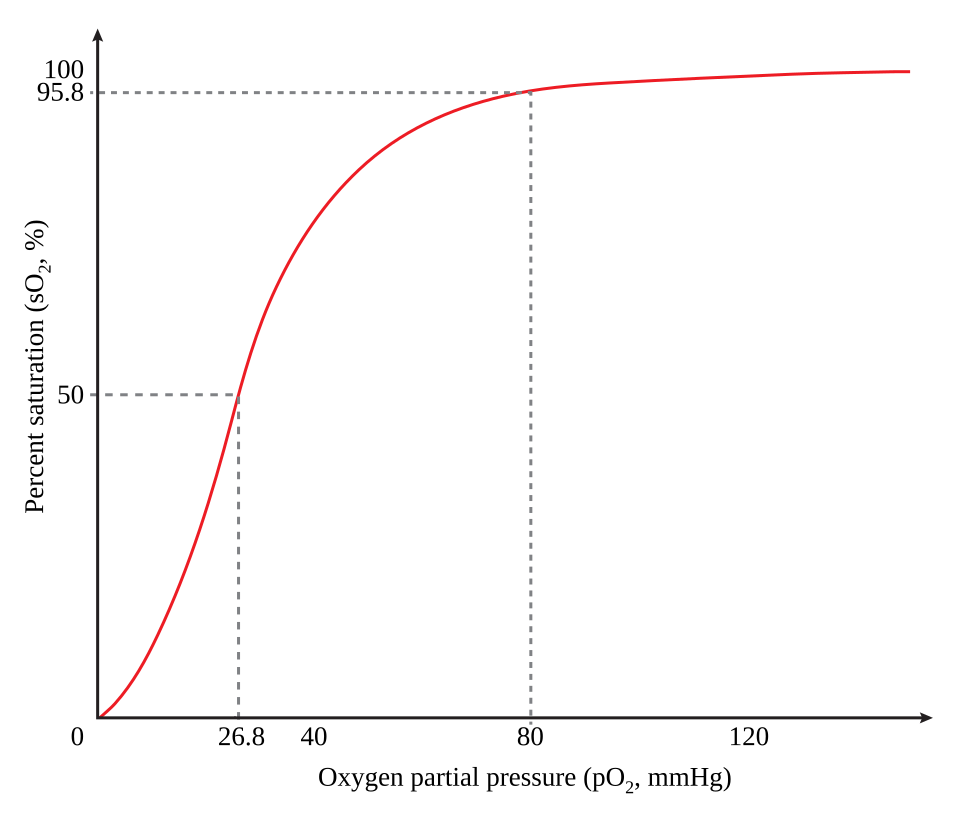
- Dissociation curve: Flat above about 60 mmHg. Steep below it. Acidosis, high PaCO₂, fever and 2,3-DPG push it right. Alkalosis, hypothermia and fetal hemoglobin push it left.
- Oxygen content: CaO₂ = 1.34 × Hb × SaO₂ + 0.0031 × PaO₂. Dissolved oxygen makes up only a small fraction.
- Chronic adaptation: Long-term hypoxemia raises red-cell 2,3-DPG. The curve shifts right, so tissues unload more oxygen.
How it is measured
Draw arterial whole blood, usually from the radial artery, into a pre-heparinized syringe (dry lithium heparin). Numb the site with local anesthesia unless it is an emergency. Expel the air, cap the syringe, mix and analyze promptly at room temperature. An amperometric oxygen electrode on a blood gas analyzer measures it, in the lab or at the bedside, within minutes. Fasting is not needed. Record FiO₂, device and position.
Why it matters
PaO₂ confirms hypoxemic respiratory failure and grades it. It defines ARDS through the P/F ratio. It catches hyperoxemia that oximetry cannot see. Use it to guide oxygen, PEEP and escalation in emergency, ICU and transport care.
Clinical Pearls
References
- Matthay, M. A., Arabi, Y., Arroliga, A. C., et al. (2024). A new global definition of acute respiratory distress syndrome. American Journal of Respiratory and Critical Care Medicine, 209(1), 37–47. https://doi.org/10.1164/rccm.202303-0558WS
- Qadir, N., Sahetya, S., Munshi, L., et al. (2024). An update on management of adult patients with acute respiratory distress syndrome: an official American Thoracic Society clinical practice guideline. American Journal of Respiratory and Critical Care Medicine, 209(1), 24–36. https://doi.org/10.1164/rccm.202311-2011ST
- Hirsch, K. G., Amorim, E., Coppler, P. J., et al. (2025). Part 11: Post–cardiac arrest care: 2025 American Heart Association guidelines for cardiopulmonary resuscitation and emergency cardiovascular care. Circulation, 152(16 Suppl 2), S673–S718. https://doi.org/10.1161/CIR.0000000000001375
- 2025 American Heart Association Guidelines for Cardiopulmonary Resuscitation and Emergency Cardiovascular Care, Part 8: Pediatric Advanced Life Support, section 11.3 (post-cardiac arrest oxygenation and ventilation management). https://cpr.heart.org/en/resuscitation-science/cpr-and-ecc-guidelines/pediatric-advanced-life-support
- O'Driscoll, B. R., Howard, L. S., Earis, J., & Mak, V. (2017). BTS guideline for oxygen use in adults in healthcare and emergency settings. Thorax, 72(Suppl 1), ii1–ii90. https://doi.org/10.1136/thoraxjnl-2016-209729
- Emeriaud, G., López-Fernández, Y. M., Iyer, N. P., et al. (2023). Executive summary of the second international guidelines for the diagnosis and management of pediatric acute respiratory distress syndrome (PALICC-2). Pediatric Critical Care Medicine, 24(2), 143–168. https://doi.org/10.1097/PCC.0000000000003147
- Sarkar, M., Niranjan, N., & Banyal, P. K. (2017). Mechanisms of hypoxemia. Lung India, 34(1), 47–60. https://doi.org/10.4103/0970-2113.197116
- Çuhadar, S., Özkanay-Yörük, H., Köseoğlu, M., & Katırcıoğlu, K. (2022). Detection of preanalytical errors in arterial blood gas analysis. Biochemia Medica, 32(2), 020708. https://doi.org/10.11613/BM.2022.020708
- NIH NHLBI ARDS Clinical Network. (2008). Mechanical ventilation protocol summary (landmark protocol). https://www.ardsnet.org/files/ventilator_protocol_2008-07.pdf
Medical Disclaimer
- For Educational Purposes Only: This content is intended for educational reference and should not be used for clinical decision-making.
- Not a Substitute for Professional Judgment: Always consult your local protocols, institutional guidelines, and supervising physicians.
- Verify Before Acting: Users are responsible for verifying information through authoritative sources before any clinical application.