

Bedside Snapshot
- Normal (Adult)
- Lab-specific (mmol/L). DKA resolves below 0.6 mmol/L only with pH ≥7.3 or HCO₃⁻ ≥18. 0.6 to under 3.0 mmol/L without acidosis and hyperglycemia is ketosis, not DKA.
- Critical Values
- No universal low value. High: ≥3.0 mmol/L is the DKA range; >6.0 mmol/L with acidosis is severe (typical; lab-specific)
- High Suggests
- DKA (glucose ≥11.1 mmol/L or known diabetes, plus acidosis)
- Euglycemic DKA (SGLT2 inhibitor, glucose below 11.1 mmol/L)
- Starvation ketosis (intake under about 500 kcal/day)
- Alcohol-related ketoacidosis (binge, vomiting, poor intake)
- Low Suggests
- Rarely clinically significant on its own. A falling value in a treated patient is expected as ketosis clears; confirm with pH and glucose.
- Act Now If
- BHB ≥3.0 mmol/L with glucose ≥11.1 mmol/L or known diabetes: check venous pH and K⁺, start the DKA protocol; insulin only once K⁺ is known; notify receiving team
- Watch Out For
- A negative urine dipstick does not exclude DKA. Euglycemic DKA can occur with a glucose below 11.1 mmol/L on an SGLT2 inhibitor.
Reference & Critical Ranges
Reference ranges
| Population | Conventional | SI | Notes |
|---|---|---|---|
| Adult (blood β-hydroxybutyrate) | Lab-specific (mg/dL) | Lab-specific (mmol/L) | Interpret with glucose and pH. DKA diagnosis at 3.0 mmol/L or higher; DKA resolution below 0.6 mmol/L |
| Adult (urine dipstick) | Negative (lab grades) | Negative (lab grades) | Nitroprusside reagent detects acetoacetate and acetone, not β-hydroxybutyrate |
| Children | — | — | No pediatric numeric range on this page. Use the pediatric DKA protocol; see Special Populations |
Severity & critical values
| Level | BHB (mmol/L) | Acidosis (pH or HCO₃⁻) | Mental status and care |
|---|---|---|---|
| Mild DKA | 3.0–6.0 | pH >7.25 to <7.30 or HCO₃⁻ 15–18 mmol/L | Alert. Regular or observation nursing unit |
| Moderate DKA | 3.0–6.0 | pH 7.00–7.25 or HCO₃⁻ 10 to <15 mmol/L | Alert or drowsy. Step-down or intermediate care |
| Critical: severe DKA | >6.0 | pH <7.00 or HCO₃⁻ <10 mmol/L | Stupor or coma. ICU |
Conversion: β-hydroxybutyrate mg/dL × 0.0961 = mmol/L
Lab-specific normal. An anion gap above 12 mmol/L points to a high-gap acidosis that fits DKA. Here's what people miss: the gap is not a criterion for DKA resolution.
Causes of Abnormal Results
Ketones climb when insulin runs low. Free fatty acids reach the liver, and the liver burns them without a brake. Insulin deficiency and counterregulatory hormones drive lipolysis. The result is excess ketone bodies, ketonemia and metabolic acidosis. HHS is different. Its insulin deficiency is milder: enough insulin to stop ketogenesis, but not enough to stop hyperglycemia.
High (ketonemia)
| Mechanism | Common causes | Bedside clue |
|---|---|---|
| Insulin deficiency (DKA) | Omitted or insufficient insulin; infection is the most common trigger worldwide (14–58%); also MI, stroke, pancreatitis, pulmonary embolism, trauma | Glucose ≥11.1 mmol/L or known diabetes; vomiting; abdominal pain; Kussmaul breathing; drowsy |
| Euglycemic DKA | SGLT2 inhibitor therapy, reduced food intake, pregnancy, alcohol use or liver failure. About 10% of DKA presents this way | Glucose below 11.1 mmol/L with ketosis and acidosis; SGLT2 inhibitor on the medication list |
| Starvation ketosis | Dietary intake under about 500 kcal/day (2,090 kJ/day) with low insulin | Intake history; glucose below 11.1 mmol/L |
| Alcohol-related ketoacidosis | Chronic ethanol use with a recent binge, vomiting and acute starvation | Ketoacidosis with or without hyperglycemia; alcohol history |
| Pregnancy | Ketosis of pregnancy and hyperemesis gravidarum; vomiting drives counterregulatory hormones | Persistent vomiting; euglycemic DKA is reported in pregnancy |
Ketonemia alone does not make DKA. Here's the line: blood β-hydroxybutyrate of 3.0 mmol/L or higher, with hyperglycemia or known diabetes, and acidosis. Starvation ketosis without hyperglycemia or acidosis does not meet DKA criteria. Values from 0.6 to under 3.0 mmol/L need the same workup. Check glucose, pH, bicarbonate and the intake or medication history. Alcohol-related ketoacidosis can occur with or without hyperglycemia (consensus).
Low (below 0.6 mmol/L)
Below 0.6 mmol/L is the consensus level for DKA resolution. It is not a treatment target. A low value does not prove the patient is well. Check glucose, pH and the clinical picture.
Mixed acid–base disorders
Mixed acid–base disorders show up in about one-third of DKA presentations. Osmotic diuresis, vomiting with metabolic alkalosis and respiratory compensation can all sit alongside the ketoacidosis. That is why you read pH and bicarbonate together with the anion gap.
Interpretation & Bedside Approach
Step-by-step approach
- Is it real? Confirm with a laboratory sample when a point-of-care result is high or unexpected. If DKA is suspected, measure blood β-hydroxybutyrate rather than relying on the dipstick.
- How sick is the patient? Check mental status, vomiting, abdominal pain, deep or rapid breathing, hypotension and dehydration.
- Check the glucose first. Glucose ≥11.1 mmol/L (200 mg/dL) or known diabetes points toward DKA. Glucose below 11.1 mmol/L with ketosis still needs an acidosis check, especially on an SGLT2 inhibitor.
- Calculate derived values. Venous pH or bicarbonate, and the anion gap from the formula box in Reference & Critical Ranges.
- Classify with the 2024 criteria. DKA needs all three components below, then grade severity with the table in Reference & Critical Ranges.
- Escalate or dispose. Severe DKA, altered mental status or a critical precipitant (for example MI, GI bleeding or sepsis) goes to the ICU. Mild to moderate DKA goes to step-down or observation, per local resources.
DKA criteria (2024 consensus)
| Criterion | Threshold |
|---|---|
| Hyperglycemia or diabetes | Glucose ≥11.1 mmol/L (200 mg/dL), or known diabetes irrespective of glucose |
| Ketonemia | Blood β-hydroxybutyrate ≥3.0 mmol/L (recommended for diagnosis and monitoring). Nitroprusside testing of urine or serum is a semiquantitative alternative but does not measure BHB; in mixed DKA/HHS, ketonuria 2+ or more counts as significant ketonemia |
| Acidosis | pH <7.30 or bicarbonate <18 mmol/L |
Patterns and what they suggest
| Pattern | Suggests |
|---|---|
| BHB ≥3.0 mmol/L; glucose ≥11.1 mmol/L or known diabetes; pH <7.30 or HCO₃⁻ <18 | DKA. Start the DKA pathway |
| BHB ≥3.0 mmol/L; glucose below 11.1 mmol/L; acidosis present | Euglycemic DKA. Check the SGLT2 inhibitor history |
| BHB 1.0 to <3.0 mmol/L; very high glucose; pH ≥7.30 and HCO₃⁻ ≥18 | HHS, possibly with mild ketonemia. No DKA criteria met |
| BHB ≥3.0 mmol/L with HHS-range glucose and acidosis | Mixed DKA/HHS. Treat as DKA with HHS features |
| BHB falling; pH and bicarbonate rising | Improving. Continue monitoring until resolution criteria are met |
Management Priorities
Emergency: Suspected DKA (glucose ≥11.1 mmol/L or known diabetes, BHB ≥3.0 mmol/L, pH <7.30 or bicarbonate <18)
- Stabilize: airway, breathing and circulation; IV access; point-of-care glucose and venous blood gas.
- Fluids: isotonic saline or balanced crystalloid at 500–1,000 mL/hr for the first 2–4 hr in adults without renal or cardiac compromise, then reassess volume status. Older adults, people with heart failure, and dialysis-dependent kidney disease: smaller boluses (for example 250 mL) with frequent hemodynamic reassessment. In pregnancy, see Special Populations.
- Potassium, then insulin: check K⁺ before insulin. Replace K⁺ when below 5.0 mmol/L. Start the insulin infusion only once K⁺ is above 3.5 mmol/L.
- Monitor and repeat: capillary glucose every 1–2 hr; electrolytes, phosphate, creatinine, BHB and venous pH every 4 hr until resolution.
Medications
| Drug | Adult dose | Pediatric dose | Onset / key notes |
|---|---|---|---|
| 0.9% saline or balanced crystalloid | 500–1,000 mL/hr IV for the first 2–4 hr in adults without renal or cardiac compromise. Older adults, heart failure or dialysis dependence: smaller boluses (for example 250 mL) with frequent reassessment. Then per volume status | Weight-based per pediatric DKA protocol | Balanced crystalloid is associated with faster DKA resolution and less hyperchloremic acidosis than saline (consensus) |
| Insulin, short-acting (regular), IV infusion High-alert | 0.1 units/kg/hr fixed-rate IV infusion. Optional 0.1 units/kg IV or IM bolus if venous access is delayed. Once glucose is below 13.9 mmol/L (250 mg/dL), add dextrose and reduce to 0.05 units/kg/hr | Weight-based per pediatric DKA protocol | Start only once K⁺ is above 3.5 mmol/L. Hold glucose near 11.1 mmol/L (200 mg/dL) until ketoacidosis resolves |
| Potassium chloride, IV High-alert | K⁺ below 3.5 mmol/L: 10 mEq/hr (10 mmol/hr) and delay insulin. K⁺ 3.5–5.0 mmol/L: 20–30 mEq per liter of IV fluid for most patients. At 500–1,000 mL/hr, 20–30 mEq/L can exceed 10 mEq/hr, so calculate the hourly dose. Do not exceed the institutional maximum potassium infusion rate. The DailyMed label for potassium chloride in dextrose limits the rate to 10 mEq/hour at concentrations below 30 mEq/L, with a 24-hour total generally not above 200 mEq. Hold potassium while K⁺ is 5.0 mmol/L or higher (consensus: replace only after K⁺ falls below 5.0). | Weight-based per pediatric DKA protocol | Target K⁺ 4–5 mmol/L. Check K⁺ 2 hr after insulin starts, then every 4 hr until resolution |
| Dextrose 5–10% | Added to the IV fluid once glucose is below 13.9 mmol/L (250 mg/dL), so insulin can continue | Per pediatric DKA protocol | Keeps insulin running until ketoacidosis clears; prevents hypoglycemia |
| Sodium bicarbonate 8.4% | Not routine. Consider only if pH is below 7.0. Dilution and rate per hospital pharmacy protocol | Not routine; per pediatric DKA protocol | Bicarbonate has not improved outcomes in DKA and can cause hypokalemia (consensus). Monitor K⁺ with any bicarbonate |
| Thiamine (suspected alcohol-related ketoacidosis) | Dose per local protocol; adult and pediatric doses are on the Thiamine page | Per local protocol | Alcohol-related ketoacidosis only; outside the 2024 DKA consensus. Give before or with dextrose without delaying dextrose. Confirm with medical direction |
Phosphate and magnesium
Routine phosphate replacement is not indicated. Replace phosphate only with muscle weakness, respiratory or cardiac compromise, or phosphate below 1.0 mmol/L (consensus). Check magnesium with the electrolyte panel.
Mixed DKA/HHS and HHS
- HHS or mild ketonemia: BHB 1.0 to <3.0 mmol/L, or urine ketones below 2+, with no acidosis (pH ≥7.30 and HCO₃⁻ ≥18): fixed-rate insulin at 0.05 units/kg/hr.
- Mixed DKA/HHS: significant ketonemia (BHB ≥3.0 mmol/L, urine ketones 2+ or more, pH <7.30 or HCO₃⁻ <18): fixed-rate insulin at 0.1 units/kg/hr.
- HHS fluid pace: glucose should fall no faster than 5–6.7 mmol/L per hour (90–120 mg/dL per hour) to limit cerebral edema risk (consensus).
Definitive care & disposition
- Level of care: severe DKA, altered mental status or a critical precipitant goes to the ICU. Mild to moderate DKA goes to step-down or observation, per resources.
- Resolution: BHB below 0.6 mmol/L and venous pH ≥7.3 or bicarbonate ≥18 mmol/L (consensus). Glucose ideally below 11.1 mmol/L. Do not use the anion gap or urine ketones to confirm resolution.
- Transition: start subcutaneous insulin with a 1–2 hr overlap before stopping the IV infusion.
- Precipitant and follow-up: find and treat the trigger, including insulin omission. Close follow-up within 2–4 weeks of discharge may reduce recurrence (consensus).
Doses are typical references. Follow local protocols, medical direction and institutional policy.
Field & Transport Considerations
Point-of-care testing
A capillary β-hydroxybutyrate meter reads the main DKA ketone directly. The consensus says its precision is similar to the lab. Accuracy against lab analyzers is the worry at concentrations of 5 mmol/L and above. So confirm high or unexpected values with a lab sample. A point-of-care glucose sets the first branch point. A venous blood gas gives pH and bicarbonate. The urine dipstick is fast. It still does not measure β-hydroxybutyrate.
Before and during interfacility transport
- Obtain glucose, mental status, vital signs and, if available, BHB or venous pH.
- Record the time of first fluid and of any insulin started. Check that the pump rate matches the protocol.
- Recheck glucose during transport if the patient cannot maintain oral intake or is on insulin, per local protocol.
- Vomiting or drowsy patients need airway protection and suction. Mental status can change quickly.
Scope notes
Insulin infusions, IV potassium and bicarbonate belong to the hospital in most systems. Prehospital care is glucose assessment, IV access and fluids per local protocol. Transport goes to a facility that can start the insulin protocol. Follow local protocols and medical direction.
Special Populations
| Population | What changes | Clinical implication |
|---|---|---|
| Children & adolescents | Pediatric DKA has its own ISPAD 2022 consensus with weight-based, protocol-driven fluid and insulin rules | Use the pediatric DKA protocol. Do not apply adult fluid rates, insulin boluses or insulin numbers from this page to children. Cerebral edema is a risk during treatment: new confusion, drowsiness, headache or a change in behavior needs immediate escalation |
| Pregnancy | Ketosis of pregnancy, hyperemesis and euglycemic DKA (glucose below 11.1 mmol/L) can occur | Take an intake and vomiting history. Mixed acid–base disturbances with hyperemesis can mask the diagnosis; check glucose, pH and bicarbonate. Significant maternal and fetal risk: involve obstetrics and senior medical staff immediately (consensus) |
| Older adults | Higher risk of fluid overload; overlap with HHS | Replace fluid cautiously with frequent reassessment (consensus) |
| Heart or kidney disease | Higher risk of fluid overload when fluids are given rapidly | Slower fluid replacement with frequent hemodynamic checks (consensus) |
| SGLT2 inhibitor users | Euglycemic DKA with glucose below 11.1 mmol/L; majority of euglycemic cases in recent years (consensus) | Check the medication list. A normal glucose does not exclude DKA |
| Alcohol use | Alcohol-related ketoacidosis can occur with or without hyperglycemia. Dextrose-containing fluid is preferred over saline when it is suspected (2016 critical care review) | Take an alcohol history. Give dextrose-containing fluid and thiamine before or with dextrose, without delaying dextrose. Check phosphate and magnesium. Insulin use is protocol-dependent; treat per local protocol with medical direction |
Interfering Factors & Pitfalls
Test choice & assay
| Factor | Effect | Why | Avoid / fix |
|---|---|---|---|
| Urine dipstick used instead of blood BHB | False − | Nitroprusside does not detect β-hydroxybutyrate, the main DKA ketone | Order blood β-hydroxybutyrate or venous pH |
| Point-of-care meter at high concentration | Variable | Accuracy concern against laboratory analyzers at 5 mmol/L and above | Confirm high or unexpected results with a laboratory sample |
Medications & supplements
| Factor | Effect | Why | Avoid / fix |
|---|---|---|---|
| Captopril and other sulfhydryl drugs | False + (urine test) | Reported to give false-positive nitroprusside tests | Measure blood β-hydroxybutyrate |
| Valproate | False + (urine test) | Reported to give false-positive nitroprusside tests | Measure blood β-hydroxybutyrate |
Physiologic & biologic
| Factor | Effect | Why | Avoid / fix |
|---|---|---|---|
| Hyperchloremic normal-gap acidosis after saline | Anion gap falsely reassuring | Chloride-rich fluid lowers bicarbonate without raising the gap | Use BHB and pH to judge resolution, not the gap |
| Mixed acid–base disorders | Gap misleads | Present in about one-third of DKA presentations | Read pH and bicarbonate together with the gap |
| BHB converting to acetoacetate during treatment | ↑ Urine ketones | Urine ketones can rise as acidosis improves | Follow blood BHB and pH trends |
Common misinterpretations
- A negative urine dipstick does not exclude DKA. Don't treat it like it does.
- Don't call ketonemia alone DKA. Glucose and acidosis must also be present.
- Don't read rising urine ketones during treatment as DKA getting worse. They can reflect BHB converting to acetoacetate.
- Watch the units. 3.0 mmol/L is about 31 mg/dL. Never compare a mg/dL value with a mmol/L threshold.
Physiology & Test Basics
What it measures
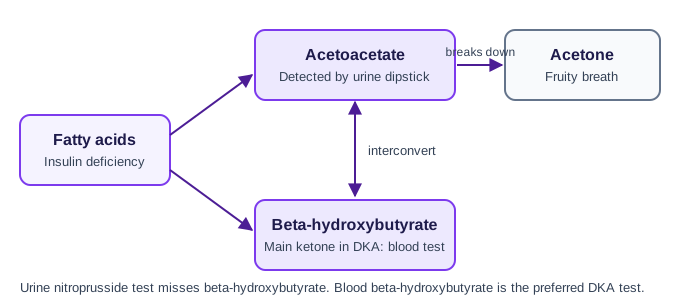
Blood β-hydroxybutyrate (BHB) is the main ketone body in DKA, so it is the one to measure. Urine tests read acetoacetate, not BHB, and that is why they fall short. Blood BHB is the preferred test for diagnosing and monitoring DKA. This page covers blood BHB. The urine ketone test has its own page.
Physiology & regulation
- Insulin deficiency and counterregulatory hormones drive lipolysis. Fatty acids reach the liver and turn into excess ketone bodies.
- Three ketone bodies matter: BHB (the predominant one in DKA), acetoacetate (the one nitroprusside detects) and acetone. Acetone is a breakdown product of acetoacetate. It is exhaled and gives a fruity breath odor.
- As acidosis improves, BHB converts to acetoacetate. Urine ketones can then overstate severity later in DKA.
- Ketoacids use up bicarbonate and widen the anion gap. A gap above 12 mmol/L fits DKA.
- Starvation (intake under about 500 kcal/day) and vomiting also push ketone production up.
How it is measured
- Blood BHB, laboratory: serum sample on a laboratory analyzer. Specimen tube and additive per your laboratory.
- Blood BHB, point of care: capillary fingerstick on a handheld meter; similar precision to laboratory analysis (consensus).
- Urine dipstick: nitroprusside reagent strip; semiquantitative grades for acetoacetate and acetone only.
Why it matters
Three numbers tell the story: glucose, pH and blood BHB. Together they settle whether a patient has DKA, how severe it is and where that patient belongs. Watching BHB and pH through treatment shows whether the ketoacidosis is clearing.
Clinical Pearls
References
- Umpierrez GE, Davis GM, ElSayed NA, Fadini GP, Galindo RJ, Hirsch IB, Klonoff DC, McCoy RG, Misra S, Gabbay RA, Bannuru RR, Dhatariya KK. Hyperglycemic crises in adults with diabetes: a consensus report (2024). Joint consensus of the American Diabetes Association, EASD, JBDS, AACE and DTS. Diabetes Care. 2024;47(8):1257–1275. https://doi.org/10.2337/dci24-0032
- Umpierrez GE, Davis GM, ElSayed NA, Fadini GP, Galindo RJ, Hirsch IB, Klonoff DC, McCoy RG, Misra S, Gabbay RA, Bannuru RR, Dhatariya KK. Hyperglycaemic crises in adults with diabetes: a consensus report (2024), Same consensus report as reference 1, published in Diabetologia. Diabetologia. 2024;67(8):1455–1479. https://doi.org/10.1007/s00125-024-06183-8
- Glaser N, Fritsch M, Priyambada L, Rewers A, Cherubini V, Estrada S, Wolfsdorf JI, Codner E. ISPAD Clinical Practice Consensus Guidelines 2022: Diabetic ketoacidosis and hyperglycemic hyperosmolar state. Pediatr Diabetes. 2022;23(7):835–856. https://doi.org/10.1111/pedi.13406
- Dhatariya KK, Glaser NS, Codner E, Umpierrez GE. Diabetic ketoacidosis (review, 2020). Nat Rev Dis Primers. 2020;6:40. https://doi.org/10.1038/s41572-020-0165-1
- Flannery AH, Adkins DA, Cook AM. Unpeeling the evidence for the banana bag: evidence-based recommendations for the management of alcohol-associated vitamin and electrolyte deficiencies in the ICU. Crit Care Med. 2016;44(8):1545–1552. https://doi.org/10.1097/CCM.0000000000001659
Medical Disclaimer
- For Educational Purposes Only: This content is intended for educational reference and should not be used for clinical decision-making.
- Not a Substitute for Professional Judgment: Always consult your local protocols, institutional guidelines, and supervising physicians.
- Verify Before Acting: Users are responsible for verifying information through authoritative sources before any clinical application.