

Bedside Snapshot
- Normal (Adult)
- Desirable <130 mg/dL (<3.4 mmol/L). Fasting not required. On therapy, compare with the risk-based LDL-C goal in the treatment table below
- Critical Values
- No universal critical value: interpret by trend and clinical context
- High Suggests
- Familial hypercholesterolemia (≥220 mg/dL)
- Diabetes, metabolic syndrome, obesity
- Hypothyroidism, nephrotic syndrome, CKD
- Drugs: glucocorticoids, cyclosporine, protease inhibitors
- Low Suggests
- Rarely clinically significant: usually effective lipid-lowering therapy, or a sample drawn during ACS or infection (acute-phase drop)
- Act Now If
- No non-HDL-C value needs emergency treatment. Triglycerides ≥500 mg/dL on the same panel: pancreatitis risk rises, highest at ≥880–1,000 mg/dL; with abdominal pain check lipase. ≥220 mg/dL: refer for FH evaluation
- Watch Out For
- LDL-C at goal with high triglycerides: non-HDL-C can still be high. Check both, and repeat a panel drawn during acute illness
Reference & Critical Ranges
Reference ranges
| Population | Conventional | SI | Notes |
|---|---|---|---|
| Adult | Desirable <130 mg/dL | <3.4 mmol/L | Same for men and women. Fasting not required. Adults on therapy are judged against a risk-based goal (table below), not this cut point |
| Pregnancy | No pregnancy-specific range | — | Pregnancy raises LDL cholesterol (LDL-C) and triglycerides; assess long-term risk after pregnancy |
| Older adult | Same as adult | — | No separate range |
| Children and adolescents | Acceptable <120 mg/dL; borderline 120–144; high ≥145 | <3.1; 3.1–3.7; ≥3.8 mmol/L | National Heart, Lung, and Blood Institute (NHLBI) pediatric cut points; a nonfasting non-HDL-C is the first screening step |
| Young adults (20–24 years) | Acceptable <150 mg/dL; borderline 150–189; high ≥190 | <3.9; 3.9–4.9; ≥4.9 mmol/L | NHLBI young-adult cut points for pediatric clinicians |
Severity & critical values
| Level | Conventional | SI | What it means / typical findings |
|---|---|---|---|
| Desirable | <130 mg/dL | <3.4 mmol/L | Primary-prevention goal for borderline or intermediate risk |
| Above desirable | 130–159 mg/dL | 3.4–4.1 mmol/L | Parallels LDL-C 100–129 mg/dL |
| Borderline high | 160–189 mg/dL | 4.1–4.9 mmol/L | Parallels LDL-C 130–159 mg/dL |
| High | 190–219 mg/dL | 4.9–5.7 mmol/L | A risk-enhancing range in ACC/AHA cholesterol guidance; parallels LDL-C 160–189 mg/dL |
| Very high | ≥220 mg/dL | ≥5.7 mmol/L | Parallels LDL-C ≥190 mg/dL (severe hypercholesterolemia). Suspect familial hypercholesterolemia (FH) |
| Critical | No universal critical value | — | Interpret by trend and clinical context |
Treatment goals (2026 ACC/AHA dyslipidemia guideline)
| Risk group | LDL-C goal |
|---|---|
| Clinical ASCVD, very high risk | <55 mg/dL (<1.4 mmol/L) |
| Clinical ASCVD, not very high risk | <70 mg/dL (<1.8 mmol/L) |
| No ASCVD, by PREVENT-ASCVD risk tier | Set by risk tier and therapy; see the guideline |
ASCVD is atherosclerotic cardiovascular disease. PREVENT is the American Heart Association (AHA) Predicting Risk of cardiovascular disease EVENTs equations. Diabetes, chronic kidney disease (CKD), LDL-C ≥190 mg/dL, coronary artery calcium and hypertriglyceridemia can move the goal. For those patients, check the guideline table.
Conversion: mg/dL × 0.0259 = mmol/L (mmol/L × 38.67 = mg/dL)
Worked example: total cholesterol 220 mg/dL minus HDL-C 50 mg/dL gives non-HDL-C 170 mg/dL, which is borderline high. A normal non-HDL-C sits about 30 mg/dL above LDL-C.
Causes of Abnormal Results
High (non-HDL-C ≥130 mg/dL; very high ≥220 mg/dL)
| Mechanism | Common causes | Bedside clue |
|---|---|---|
| Genetic: impaired LDL clearance | Familial hypercholesterolemia (FH) | Non-HDL-C ≥220 mg/dL with normal triglycerides; high cholesterol since youth; family history of premature ASCVD |
| Genetic: mixed or remnant disorders | Familial combined hyperlipidemia; dysbetalipoproteinemia (remnant accumulation) | Cholesterol and triglycerides both high; family clustering |
| Genetic: lipoprotein(a) | High lipoprotein(a) [Lp(a)], whose cholesterol is counted in non-HDL-C and LDL-C | Premature ASCVD in the patient or family despite modest LDL-C; Lp(a) measured once in adulthood |
| Insulin resistance: excess triglyceride-rich lipoproteins | Type 2 diabetes, metabolic syndrome, obesity, polycystic ovary syndrome | Triglycerides ≥150 mg/dL, low HDL-C, non-HDL-C more than 30 mg/dL above LDL-C |
| Endocrine, renal, hepatic | Hypothyroidism; nephrotic syndrome; CKD; obstructive liver disease | High thyroid-stimulating hormone (TSH); edema and heavy proteinuria; low estimated glomerular filtration rate (eGFR); cholestatic liver tests |
| Diet and lifestyle | Weight gain or positive energy balance; saturated and trans fats; high glycemic load; excess alcohol (triglycerides) | Diet and alcohol history; values improve with lifestyle change |
| Drugs: raise LDL-C | Glucocorticoids, cyclosporine, isotretinoin, anabolic steroids, some progestins, thiazides, amiodarone | Lipids rose after the drug was started |
| Drugs: raise triglycerides | Oral estrogens, tamoxifen, sirolimus, protease inhibitors, atypical antipsychotics (clozapine, olanzapine), nonselective beta-blockers, bile acid sequestrants, L-asparaginase | Medication list; oncology, transplant, HIV or psychiatric history |
Pregnancy, the menopause transition, HIV infection and autoimmune disorders can also raise LDL-C and triglycerides.
Low (below 130 mg/dL or below goal)
Alone, a low value rarely matters clinically. In practice, it comes down to one of the following:
| Mechanism | Common causes | Bedside clue |
|---|---|---|
| Treatment effect | Statin or other lipid-lowering therapy | Medication list; compare with the goal for the patient's risk group |
| Acute-phase response | Acute coronary syndrome (ACS), acute infection | Sample drawn during acute illness; value lower than the patient's baseline |
Interpretation & Bedside Approach
Step-by-step approach
- Is it real and representative? A nonfasting sample is valid. Total cholesterol and HDL-C have to come from the same draw. Was the patient acutely ill? ACS and infection both lower lipid values.
- How sick is the patient? Non-HDL-C never changes emergency management. Read the triglycerides on the same panel. Pancreatitis risk rises from about 500 mg/dL and is highest from ≥880 mg/dL (10 mmol/L) to ≥1,000 mg/dL. Preventing pancreatitis comes first.
- Acute vs chronic, and the trend: Set it against a value from a well period. After ACS, draw on admission and repeat after recovery. After an infection, NHLBI advises waiting at least 3 weeks before a screening panel.
- Calculate and compare: Non-HDL-C = total cholesterol − HDL-C. Then subtract LDL-C. The gap is the cholesterol in very-low-density lipoprotein (VLDL) and remnants. With triglycerides <150 mg/dL, that gap normally runs 30 mg/dL or less.
- Classify with current criteria: Use the National Lipid Association (NLA) categories for the level. For treated patients, the 2026 ACC/AHA guideline sets goals by PREVENT risk (adults 30–79 years without ASCVD) or by ASCVD status. Children get NHLBI cut points.
- Escalate or dispose: No acute action is needed. Primary care or cardiology follows up on goals. A lipid specialist sees ≥220 mg/dL or a suspected genetic disorder. Triglycerides ≥500 mg/dL with abdominal pain need same-day evaluation (check lipase).
Patterns
| Pattern | Suggests |
|---|---|
| Non-HDL-C about 30 mg/dL above LDL-C, triglycerides <150 mg/dL | Cholesterol is mostly in LDL; LDL-C and non-HDL-C tell the same story |
| Non-HDL-C more than 30 mg/dL above LDL-C, triglycerides ≥150 mg/dL | Excess triglyceride-rich lipoproteins and remnants (insulin resistance, diabetes); LDL-C understates the atherogenic load |
| LDL-C at goal, non-HDL-C still high | Residual risk. On statins, risk tracks non-HDL-C more closely than LDL-C when the two disagree. Apolipoprotein B (apoB) can refine the decision |
| Non-HDL-C ≥220 mg/dL, normal triglycerides | FH until proven otherwise |
| Triglycerides ≥400 mg/dL | Friedewald LDL-C is invalid; use non-HDL-C, a direct LDL-C or the NIH (Sampson) equation, which stays accurate to 800 mg/dL |
| Triglycerides ≥500 mg/dL | Severe hypertriglyceridemia. Pancreatitis risk rises, highest at ≥880–1,000 mg/dL; pancreatitis prevention comes before ASCVD goals |
The formula holds only when triglycerides are <400 mg/dL (<4.5 mmol/L). Dividing triglycerides by 5 estimates VLDL cholesterol. That is why a normal non-HDL-C sits about 30 mg/dL above LDL-C.
Special Populations
| Population | What changes | Clinical implication |
|---|---|---|
| Neonates & infants | Lipid screening is not routine before 2 years | Targeted screening may start at 2 years with a family history of premature ASCVD, severe hypercholesterolemia or FH |
| Children & adolescents | Own cut points: acceptable <120 mg/dL, high ≥145 mg/dL | Universal screening at 9–11 years with a nonfasting non-HDL-C; confirm an abnormal result with fasting lipid profiles. Delay screening at least 3 weeks after an infection |
| Pregnancy | LDL-C and triglycerides rise | Do not use pregnancy values for long-term risk; reassess after pregnancy |
| Older adults | No clinically meaningful difference in range | PREVENT was developed for ages 30–79 years; goals follow risk group, not age alone |
| CKD / dialysis | CKD and nephrotic syndrome raise LDL-C and triglycerides | CKD raises cardiovascular risk and changes the goal row used; PREVENT includes eGFR. Confirm the target for clinical ASCVD with CKD in the guideline table |
| Critically ill | ACS and acute infection lower lipid values | Draw the ACS panel on admission without fasting, then repeat after recovery before judging long-term risk |
| HIV, transplant, oncology, psychiatric | Protease inhibitors, cyclosporine, sirolimus, L-asparaginase and atypical antipsychotics raise LDL-C or triglycerides | Check lipids after starting these drugs; interpret against the on-treatment baseline |
Interfering Factors & Pitfalls
Collection & handling
| Factor | Effect | Why | Avoid / fix |
|---|---|---|---|
| Nonfasting sample | ↓ slightly (mean about 8 mg/dL; not clinically significant) | Small postprandial fall in total cholesterol, calculated LDL-C and non-HDL-C; HDL-C not meaningfully changed | Nonfasting is the default; fast only if nonfasting triglycerides are >440 mg/dL (5 mmol/L) |
| Drawn during ACS or infection | ↓ | Acute-phase response lowers lipid values | Repeat after recovery (at least 3 weeks after an infection) |
| Total cholesterol and HDL-C from different draws | False + or False − | The calculation assumes one sample | Calculate only from the same panel |
Medications & supplements
| Factor | Effect | Why | Avoid / fix |
|---|---|---|---|
| Glucocorticoids, cyclosporine, retinoids, protease inhibitors, oral estrogens, atypical antipsychotics | ↑ | Raise LDL-C, triglycerides or both | Note the drug and the start date; recheck on stable therapy |
| Fibrates or DHA-containing omega-3 in severe hypertriglyceridemia | LDL-C ↑ while triglycerides ↓ | LDL-C can rise as triglycerides fall | Expect it; judge the response with non-HDL-C and triglycerides together |
Physiologic / biologic
| Factor | Effect | Why | Avoid / fix |
|---|---|---|---|
| High triglycerides | ↑ (true) | More cholesterol carried in VLDL and remnants | Expected; this is what non-HDL-C is meant to capture |
| High Lp(a) | ↑ (true) | Lp(a) cholesterol is counted in total, non-HDL and LDL cholesterol | Measure Lp(a) once to identify it |
| Pregnancy | ↑ | Physiologic rise in LDL-C and triglycerides | Reassess after pregnancy |
Assay & calculation
| Factor | Effect | Why | Avoid / fix |
|---|---|---|---|
| Error in total cholesterol or HDL-C | False + or False − | Non-HDL-C carries the error of both measurements | Repeat the panel if a value is implausible |
| Cholesterol content vs particle number | Under- or overestimates particle burden | Cholesterol per apoB particle varies; apoB is more informative with high triglycerides, diabetes or very low LDL-C | Consider apoB when non-HDL-C and the clinical picture disagree |
Common misinterpretations
- "Non-HDL-C needs a fasting sample": Wrong. Nonfasting values predict risk just as well as fasting ones.
- "LDL-C at goal means the job is done": Not when triglycerides are high. Non-HDL-C can stay high.
- "Only non-HDL-C includes Lp(a)": LDL-C carries Lp(a) cholesterol as well. Neither number identifies it, so measure Lp(a).
- "Lowering triglycerides lowers risk": only if non-HDL-C and apoB fall too.
Physiology & Test Basics
What it measures
Non-HDL cholesterol (non-HDL-C) is all the blood cholesterol that HDL does not carry. Total cholesterol counts it in every lipoprotein. HDL-C counts only the cholesterol in HDL. LDL-C counts only the cholesterol in LDL, plus IDL and Lp(a). Non-HDL-C adds the cholesterol in VLDL and remnants. That makes one number that captures every atherogenic apoB particle.
Physiology & regulation
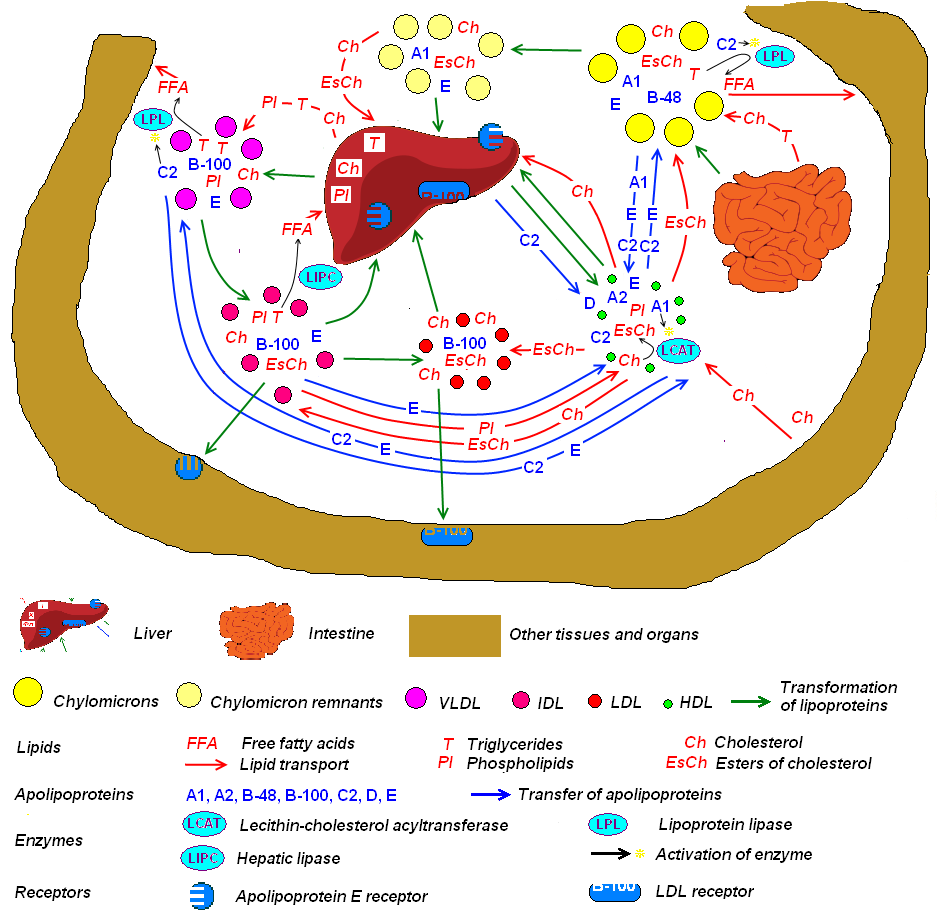
- One apoB per particle: Chylomicron remnants, VLDL, intermediate-density lipoprotein (IDL), LDL and Lp(a) each carry one apoB molecule. Non-HDL-C counts the cholesterol they carry.
- Cascade: the liver secretes triglyceride-rich VLDL. Lipoprotein lipase strips off the triglyceride, leaving IDL, and then LDL.
- Clearance: LDL receptors on the liver pull LDL out of the blood. Defects, as in FH, push LDL-C and non-HDL-C up.
- Remnants: Per mg/dL, cholesterol in triglyceride-rich remnants carries at least as much ASCVD risk as LDL-C.
- Excluded: HDL, which returns cholesterol to the liver.
How it is measured
The lab calculates it from the total cholesterol and HDL-C on a standard lipid panel, so there is no extra charge. Serum (red or gold top) or plasma, depending on the lab. Fasting is not required. Nonfasting is preferred for most patients. Some point-of-care lipid devices report it too.
Why it matters
In dyslipidemia care, non-HDL-C is read alongside LDL-C. It is also the first pediatric screening test. Higher levels predict long-term ASCVD risk across the full range. Emergency and critical care rarely act on it. Still, the same panel can reveal dangerous hypertriglyceridemia, and a sample drawn during ACS or sepsis understates the baseline.
Clinical Pearls
References
- Writing Committee Members; Blumenthal, R. S., Morris, P. B., Gaudino, M., et al. (2026). 2026 ACC/AHA/AACVPR/ABC/ACPM/ADA/AGS/APhA/ASPC/NLA/PCNA guideline on the management of dyslipidemia: A report of the American College of Cardiology/American Heart Association Joint Committee on Clinical Practice Guidelines. Circulation, 153(17), e1154–e1276. https://doi.org/10.1161/CIR.0000000000001423
- Khan, S. S., Matsushita, K., Sang, Y., Ballew, S. H., Grams, M. E., Surapaneni, A., et al. (2024). Development and validation of the American Heart Association's PREVENT equations. Circulation, 149(6), 430–449. https://doi.org/10.1161/CIRCULATIONAHA.123.067626
- Jacobson, T. A., Ito, M. K., Maki, K. C., Orringer, C. E., Bays, H. E., Jones, P. H., et al. (2015). National Lipid Association recommendations for patient-centered management of dyslipidemia: Part 1, full report (landmark consensus). Journal of Clinical Lipidology, 9(2), 129–169. https://doi.org/10.1016/j.jacl.2015.02.003
- Nordestgaard, B. G., Langsted, A., Mora, S., Kolovou, G., Baum, H., Bruckert, E., et al. (2016). Fasting is not routinely required for determination of a lipid profile: Clinical and laboratory implications including flagging at desirable concentration cut-points. A joint consensus statement from the European Atherosclerosis Society and European Federation of Clinical Chemistry and Laboratory Medicine. European Heart Journal, 37(25), 1944–1958. https://doi.org/10.1093/eurheartj/ehw152
- Expert Panel on Integrated Guidelines for Cardiovascular Health and Risk Reduction in Children and Adolescents; National Heart, Lung, and Blood Institute. (2011). Integrated guidelines for cardiovascular health and risk reduction in children and adolescents: Full report (landmark guideline). National Institutes of Health. https://www.nhlbi.nih.gov/health-topics/integrated-guidelines-for-cardiovascular-health-and-risk-reduction-in-children-and-adolescents/integrated-guidelines-for-cardiovascular-health-and-risk-reduction-in-children-and-adolescents-full-report
- Brunner, F. J., Waldeyer, C., Ojeda, F., Salomaa, V., Kee, F., Sans, S., et al. (2019). Application of non-HDL cholesterol for population-based cardiovascular risk stratification: Results from the Multinational Cardiovascular Risk Consortium. The Lancet, 394(10215), 2173–2183. https://doi.org/10.1016/S0140-6736(19)32519-X
- Sampson, M., Ling, C., Sun, Q., Harb, R., Ashmaig, M., Warnick, R., et al. (2020). A new equation for calculation of low-density lipoprotein cholesterol in patients with normolipidemia and/or hypertriglyceridemia. JAMA Cardiology, 5(5), 540–548. https://doi.org/10.1001/jamacardio.2020.0013
- Das Pradhan, A., Glynn, R. J., Fruchart, J. C., MacFadyen, J. G., Zaharris, E. S., Everett, B. M., et al. (2022). Triglyceride lowering with pemafibrate to reduce cardiovascular risk. New England Journal of Medicine, 387(21), 1923–1934. https://doi.org/10.1056/NEJMoa2210645
Medical Disclaimer
- For Educational Purposes Only: This content is intended for educational reference and should not be used for clinical decision-making.
- Not a Substitute for Professional Judgment: Always consult your local protocols, institutional guidelines, and supervising physicians.
- Verify Before Acting: Users are responsible for verifying information through authoritative sources before any clinical application.