

Bedside Snapshot
- Use It For
- Anaphylaxis from any trigger (first-line, at first suspicion); other Type I allergic reactions (FDA-labeled)
- Adult Dose
- Anaphylaxis: 0.3–0.5 mg IM (0.3–0.5 mL) mid-outer thigh, every 5–15 min (max 0.5 mg/dose)
- Devices: 0.3 mg autoinjector or neffy 2 mg IN
- No better after 2 doses: IV infusion
- Pediatric Dose
- 0.01 mg/kg IM (0.01 mL/kg), max 0.3 mg (RCUK: 0.5 mg over 12 yr unless small or prepubertal), every 5–15 min. Autoinjector 0.1 or 0.15 mg (7.5 to <15 kg), 0.15 mg (15 to <30 kg), 0.3 mg (≥30 kg). neffy 1 mg (15–30 kg)
- Onset / Duration
- IM thigh: peak about 5–10 min (wide variation); short-lived, so reassess every 5 min. IN (neffy 2 mg): median peak 30 min in healthy adults (neffy label)
- Do Not Give / Hold If
- No absolute contraindication in anaphylaxis. Never push 1 mg/mL undiluted IV; never inject the buttock, digits, hands or feet
- Watch For
- Tachyarrhythmia or ischemia (ECG, chest pain); severe hypertension (BP after each dose); pulmonary edema (crackles, SpO₂); pallor mistaken for shock in children
- Reversal / Rescue
- No antidote needed: effect lasts minutes. Poor response: repeat IM every 5–15 min, fluids, then low-dose IV infusion. β-blocker and refractory: add glucagon
- Must Remember
- Give IM epinephrine first and early, into the outer mid-thigh. 1 mg/mL is 10 times the 0.1 mg/mL arrest syringe: confirm concentration, dose in mL and route
Indications
Emergency & Prehospital
- Anaphylaxis from any trigger (foods, stings or bites, drugs, diagnostic agents, exercise or idiopathic): first-line treatment. Give it at the first suspicion. Antihistamines, steroids or IV access come after, not before.
- Type I allergic reactions, including anaphylaxis: FDA-labeled emergency indication. In practice, give it for any reaction that involves the airway, breathing or circulation. Do not wait for hypotension.
- Upper-airway edema or stridor in anaphylaxis: nebulized epinephrine as an adjunct after IM epinephrine, never in place of repeated IM doses (off-label)
- Croup, moderate to severe: nebulized epinephrine from the 1 mg/mL vial, alongside a corticosteroid such as dexamethasone (off-label)
- Asthma: not routinely indicated for exacerbations without anaphylaxis. Asthma features and anaphylaxis together? Give IM epinephrine first, then bronchodilators.
ED / ICU / Transport
- Refractory anaphylaxis: after 2 IM doses fail, the 1 mg/mL vial becomes the stock for the low-dose IV infusion (see epinephrine 0.1 mg/mL (IV/IO))
- Hypotension in septic shock: FDA-labeled as an IV infusion, after dilution. norepinephrine is still the usual first vasopressor
Dosing & Administration
Anaphylaxis: 0.3–0.5 mg IM for adults and 0.01 mg/kg IM (max 0.3 mg) for children, repeated every 5–15 min as needed. Each device, the nasal spray and the infusion have their own doses. Look in the tables.
Available Forms
- Single-dose vial: 1 mg/mL (1:1,000) in 1 mL (1 mg). It contains sodium metabisulfite. This is the vial EMS draws up in check-and-inject kits.
- Multiple-dose vial: 1 mg/mL in 30 mL (30 mg), chlorobutanol preservative, amber glass. Discard it 30 days after first use. Keep it out of resuscitation and pediatric kits.
- Autoinjectors: 0.1 mg (Auvi-Q only), 0.15 mg (EpiPen Jr, Auvi-Q, generics) and 0.3 mg (EpiPen, Auvi-Q, generics). Each device is one fixed dose.
- Nasal spray: neffy 2 mg and 1 mg single-use devices (not 1 mg/mL solution).
Concentration and route check: 1 mg/mL is 10 times stronger than the 0.1 mg/mL arrest syringe. Never push it undiluted IV. Before every dose, read back the drug, the mg/mL, the dose in mg and mL, and the route.
Adult Dosing
| Indication | Dose & Route | Repeat / Max | Notes |
|---|---|---|---|
| Anaphylaxis (vial and syringe) | 0.3–0.5 mg IM (0.3–0.5 mL of 1 mg/mL) into the anterolateral mid-thigh | Every 5–15 min as needed (label: every 5–10 min); max 0.5 mg/dose; no fixed number of doses | Label dose for adults and children 30 kg or more. RCUK gives 0.5 mg to adults. Rotate the site. |
| Anaphylaxis (autoinjector, 30 kg or more) | 0.3 mg IM, outer thigh, through clothing if needed | New device after 5 min if no improvement; more than 2 sequential doses only under direct medical supervision | Hold in place 3 s (EpiPen) or 2 s (Auvi-Q). In a healthcare setting give further doses from a vial. |
| Anaphylaxis (neffy nasal spray, 30 kg or more) | 2 mg IN, one spray into one nostril | Second dose with a new device in the same nostril 5 min later if no improvement; more than 2 sequential doses only under direct medical supervision | Use an injectable form if nasal polyps, nasal injury or prior nasal surgery may limit absorption. |
| Refractory anaphylaxis (no improvement in breathing or circulation after 2 IM doses) | Low-dose IV infusion (see Continuous Infusion) | Keep giving IM every 5 min until the infusion runs; titrate to effect: no fixed max | (Paramedic/RN/CCT, per protocol.) Never give 1 mg/mL undiluted IV. IV boluses are for cardiac arrest, or small titrated boluses (adult 50 mcg) by clinicians experienced with vasopressors while the infusion is set up. |
| Stridor or laryngeal edema in anaphylaxis (adjunct) | 5 mg (5 mL of 1 mg/mL) INH (nebulized) | Repeat per protocol; max 5 mg (5 mL) per nebulized dose | Only after IM (or IV) epinephrine, never instead of it. Must not delay an infusion or intubation for critical airway obstruction. |
Pediatric Dosing
| Indication | Dose (per kg) & Route | Max Single / Max Total | Notes |
|---|---|---|---|
| Anaphylaxis (vial and syringe) | 0.01 mg/kg IM (0.01 mL/kg of 1 mg/mL), anterolateral thigh; repeat every 5–15 min | Max 0.3 mg/dose for children and teens (US 2023 practice parameter); RCUK: 0.5 mg over 12 yr unless small or prepubertal; label: 0.3 mg under 30 kg, 0.3–0.5 mg at 30 kg or more. Follow protocol. No fixed number of doses | Preferred in healthcare settings because it gives a weight-appropriate dose. Under 7.5 kg there is no autoinjector: draw up. |
| Anaphylaxis, weight unknown (RCUK age doses) | Over 12 yr: 0.5 mg; 6–12 yr: 0.3 mg; 6 months–6 yr: 0.15 mg; under 6 months: 0.1–0.15 mg IM | 0.3 mg if over 12 yr but small or prepubertal | Same volumes in mL of 1 mg/mL. |
| Anaphylaxis (autoinjector) | 7.5 to <15 kg: 0.1 mg; 15 to <30 kg: 0.15 mg; ≥30 kg: 0.3 mg IM | One device per dose; new device after 5 min; more than 2 doses under medical supervision | Label bands shown. 0.1 mg is Auvi-Q only. The US 2023 practice parameter accepts either 0.1 mg or 0.15 mg under 15 kg (0.15 mg when 0.1 mg is unavailable); AAAAI, AAP, CSACI and EAACI support switching to 0.3 mg at 25 kg to limit underdosing near 30 kg (US 2023 practice parameter). Never withhold epinephrine because the exact device is not on hand. Hold the child's leg firmly. |
| Anaphylaxis (neffy nasal spray) | 15 to <30 kg: 1 mg IN; ≥30 kg: 2 mg IN | Second dose in the same nostril after 5 min; more than 2 doses under medical supervision | Not approved under 15 kg. |
| Refractory anaphylaxis | Same low-dose IV infusion as adults, by mL/kg/hr (see Continuous Infusion) | Titrate to effect: no fixed max | Expert help; pediatric critical care. |
| Stridor or laryngeal edema in anaphylaxis (adjunct) | 5 mg (5 mL of 1 mg/mL) INH (nebulized), the same dose as adults (RCUK) | Max 5 mg (5 mL) per nebulized dose | Only after IM epinephrine, never instead of it. |
| Croup, moderate to severe (off-label) | 5 mg (5 mL of 1 mg/mL L-epinephrine) INH (nebulized); the same dose at any age or weight (CPS), equivalent to 0.5 mL racemic epinephrine | Max 5 mg (5 mL) per nebulized dose; repeat per protocol | Give a corticosteroid (dexamethasone) too. Effect lasts at least 1 hr and is gone by 2 hr: discharge only if croup has not recurred 2–4 hr after the dose. Doses are protocol-dependent. |
See weight-based dosing and the Broselow tape.
Continuous Infusion
| Setting | Example Concentration | Start | Titrate | Usual Range / Max |
|---|---|---|---|---|
| Refractory anaphylaxis (RCUK protocol, adults and children) | Example (institution-specific): 1 mg in 100 mL NS = 10 mcg/mL, peripheral line | 0.5 mL/kg/hr (about 0.1 mcg/kg/min, weight-based); 1 mL/kg/hr if hypotensive or hypoxic | Up or down to the lowest effective rate; RCUK: steady state 5–10 min after each change | No fixed max. Refractory to the infusion (RCUK): add a second vasopressor (norepinephrine, vasopressin or metaraminol), consider glucagon if on a β-blocker, and consider extracorporeal life support. Wean to half the start rate as symptoms settle, then off over 30 min, 1 hr after full resolution |
| Septic shock hypotension (FDA label, adults) | Example: 1 mg in 1,000 mL D5W or D5NS = 1 mcg/mL (saline alone not recommended) | 0.05 mcg/kg/min, the low end of the range (especially in older adults) | Increase or decrease in steps of 0.05–0.2 mcg/kg/min about every 10–15 min to the MAP target | 0.05–2 mcg/kg/min, titrated to MAP. Wean gradually. See epinephrine IV |
Preparation & Administration
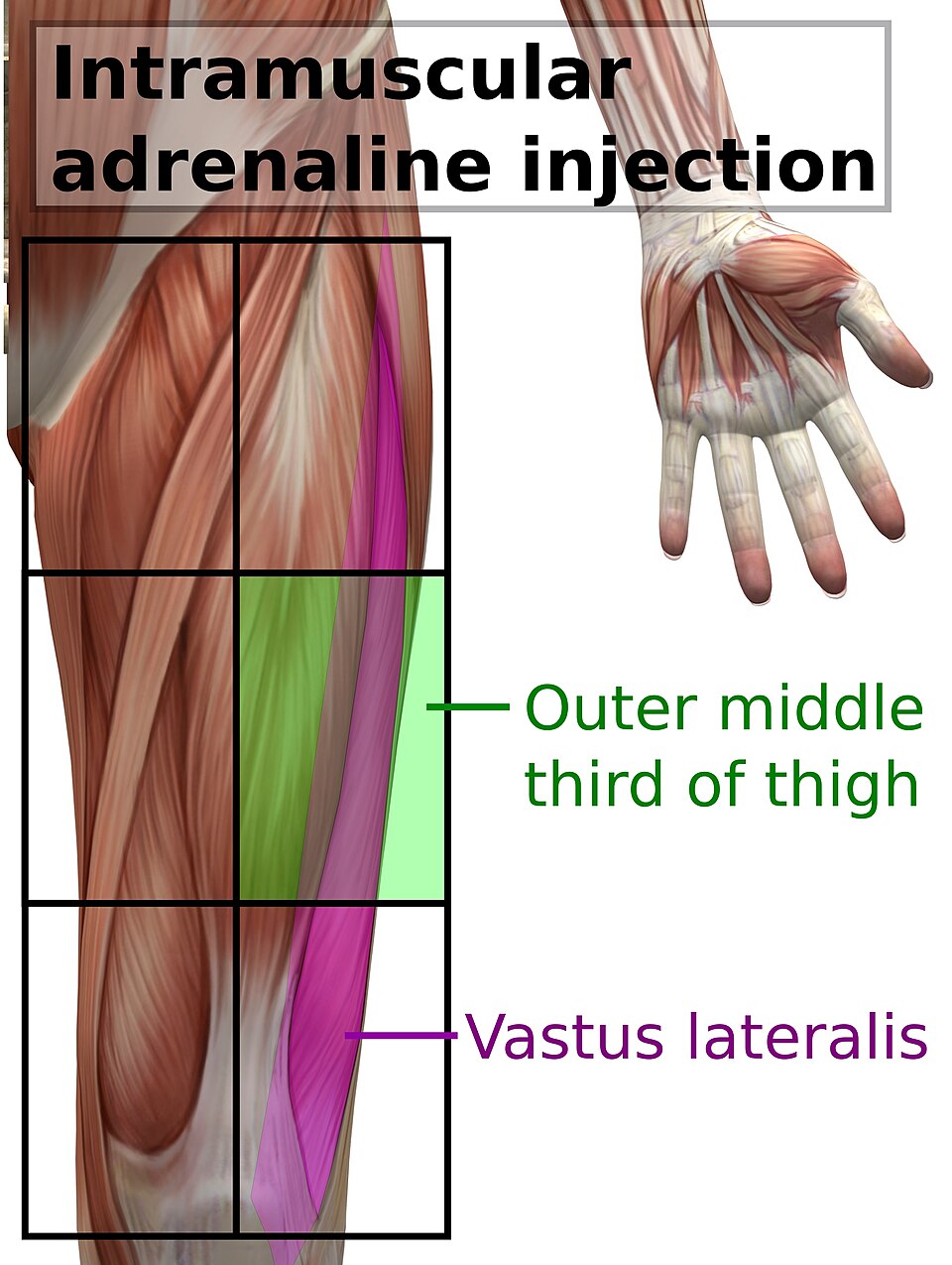
- Site: anterolateral middle third of the thigh (vastus lateralis). Never the buttock, digits, hands or feet.
- Route: IM, not subcut, for anaphylaxis. The subcut and inhaled routes are less effective.
- Needle: at least 1/2 inch long (label). RCUK: 25 mm suits all ages, 16 mm for very small infants, 38 mm for some adults.
- Draw-up: use a 1 mL syringe. At 1 mg/mL, the mL and the mg are the same number (0.3 mg = 0.3 mL).
- Autoinjector: press firmly into the outer thigh, through clothing if needed, and hold for the time in the device instructions (EpiPen 3 s, Auvi-Q 2 s). A child who kicks or moves can tear the skin, or bend or embed the needle. The EpiPen label reports both. Hold a young child's leg firmly before and during the injection.
- Nebulizer: 5 mL of undiluted 1 mg/mL (five 1 mL vials) in the nebulizer cup; label the cup and keep it apart from injectable doses.
- neffy: do not prime; insert the nozzle fully, straight up (not toward the septum), press the plunger firmly; no sniffing afterward.
- Inspection: solution must be clear and colorless; do not use if colored, cloudy or with particles.
Contraindications & Precautions
Contraindications
- The FDA label lists none. In anaphylaxis, none is absolute, and withholding it is the greater risk.
Precautions
- Heart disease: Coronary disease, cardiomyopathy or arrhythmia raise the risk of ischemia and arrhythmia. Give it anyway in anaphylaxis, and put the patient on a monitor.
- Hypertension, hyperthyroidism: adverse effects become more likely.
- Parkinson disease, diabetes: temporary worsening of agitation or tremor; transient rise in blood glucose.
- Sulfite sensitivity: The vial contains sodium metabisulfite. That must not stop use in an emergency.
- Nasal conditions (neffy): polyps, nasal injury or prior nasal surgery may reduce absorption. Use an injection.
Hold / Reassess If
- Signs of excess: tachycardia, tremor and pallor with a normal or raised BP: cut the infusion back (stop it if the effects are severe). With IM dosing, reassess before the next dose.
- Chest pain, new arrhythmia or severe hypertension: Get a 12-lead ECG and reassess before the next dose. Anaphylaxis signs that persist still need epinephrine.
Never IV push the 1 mg/mL vial: Undiluted, an IV bolus can bring severe hypertension, cerebral hemorrhage, pulmonary edema and fatal arrhythmias. The IV route in anaphylaxis is a monitored, low-dose infusion.
Adverse Effects & Toxicity
Common
- Anxiety, apprehension, restlessness, tremor and weakness
- Palpitations, tachycardia and pallor
- Headache, dizziness and sweating
- Nausea and vomiting
- neffy: nasal discomfort, rhinorrhea, throat irritation; nasal congestion in children
Serious / Life-Threatening
| Effect | Recognition | Management |
|---|---|---|
| Arrhythmia, ischemia, stress cardiomyopathy | Chest pain, ectopy, VT, ST changes | Monitor and 12-lead ECG; treat the arrhythmia per ACLS; reassess the need for more epinephrine |
| Severe hypertension, cerebral hemorrhage | BP spike, severe headache, neurologic change (older adults with heart disease most at risk) | Stop further doses once anaphylaxis has resolved; supportive care; neurologic change needs emergency evaluation |
| Pulmonary edema | Crackles, falling SpO₂, frothy sputum | Oxygen and ventilatory support; an α-blocker (phentolamine) per medical direction |
| Tissue ischemia | Blanched or cold digit after accidental autoinjector injection; IV extravasation | ED evaluation; phentolamine infiltration is the labeled antidote for extravasation |
| Necrotizing soft-tissue infection | Pain, swelling or skin change at a thigh or buttock site days later | Urgent surgical assessment; rare (clostridial gas gangrene reported) |
Overdose & Toxicity Management
- Signs: extreme hypertension, tachyarrhythmias, pulmonary edema, metabolic acidosis. In children, pallor gets mistaken for shock and doses stack up.
- Immediate management: Stop epinephrine. Then ABCs, monitor, 12-lead ECG. The effects wear off fast, because the drug clears in minutes.
- Specific treatment: No antidote. The label names an α-blocker (phentolamine) for pulmonary edema and a β-blocker (propranolol) for arrhythmias, dosed per medical direction or poison center (1-800-222-1222).
Monitoring
| Parameter | When / How Often | Target / Act If |
|---|---|---|
| Clinical: airway and breathing | Before and 5 min after each dose | Stridor, wheeze, rising work of breathing or falling SpO₂ after 5 min: repeat IM epinephrine |
| Clinical: HR, BP, ECG | Monitor as soon as possible; BP at least every 5 min on an infusion | Persistent hypotension: repeat IM, fluid bolus, then infusion. Tachycardia, tremor, pallor with normal or high BP: reduce or hold |
| Clinical: response to 2 doses | After the second IM dose | No improvement in breathing or circulation: refractory anaphylaxis; start the IV infusion and call for expert help |
| Clinical: injection site | After each dose and at discharge teaching | Blanched digit, or pain and swelling days later: ED evaluation |
| Laboratory: glucose and potassium | Diabetes, repeated doses or infusion | |
| Observation: US practice parameter (2020) | Every patient, after diagnosis and treatment | Observe until symptoms have fully resolved. Severe anaphylaxis and needing more than 1 dose are biphasic risk factors; durations follow local protocol |
| Observation: 2 hr fast-track (RCUK) | At least 2 hr from resolution, only if a single dose given within 30 min of onset worked within 5–10 min and symptoms fully resolved | Also required: unused autoinjectors plus training, and adequate supervision after discharge. Any criterion missing: observe longer |
| Observation: 6 or 12 hr (RCUK) | At least 6 hr from resolution if 2 IM doses were needed or there was a previous biphasic reaction | At least 12 hr: severe reaction needing more than 2 doses, severe asthma or respiratory compromise, possible ongoing allergen absorption, late-night presentation, or poor access to emergency care |
Interactions & Compatibility
Clinically Significant Interactions
| Drug / Class | Effect | What To Do |
|---|---|---|
| β-blockers (e.g., propranolol) | Blunted cardiac and bronchodilator response; anaphylaxis may be harder to treat. Label: also more arrhythmias, and nonselective agents leave α effects unopposed, so BP can rise sharply | Give the normal dose and repeat; BP after each dose. If refractory to infusion and fluids add glucagon (RCUK: adult 1 mg IV, repeated or followed by 1–2 mg/hr; child 20–30 mcg/kg, max 1 mg, repeated every 5 min; watch for vomiting, hyperglycemia, hypokalemia, hypocalcemia; protocol-dependent). Afterward, the 2023 practice parameter favors continuing most β-blockers |
| TCAs, MAOIs, COMT inhibitors, clonidine, oxytocin, doxapram, other sympathomimetics | Potentiated pressor response; severe, prolonged hypertension | Do not withhold in anaphylaxis; BP after each dose |
| Antihistamines (diphenhydramine, chlorpheniramine) | May potentiate epinephrine effects, including arrhythmias | Expected co-therapy; monitor HR, BP and ECG |
| Digoxin, diuretics, quinidine, thyroid hormones, halogenated anesthetics | Higher arrhythmia risk | Continuous ECG |
| α-blockers, vasodilators (nitrates), diuretics, antihypertensives, ergot alkaloids, phenothiazine antipsychotics | Reduced or reversed pressor effect | Expect to need more doses or an infusion |
| K⁺-depleting diuretics, corticosteroids, theophylline | Additive hypokalemia | Check potassium after repeated doses or infusion |
IV Compatibility
- The label's diluent is D5W or D5NS. The label does not recommend saline alone, although the RCUK anaphylaxis protocol uses NS.
- Dedicated line on a pump; do not piggyback without an anti-reflux valve; not on the same arm as the BP cuff.
- Verify with an institutional compatibility resource.
Special Populations
- Pediatrics: use the weight-based doses in the Pediatric Dosing table. Autoinjector label bands are 0.1 mg (7.5 to under 15 kg), 0.15 mg (15 to under 30 kg) and 0.3 mg (30 kg or more). The US 2023 practice parameter accepts 0.1 mg or 0.15 mg under 15 kg. If a 0.15 mg device is what you have, use it. Do not withhold epinephrine over the device. Needle length for small children is still unresolved. Pallor after a dose can pass for shock.
- Pregnancy: Treat anaphylaxis exactly as you would in a non-pregnant patient. Place her on her left side. Decades of use show no drug-linked risk of birth defects. Epinephrine can inhibit uterine contractions. The label advises avoiding it in the second stage of labor, and in obstetric use when maternal BP exceeds 130/80 mmHg. Those are obstetric warnings. Maternal anaphylaxis still gets IM epinephrine, as usual.
- Lactation: There are no data on milk transfer. Infant exposure is expected to be very low, for two reasons: poor oral bioavailability and a short half-life. Treat as usual.
- Older Adults: Older adults may be more sensitive. The label suggests considering a lower starting dose for anaphylaxis. Rapid BP rises have caused cerebral hemorrhage. RCUK 2021 no longer recommends dose adjustment in specific patient groups. In true anaphylaxis, do not withhold or underdose. Give the standard IM dose and monitor BP and ECG.
- Renal Impairment: Renal vasoconstriction may reduce urine output. No dose adjustment has been established.
- Hepatic Impairment: no specific adjustment established.
- Obesity / Dosing Weight: Dose on actual body weight, up to the caps (0.3 mg in children; 0.5 mg in adults; teens per protocol, see Pediatric Dosing). A needle has to be long enough to reach muscle (38 mm in some adults).
Field & Transport Considerations
- Scope: EMTs give autoinjectors. In many states, they also give vial-and-syringe doses through check-and-inject programs. It varies by state and agency protocol.
- After Self-Treatment: the 2023 US practice parameter says immediate EMS activation may not be needed after a prompt, complete and durable response to epinephrine, as long as more epinephrine and medical care are readily available. It advises always activating EMS if the reaction was severe, did not resolve promptly and completely, or came back or worsened after the first dose. Transport and refusal decisions follow local protocol and medical direction.
- Storage & Stability: Vials and autoinjectors at 20–25°C (68–77°F). Autoinjector excursions 15–30°C (59–86°F). Neffy excursions up to 50°C (122°F). Protect from light and freezing. neffy freezes below −15°C (5°F) and will not spray while frozen. Do not wait for it to thaw. Use an injection instead (a thawed device may be used). Do not leave devices in a vehicle glove box. Check the solution window and expiry at each kit check.
- Carried Concentration: Keep the 1 mg/mL vial apart from the 0.1 mg/mL arrest syringes. Never stock the 30 mL multiple-dose vial in a drug box.
- Positioning: Lay the patient flat, with legs raised if hypotensive. Semi-recumbent if breathing is the problem. Left side in pregnancy. Deaths have occurred within minutes of a patient standing, walking or sitting up suddenly. Never let it happen.
- Infusions in Transport: pump, dedicated line, NIBP at least every 5 min on the opposite arm; carry enough IM doses to keep dosing if the line fails.
- Handoff Essentials: trigger and onset time, time, dose, form (vial, autoinjector, nasal) and site of each dose, response, and total doses (2 or more raises biphasic risk).
Clinical Pearls
Antihistamines and steroids are not rescue drugs: H1 antihistamines only treat the skin. Steroids are no longer advised for routine anaphylaxis treatment. Never let either one delay or replace IM epinephrine.
Two doses and not better means refractory: Breathing or circulation still not better after 2 IM doses? Start a low-dose infusion and get expert help. Keep giving IM doses every 5 min until it runs.
Exam discriminator: IM anaphylaxis vs IV arrest: Both pediatric doses are 0.01 mg/kg. The concentration and the route are not the same. Anaphylaxis is 1 mg/mL IM. Arrest is 0.1 mg/mL IV/IO, so the volume differs tenfold. Mixing them up is the classic 10-fold error.
Pallor is not always shock: Epinephrine causes vasoconstriction, and a pale child is the result. Before you stack another dose in a small child, check pulse, BP, capillary refill and mental status.
Vial beats autoinjector in the ambulance and ED: Drawing up gives a weight-appropriate dose, and it costs less. RCUK advises against autoinjectors for repeat doses in healthcare settings.
neffy vs injection: In healthy adults (neffy label, Table 3), a 2 mg spray gave first-10-minute exposure that generally sat within the range of a 0.3 mg needle-syringe injection. The median peak came at 30 min, against 8 min for an autoinjector. If nasal anatomy may limit absorption, choose an injection.
Biphasic risk: Biphasic reactions occur in about 5% of patients, at a median of about 12 hr (RCUK 2021, section 8.2). So 6–12 hr of observation may miss over half of them. Risk climbs with more than one dose, a severe first reaction, or epinephrine given more than 30–60 min after onset. Teach every patient to return if symptoms recur.
Anaphylaxis that progresses to cardiac arrest: Switch to standard ACLS/PALS with IV/IO epinephrine 0.1 mg/mL. Once circulation stops, IM absorption is unreliable. Start compressions early, give isotonic IV fluids and consider ECPR for refractory cases (AHA 2025 Part 10).
Pharmacology
Mechanism of Action
- α1 receptors: vasoconstriction → reverses vasodilation, capillary leak and mucosal edema → raises BP and opens the upper airway.
- β1 receptors: faster heart rate and stronger contraction → restores cardiac output.
- β2 receptors: bronchial smooth-muscle relaxation → relieves bronchospasm; on mast cells, inhibits activation and further mediator release.
- Metabolic: glycogenolysis, less glucose uptake and suppressed insulin release → transient hyperglycemia and raised lactate.
Pharmacokinetics
| Route | Onset | Peak | Duration |
|---|---|---|---|
| IM thigh | Within minutes | RCUK: about 5–10 min, with wide variation. Healthy volunteers (neffy label, Table 3): median 8 min (autoinjector), 45 min (needle and syringe) | Short; reassess every 5 min |
| IN (neffy 2 mg) | BP and HR responses within the injection range over the first 10 min | Median 30 min (healthy adults) | BP and HR above injection values through 60 min |
| IV infusion | BP rises within 5 min | PK steady state within 10–15 min (label) | BP returns to baseline about 15 min after stopping |
- Half-life: under 5 min after IV injection.
- Metabolism: MAO and COMT, mainly in liver, kidney and skeletal muscle, to inactive vanillylmandelic acid.
- Elimination: inactive metabolites in urine; little unchanged drug.
- Absorption variability: The healthy-volunteer peak times above come from the neffy label study. Repeat dosing follows the patient, not the clock. Once cardiac arrest occurs, IM absorption is unreliable, so use IV/IO.
Names & Classification
- Generic Name
- Epinephrine (adrenaline) injection, 1 mg/mL; epinephrine nasal spray
- Brand Names
- Adrenalin (vials); EpiPen, EpiPen Jr, Auvi-Q and generic autoinjectors; neffy (nasal spray)
- Pharmacologic Class
- Endogenous catecholamine; nonselective α- and β-adrenergic agonist
- Therapeutic Class
- First-line anaphylaxis treatment; vasopressor (IV, after dilution)
- Controlled Substance
- Not controlled
- High-Alert Status
- No for IM, subcut and nasal use. Treat the diluted IV infusion from this vial as high-alert (see Continuous Infusion)
- Look-Alike / Sound-Alike
- EPINEPHrine / ePHEDrine; 1 mg/mL vial vs 0.1 mg/mL syringe
- Error-Prone Abbreviations to Avoid
- Ratio strengths alone (1:1,000, 1:10,000): state mg/mL and the dose in mg and mL
References
- Golden, D. B. K., Wang, J., Waserman, S., Akin, C., et al. (2024). Anaphylaxis: A 2023 practice parameter update. Annals of Allergy, Asthma & Immunology, 132(2), 124–176. https://doi.org/10.1016/j.anai.2023.09.015
- Resuscitation Council UK. (2021). Emergency treatment of anaphylaxis: Guidelines for healthcare providers. https://www.resus.org.uk/library/additional-guidance/guidance-anaphylaxis/emergency-treatment
- Cardona, V., Ansotegui, I. J., Ebisawa, M., et al. (2020). World Allergy Organization anaphylaxis guidance 2020. World Allergy Organization Journal, 13(10), 100472. https://doi.org/10.1016/j.waojou.2020.100472
- Par Health USA. (2026). ADRENALIN (epinephrine) injection, 1 mg/mL: Prescribing information. DailyMed, National Library of Medicine. https://dailymed.nlm.nih.gov/dailymed/drugInfo.cfm?setid=3b7a4364-668d-4eb2-a20c-04adc35aabe4
- kaléo, Inc. (2025). AUVI-Q (epinephrine injection) auto-injector 0.1 mg, 0.15 mg, 0.3 mg: Prescribing information. DailyMed, National Library of Medicine. https://dailymed.nlm.nih.gov/dailymed/drugInfo.cfm?setid=6180fb40-7fca-4602-b3da-ce62b8cd2470
- ARS Pharmaceuticals Operations. (2026). NEFFY (epinephrine nasal spray) 1 mg and 2 mg: Prescribing information. DailyMed, National Library of Medicine. https://dailymed.nlm.nih.gov/dailymed/drugInfo.cfm?setid=a1758142-a905-401d-8961-05829f51023a
- Ortiz-Alvarez, O., & Canadian Paediatric Society Acute Care Committee. (2026). Acute management of croup in the emergency department (practice point, posted 2017, updated March 2026). Canadian Paediatric Society. https://cps.ca/en/documents/position/acute-management-of-croup
- Global Initiative for Asthma. (2026). Global strategy for asthma management and prevention (2026 update). https://ginasthma.org/2026-gina-strategy-report/
- Mylan Specialty L.P. (2023). EpiPen and EpiPen Jr (epinephrine injection, USP) auto-injectors: Prescribing information (revised 2/2023). DailyMed, National Library of Medicine. https://dailymed.nlm.nih.gov/dailymed/drugInfo.cfm?setid=7560c201-9246-487c-a13b-6295db04274a
- Shaker, M. S., Wallace, D. V., Golden, D. B. K., Oppenheimer, J., Bernstein, J. A., Campbell, R. L., et al. (2020). Anaphylaxis—a 2020 practice parameter update, systematic review, and GRADE analysis. Journal of Allergy and Clinical Immunology, 145(4), 1082–1123. https://doi.org/10.1016/j.jaci.2020.01.017
- American Heart Association. (2025). Part 10: Adult and pediatric special circumstances of resuscitation, 2025 AHA Guidelines for CPR and ECC. https://cpr.heart.org/en/resuscitation-science/cpr-and-ecc-guidelines/adult-and-pediatric-special-circumstances-of-resuscitation
Medical Disclaimer
- For Educational Purposes Only: This content is intended for educational reference and should not be used for clinical decision-making.
- Not a Substitute for Professional Judgment: Always consult your local protocols, institutional guidelines, and supervising physicians.
- Verify Before Acting: Users are responsible for verifying information through authoritative sources before any clinical application.
AI Assistance Notice
AI was used to assist in organizing, paraphrasing, and formatting this information.