

Bedside Snapshot
- Use It For
- Nausea and vomiting in the field or ED; vomiting from pediatric gastroenteritis so oral rehydration can work; prevention and treatment of PONV; chemotherapy and radiation nausea prevention
- Adult Dose
- Nausea/vomiting: 4 mg IV/IM/ODT; ODT 4 or 8 mg; no labeled interval (NASEMSO altitude: 4 mg q6h)
- PONV: 4 mg IV/IM before induction or after surgery
- CINV: 0.15 mg/kg IV over 15 min ×3 (max 16 mg/dose); in combinations
- Pediatric Dose
- EMS, 6 mo–14 yr: 0.15 mg/kg (max 4 mg) IV/PO. ED gastroenteritis, single oral dose: 8–15 kg 2 mg; >15–30 kg 4 mg; >30 kg 6–8 mg (ODT is 4 or 8 mg only). PONV, 1 mo–12 yr: 0.1 mg/kg IV (max 4 mg)
- Onset / Duration
- No labeled clinical onset. Plasma peak: IV about 10 min; IM about 40 min; PO/ODT about 2 hr. Labeled repeat schedules every 4–12 hr by indication (T½ 3–6 hr)
- Do Not Give / Hold If
- Apomorphine use; prior anaphylaxis to ondansetron; congenital long QT syndrome or known prolonged QTc; suspected bowel obstruction or ileus (relative: masks it)
- Watch For
- QT prolongation or torsades (ECG if K⁺/Mg²⁺ low, heart failure, bradycardia or QT drugs); chest pain during IV push (coronary spasm); serotonin syndrome (clonus, hyperthermia); anaphylaxis
- Reversal / Rescue
- No antidote: stop, supportive care, poison center. Torsades: IV magnesium; unsynchronized shock for sustained torsades, with or without a pulse. Serotonin syndrome: stop all serotonergic drugs, supportive care
- Must Remember
- Screen for long QT first: push IV over 2–5 min (never faster than 30 sec) and keep single IV doses at 16 mg or less. No relief after the first dose: consider another antiemetic class.
Indications
Emergency & Prehospital
- Nausea and vomiting, any cause: listed in the NASEMSO model EMS guideline, which prefers it for children. Look for the cause at the same time. Off-label for undifferentiated nausea.
- Vomiting from acute gastroenteritis in children 6 months and older: a single oral or ODT (orally disintegrating tablet) dose helps the child keep down oral rehydration. Off-label in the US.
ED / ICU / Transport
- Postoperative nausea and vomiting (PONV): give it before induction to prevent it, or to treat it when no prophylaxis was given. FDA-labeled from age 1 month.
- Chemotherapy-induced nausea and vomiting (CINV): prevention. The IV form is labeled from age 6 months. The oral form is for highly and moderately emetogenic regimens.
- Radiation-induced nausea and vomiting: prevention during total-body or abdominal radiotherapy. Oral, and labeled.
- Nausea and vomiting of pregnancy and hyperemesis gravidarum: second-line, once first-line antiemetics have failed. The source is RCOG 2024. Off-label.
- Pediatric gastroenteritis after discharge: a 2025 multicenter trial found that up to 6 as-needed oral doses over the first 48 hr lowered moderate-to-severe illness over the next week (5.1% vs 12.5% with placebo). It is newer than the CPS 2018 single-dose advice. The trial schedule is in Pediatric Dosing (off-label).
Dosing & Administration
Available Forms
- Injection: 2 mg/mL in a 2 mL (4 mg) single-dose vial. That is the form you push IV or IM. The 20 mL (40 mg) multiple-dose vial contains methylparaben and propylparaben.
- ODT: 4 mg and 8 mg. It dissolves on the tongue in seconds, with no water needed. Many generics contain aspartame (phenylalanine). In phenylketonuria, check the product label.
- Tablets: 4 mg and 8 mg film-coated.
- Oral solution: 4 mg/5 mL (0.8 mg/mL).
Adult Dosing
| Indication | Dose & Route | Repeat / Max | Notes |
|---|---|---|---|
| Nausea and vomiting (EMS/ED; off-label when undifferentiated) | 4 mg IV/IM/ODT; ODT 4 or 8 mg placed on the tongue; the IV solution can be given by mouth at the same dose | No labeled re-dose interval. NASEMSO altitude guideline: 4 mg every 6 hr. No relief after the first dose: consider another class. Max 16 mg per IV dose; 8 mg/day in severe hepatic impairment | NASEMSO 2022 nausea guideline: 4 mg IV/PO/SL or ODT 4–8 mg (IM not listed there; the NASEMSO stimulant poisoning guideline lists 4–8 mg IM). IM 4 mg is FDA-labeled for PONV; IM for other nausea is off-label. Push IV over 2–5 min. Screen for long QT first. |
| PONV prevention | 4 mg IV/IM immediately before induction of anesthesia; or 16 mg PO 1 hr before induction | Single dose; a second 4 mg IV dose after failed 4 mg prophylaxis adds no control | IV undiluted over at least 30 sec, preferably 2–5 min. Few patients over 80 kg were studied. Fifth PONV Consensus guidelines: adults at risk get 2 prophylactic interventions, for example ondansetron plus dexamethasone. |
| PONV treatment (no prophylaxis given) | 4 mg IV/IM | Single dose | For nausea or vomiting within 2 hr after surgery. Rescue after failed prophylaxis: use a different class; repeat a 5-HT3 antagonist only if more than 6 hr have passed and no alternative is available (Fifth PONV Consensus). |
| CINV prevention, IV | 0.15 mg/kg IV over 15 min, 30 min before chemotherapy, then at 4 and 8 hr | 3 doses; max 16 mg per dose | Dilute in 50 mL D5W or 0.9% NaCl. No single IV dose above 16 mg (QT): the former 32 mg single IV dose was withdrawn. Label doses shown; current oncology guidelines (ASCO) give a 5-HT3 antagonist only in combination: with dexamethasone for moderate emetic risk, and with an NK1 antagonist, dexamethasone and olanzapine for high emetic risk. Follow the oncology order set. |
| CINV prevention, oral | Highly emetogenic: 24 mg PO once, 30 min before. Moderately emetogenic: 8 mg PO 30 min before and 8 mg at 8 hr | Moderately emetogenic: then 8 mg every 12 hr for 1–2 days after chemotherapy; max 24 mg as a single oral dose | Tablets and ODT are interchangeable mg for mg. Radiotherapy: 8 mg PO 1–2 hr before each fraction (abdominal: then every 8 hr). |
| Nausea and vomiting of pregnancy (second-line, off-label) | 4 mg IV/IM/ODT (adult nausea dose) | Single dose in the field or ED; ongoing regimen per obstetric team | First trimester: counsel on the small oral-cleft signal (Special Populations). NASEMSO prefers metoclopramide plus diphenhydramine in the first trimester. |
Pediatric Dosing
| Indication | Dose (per kg) & Route | Max Single / Max Total | Notes |
|---|---|---|---|
| Nausea and vomiting, EMS (6 months–14 yr) | 0.15 mg/kg (max 4 mg) IV/PO; or 2 mg SL (age 1–5 yr) or 4 mg ODT (age 6 yr and older) | Max 4 mg per dose; single dose | NASEMSO 2022 model guideline. ODT comes only as 4 or 8 mg: give 2 mg as 1 mL of the 2 mg/mL injection by mouth or 2.5 mL of the 4 mg/5 mL oral solution. Very young children may become drowsy. |
| Sympathomimetic (stimulant) toxicity with agitation (specialist and toxicology setting) | 0.15 mg/kg slow IV over 2–5 min | No fixed max stated in the source for this use (EMS antiemetic max is 4 mg) | Prophylactic antiemetic in stimulant toxicity per NASEMSO stimulant poisoning guideline, p. 280; adult 4–8 mg IV or IM. Haloperidol or droperidol add QT risk: monitor the ECG. |
| Gastroenteritis vomiting, ED (6 months and older; off-label in the US) | 0.15 mg/kg PO as liquid; or a single oral dose by weight: 8–15 kg 2 mg; >15–30 kg 4 mg; >30 kg 6–8 mg | Max 8 mg; single ED dose | ODT is 4 or 8 mg only: use the oral solution (4 mg/5 mL) for 2 mg or 6 mg doses. Start oral rehydration 15–30 min after the dose. Not routine when diarrhea is the main symptom. Discharge use (off-label, 2025 multicenter trial): up to 6 as-needed oral doses over 48 hr for ongoing vomiting; the per-dose amount is not in the abstract and the full text was not readable, so it is not stated here. Differs from CPS 2018 (single ED dose only). Differs from NASEMSO (EMS max 4 mg): CPS 2018 ED single oral dose up to 8 mg. |
| PONV prevention or treatment (1 month–12 yr) | 40 kg or less: 0.1 mg/kg IV; more than 40 kg: 4 mg IV | Max 4 mg; single dose | IV over at least 30 sec, preferably 2–5 min. Older than 12 yr: adult dose. |
| CINV prevention, IV (6 months and older) | 0.15 mg/kg IV over 15 min, 30 min before chemotherapy, then at 4 and 8 hr | Max 16 mg per dose; 3 doses | Age 6–12 months or 10 kg or less: dilute in 10–50 mL D5W or 0.9% NaCl to suit fluid needs. |
| CINV prevention, oral | 4–11 yr: 4 mg PO 30 min before chemotherapy, then at 4 and 8 hr. 12–17 yr: adult moderately emetogenic regimen | 4–11 yr: then 4 mg three times daily for 1–2 days; 12–17 yr: 8 mg per dose | Moderately emetogenic chemotherapy only (labeled). |
| Neonates and young infants | Not established under 1 month: specialist use only | — | Age 1–4 months: half-life about 2.5 times longer than in older infants; monitor closely. |
Check the math against the weight-based dosing page: pediatric weight-based dosing.
Preparation & Administration
- IV push: Undiluted, over at least 30 sec and preferably 2–5 min. Pushing faster has been linked to myocardial ischemia from coronary spasm. A 32 mg dose given over 4 min caused a vasovagal episode with transient 2nd-degree heart block.
- IV infusion (CINV): Dilute in 50 mL D5W or 0.9% NaCl, then infuse over 15 min.
- IM: 4 mg, undiluted. Total exposure matches IV. The peak comes later and is lower.
- ODT: With dry hands, peel back the foil (do not push the tablet through it), place the tablet on top of the tongue and let it dissolve, then swallow with saliva.
- Vial check: A precipitate at the stopper of an upright vial does not touch potency. Shake it hard until it redissolves. Use diluted solutions within 24 hr.
Dosing Notes: Severe hepatic impairment (Child-Pugh score 10 or more) caps the total daily dose at 8 mg. Details are under Special Populations. No renal adjustment is needed.
Contraindications & Precautions
Contraindications
- Hypersensitivity: anaphylaxis to ondansetron or any product component
- Apomorphine: concurrent use (profound hypotension and loss of consciousness reported)
- Congenital long QT syndrome: The label says avoid it. The NASEMSO model guideline treats known or suspected prolonged QT as a contraindication.
Precautions
- QT risk factors: hypokalemia, hypomagnesemia, heart failure, bradyarrhythmias or other QT-prolonging drugs: ECG monitoring recommended.
- Other 5-HT3 antagonist allergy (granisetron, palonosetron): Cross-reactive anaphylaxis and bronchospasm have been reported.
- Coronary artery disease: Watch for myocardial ischemia, mostly during IV dosing. Do not push faster than the labeled rate.
- Abdominal surgery or bowel obstruction risk: It can mask a progressive ileus or gastric distension. It is not prokinetic, and it does not replace nasogastric suction.
Hold / Reassess If
- Prolonged QTc, new ectopy or bradycardia: no further doses; correct K⁺ and Mg²⁺; consider isopropyl alcohol inhalation instead
- Chest pain or ST change during or after an IV dose: stop, obtain a 12-lead ECG
- Agitation, clonus, hyperreflexia or hyperthermia with serotonergic drugs: stop and treat as serotonin syndrome
- Abdominal distension or absent bowel sounds after abdominal surgery or chemotherapy: evaluate for ileus or obstruction
- No relief after one adequate dose: consider another antiemetic class rather than repeating
Treat the cause, not just the nausea: Vomiting can signal myocardial infarction, bowel obstruction, diabetic ketoacidosis (DKA), raised intracranial pressure, pregnancy or poisoning. Before you blame the stomach, check the glucose and the pregnancy status. Cardiac risk factors? Get an ECG.
Adverse Effects & Toxicity
Common
- Headache: 17% after a single 4 mg IV dose (placebo 14%)
- Diarrhea: 16% with CINV dosing (placebo 18%, so not drug-related in adults); in infants 1–24 months after PONV dosing, 2% vs under 1% with placebo
- Constipation: 11% with multiday dosing
- Drowsiness or sedation: about 8%
- Fever: 8% with CINV dosing
- Transaminase rise: above twice normal in about 5% of cisplatin patients, transient
- Injection-site reaction: about 4%; transient dizziness during IV infusion
Serious / Life-Threatening
| Effect | Recognition | Management |
|---|---|---|
| QT prolongation, torsades de pointes | Dose-dependent QTc rise; polymorphic VT on the monitor; syncope | Stop; 12-lead; correct K⁺/Mg²⁺; IV magnesium for torsades; unsynchronized shock for sustained torsades, with or without a pulse |
| Myocardial ischemia (coronary spasm) | Chest pain or ST change, often right after an IV dose | Stop; 12-lead ECG; treat per chest pain protocol |
| Serotonin syndrome | Agitation, tremor, clonus, hyperreflexia, hyperthermia, labile BP; most reports in PACU or infusion centers | Stop ondansetron and other serotonergic drugs; supportive care; can be fatal |
| Anaphylaxis | Urticaria, angioedema, bronchospasm, stridor, hypotension | Stop; IM epinephrine and anaphylaxis protocol |
| Arrhythmias and conduction changes | SVT, VT, AF, bradycardia, 2nd-degree block (postmarketing) | Monitor; treat the rhythm per ACLS |
| Transient blindness, dystonia | Vision loss during IV dosing (resolves in minutes to 48 hr); rare oculogyric crisis | Stop; supportive care; neurologic assessment if persistent |
Overdose & Toxicity Management
- Signs: Usually mild. Reported effects include transient blindness, hypotension, a vasovagal episode with transient 2nd-degree block, and severe constipation. Doses up to 150 mg IV have been given in error without significant harm.
- Children: Oral ingestions above about 5 mg/kg have caused serotonin syndrome. Think somnolence or agitation, tachycardia, mydriasis, myoclonus, hyperreflexia and seizures. With supportive care, some were intubated, and all recovered in 1–2 days.
- Antidote: None. Treat with supportive care and a continuous ECG. For torsades, give IV magnesium sulfate (adult 2 g; pediatric 25–50 mg/kg, max 2 g). Sustained torsades, with or without a pulse, needs an immediate unsynchronized shock.
- Poison control: 1-800-222-1222.
Monitoring
| Parameter | When / How Often | Target / Act If |
|---|---|---|
| Clinical: nausea and vomiting | Before and after each dose, with vital signs | No relief after one dose: consider another class; persistent vomiting: look for a surgical, cardiac or metabolic cause |
| Clinical: ECG and QTc | Before dosing with low K⁺/Mg²⁺, heart failure, bradyarrhythmia, cardiac risk factors or other QT drugs | Prolonged QTc or new ectopy: hold further doses, correct electrolytes. Healthy children getting one oral dose need no routine ECG |
| Clinical: chest pain, ST segment | During and after IV push | New chest pain or ST change: stop, 12-lead, treat as ischemia |
| Clinical: serotonin toxicity | With SSRIs, SNRIs, fentanyl, tramadol, lithium, mirtazapine or methylene blue | Clonus, hyperreflexia, agitation, hyperthermia: stop and give supportive care |
| Clinical: hydration (children) | Oral rehydration challenge 15–30 min after the dose | Ongoing vomiting or worsening dehydration: IV fluids per protocol |
| Clinical: abdomen | After abdominal surgery or during CINV | Distension, absent bowel sounds: evaluate for ileus or obstruction |
| Laboratory: potassium and magnesium | Baseline when QT risk, diuretics or heavy GI losses | Low K⁺ or Mg²⁺: replace before further doses |
| Laboratory: glucose, pregnancy status | On assessment | Treat hypoglycemia or hyperglycemia; pregnant: counsel on first-trimester data, involve obstetrics |
Interactions & Compatibility
Clinically Significant Interactions
| Drug / Class | Effect | What To Do |
|---|---|---|
| Apomorphine | Profound hypotension and loss of consciousness | Contraindicated: use another antiemetic |
| QT-prolonging drugs (droperidol, haloperidol, methadone, class IA and III antiarrhythmics) | Additive QT prolongation, torsades | ECG monitoring; correct K⁺/Mg²⁺; avoid stacking in high-risk patients |
| Serotonergic drugs (SSRIs, SNRIs, MAOIs, mirtazapine, fentanyl, lithium, tramadol, IV methylene blue) | Serotonin syndrome, sometimes fatal | Monitor for clonus, agitation, hyperthermia; stop if it develops |
| Tramadol | Reduced analgesia; patients self-dosed more tramadol | Expect higher tramadol needs; consider another analgesic |
| Strong CYP3A4 inducers (phenytoin, carbamazepine, rifampin) | Ondansetron clearance up; levels down (rifampin cut exposure by about half) | No labeled dose change; watch for reduced effect |
Studies turned up no interaction with alfentanil respiratory depression, atracurium blockade or temazepam.
IV Compatibility
- Compatible diluents: 0.9% NaCl, D5W, D5/0.9% NaCl, D5/0.45% NaCl and 3% NaCl. Stable 48 hr at room temperature. For sterility, use within 24 hr.
- Incompatible: Alkaline solutions. They form a precipitate. Do not mix it with a solution of unknown compatibility.
- Verify with an institutional compatibility resource.
Special Populations
- Pediatrics: The label covers PONV from 1 month and CINV from 6 months. Gastroenteritis from 6 months is widely used off-label (see the Pediatric Dosing table). Very young children may become drowsy.
- Neonates: Data under 1 month are thin. From 1 to 4 months, clearance is slower and the half-life runs about 2.5 times longer. Monitor closely.
- Pregnancy: Confounding limits these studies. They do not allow a firm safety conclusion. Overall major malformations show no association. One cohort found none with miscarriage. Cardiac-defect findings are inconsistent, with relative risks from 0.97 to 1.62 across studies. A US Medicaid cohort of 1.8 million pregnancies found a small oral-cleft signal with first-trimester oral ondansetron (relative risk 1.24). It found none with IV ondansetron (relative risk 0.95). RCOG 2024 backs ondansetron as second-line when first-line antiemetics fail, after counseling on this very small absolute risk. NASEMSO prefers metoclopramide plus diphenhydramine in the first trimester. Do not leave dehydration or hyperemesis untreated.
- Lactation: Milk levels are low (relative infant dose 3.7%), and no infant effects have been reported. After IV doses up to 4 mg/day, infant exposure is unlikely to be clinically relevant. Do not interrupt breastfeeding.
- Older Adults: Over 65, no dose adjustment. After 75, clearance falls and the half-life rises. Check QT risk factors and interacting drugs.
- Renal Impairment: No adjustment needed. Clearance falls about 41% when CrCl is under 30 mL/min, but half-life does not rise consistently.
- Hepatic Impairment: Severe (Child-Pugh score 10 or more): the total is capped at 8 mg per day, with a half-life of about 20 hr. Mild to moderate: a half-life of about 11.6 hr.
- Obesity / Dosing Weight: Adult doses stay fixed, though few patients over 80 kg were studied. Weight-based CINV doses are capped at 16 mg per dose.
- Congenital Long QT or Structural Heart Disease: Avoid it in congenital long QT. In heart failure or bradyarrhythmia, get an ECG first.
Field & Transport Considerations
- Scope: AEMT and above. The National EMS Scope of Practice Model names antiemetics on its AEMT IV list. EMT is not in the national model, though some states add the ODT form. Michigan's scope document lists ondansetron ODT at EMT level. RN and critical-care transport give all routes. Scope varies by state and agency protocol.
- Storage & Stability: Injection at 20–25 °C (68–77 °F), or refrigerated at 2–8 °C (36–46 °F). Keep it in the carton to protect it from light. Tablets and ODT stay at 20–25 °C, protected from light, with the blisters kept in the carton. Limit heat exposure in vehicles.
- Carried Concentration: 2 mg/mL, so 4 mg is 2 mL. The 20 mL multiple-dose vial holds 40 mg. Draw up only the ordered dose.
- QT Screen in the Field: Ask about long QT syndrome, prior torsades and QT drugs (antipsychotics, methadone, antiarrhythmics). With cardiac risk factors present, get a 12-lead.
- Non-Drug Option: NASEMSO lists isopropyl alcohol inhalation as an alternative or a bridge: 3 inhalations of the vapor from an alcohol prep pad every 15 min, as tolerated.
- Handoff Essentials: time, dose, route and response; ECG or QTc if obtained; other antiemetics given (QT stacking); pregnancy status.
Clinical Pearls
Do not stack a failed antiemetic: A second ondansetron dose soon after failed prophylaxis adds no control. Switch class: a dopamine antagonist or an antihistamine. Keep looking for the cause. Repeat a 5-HT3 antagonist only after more than 6 hr, and only when no alternative is available.
Slow the push: Chest pain right after an IV dose can be coronary spasm. Push IV over 2–5 min, never faster than 30 sec. Pain appears? Get a 12-lead.
ODT then sips: Vomiting child? Give the ODT and wait 15–30 min. Then start small, frequent sips of oral rehydration solution. One ED dose reduces vomiting and the need for IV fluids.
Exam discriminator: ondansetron vs dopamine antagonists:
- Ondansetron: A 5-HT3 antagonist with no dopamine blockade. Extrapyramidal reactions are rare. It prolongs QT, and it is not prokinetic.
- Metoclopramide: A D2 antagonist and prokinetic. Contraindicated in bowel obstruction. Dystonia and akathisia are the effects to know.
- Prochlorperazine, droperidol: D2 antagonists. Akathisia, dystonia and QT effects.
Migraine with nausea: Want one drug for both? A dopamine antagonist (IV prochlorperazine or metoclopramide) treats the headache and the nausea together. It is a recommended ED migraine treatment. Ondansetron is an antiemetic only, not a migraine treatment.
Not with every opioid order: Reflex ondansetron with every opioid adds constipation (11% with multiday dosing) and QT burden. Order it when there is nausea, or when the patient is at real risk of it.
Cyclic vomiting with daily cannabis use: Think cannabinoid hyperemesis syndrome. Ondansetron often lets people down here. In one ED trial, haloperidol relieved symptoms better than ondansetron did.
The QT signal in context: QT prolongation rises with the dose, and torsade de pointes has been reported. The label says avoid ondansetron in congenital long QT syndrome. Screen for the risk factors under Precautions first.
Pharmacology
Mechanism of Action
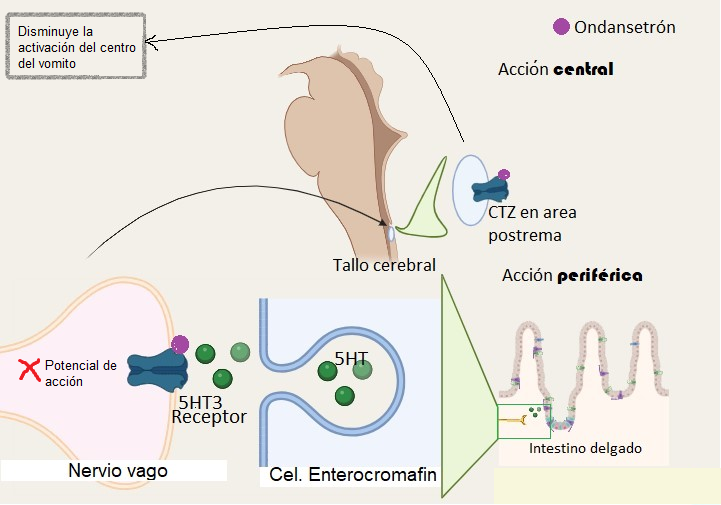
- On vagal afferents in the gut, it blocks 5-HT3 receptors. Serotonin released from enterochromaffin cells (by chemotherapy, radiation or surgery) can no longer trigger the vomiting reflex.
- In the chemoreceptor trigger zone (area postrema), it blocks 5-HT3 receptors. The vomiting center gets less central activation.
- It has no dopamine blockade, so extrapyramidal reactions are rare. It is not prokinetic. Multiday use slows colonic transit (constipation).
Pharmacokinetics
| Route | Onset | Peak | Duration |
|---|---|---|---|
| IV | — | Plasma peak about 10 min (after a 5-min infusion) | Not measured; labeled CINV repeats at 4 and 8 hr; PONV single dose |
| IM | — | Plasma peak about 40 min; same total exposure as IV | Not measured; labeled as a single 4 mg PONV dose |
| PO / ODT | — | Plasma peak about 2 hr | Not measured; labeled schedules every 8–12 hr in adults, three times daily at 4–11 yr |
What the label measured is plasma peaks, not clinical onset or duration. Read the Duration column as the labeled repeat schedule.
- Half-life: 3–6 hr in adults (longer after age 75); 2.5–3 hr in most children; about 6.7 hr at 1–4 months.
- Metabolism: The liver hydroxylates it, then conjugates it. CYP3A4 does most of the work, with CYP1A2 and CYP2D6 also involved. The metabolites are not clinically active.
- Elimination: Metabolites leave in the urine. About 5% comes out unchanged.
- Bioavailability: About 56% orally, after first-pass metabolism. Food raises it slightly. Protein binding runs 70–76%.
Names & Classification
- Generic Name
- Ondansetron hydrochloride (injection, tablets, oral solution); ondansetron base (ODT)
- Brand Names
- Zofran, Zofran ODT; Zuplenz (oral soluble film, discontinued in the US); most US supply is generic
- Pharmacologic Class
- Selective serotonin 5-HT3 receptor antagonist
- Therapeutic Class
- Antiemetic
- Controlled Substance
- Not controlled
- ISMP High-Alert
- No
- Look-Alike / Sound-Alike
- None on the ISMP List of Confused Drug Names (updated through June 2024)
References
- Hospira, Inc. (2026). Ondansetron injection, for intravenous or intramuscular use [prescribing information]. DailyMed, National Library of Medicine. https://dailymed.nlm.nih.gov/dailymed/drugInfo.cfm?setid=6a11f61b-2318-4382-2b91-4366e4bb53fa
- Glenmark Pharmaceuticals Inc., USA. (2026). Ondansetron tablets and ondansetron orally disintegrating tablets [prescribing information]. DailyMed, National Library of Medicine. https://dailymed.nlm.nih.gov/dailymed/drugInfo.cfm?setid=eee5217a-eba8-463a-812d-bf3c66f0934f
- National Association of State EMS Officials. (2022). National Model EMS Clinical Guidelines, version 3.0 (Nausea-Vomiting guideline). https://nasemso.org/wp-content/uploads/National-Model-EMS-Clinical-Guidelines_2022.pdf
- National Highway Traffic Safety Administration. (2019). National EMS Scope of Practice Model (DOT HS 812 666; Section V and footnote 5). https://ldh.la.gov/assets/oph/ems/2025/EMSEducation/National_EMS_Scope_of_Practice_Model_2019.pdf
- Michigan EMS Scope of Practice quick reference. (2024, February). Michigan EMS Scope of Practice (Kellogg College copy; row "Ondansetron ODT (meltable)"). https://kellogg.edu/wp-content/uploads/2026/07/24228-Michigan-EMS-Scope-of-Practice-022024.pdf
- Cheng, A., Doré-Bergeron, M.-J., & Chauvin-Kimoff, L. (2018). Emergency department use of oral ondansetron for acute gastroenteritis-related vomiting in infants and children. Canadian Paediatric Society, Acute Care Committee. https://cps.ca/en/documents/position/oral-ondansetron
- Gan, T. J., Jin, Z., Ayad, S., Belani, K. G., Habib, A. S., Meyer, T. A., et al. (2026). Fifth consensus guidelines for the management of postoperative nausea and vomiting: executive summary. Anesthesia & Analgesia, 143(3), 497–513. https://doi.org/10.1213/ANE.0000000000007816
- Nelson-Piercy, C., Dean, C., Shehmar, M., Gadsby, R., O'Hara, M., Hodson, K., & Nana, M. (2024). The management of nausea and vomiting in pregnancy and hyperemesis gravidarum (Green-top Guideline No. 69). BJOG, 131(7), e1–e30. https://doi.org/10.1111/1471-0528.17739
- Freedman, S. B., Williamson-Urquhart, S., Plint, A. C., Dixon, A., Beer, D., Joubert, G., et al. (2025). Multidose ondansetron after emergency visits in children with gastroenteritis. New England Journal of Medicine, 393(3), 255–266. https://doi.org/10.1056/NEJMoa2503596
- Ruberto, A. J., Sivilotti, M. L. A., Forrester, S., Hall, A. K., Crawford, F. M., Day, A. G., et al. (2021). Intravenous haloperidol versus ondansetron for cannabis hyperemesis syndrome (HaVOC): A randomized, controlled trial. Annals of Emergency Medicine, 77(6), 613–619. https://doi.org/10.1016/j.annemergmed.2020.08.021
- Robblee, J., Minen, M. T., Friedman, B. W., et al. (2025). 2025 guideline update to acute treatment of migraine for adults in the emergency department: The American Headache Society evidence assessment of parenteral pharmacotherapies. Headache, 66(1), 53–76. https://doi.org/10.1111/head.70016
- Hesketh, P. J., Kris, M. G., Basch, E., et al. (2020). Antiemetics: ASCO guideline update. Journal of Clinical Oncology, 38(24), 2782–2797. https://doi.org/10.1200/JCO.20.01296
Medical Disclaimer
- For Educational Purposes Only: This content is intended for educational reference and should not be used for clinical decision-making.
- Not a Substitute for Professional Judgment: Always consult your local protocols, institutional guidelines, and supervising physicians.
- Verify Before Acting: Users are responsible for verifying information through authoritative sources before any clinical application.
AI Assistance Notice
AI was used to assist in organizing, paraphrasing, and formatting this information.