

Bedside Snapshot
- Indications
- Opioid overdose with respiratory depression, no IV or IO (naloxone)
- Severe hypoglycemia in diabetes, age 1 yr+, no safe swallow (glucagon)
- Seizure cluster, epilepsy age 12 yr+ (Nayzilam); prolonged seizure per protocol
- Acute pain in a child without IV (fentanyl, off-label)
- Contraindications / Abort
- Known hypersensitivity; glucagon also: pheochromocytoma, insulinoma
- Blocked or bleeding nostril: suction or change route
- Apnea or falling SpO₂: ventilate first
- No response at the drug interval: IV, IO or IM per protocol
- Critical Steps
- Concentrated drug; smallest volume that holds the dose
- MAD dead space: 0.15 mL (MAD100/110/130/140); 0.06 mL (MAD300)
- Labeled sprays: one device, one nostril, given whole
- Split MAD doses only: half per nostril; new device per repeat
- Confirm & Monitor
- Breathing, level of consciousness, seizure stop or glucose rise
- SpO₂ and waveform EtCO₂ after every sedating drug
- Repeat intervals: naloxone 2–3 min; glucagon 15 min; Nayzilam 10 min (max 2 doses)
- Watch for resedation after naloxone
Key Numbers
Intranasal dosing is for when IV or IO access is not available or not quick enough. Use the concentrated drug and the labeled device. Split a dose between nostrils only when it is delivered by MAD.
| Parameter | Value |
|---|---|
| Dead space (device) | 0.15 mL (MAD100, MAD110, MAD130, MAD140); 0.16 mL (MAD140OS); 0.06 mL (MAD300) |
| Volume split | Labeled sprays (Narcan, Baqsimi, Nayzilam): one device, one nostril, given whole. MAD-delivered injectable doses only: half per nostril. No per-nostril volume cap is given in the sources used; the local protocol sets it |
| Naloxone (Narcan OTC) | 4 mg, one spray in one nostril; new device every 2–3 min if no response; call 911 after the first dose |
| Glucagon (Baqsimi) | 3 mg, one nostril; diabetes, age 1 year and older; one more 3 mg device after 15 min if no response |
| Midazolam nasal spray (Nayzilam) | 5 mg (one spray) in one nostril; a second spray in the opposite nostril after 10 min only if breathing is adequate. Max 2 doses per episode. Age 12 years and older (labeled) |
| Fentanyl (off-label) | Children: 1.5 mcg/kg, max 75 mcg (1.5 mL at 50 mcg/mL) Adults: 1 mcg/kg, max 100 mcg first dose (2 mL at 50 mcg/mL) |
| Ketamine (off-label) | No established IN analgesic dose. See Medications & Settings |
| Particle size | 30–100 µm atomized mist (manufacturer typical value) |
Overview & Principles
Intranasal (IN) drugs go onto the nasal lining and into the circulation from there. A mucosal atomization device (MAD) turns the liquid into a fine mist, and that mist covers more of the lining than a drip does.
How It Works
- Absorption: the nasal mucosa takes the drug into the circulation. What it absorbs skips first-pass liver metabolism.
- Variable amount: some spray drains down the throat and gets swallowed. That makes the dose reaching the blood less predictable than a measured IV dose.
- Absorption limits: mucus, blood and vasoconstrictors can cut absorption of atomized off-label drugs. Suction the nostril or pick another route. The Baqsimi label found that a common cold with nasal congestion, with or without a decongestant, changed neither absorption nor glucose response.
- Concentration matters: the manufacturer says keep the volume low and the concentration high, and atomize the drug so it covers a broad surface.
Where It Fits
IN is a bridge route. Use IV or IO when they are quick and reliable. Once they are in, switch to them. For children with severe pain and no IV access, NAEMSP strongly recommends IN fentanyl over IV opioids. The NAEMSP pain guideline makes no intranasal ketamine recommendation. For seizure and hypoglycemia rescue, IN is one alternative to IM or IV dosing under local protocol.
Indications & Contraindications
Indications
- Opioid overdose with respiratory depression, when IV or IO access is not in place (naloxone)
- Severe hypoglycemia in a patient with diabetes who cannot safely swallow, when IV dextrose is not immediate (glucagon, age 1 year and older)
- Seizure cluster in epilepsy patients 12 years and older (Nayzilam, labeled); prolonged seizure without IV access, per protocol (midazolam injection, off-label route)
- Acute pain in a child without IV access, per protocol (fentanyl, off-label; NAEMSP strong recommendation)
Absolute Contraindications
- Known hypersensitivity to the drug or a product component
- Glucagon (Baqsimi): pheochromocytoma (risk of a substantial rise in blood pressure) and insulinoma (risk of hypoglycemia)
- A blocked or bleeding nostril that cannot be cleared, when another route is available
Relative Contraindications & Cautions
- Mucus, blood or vasoconstrictor in the nostril with atomized off-label drugs: reduced absorption; suction or choose another route
- Opioid or benzodiazepine given together: profound sedation, respiratory depression, coma and death (boxed warnings for midazolam); additive respiratory depression
- Opioid dependence: naloxone can bring on withdrawal
- Glucagon with depleted liver glycogen (prolonged fasting, alcohol, adrenal insufficiency): less effective; IV dextrose per protocol
Consider an Alternative
- IV or IO access when it is quick: titration gets easier and onset gets more predictable (IV Insertion, IO Access)
- Glucose: IV or IO dextrose when it can be given at once, per protocol. Baqsimi carries a label for diabetes only. Other patients need dextrose per protocol
Scope & Team Roles
| Provider Level | Typical Role | Notes |
|---|---|---|
| EMT | Performs (protocol/credentialing required) | Naloxone nasal device in many systems; other IN drugs vary by state protocol |
| AEMT | Performs (protocol/credentialing required) | Drug list set by state and agency protocol |
| Paramedic | Performs (protocol/credentialing required) | Midazolam, fentanyl IN where protocol allows; IN ketamine protocol and medical direction only |
| RN (ED/ICU) | Performs (protocol/credentialing required) | Only by order and facility policy |
| Critical Care Transport (CFRN / CTRN / FP-C / CCP-C) | Performs (protocol/credentialing required) | Same rules as paramedic; more drug options by protocol |
| Physician / APP | Performs | Sets the order and dose |
Team Roles During the Procedure
- Operator: draws up, attaches the device and delivers the dose
- Drug verifier: reads drug, mg or mcg, mL and concentration aloud
- Monitor: breathing rate, SpO₂, waveform EtCO₂ and level of consciousness
- Recorder: time of dose, device count, nostril used and response
Pre-Procedure Assessment
Patient Check
- Nasal airway: look for blockage, drainage, bleeding and recent nasal surgery or trauma before choosing the nostril
- Mental status and breathing: baseline level of consciousness, respiratory rate and SpO₂ before any sedating drug
- Weight: pediatric, fentanyl and ketamine doses are weight-based. Use a current weight or a length-based estimate
- Opioid or sedative exposure: recent drugs, dependence and co-ingestants all change the dose and the monitoring
Physiologic Risk
Sedating drugs, opioids and benzodiazepines can all depress breathing. Get ventilation support ready before the dose. Keep naloxone on hand for opioid-related depression.
Anatomy & Landmarks
Nasal Target
Seat the tip snugly against the nostril. Aim it slightly up and outward, toward the top of the ear. That angle covers the turbinates and olfactory mucosa (manufacturer technique). A split MAD dose uses both nostrils. A labeled spray goes in whole, in one nostril.
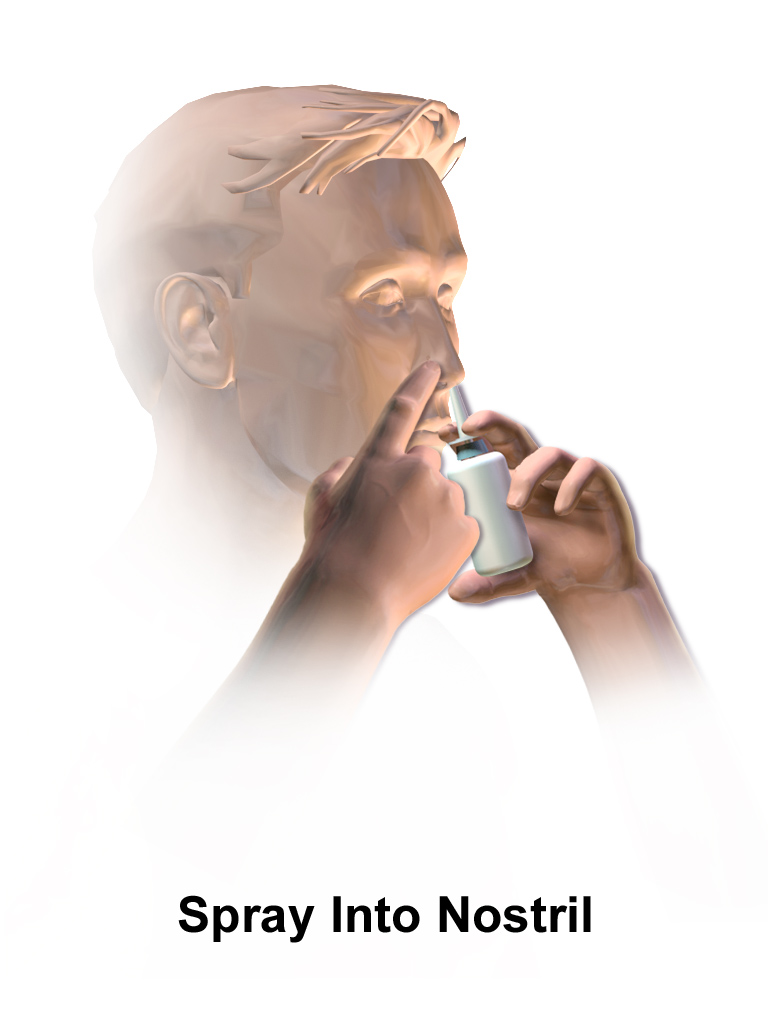
Nasal Obstruction and Drainage
- Mucus or blood: suction the nostril first (manufacturer)
- Drug running out of the nostril or down the throat: treat the dose as uncertain. Repeat only per protocol, with a new device
Equipment & Preparation
Equipment
| Item | Spec | Notes |
|---|---|---|
| MAD100 | Device with 3 mL syringe | Dead space 0.15 mL |
| MAD110 | Device with 1 mL syringe | Dead space 0.15 mL |
| MAD130 / MAD140 | Device with vial adapter and 1 mL or 3 mL syringe | Dead space 0.15 mL; draw from the vial |
| MAD300 | Device without syringe | Dead space 0.06 mL |
| Concentrated drug | Use the strongest labeled form | Keeps volume low (for example, midazolam 5 mg/mL; fentanyl 50 mcg/mL) |
| Suction | Oral or nasal suction | Clear mucus or blood before dosing |
| Naloxone, glucagon or midazolam nasal device | Labeled single-dose product | Check expiry; do not reuse |
Patient Positioning & Preparation
Hold the head and neck steady, with the free hand on the occiput. That lets the tip seat against the nostril.
Pre-Procedure Checklist
- A second clinician checks the drug, the dose in mg or mcg and the volume in mL, aloud
- Confirm the concentration on the vial or label
- The volume includes dead space for the device you are using
- Device model, syringe size and vial adapter all match
- Suction is ready for mucus or blood
- Monitoring is running: SpO₂, waveform EtCO₂, timer
- Ventilation and reversal are ready: bag-valve mask, naloxone for opioid sedation
- A second device or the next dose is ready per protocol
Medications & Settings
Treat these doses as typical references. Check them against local protocol and the current drug labeling. Doses vary by protocol; follow local protocols and medical direction.
| Indication / Drug | Adult | Pediatric | Route / Device | Max / Repeat |
|---|---|---|---|---|
| Opioid overdose Naloxone |
4 mg (Narcan OTC device) |
Per protocol; see naloxone page |
IN spray, one nostril |
New device every 2–3 min if no response; call 911 after the first dose (label) |
| Severe hypoglycemia Glucagon (Baqsimi) |
3 mg, one nostril |
3 mg, age 1 year and older Not established under 1 year |
IN device, one nostril. Contraindicated: pheochromocytoma, insulinoma |
One more 3 mg device after 15 min if no response |
| Seizure cluster (labeled) High-alert Midazolam nasal spray (Nayzilam) |
5 mg (one spray), one nostril |
Not established under 12 years |
Nasal spray. Boxed warning: opioid co-use (profound sedation, respiratory depression, coma, death); abuse; dependence |
Second 5 mg spray, opposite nostril, after 10 min, only if breathing is adequate. Max 2 doses per episode; no more than 1 episode every 3 days or 5 per month |
| Prolonged seizure, no IV (off-label) High-alert Midazolam injection 5 mg/mL |
Per protocol; no verified IN dose on this page |
Per protocol; no verified IN dose on this page. One prehospital cohort used 0.1 mg/kg IN and found more redosing; that was the cohort's dose, not a recommendation |
IN atomizer, concentrated 5 mg/mL form. Some vials contain benzyl alcohol (check the label) |
Redose per protocol. Boxed warning applies with any opioid |
| Acute pain (off-label) High-alert Fentanyl 50 mcg/mL |
1 mcg/kg, max 100 mcg first dose (per fentanyl page; protocol) |
1.5 mcg/kg, max 75 mcg (per fentanyl page; 1.5 mL at 50 mcg/mL). Most pediatric trials used 1.5 mcg/kg, ages 1–16 years |
IN atomizer; state mcg and mL |
Repeat per protocol after 5–10 min. Rare chest-wall rigidity: naloxone and ventilation ready |
| Sedation or analgesia (off-label; not established) Ketamine |
Per protocol; no established IN analgesic dose |
Not established for analgesia. One ED trial (Reference 3) used 1.5 mg/kg IN (1 mL) to reduce the pain of an IM ketamine injection; hypoventilation 7%, vomiting 16.7% vs 4.2% with placebo |
IN atomizer (off-label) |
Protocol and medical direction only. Dissociation, hypoventilation and vomiting are possible; monitor SpO₂ and EtCO₂ continuously |
Step-by-Step Procedure
Phase 1: Prepare
- Confirm drug, dose and route: state the drug, mg or mcg, and mL aloud; check the label and concentration.
- Choose the concentrated form: use the smallest volume that holds the dose.
- Draw up the dose plus dead space: add 0.15 mL for MAD100, MAD110, MAD130 or MAD140 (0.06 mL for MAD300).
- Attach the device: connect the MAD to the syringe by luer lock; remove the vial adapter cap if used.
Phase 2: Perform
- Stabilize the head: hold the occiput with the free hand.
- Seat the tip: place it snugly in one nostril, aimed slightly up and outward.
- Deliver half (MAD-delivered doses only): briskly compress the plunger to deliver half the dose.
- Deliver the rest: move the device to the opposite nostril and give the remainder if the dose is split. A labeled spray is never split: one device, one nostril.
Phase 3: Confirm & Secure
- Start the timer: note the time and the device count.
- Reassess: breathing rate, SpO₂, waveform EtCO₂ and level of consciousness (see Confirmation & Monitoring).
- Repeat only by protocol: use a new device and the interval set by the drug (naloxone 2–3 min; glucagon 15 min; Nayzilam 10 min, max 2 doses per episode).
Alternative Technique: Suction and Route Change
Mucus or blood blocking the nostril? Suction it, then dose the other nostril, or switch to IV, IO or IM under protocol.
Confirmation & Monitoring
Primary Confirmation
The clinical effect is the test. Breathing returns after naloxone. Seizure activity stops after midazolam. Glucose rises after glucagon. For analgesics, look for calmer, arousable behavior with stable breathing.
Secondary Confirmation
- Pulse oximetry and waveform capnography for any sedating drug
- Point-of-care glucose for glucagon
- Level of consciousness (AVPU or GCS) at each reassessment
| Finding | Success | Failure / Next Step |
|---|---|---|
| Breathing (opioid) | Rate and depth recover | Still shallow or apneic: ventilate and repeat per protocol |
| Seizure | Activity stops | Continues: second dose or second-line drug per protocol |
| Glucose (glucagon) | Rising; patient can swallow | No response at 15 min: second device, then IV dextrose |
| Sedation | Calm, arousable, SpO₂ stable | Deepening sedation, falling SpO₂ or rate: support and reverse per protocol |
Ongoing Monitoring
- SpO₂ and waveform EtCO₂ continuously after any sedating drug, until awake
- Respiratory rate and depth at each reassessment
- Watch for resedation after naloxone. Watch for prolonged sedation after midazolam
Troubleshooting
| Problem | Likely Cause | Fix |
|---|---|---|
| Drug runs down the throat | Drip instead of atomized mist | Atomize, aim up and outward; use both nostrils |
| Dose too big for one nostril | Low concentration or large volume | Use the concentrated form. Split half per nostril only for MAD doses; the protocol sets any volume limit |
| Labeled spray split across nostrils | Treating a single-dose device as a split dose | Give the whole device in one nostril; use a new device for the repeat |
| Less drug than expected | Dead space left in the syringe and device | Draw up dose plus 0.15 mL (MAD100/110/130/140) |
| Poor absorption | Mucus, blood or vasoconstrictor in the nostril | Suction; use another route per protocol |
| Device will not dispense | Wrong syringe or adapter for the device model | Check model number; use the matched syringe |
| No response | Dose lost or too small for the patient | Repeat with new device at drug interval; move to IV, IO or IM per protocol |
| Sedation deepens | Drug accumulation or added sedatives | Stop further doses; ventilate; reverse per protocol |
If It Still Fails
- Ventilate: the next dose waits until you have supported breathing with a bag-valve mask.
- Switch route: IV, IO or IM, as protocol and medical direction allow.
- Escalate: medical direction or the receiving team gets a call. Every device you used goes in the record.
Complications
| Complication | Recognition | Prevention | Management |
|---|---|---|---|
| Respiratory depression | Falling rate, SpO₂ drop, rising EtCO₂ or flat waveform | Right dose by weight; monitor after every sedating drug | Ventilate; naloxone for opioid toxicity; per protocol |
| Vomiting | Retching or emesis after dose | Antiemetic per protocol; avoid overdosing | Position, suction, airway protection |
| Hypoventilation (ketamine) | Shallow breathing after IN ketamine | Monitor SpO₂ and EtCO₂ continuously | Airway maneuvers and oxygen; ventilate if needed |
| Chest-wall rigidity (opioid) | Stiff chest and difficult bag ventilation after an opioid | Right dose by weight; ventilation ready | Ventilate; naloxone for opioid toxicity; per protocol |
| Nasal burning or itch | Patient reports burning or sneezing | Atomize, do not drip; use the lowest effective volume | Reassure; continue monitoring; no treatment usually needed |
| Resedation or withdrawal | Sleepiness returns; agitation after naloxone | Watch per protocol and reassess after each dose | Repeat naloxone per protocol; monitor |
Special Populations
Pediatrics
- Glucagon (Baqsimi): 3 mg labeled for diabetes, age 1 year and older; not established under 1 year
- Midazolam nasal spray (Nayzilam): labeled for epilepsy patients age 12 years and older; not established under 12 years
- Fentanyl: 1.5 mcg/kg, max 75 mcg (per fentanyl page); most trials used 1.5 mcg/kg in children aged 1–16 years (Serra 2023 review)
- Ketamine: not an established analgesic. One ED trial used 1.5 mg/kg IN to reduce IM-injection pain; vomiting 16.7% vs 4.2% with placebo; hypoventilation in 7%
- Midazolam injection: no verified IN dose here. The 0.1 mg/kg cohort dose was linked to more redosing. Set the protocol dose with medical direction
Dose by weight, and get a second check. See Weight-Based Dosing, Pediatric Vascular Access and Pediatric Airway.
Older Adults
- In older adults, sedating drugs cause more respiratory depression. Use the protocol dose and reassess more often
Pregnancy, Lactation and Head Trauma
This page does not review pregnancy or lactation. Check each drug's label for both. For facial or skull-base trauma, no source was verified. Follow local protocol and medical direction.
Opioid-Dependent Patients
- Naloxone can bring on withdrawal. Titrate to breathing, not to full alertness
- Expect sedation to come back if the naloxone wears off first
Post-Procedure Care & Transport
Immediate Aftercare
- Keep SpO₂ and waveform EtCO₂ on until the patient is awake and breathing well
- Keep the patient on their side if vomiting is likely
Ongoing Maintenance
- Reassess every 5–10 minutes or per protocol
- Keep sharps and used devices in a sharps container; do not reuse any device
Transport Considerations
- Expect resedation in transit after naloxone. Keep ventilation support ready
- Monitor SpO₂ and EtCO₂ through noise and motion. Confirm the monitor alarms are on
Document & Hand Off
- Write down the drug, the dose in mg or mcg and mL, the route and the nostril used
- Record the device count and the time of each dose
- Note the dead space and any dose known to be lost
- Chart the response, breathing, SpO₂, EtCO₂ and level of consciousness
- State the protocol and the medical direction you followed
Clinical Pearls & Pitfalls
Pearls
- Atomize, don't drip: a mist covers the turbinates. A drip runs down the throat.
- Split only MAD doses: a split MAD dose uses both nostrils. A labeled spray goes in whole, in one nostril.
- Concentrate it: the smallest volume that holds the dose gives the best absorption.
- Count the dead space: it is 0.15 mL for MAD100, MAD110, MAD130 and MAD140.
Common Pitfalls
- Forgetting dead space: the fix is to draw up the dose plus device dead space.
- Reusing a device: use a new device for every dose. Glucagon devices are single-dose.
- Units by habit: say mcg and mL for fentanyl, and mg and mL for midazolam.
- Assuming a set onset: reassess at the interval the drug and the protocol set.
Education & Skill Maintenance
Skill Maintenance
- Drill device assembly and dead-space math on a trainer every quarter
- Rehearse the double-check out loud: drug, mg or mcg, mL and concentration
- Run simulated cases that include a sedation check and ventilation support
- Debrief every drill on volume, nostrils used, device count and timing
Patient & Family Teaching
- Show caregivers how to give the naloxone and glucagon nasal products. Tell them to call 911 after the first dose
- Tell caregivers a used device is single-dose. It must not be reused
- Tell them a second device may be needed at the labeled interval
References
- Lindbeck G, Shah MI, Braithwaite S, Powell JR, Panchal AR, Browne LR, et al. Evidence-Based Guidelines for Prehospital Pain Management: Recommendations. Prehosp Emerg Care. 2023;27(2):144–153. https://doi.org/10.1080/10903127.2021.2018073
- Serra S, Spampinato MD, Riccardi A, Guarino M, Pavasini R, Fabbri A, et al. Intranasal Fentanyl for Acute Pain Management in Children, Adults and Elderly Patients in the Prehospital Emergency Service and in the Emergency Department: A Systematic Review. J Clin Med. 2023;12:2609. https://doi.org/10.3390/jcm12072609
- Mirfazaelian H, Darafshi AS, Sedaghat M, Akbari H. The Effectiveness of Intranasal Ketamine on Intramuscular Ketamine Injection Pain Among Children in the Emergency Department, a Randomized, Controlled Trial. Pediatr Emerg Care. 2025;41(12):e233–e236. https://doi.org/10.1097/PEC.0000000000003485
- Whitfield D, Bosson N, Kaji AH, Gausche-Hill M. The Effectiveness of Intranasal Midazolam for the Treatment of Prehospital Pediatric Seizures: A Non-inferiority Study. Prehosp Emerg Care. 2022;26(3):339–347. https://doi.org/10.1080/10903127.2021.1897197
- Teleflex Incorporated. MAD Nasal Intranasal Mucosal Atomization Device: User Guide (MC-001925 Rev 1). Undated; no printed date. https://www.teleflex.com/usa/en/product-areas/anesthesia/atomization/mad-nasal-device/AN_ATM_Anesthesia-MAD-Nasal-User-Guide_MC_MC-001925_Rev1.pdf
- NARCAN (naloxone hydrochloride) nasal spray 4 mg, OTC Drug Facts. DailyMed, U.S. National Library of Medicine; label updated August 17, 2026. https://dailymed.nlm.nih.gov/dailymed/drugInfo.cfm?setid=a0ebc83d-2892-40de-bc0a-775ce90b30db
- BAQSIMI (glucagon) nasal powder, prescribing information. DailyMed, U.S. National Library of Medicine; label updated August 2025. https://dailymed.nlm.nih.gov/dailymed/drugInfo.cfm?setid=f1f5df9b-872f-44e5-a18f-f0b68e7e9254
- NAYZILAM (midazolam) nasal spray CIV, prescribing information. UCB, Inc. DailyMed, U.S. National Library of Medicine; label updated January 2023. https://dailymed.nlm.nih.gov/dailymed/drugInfo.cfm?setid=2b29422e-54d5-4a49-8522-e9cf752368c3
Medical Disclaimer
- For Educational Purposes Only: This content is intended for educational reference and should not be used for clinical decision-making.
- Not a Substitute for Professional Judgment: Always consult your local protocols, institutional guidelines, and supervising physicians.
- Verify Before Acting: Users are responsible for verifying information through authoritative sources before any clinical application.