

Bedside Snapshot
- Use It For
- Suspected opioid overdose with respiratory depression or arrest; iatrogenic opioid oversedation; recurrent toxicity from long-acting opioids (infusion); diagnostic trial in unexplained coma
- Adult Dose
- Overdose: 0.2–2 mg IV/IO/IM or 2–4 mg IN, every 2–3 min, titrated to breathing
- Iatrogenic: 0.1–0.2 mg IV every 2–3 min
- Infusion: two-thirds of the waking dose per hour IV
- Pediatric Dose
- 0.1 mg/kg IV/IO (max 2 mg/dose); IM/IN/ETT same mg/kg, IN max 4 mg (NASEMSO), every 2–3 min; label regimen: 0.01 mg/kg IV, then 0.1 mg/kg. Newborns: ventilate; naloxone is not routine
- Onset / Duration
- IV: within 2 min; IM/subcut: slightly slower but longer-lasting; IN: several minutes, may need repeat doses. Often shorter-acting than the opioid: redosing may be needed within 1–2 hr
- Do Not Give / Hold If
- Known hypersensitivity (none absolute in life-threatening toxicity). Stop titrating once breathing is adequate for age (rate, depth, SpO₂, EtCO₂) with protective airway reflexes back
- Watch For
- Precipitated withdrawal (vomiting, agitation, tachycardia); pulmonary edema (hypoxia, crackles); VT/VF in heart disease; re-sedation as naloxone wears off (falling RR, rising EtCO₂)
- Reversal / Rescue
- Poor response: ventilate, repeat doses, reconsider the cause (benzodiazepines, xylazine, medetomidine, hypoglycemia). Recurrence: repeat bolus or infusion. Withdrawal: stop dosing, protect airway
- Must Remember
- Ventilate first, then titrate naloxone to breathing, not alertness: breaths prevent hypoxic arrest; full arousal in a dependent patient brings vomiting, agitation and refusal
Indications
Emergency & Prehospital
- Suspected opioid overdose with respiratory depression or arrest (definite pulse): breaths or bag-mask ventilation (AHA 2025, Class 1). Naloxone for respiratory arrest with a definite pulse (AHA 2025, Class 1, trained rescuers) goes alongside ventilation. Never instead of it.
- Cardiac arrest with suspected opioid overdose: may be reasonable, but only if it does not interrupt high-quality CPR (AHA 2025, Class 2b).
- Lay-rescuer and first-responder overdose response: over-the-counter nasal sprays, prefilled devices and EMS leave-behind kits
ED / ICU / Transport
- Iatrogenic opioid oversedation: postoperative, procedural or infusion-related respiratory depression (partial reversal)
- Recurrent toxicity from long-acting opioids: methadone, extended-release products and buprenorphine. Repeat boluses or give a continuous infusion.
- Potent synthetic opioids: fentanyl, fentanyl analogues and nitazenes respond to naloxone. Expect to need repeat doses, infusions and longer observation more often.
- Undifferentiated coma or respiratory depression: give a diagnostic trial when opioid toxicity is possible (FDA-labeled diagnostic use).
Other Uses
- Septic shock: the injection label lists it as an adjunct to raise blood pressure. No survival benefit has been shown, and adverse effects occur. Not a routine therapy.
Dosing & Administration
Doses below follow AHA 2025 Table 4 and NASEMSO. The FDA label differs where noted. Agency protocols may still limit route or scope.
Available Forms
- Injection 0.4 mg/mL: 1 mL (0.4 mg) single-dose vial; 10 mL (4 mg) multiple-dose vial (contains parabens). IV, IM or subcut.
- Injection 1 mg/mL: 2 mL (2 mg) single-dose prefilled syringe. EMS/transport: commonly carried for IV, IO or IM use, and for IN use with an atomizer where protocols allow (off-label).
- Nasal spray, OTC: 4 mg (Narcan) or 3 mg (RiVive) in a 0.1 mL single-dose device; sold without a prescription.
- Nasal spray 8 mg (Kloxxado): prescription, single-dose device, 2 per carton.
- Prefilled syringe 5 mg/0.5 mL (Zimhi): prescription, IM or subcut into the outer thigh; intended to be given by people aged 12 years or older.
AHA 2025 opioid-associated emergency: ventilation first
- Check and call: unresponsive, not breathing normally (slow, shallow or gurgling breathing, small pupils, blue or grey skin): activate EMS and get naloxone and an AED.
- No definite pulse (or lay rescuer): start CPR with breaths. Naloxone only if it does not interrupt CPR.
- Definite pulse, inadequate breathing: open the airway and ventilate with visible chest rise (adult: 1 breath every 6 sec, 10/min; infant or child: 1 breath every 2–3 sec, 20–30/min) and give naloxone without delaying or pausing ventilation.
- Titrate: repeat every 2–3 min until breathing is adequate and airway reflexes return. Keep ventilating while you wait.
- After response: observe in a health care setting, and give a naloxone kit and teaching at discharge.
Adult Dosing
| Indication | Dose & Route | Repeat / Max | Notes |
|---|---|---|---|
| Opioid overdose with respiratory depression or arrest (pulse present) | 0.2–2 mg IV/IO/IM, or 2–4 mg IN | Every 2–3 min, titrated to breathing; no fixed max. No response after 10 mg: question the diagnosis (label) | Ventilate first. Titrate to adequate breathing and restored airway reflexes, not to alertness. Start at the low end when opioid dependence is likely. Differs from FDA label: the label's initial IV dose is 0.4–2 mg. Fixed adult doses (not weight-based). |
| Cardiac arrest, suspected opioid overdose | Same doses as above | Only if it does not interrupt CPR; no fixed max | AHA 2025 Class 2b. CPR, defibrillation and epinephrine come first; naloxone does not reverse VF. |
| Iatrogenic (postoperative or procedural) opioid depression | 0.1–0.2 mg IV | Every 2–3 min to adequate ventilation and alertness without significant pain; titrate to effect: no fixed max | Larger doses reverse analgesia and raise BP. Supplemental IM doses last longer; repeat doses may be needed within 1–2 hr (label). |
| Monitored low-dose titration: opioid-dependent or over-sedated patient not in immediate danger of apnea | 0.1–0.2 mg IV | Every 2–3 min, titrated to adequate breathing (not alertness); no fixed max. If breathing does not improve or the patient is in respiratory arrest, give the full overdose dose | Lower starts (0.15 mg or less) caused less withdrawal but less often reversed toxicity than doses above 0.15 mg in one retrospective cohort. Same increments as the label postoperative regimen. |
| Lay-rescuer or first-responder devices | 4 mg IN (Narcan), 3 mg IN (RiVive), 8 mg IN (Kloxxado) or 5 mg IM/subcut (Zimhi) | One device per dose; new device every 2–3 min if no response or relapse (IN: use the other nostril for each repeat where the label directs: Narcan Rx, Kloxxado); no fixed max | Call 911 after the first dose and stay until EMS arrives. Labels warn that comparing products mg-for-mg is misleading. |
| Recurrent respiratory depression: continuous infusion | Two-thirds of the waking dose per hour IV (e.g., 2 mg bolus worked: about 1.33 mg/hr) | Titrate to respiratory effort; no fixed max | For long-acting opioids, buprenorphine or nitazenes. Waking dose = the bolus that restored breathing. At the label dilution (0.004 mg/mL), about 1.33 mg/hr runs at 333 mL/hr: see Preparation & Administration. Consult poison control (1-800-222-1222) or toxicology. |
Pediatric Dosing
| Indication | Dose (per kg) & Route | Max Single / Max Total | Notes |
|---|---|---|---|
| Opioid overdose with respiratory depression or arrest | 0.1 mg/kg IV/IO; IM, IN or ETT at the same mg/kg (NASEMSO) | Max 2 mg/dose IV/IO/IM/ETT (AHA: not above the adult dose); IN max 4 mg (NASEMSO); repeat every 2–3 min; no fixed total | AHA 2025 dose; IV/IO route unless stated. Ventilate first. IV/IO preferred. Differs from FDA label: label starts at 0.01 mg/kg IV, then 0.1 mg/kg. IM, IN and subcut are label or protocol routes: the injection label quotes an AAP statement that IM and subcut absorption may be erratic or delayed, while the Narcan (prescription label), Kloxxado and Zimhi devices are labeled for all pediatric ages. |
| FDA label pediatric overdose regimen | 0.01 mg/kg IV, then 0.1 mg/kg if the response is inadequate | Label gives no max; AHA: not above the adult dose (2 mg); titrate to breathing | The label's general regimen for known or suspected opioid overdose; IM or subcut in divided doses if no IV. Clinical rationale, not a labeled indication: the lower start may suit children on long-term opioids (e.g., palliative or ventilated) to limit withdrawal. |
| Iatrogenic (postoperative) depression | 0.005–0.01 mg IV increments (label; not per kg) | Every 2–3 min to the desired reversal; titrate to effect: no fixed max | Preserves analgesia; same cautions as adult postoperative use. |
| Community devices | Any FDA-approved device at its labeled dose, one device: Narcan 4 mg IN, Kloxxado 8 mg IN or Zimhi 5 mg IM/subcut (each labeled for all pediatric ages); RiVive 3 mg OTC carries no age statement | New device every 2–3 min if needed; no fixed max | Absorption in children after IN (Narcan, Kloxxado) or IM/subcut (Zimhi) dosing may be erratic or delayed; monitor at least 24 hr, as relapse can occur (labels). Neonates with known or suspected maternal opioid exposure: the labels advise a weight-dosed, titratable naloxone product instead of a fixed-dose device, to avoid abrupt withdrawal (neonatal withdrawal seizures can be life-threatening). Where infants are the main concern, the Narcan Rx and Kloxxado labels note other naloxone products may be better suited. Infant under 1 year: pinch the thigh muscle while injecting Zimhi. |
| Recurrent respiratory depression: infusion | Two-thirds of the waking dose per hour IV | Titrate to respiratory effort; no fixed max | State mg/hr and mL/hr: at 0.004 mg/mL, 0.67 mg/hr (1 mg waking dose) runs at 167 mL/hr, so use a pharmacy-verified concentrated standard. Exploratory ingestions of buprenorphine or methadone can cause prolonged toxicity; admit and consult poison control. |
| Neonates (specialist use) | 0.01 mg/kg IV/IM/subcut (label) | Specialist or NICU use; repeat per postoperative guidance | Not routinely used (consult). Ventilation is the treatment for a depressed newborn. Avoid in newborns of opioid-dependent mothers: withdrawal can cause seizures. |
Weight-based calculations: pediatric weight-based dosing and Broselow tape.
Preparation & Administration
- IV/IO push: give undiluted and flush. For small titrated doses, dilute with NS or sterile water per institutional practice and label the syringe with the final mg/mL.
- Infusion: the label dilution is 2 mg in 500 mL NS or D5W (0.004 mg/mL); use within 24 hr. It suits low-rate titration only: at 0.004 mg/mL, about 1.33 mg/hr runs at 333 mL/hr (about 8 L/day). At two-thirds-of-waking-dose rates, use the institution's more concentrated standard as verified by pharmacy, especially for children, older adults and patients with heart failure or pulmonary edema. Order and hand off in both mg/hr and mL/hr; run on a pump and titrate to breathing.
- IM: anterolateral thigh or deltoid; prefilled devices can go through clothing. IM effect lasts longer than IV.
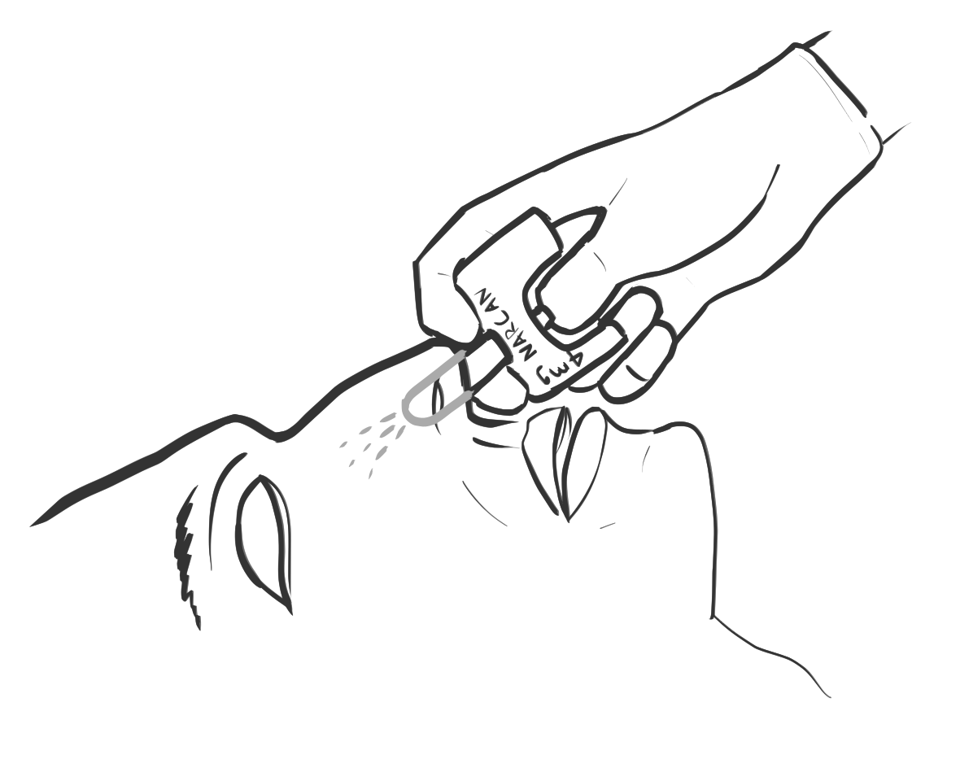
- IN device: do not prime or test. Lay the patient supine, support the neck and tilt the head back, insert the nozzle into one nostril and press the plunger firmly (Figure 1). Give each repeat dose with a new device in the other nostril (the Narcan Rx and Kloxxado labels direct alternating nostrils; the OTC Drug Facts say either nostril), and place the patient in the recovery position.
- IN atomizer (injection solution): agency-specific and off-label; max 1 mL per naris.
- Light: protect vials, syringes and Zimhi from light.
Contraindications & Precautions
Contraindications
- Known hypersensitivity to naloxone or any component: the only labeled contraindication
- There is no absolute contraindication in life-threatening opioid toxicity.
Precautions
- Opioid dependence (opioid use disorder, methadone or buprenorphine treatment, chronic pain, palliative care): abrupt, complete reversal precipitates acute withdrawal. Give the smallest dose that restores breathing.
- Cardiovascular disease or cardiotoxic co-ingestants: Abrupt reversal has caused hypertension, VT/VF, pulmonary edema and cardiac arrest. It happened mostly in patients with heart disease or on drugs with similar effects.
- Buprenorphine and other partial agonists: reversal may be slow and incomplete. Larger or repeated doses may be needed. Ventilation may be required.
- Non-opioid sedatives: Naloxone does nothing for benzodiazepines, alcohol, xylazine or medetomidine.
- Pregnancy with opioid dependence: Naloxone may precipitate maternal and fetal withdrawal. Never withhold it for a life-threatening overdose. In labor, severe hypertension may occur in patients with mild to moderate hypertension.
Hold / Reassess If
- Breathing adequate for age (rate, depth, SpO₂, EtCO₂) with protective airway reflexes back: stop further doses; do not dose for alertness
- Vomiting, agitation, tachycardia or hypertension (withdrawal): stop, protect the airway, reassess before any further dose. This may be opioid withdrawal. With fluctuating alertness and severe hypertension, it may be medetomidine withdrawal, which naloxone does not treat (Clinical Pearls).
- Adult with no response after 10 mg: question the diagnosis (non-opioid or mixed cause); keep ventilating and secure the airway. Further doses (e.g., for buprenorphine) only per medical direction or toxicology
- Breathing restored but sedation persists with bradycardia: suspect medetomidine or another alpha-2 agonist; supportive care, not more naloxone
Naloxone does not replace ventilation: Breaths now for a hypoxic patient with a pulse. IN and IM naloxone takes several minutes, and several doses, to work. It does nothing for co-ingested sedatives. No definite pulse means CPR.
Adverse Effects & Toxicity
Common
- Withdrawal symptoms (dose-related): nausea and vomiting, sweating, tremor, yawning, rhinorrhea, piloerection
- Agitation, irritability or anger on waking: expected. The OTC labels warn bystanders about it.
- Tachycardia and hypertension
- Body aches, abdominal cramps, diarrhea
- Return of pain in postoperative or chronic pain patients
- Injection site reactions (IM, subcut)
Serious / Life-Threatening
| Effect | Recognition | Management |
|---|---|---|
| Severe precipitated withdrawal | Within minutes of a dose: vomiting, agitation, combativeness, tachycardia, hypertension; usually subsides in about 2 hr, with severity and duration depending on the naloxone dose and degree of dependence (label) | Stop dosing; airway protection and suctioning, antiemetic, calm environment. Offer buprenorphine per protocol to patients with opioid use disorder |
| Pulmonary edema | Hypoxia and crackles soon after reversal; thought to follow a catecholamine surge (like neurogenic pulmonary edema) | Oxygen, CPAP or ventilation with PEEP; supportive care |
| Arrhythmia or cardiac arrest | VT/VF, severe hypertension, especially with heart disease or cardiotoxic co-ingestants | ACLS; avoid abrupt full reversal in high-risk patients |
| Seizures | Rare; reported after abrupt reversal and in neonatal withdrawal | Airway, benzodiazepine, check glucose |
| Recurrent opioid toxicity | Re-sedation, slowing breathing or rising EtCO₂ as naloxone wears off | Ventilate, repeat bolus, start an infusion; extend observation |
Overdose & Toxicity Management
- Naloxone itself has a wide margin: volunteers given 24 mg/70 kg showed no toxicity. Very high doses (2 mg/kg) caused irritability, anxiety and poor concentration lasting 2–3 days.
- Pediatric overdose: a 2½-year-old who received 20 mg recovered without sequelae (label).
- The real toxicity is withdrawal: major complications are rare and dose-related. That is the reason to titrate. Manage the symptoms and call poison control (1-800-222-1222).
Monitoring
| Parameter | When / How Often | Target / Act If |
|---|---|---|
| Clinical: breathing and SpO₂ | Continuously; reassess 2–3 min after each dose | Rate or depth inadequate for age, or SpO₂ falling: ventilate and redose |
| Clinical: waveform EtCO₂ | Continuously during treatment and transport | EtCO₂ >50 mmHg or rising, or flat waveform: ventilate, redose, consider an airway |
| Clinical: airway reflexes and mental status | After each dose | Goal is a protected airway, not full arousal; vomiting or agitation: stop dosing, suction, recovery position |
| Clinical: HR, BP and ECG | Continuously after large doses or with heart disease | VT/VF: ACLS. Bradycardia with persistent sedation: suspect medetomidine or another alpha-2 agonist |
| Clinical: lung exam | After reversal | New crackles or hypoxia: treat as pulmonary edema |
| Laboratory: glucose | Every patient with depressed consciousness | Glucose low: dextrose; do not attribute coma to opioids alone |
| Laboratory: blood gas | Persistent hypoventilation or after prolonged apnea | PaCO₂ high despite naloxone: ventilate; look for co-ingestants |
| Laboratory: co-ingestants | Intentional ingestion or combination products | Acetaminophen level for hydrocodone- or oxycodone-acetaminophen products; consider a toxicology panel |
| Observation after reversal | Until low risk of recurrence, normal mental status and normal vital signs, per AHA 2025 | Short observation may suffice after fentanyl, heroin or morphine; longer after methadone, extended-release products, buprenorphine or nitazenes. Children: label advises at least 24 hr. Recurrence is common: in one randomized trial, 72% of patients given titrated IV naloxone 100 mcg and placebo had recurrent respiratory depression within 4 hr; adding IM naloxone 1,600 mcg reduced this to 41%. |
| Infusion safety | At each titration and every handoff | Confirm concentration and mg/hr; reassess RR, EtCO₂, sedation and withdrawal |
Interactions & Compatibility
Clinically Significant Interactions
| Drug / Class | Effect | What To Do |
|---|---|---|
| Buprenorphine (partial agonist) | Slow dissociation from the receptor: reversal is gradual and may be incomplete | Ventilate; give larger or repeated doses or an infusion; expect a slower response |
| Methadone, extended-release opioids, nitazenes | Opioid outlasts naloxone; toxicity recurs | Repeat boluses or infusion; prolonged observation |
| Benzodiazepines, alcohol, other sedatives | Additive respiratory depression that naloxone does not reverse | Ventilate and support. Suspected combined opioid and benzodiazepine poisoning: give naloxone first, before other antidotes (AHA 2025, Class 2a, adults and children). Flumazenil only in selected low-risk cases (seizure risk) |
| Xylazine, medetomidine (alpha-2 agonist adulterants) | Sedation, bradycardia and hypotension persist after naloxone; no approved reversal agent | Give naloxone to restore breathing, not alertness; oxygen, airway and BP support; poison control. Medetomidine withdrawal (tachycardia, severe hypertension, fluctuating alertness, vomiting) can follow within hours and needs its own treatment (CDC) |
| Drugs with cardiovascular toxicity | Higher risk of arrhythmia, hypotension and pulmonary edema after abrupt reversal | Titrate small doses; continuous ECG |
IV Compatibility
- Diluents: Use NS or D5W for infusions. Sterile water for injection may be used to dilute small pediatric doses.
- Do not mix with solutions containing bisulfite or metabisulfite, long-chain or high-molecular-weight anions, or any alkaline solution.
- Stability: discard infusion mixtures after 24 hr.
- Verify with an institutional compatibility resource.
Special Populations
- Pediatrics: doses are weight-based, capped at the adult maximum (Pediatric Dosing table). Narcan (prescription label), Kloxxado and Zimhi are labeled for all pediatric ages. Absorption in children after IN (Narcan, Kloxxado) or IM/subcut (Zimhi) dosing may be erratic or delayed. For neonates with known or suspected maternal opioid exposure, the labels advise a weight-dosed, titratable naloxone product rather than a fixed-dose device. The reason: abrupt withdrawal, including seizures, can be life-threatening. Children who swallow buprenorphine or methadone can have prolonged toxicity. The injection label advises monitoring an opioid-intoxicated child for at least 24 hr.
- Neonates: ventilation treats respiratory depression in the newly born. The 2025 AHA neonatal guidelines contain no naloxone recommendation. Naloxone given to the mother shortly before delivery lasts only about the first 2 hr of neonatal life. The neonatal half-life is about 3.1 hr. In newborns of opioid-dependent mothers, withdrawal can cause seizures.
- Pregnancy: Retrospective cohort data have not shown a drug-associated risk of major birth defects or miscarriage. Naloxone crosses the placenta. In an opioid-dependent mother and fetus, it can precipitate withdrawal. Evaluate the fetus after use. Never withhold life-sustaining treatment of an overdose.
- Lactation: There are no data on milk transfer. Naloxone has minimal oral bioavailability. It is unlikely to affect a breastfed infant.
- Older Adults: no specific adjustment. Start at the low end because of more cardiac disease and co-medication. It is not listed in the 2023 AGS Beers Criteria.
- Renal Impairment: no specific adjustment is established. Use with caution (label).
- Hepatic Impairment: no specific adjustment is established. Use with caution (label). Naloxone is cleared by hepatic glucuronidation.
- Obesity / Dosing Weight: adult doses ignore weight. Pediatric doses use body weight, capped at the adult dose.
- Opioid use disorder: titrate to breathing to limit withdrawal. After reversal, offer a naloxone kit, teaching and a route to treatment, including buprenorphine where protocols allow.
Field & Transport Considerations
- Scope: EMR and above may give the intranasal unit-dose device and the opioid antagonist auto-injector. EMT may give IM naloxone only with medical direction that covers drawing up and diluting. AEMT and above add IV naloxone and IO access. Paramedics, nurses and critical-care transport add titration and infusions. Varies by state and agency protocol.
- Storage & Stability: injection 20–25 °C (68–77 °F), protect from light. Narcan nasal spray 2–25 °C (36–77 °F); avoid heat above 40 °C (104 °F); do not freeze. RiVive nasal spray 20–25 °C (68–77 °F); do not refrigerate; avoid heat above 40 °C (104 °F). Kloxxado freezes below −15 °C (5 °F) and will not spray. Do not wait for it to thaw. Get help and use another device. A thawed device still works after 15 min at room temperature. Keep Zimhi in its case.
- Carried Concentration: 0.4 mg/mL vials and 1 mg/mL syringes look alike. State every dose in mg and mL at the cross-check.
- Ventilation First: bag-mask with oxygen and an airway adjunct, before and while naloxone takes effect. Get waveform EtCO₂ as soon as possible.
- Leave-Behind Kits: Kits are not EMS stock. They go out only through an agency program approved by the medical director. AHA 2025 (Class 1) recommends naloxone and teaching at discharge from a health care setting. For EMS, NAEMSP 2026 calls on systems to support harm reduction, including opioid education and naloxone distribution. Typical recipients are at-risk patients, patients who are reversed and refuse transport, and family or friends likely to witness an overdose. A kit can also replace a dose a bystander used before EMS arrival. Use a leave-behind kit on the current patient only if it is a state-supplied (OEND-type) kit and no other EMS naloxone is available (Washington DOH 530-303). Show the patient and family how to use it. Give brief instructions, and document the kit and the encounter in the patient care report. Varies by state and agency protocol.
- Buprenorphine Bridge: NAEMSP recommends low-barrier buprenorphine programs for EMS systems, linked to community treatment. Give it only under a protocol. Typically, that means once objective withdrawal is present.
- Refusal After Reversal: naloxone can wear off before the opioid. AHA 2025 recommends observation in a health care setting. If a patient with capacity refuses transport, follow agency refusal protocol. Leave a kit and a sober companion, and document.
- Handoff Essentials: every dose (including bystander doses) with time, route and product, the response, ventilation needed, suspected substances, glucose, withdrawal signs and any infusion rate.
Clinical Pearls
Breathe for them first: An apneic patient with a pulse is minutes from hypoxic arrest. IN or IM naloxone may need several minutes and repeat doses to work. Ventilate with bag-mask first, naloxone second. No definite pulse means CPR.
Dose to breathing, not to waking: The AHA target is reversal of respiratory depression. That means rate and depth adequate for age, SpO₂ and EtCO₂, with protective airway reflexes back. Wake a dependent patient fully and you trade a breathing patient for a vomiting, combative one who refuses care.
Breathing back, still sedated: Think xylazine or medetomidine. Sedation that persists with bradycardia points to medetomidine (or xylazine). Decreased or fluctuating alertness, with tachycardia (>100/min) and severe hypertension, may be medetomidine withdrawal (CDC HAN 00527). It is not just naloxone-precipitated opioid withdrawal. More naloxone will not wake an alpha-2 agonist sedation. Dose naloxone for breathing, not alertness. Support the airway, oxygen and blood pressure.
- Medetomidine withdrawal is clonidine-like. Expect tremor, chest pain and intractable vomiting. It can start within hours of last use and peak 18–36 hr later. NSTEMI and posterior reversible encephalopathy syndrome (PRES) have been reported.
- Many patients have needed ICU care. Per CDC, management includes opioid withdrawal treatment, alpha-2 agonist therapy (clonidine, dexmedetomidine if needed), and agitation and blood pressure control. Consult toxicology or poison control (1-800-222-1222).
Higher-dose products: Kloxxado 8 mg IN and Zimhi 5 mg IM put more drug in one device. Labels note that all approved products reach effective levels. Comparing mg for mg misleads. Major complications of naloxone are dose-related. Ventilation, not a bigger first dose, buys time.
Naloxone vs nalmefene (FP-C, CCP-C):
- Nalmefene T½ about 9–11 hr vs about 1 hr for naloxone
- Opvee 2.7 mg IN and Zurnai 1.5 mg auto-injector are for age 12 and older. Repeat every 2–5 min with a new device (label).
- Toxicology societies: naloxone stays first-line. A longer-acting antagonist means longer precipitated withdrawal.
Nitazenes still respond: Naloxone reverses nitazene poisoning in case series (median parenteral dose 1.2 mg). Some patients still needed infusions for prolonged toxicity. Plan on repeat doses and longer observation.
Exam discriminator (NREMT, CCRN): For opioid-associated cardiac arrest, naloxone is Class 2b, and it must not get in the way of CPR. Naloxone does not reverse VF or restart the heart. Respiratory arrest with a pulse is different: naloxone is Class 1, given with ventilation.
Every reversal is a door to treatment: Survivors of an overdose face the highest risk of death in the days that follow. Leave a kit. Teach the family. Connect the patient to buprenorphine or other treatment.
Pharmacology
Mechanism of Action
- Competitive opioid receptor antagonist, with the greatest affinity for mu. It pushes opioids off the receptor, and respiratory drive and consciousness return.
- No agonist activity: without opioids, it has essentially no effect. It causes no tolerance or dependence.
- In opioid dependence: withdrawal starts within minutes and subsides in about 2 hr. Severity depends on dose and degree of dependence.
- Buprenorphine dissociates slowly from the receptor. Expect gradual, partial reversal.
Pharmacokinetics
| Route | Onset | Peak | Duration |
|---|---|---|---|
| IV / IO | Within 2 min | — | Dose-dependent; shorter than IM; redosing may be needed within 1–2 hr |
| IM / subcut | Slightly slower than IV | Plasma peak about 15 min (median, 2–5 mg IM) | Longer than IV |
| IN | Several minutes; clinical onset varies and repeat doses may be needed: ventilate while waiting | Product-specific median plasma peak: about 30 min for Narcan 4 mg (range 10–60 min); about 10–15 min in the Kloxxado studies (4–8 mg) | Plasma T½ about 2 hr (Narcan 4 mg) and about 1.3–2.7 hr (Kloxxado), versus about 1.2 hr after 2 mg IV in the Kloxxado study |
- Half-life: 30–81 min in adults (mean 64 min); about 3.1 hr in neonates.
- Metabolism: hepatic glucuronidation; naloxone-3-glucuronide is the main metabolite.
- Elimination: urine, 25–40% within 6 hr and 60–70% by 72 hr.
- Distribution: rapid; crosses the placenta; weak protein binding (mainly albumin).
Names & Classification
- Generic Name
- Naloxone hydrochloride
- Brand Names
- Narcan and RiVive (OTC nasal sprays), Kloxxado (8 mg nasal spray), Zimhi (5 mg prefilled syringe); multiple generic injections
- Pharmacologic Class
- Opioid antagonist (oxymorphone congener with no agonist activity)
- Therapeutic Class
- Antidote; opioid overdose reversal agent
- Controlled Substance
- Not controlled
- ISMP High-Alert
- No
- Look-Alike / Sound-Alike
- naloxone / Lanoxin (digoxin); naloxone / nalbuphine; Narcan / Norcuron (vecuronium) (ISMP)
References
- Hospira, Inc. (2023). Naloxone hydrochloride injection, USP: Prescribing information (revised 07/2023). DailyMed, U.S. National Library of Medicine. https://dailymed.nlm.nih.gov/dailymed/drugInfo.cfm?setid=8535cc84-ad4a-4d67-8480-fb5a2e3406f8
- U.S. National Library of Medicine. (2026). DailyMed labeling for community opioid antagonist products: NARCAN 4 mg nasal spray (OTC Drug Facts) https://dailymed.nlm.nih.gov/dailymed/drugInfo.cfm?setid=a0ebc83d-2892-40de-bc0a-775ce90b30db; NARCAN nasal spray (prescription labeling, NDA 208411) https://dailymed.nlm.nih.gov/dailymed/drugInfo.cfm?setid=724df050-5332-4d0a-9a5f-17bf08a547e1; RIVIVE 3 mg nasal spray (OTC Drug Facts) https://dailymed.nlm.nih.gov/dailymed/drugInfo.cfm?setid=1c4f1b9d-1c70-4666-a90e-2f5d2c670d4d; KLOXXADO 8 mg nasal spray (revised 09/2025) https://dailymed.nlm.nih.gov/dailymed/drugInfo.cfm?setid=ebf0f833-c1c0-487c-8f29-01fa8c61b6cb; ZIMHI 5 mg injection https://dailymed.nlm.nih.gov/dailymed/drugInfo.cfm?setid=523c0909-bff6-4010-988a-53de18b7cb3f; OPVEE nalmefene nasal spray https://dailymed.nlm.nih.gov/dailymed/drugInfo.cfm?setid=999a4269-9e54-4801-b2ac-2a7276f0b94f; ZURNAI nalmefene auto-injector https://dailymed.nlm.nih.gov/dailymed/drugInfo.cfm?setid=a59a5847-9fe4-4341-a203-be0a5e6d3e36
- Cao, D., Arens, A. M., Chow, S. L., Easter, S. R., Hoffman, R. S., Lagina, A. T., III, Lavonas, E. J., et al. (2025). Part 10: Adult and pediatric special circumstances of resuscitation: 2025 American Heart Association Guidelines for Cardiopulmonary Resuscitation and Emergency Cardiovascular Care. Circulation, 152(16 Suppl 2), S578–S672 (opioid overdose and benzodiazepine poisoning sections, Table 4). https://doi.org/10.1161/CIR.0000000000001380. With Kleinman, M. E., et al. (2025). Part 7: Adult basic life support. Circulation, 152(16 Suppl 2), S448–S478. https://doi.org/10.1161/CIR.0000000000001369; and Joyner, B. L., et al. (2025). Part 6: Pediatric basic life support: 2025 American Heart Association and American Academy of Pediatrics Guidelines for Cardiopulmonary Resuscitation and Emergency Cardiovascular Care. Circulation, 152(16 Suppl 2), S424–S447. https://doi.org/10.1161/CIR.0000000000001370
- National Association of State EMS Officials, Medical Directors Council. (2022). National Model EMS Clinical Guidelines, Version 3.0: Opioid Poisoning/Overdose, pp. 303–304 (rev. March 2022; Iowa HHS copy). https://hhs.iowa.gov/media/198/download
- Purssell R, Godwin J, Moe J, Buxton J, Crabtree A, Kestler A, DeWitt C, Scheuermeyer F, Erdelyi S, Balshaw R, Rowe A, Cochrane CK, Ng B, Jiang A, Risi A, Ho V, Brubacher JR. (2021). Comparison of rates of opioid withdrawal symptoms and reversal of opioid toxicity in patients treated with two naloxone dosing regimens: a retrospective cohort study. Clinical Toxicology, 59(1), 38–46. https://doi.org/10.1080/15563650.2020.1758325 Isoardi KZ, Harris K, Currey E, Buckley NA, Isbister GK. (2024). Effectiveness of intramuscular naloxone 1,600 mcg in addition to titrated intravenous naloxone 100 mcg for opioid poisoning: a randomized controlled trial. Clinical Toxicology, 62(10), 643–650. https://doi.org/10.1080/15563650.2024.2396447
- Stolbach, A. I., Mazer-Amirshahi, M., Nelson, L. S., & Cole, J. B. (2024). American College of Medical Toxicology and the American Academy of Clinical Toxicology position statement: Nalmefene should not replace naloxone as the primary opioid antidote at this time. Journal of Medical Toxicology, 20(1), 64–67. https://pmc.ncbi.nlm.nih.gov/articles/PMC10774510/
- Centers for Disease Control and Prevention. (2026). Medetomidine in the U.S. illegal fentanyl supply increasing risk for overdose and severe withdrawal syndrome (Health Alert Network advisory CDCHAN-00527, April 2, 2026). https://www.cdc.gov/han/php/notices/han00527.html Centers for Disease Control and Prevention. (2023). Xylazine: Clinical management and harm reduction strategies for patients (clinician fact sheet). https://www.cdc.gov/overdose-resources/pdf/CDC_Xylazine-Clinician-Fact-Sheet_508.pdf
- Glenn, M. J., Mercer, M. P., Murrell, A., Simpson, N., Knotts, M. C., Crowe, R., Weston, B. W., Cabañas, J. G., Cage, T. M., Hickerson, M., & Joiner, A. P. (2026). The role of emergency medical services in addressing opioid use disorder: A position statement and resource document of NAEMSP. Prehospital Emergency Care, 1–11 (published online May 20, 2026). https://doi.org/10.1080/10903127.2026.2668009
- Stangeland, M., Dale, O., & Skulberg, A. K. (2025). Nitazenes: Review of comparative pharmacology and antagonist action. Clinical Toxicology, 63(6), 393–406. https://pubmed.ncbi.nlm.nih.gov/40422647/
- Washington State Department of Health. (2024). Naloxone Leave-Behind Program Guidance for EMS (DOH 530-303, December 2024). https://www.doh.wa.gov/sites/default/files/2024-12/530-303-EMSNaloxoneLeaveBehindProgramGuidance.pdf
- National Highway Traffic Safety Administration. (2021). National EMS Scope of Practice Model 2019: Including Change Notices 1.0 and 2.0, Table IV (routes), Table V and footnotes 4–5. https://mn.gov/oems/assets/National_EMS_Scope_of_Practice_Model_2021_%20%28002%29_tcm1221-744908.pdf
- American Geriatrics Society. (2023). American Geriatrics Society 2023 updated AGS Beers Criteria® for potentially inappropriate medication use in older adults. Journal of the American Geriatrics Society, 71(7), 2052–2081. https://doi.org/10.1111/jgs.18372
Medical Disclaimer
- For Educational Purposes Only: This content is intended for educational reference and should not be used for clinical decision-making.
- Not a Substitute for Professional Judgment: Always consult your local protocols, institutional guidelines, and supervising physicians.
- Verify Before Acting: Users are responsible for verifying information through authoritative sources before any clinical application.
AI Assistance Notice
AI was used to assist in organizing, paraphrasing, and formatting this information.