

Bedside Snapshot
- Recognize
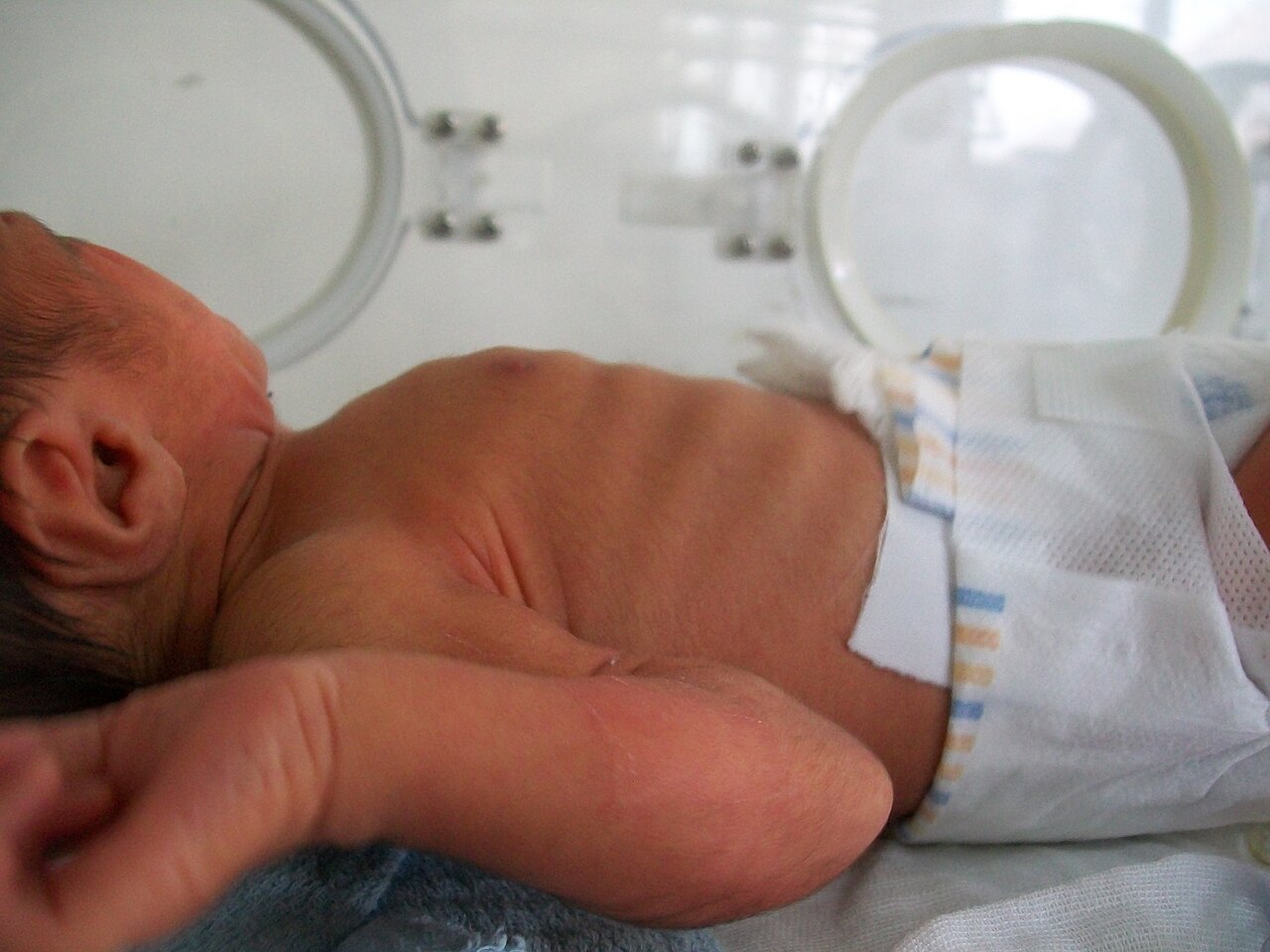
- Cough and runny nose, then tachypnea, retractions, crackles or wheeze. Infants, usually under 12 months, often with fever.
- Red Flags
- Apnea (rare, under 2%)
- SpO₂ persistently below target
- Severe distress, tiring or weak cry
- Lethargy or dehydration
- First Actions
- Suction visible nasal secretions; check SpO₂ and work of breathing; oxygen to target; support feeding and hydration; reassess 4 to 5 hr after starting support.
- Key Doses
- Oxygen if SpO₂ persistently under 90% (6 wk+) or 92% (under 6 wk, or under 12 mo with a condition); NASEMSO goal 94–98%
- Nirsevimab: 50 mg IM under 5 kg, 100 mg IM at 5 kg+
- No routine albuterol, steroids or antibiotics
- Don't Miss
- Apnea in a young or preterm infant; sepsis or pneumonia; pneumothorax; and croup, epiglottitis, foreign body or asthma, which are not bronchiolitis.
- Escalate & Transport
- Pediatric-ready ED for stabilization; ICU-level care for HFNC failure or severe distress. Hand off the SpO₂ trend, oxygen target, feeding and wet-nappy history.
Overview & Pediatric Differences
Bronchiolitis starts like a cold and then moves into the lower airways. It is a viral infection, and respiratory syncytial virus (RSV) is the most frequent cause. It is seasonal and usually shows up in winter. In Australia and Aotearoa New Zealand it is one of the most common reasons infants get admitted. It usually hits infants under 12 months of age.
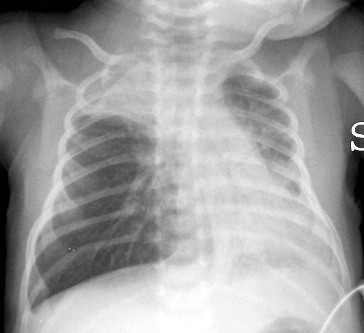
The cold comes first: rhinorrhea, nasal congestion, cough. Then the lower airways get involved, and you see distress with diffuse crackles or wheeze. You make the diagnosis at the bedside. For typical cases, routine laboratory tests, viral testing and chest X-rays are not recommended.
Why Kids Are Different
- Obligate nose breathers: infants breathe mainly through their noses. Secretions in there can cause distress and get in the way of feeding (NASEMSO guideline 2022).
- Feeding and breathing are linked: feeding trouble, vomiting and dehydration are part of this illness. A child who can't feed is sicker. Not just more uncomfortable.
- Younger and preterm infants carry more risk: younger chronological age and gestational age under 37 weeks are both listed as risk factors for more serious illness.
- Apnea is uncommon but real: the 2025 Australasian guideline says apnea is rare, under 2% of infants with bronchiolitis.
Kids aged 12 to 24 months can get bronchiolitis too. The older the child, the less certain the diagnosis. The Australasian guideline covers infants under 12 months only. In older children, consider other causes.
Recognition & Severity
Don't judge severity on one number. Look at work of breathing, oxygenation, feeding, hydration and mental state together. Is the child on low-flow oxygen, with a falling respiratory rate and heart rate? That child is responding. Is the effort rising, or is the child tiring? That child needs a senior clinician now.
| Feature | Milder, Stable | Severe, Escalate |
|---|---|---|
| Work of breathing | Mild to moderate and stable | Severe distress, tiring, or weak cry; senior clinician decides on escalation |
| Oxygen saturation | Stable without oxygen. Discharge pathway only: no further oximetry observation is needed when the infant has not received oxygen or support and/or SpO₂ is 95% or more (see Monitoring). Not a severity marker | Persistently below target despite low-flow oxygen |
| Feeding and output | At least half usual feeds and more than half usual wet nappies | Feeding difficulty, vomiting or dehydration |
| Mental status | Alert and interactive | Lethargy or unresponsiveness |
| Breathing pattern | Tachypnea without tiring | Apnea (rare), grunting, or inability to feed or cry effectively |
Age-Specific Presentation
- Under 6 weeks: the oxygen threshold is 92%, not 90%. Watch apnea and feeding closely.
- 6 weeks to 12 months: this is the typical age group. Without an underlying condition, the oxygen threshold is 90%.
- Infants under 12 months with an underlying condition: the oxygen threshold is 92%.
- 12 to 24 months: diagnostic uncertainty grows here. Consider other causes.
Consider Other Diagnoses
- Exclusions in the NASEMSO guideline: anaphylaxis, croup, epiglottitis, foreign body aspiration, drowning and asthma are not bronchiolitis. Each one needs its own pathway.
- Serious bacterial illness or a complication: sepsis, pneumonic consolidation, pneumothorax, empyema, pleural effusion, immunodeficiency or significant heart disease. Think about these when the course is unexpected or the child gets worse without warning.
Management by Type: Supportive Care
- Suction what you can see: bulb or catheter suction of the nose and mouth when secretions cause distress or get in the way of feeding. Superficial suction is the step to use (Australasian guideline 2025: consider superficial suction for distress or feeding difficulty; NASEMSO: suctioning is very effective for distress).
- Keep the infant feeding: check the feed and wet-nappy history at every reassessment. When feeding drops off, nasal saline drops at feeds can be tried. They are not routine (Australasian guideline 2025).
- Give oxygen to target: consider starting low-flow oxygen when SpO₂ is persistently below 90% (6 weeks and older) or 92% (under 6 weeks, or under 12 months with an underlying condition). These are thresholds for starting oxygen, not a field target. In the field, the NASEMSO goal is 94% to 98%. Don't wait for a number if the infant is tiring or in severe distress. Oxygen is not given for work of breathing alone (Australasian guideline 2025; NASEMSO guideline 2022).
- Hydrate when needed: IV or enteral hydration when the infant cannot keep fluids up. In the field, IV access is only for dehydration or IV medication (NASEMSO guideline 2022).
- Limit fluids to avoid overload: consider 50% to 75% of maintenance because of the risk of syndrome of inappropriate antidiuretic hormone (SIADH) secretion and hyponatremia. Monitor for overhydration (Australasian guideline 2025, consensus).
- Hand hygiene: use hand hygiene for every infant with bronchiolitis (Australasian guideline 2025, strong recommendation).
Not Routinely Recommended
- Chest physiotherapy (Australasian guideline 2025).
- Deep nasal suction (Australasian guideline 2025).
- Routine chest X-ray, blood or urine tests, and viral testing, including testing only for cohorting (Australasian guideline 2025).
- Heliox (NASEMSO guideline 2022).
- Inhaled steam or nebulized saline in the field, because there is insufficient data (NASEMSO guideline 2022).
Management by Type: Respiratory Support
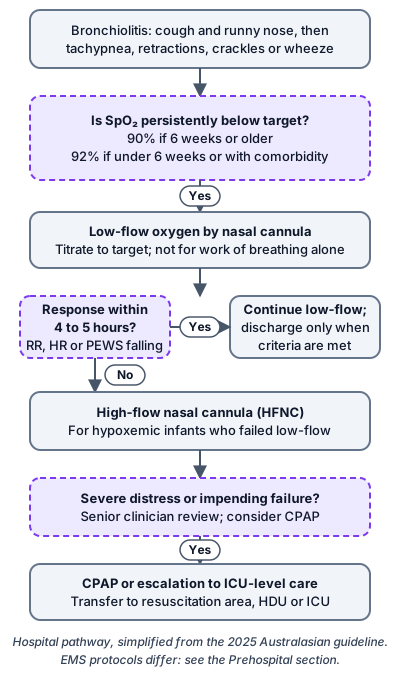
Escalate on how the child responds, not on the clock. Low-flow oxygen comes first. When SpO₂ stays below target or the work of breathing climbs, step up. The pathway below is the hospital logic of the 2025 Australasian guideline, simplified.
- High-flow nasal cannula (HFNC): use for hypoxemic infants who fail low-flow oxygen. Don't use HFNC routinely as first line in moderate hypoxemic disease, and don't use it in non-hypoxemic mild or moderate disease (Australasian guideline 2025). Flow rate and titration follow the unit protocol. In a 2018 randomized trial of infants outside intensive care, HFNC cut escalation of care for treatment failure: 12% versus 23%.
- CPAP: consider nasal CPAP for impending or severe respiratory failure. In severe disease, consider HFNC before CPAP (Australasian guideline 2025).
- Bag-valve-mask ventilation: use it for respiratory failure or impending failure. Reach for a supraglottic device or intubation only when bag-valve-mask ventilation fails. Use the least invasive airway that works (NASEMSO guideline 2022).
- Reassess 4 to 5 hours after starting support: a falling respiratory rate, heart rate or pediatric early warning score (PEWS) shows the child is responding (Australasian guideline 2025).
Medications & Dosing
Few drugs earn a place here. Most of the ones people reach for are not recommended. Doses vary by protocol; follow local protocols and medical direction. Nirsevimab and clesrovimab are prevention, and neither one treats an active infection.
| Drug | Dose & Route | Max | Notes |
|---|---|---|---|
| Oxygen Low-flow by nasal cannula or mask |
Low-flow oxygen, titrated to the protocol target. Consider starting when SpO₂ is persistently below 90% (6 weeks and older) or 92% (under 6 weeks, or under 12 months with an underlying condition) |
None established; lowest FiO₂ that holds the target |
The 90% and 92% figures are AU 2025 hospital thresholds (weak recommendation) for starting oxygen and for discharge observation. They are not a field goal: the NASEMSO EMS goal is 94% to 98% (see Prehospital). Not for work of breathing alone. Do not wait for a number if the infant is tiring or in severe distress. See Oxygen |
| Nirsevimab (Beyfortus) for prevention | 50 mg IM if under 5 kg; 100 mg IM if 5 kg or more; single dose |
One dose for the first RSV season; extra dose after cardiopulmonary bypass surgery per label |
For neonates and infants born during or entering their first RSV season. Second season for children up to 24 months who remain vulnerable: 200 mg IM as two 100 mg injections, regardless of weight (CDC risk groups in Special Populations). Most infants need a maternal vaccine or an infant antibody, not both. Contraindicated after a prior serious hypersensitivity reaction, including anaphylaxis |
| Clesrovimab (Enflonsia) for prevention | 105 mg IM, single dose |
One dose for the first RSV season; extra dose after cardiopulmonary bypass surgery per label |
For neonates and infants born during or entering their first RSV season. The label has no weight tiers and no second-season indication. CDC does not recommend it for children over 8 months of age. Contraindicated after a prior serious hypersensitivity reaction, including anaphylaxis, to any component |
| Albuterol (Ventolin) | Do not give routinely |
Not applicable (not given) |
Strong recommendation against beta-2 agonists in infants under 12 months (Australasian guideline 2025, Q8a). NASEMSO: no benefit from routine use |
| Ipratropium | Do not give |
Not applicable (not given) |
NASEMSO: anticholinergics should not be given to children with bronchiolitis in the prehospital setting. The 2025 Australasian guideline did not scope ipratropium |
| Epinephrine 1 mg/mL, nebulized Protocol-dependent |
5 mg (5 mL of 1 mg/mL) nebulized. A fixed dose in NASEMSO, not weight-adjusted: about 1.4 mg/kg in a 3.5 kg infant |
NASEMSO states no maximum or repeat dose; follow local protocol and medical direction |
NASEMSO: prehospital, severe distress, only if suctioning and oxygen fail to improve the child. Reassess immediately and escalate airway support if there is no improvement. The 2025 Australasian guideline gives a STRONG recommendation against adrenaline/epinephrine in infants presenting to or hospitalised with bronchiolitis (Q9). Give to any young or small infant only with medical direction approval. ICU exception: a steroid plus epinephrine combination is a conditional recommendation for severe bronchiolitis needing ICU-level care (Q11c ii; see Corticosteroids). Conflict flagged; follow local protocol |
| Hypertonic saline 3%, nebulized | Not routine |
Not applicable (not given) |
AU 2025: do not routinely use outside a randomized trial (weak). NASEMSO: shortens hospital stay in some studies but gives no immediate relief, so it is not for prehospital distress |
| Corticosteroids (systemic or inhaled) | Do not give routinely |
Not applicable (not given) |
AU 2025 strong recommendation against glucocorticoids (Q11a). ICU exception: a combination of steroid and epinephrine may be considered for severe bronchiolitis needing ICU-level care (Q11c ii, conditional; see Epinephrine). NASEMSO: not efficacious |
| Antibiotics (routine) | Do not give routinely |
Not applicable (not given) |
AU 2025: not routine, including azithromycin (weak). Treat a separately suspected bacterial infection under its own pathway |
| Isotonic maintenance IV fluid with 5% glucose | Consider 50% to 75% of Holliday-Segar maintenance (see weight-based dosing), when IV hydration is needed |
Reduce to 50% to 75% of maintenance; monitor for overhydration |
0.9% sodium chloride or balanced solution with 5% glucose (Australasian guideline 2025, consensus). 10% glucose may be considered for infants up to 4 weeks corrected age |
Monitoring, Reassessment & Disposition
| Parameter | Target | Notes |
|---|---|---|
| SpO₂ | 90% or more (6 weeks and older, no underlying condition); 92% or more (under 6 weeks, or under 12 months with an underlying condition) | Discharge observation targets, not an EMS field goal (NASEMSO goal is 94% to 98%). After oxygen or support, or with SpO₂ 94% or less: observe in room air for 3 to 4 hours, including sleep, before discharge (Australasian guideline 2025, discharge criterion 2) |
| Response to support | Falling respiratory rate, heart rate or PEWS | Check within 4 to 5 hours of starting oxygen or HFNC (Australasian guideline 2025) |
| Feeding | At least half usual volume | Feeding is a discharge criterion (Australasian guideline 2025) |
| Urine output | More than half usual wet nappies | Output is a discharge criterion (Australasian guideline 2025) |
| Breathing | No severe distress; no apnea | Continuous pulse oximetry where apnea or apnea risk is present (Australasian guideline 2025). Not routine for stable, non-hypoxemic infants |
| Mental status | Alert and interactive | Lethargy is a severity sign (Australasian guideline 2025) |
- Capnography (EtCO₂): NASEMSO uses pulse oximetry and end-tidal CO₂ routinely, as adjuncts to other respiratory monitoring (Treatment item 1). Watch for a rising EtCO₂ with tiring, or a falling level of consciousness. That suggests ventilation is failing. For respiratory failure or impending failure, NASEMSO calls for bag-valve-mask ventilation. For severe distress, add HFNC or CPAP where available.
- Labs: check glucose and sodium when feeding is poor, the child is dehydrated or mental state has changed. Routine labs are not recommended (Australasian guideline 2025).
- Discharge criteria (Australasian guideline 2025): the child is clinically stable; SpO₂ is at or above the threshold after observation, if oxygen was given; feeding and output are adequate; the caregiver is confident and has written return advice; the social situation and transport are suitable; and local follow-up is arranged where needed.
- Admission risk: the guideline says there is insufficient evidence for absolute discharge criteria. Younger infants (under 8 weeks), lack of social support and poor feeding are risks for return. Severe distress that fails support means escalating to ICU-level care.
Pitfalls & Safety Checks
| Pitfall | Consequence | Prevention |
|---|---|---|
| Routine albuterol, steroid or epinephrine trial | No proven benefit; time away from suction, oxygen and feeding | Use the do-not list in Medications & Dosing; ask medical direction before any non-standard drug. If protocol-approved nebulized epinephrine is used: a fixed 5 mg dose, not weight-based; reassess immediately and escalate airway support if there is no improvement (NASEMSO) |
| Oxygen for work of breathing alone | Oxygen given without a saturation indication | Titrate to the SpO₂ target, not to the child's appearance (Australasian guideline 2025) |
| Conflicting oxygen goals | EMS and receiving ED use different targets | Follow local protocol; state the target used on handoff; flagged for medical director |
| Missed apnea | Respiratory arrest in a young or preterm infant | Watch the chest and the monitor; continuous oximetry where apnea risk is present; bag-valve-mask ready |
| Routine deep nasal suction | No routine benefit (Australasian guideline 2025) | Superficial suction for distress or feeding problems only |
| IV fluid overload | Hyponatremia and overhydration from SIADH | Limit to 50% to 75% of maintenance; monitor intake, output and sodium |
| Anchoring on bronchiolitis | Missed sepsis, pneumonia, pneumothorax, croup, epiglottitis or foreign body | Reassess an unexpected or atypical course; use the exclusion list in Recognition |
Special Populations
Neonates and Young Infants
- Oxygen threshold: 92%, not 90%, for infants under 6 weeks (Australasian guideline 2025).
- Risk factors: gestational age under 37 weeks, younger chronological age, prenatal or postnatal tobacco smoke and reduced breastfeeding. Each one raises the risk of more serious illness (Australasian guideline 2025).
- Apnea: the 2025 guideline calls apnea rare. It recommends continuous oximetry when apnea or apnea risk is present. It does not define apnea risk factors. So treat any pause in breathing as serious.
Infants With Underlying Conditions
- Conditions that raise risk: chronic lung disease, congenital heart disease, chronic neurological condition, congenital diaphragmatic hernia, trisomy 21 and other genetic disorders (Australasian guideline 2025).
- Oxygen threshold: 92% for infants under 12 months with an underlying condition (Australasian guideline 2025).
RSV Prevention
- Nirsevimab and clesrovimab: both are monoclonal antibodies. One intramuscular dose covers neonates and infants born during or entering their first RSV season, from birth when they arrive in season (DailyMed labels). Find the dosing in the medications table.
- Maternal vaccine: Abrysvo goes to pregnant people at 32 through 36 weeks gestation. It protects the infant against lower respiratory disease from birth through 6 months (DailyMed label).
- One product, not all three: most infants need one or the other, not both. An infant born within 14 days of maternal vaccination still needs the infant antibody (CDC). Clesrovimab is labeled for the first season only.
- Guideline position: the guideline says to consider monoclonal antibodies for infants at increased risk. It also says to consider universal nirsevimab as a population approach, and maternal immunization. Routine universal infant RSV vaccination is not recommended (Australasian guideline 2025).
Children 12 to 24 Months
- Second season, label: nirsevimab 200 mg IM (two 100 mg injections) for children up to 24 months who remain vulnerable to severe RSV disease through their second RSV season (DailyMed label).
- Second season, CDC: nirsevimab is recommended for children aged 8 to 19 months entering their second season who have chronic lung disease of prematurity that needed medical support (corticosteroids, diuretics or supplemental oxygen) in the 6 months before the season, severe immunocompromise, cystic fibrosis with severe lung disease or weight-for-length below the 10th percentile, or American Indian or Alaska Native ancestry. From 20 months, CDC does not recommend nirsevimab. Clesrovimab has no second-season use.
- Diagnosis: the Australasian guideline stops at infants under 12 months, so the evidence is less certain for older children (Australasian guideline 2025).
Prehospital & Transport Considerations
| Level | Typical Role in Bronchiolitis |
|---|---|
| EMT | Position, suction the nose and mouth with a bulb or catheter, oxygen by nasal cannula, escalating to a simple mask or non-rebreather as needed, early transport to a pediatric-ready ED (NASEMSO guideline 2022) |
| AEMT | Pulse oximetry and end-tidal CO₂ as adjuncts; IV access only for dehydration or IV medication (NASEMSO guideline 2022); other steps per protocol |
| Paramedic | Nebulized epinephrine 5 mg (fixed dose, not weight-adjusted) in severe distress when suction and oxygen fail, per protocol (NASEMSO guideline 2022); reassess immediately and escalate airway support if no improvement; CPAP or HFNC where available; bag-valve-mask for failure; supraglottic device or intubation only if bag-valve-mask fails (commonly per protocol) |
| RN (ED/ICU) | Titrate low-flow oxygen and HFNC; CPAP; reassess 4 to 5 hours after starting support; discharge criteria; ICU-level care for severe distress (Australasian guideline 2025) |
| Critical care transport | Keep HFNC or CPAP support running during transfer per program; monitor SpO₂ continuously where apnea risk is present (Australasian guideline 2025); structured handoff |
- Oxygen target in the field: NASEMSO sets the field goal at SpO₂ 94% to 98%. The AU 2025 hospital thresholds of 90% or 92% are the points to consider starting oxygen. They are not a field target. If the infant is tiring, don't wait for a number. Use the local protocol and state the target on handoff. This conflict needs a medical director decision.
- Transport: lights and sirens are not routine for transport (NASEMSO guideline 2022). Hand the caregiver written return advice (Australasian guideline 2025).
- Infection control: use hand hygiene (Australasian guideline 2025). Follow the agency's infection-control policy.
- Handoff: SpO₂ trend, oxygen device and target, feeding and wet-nappy history, last nebulized treatment, and the response to suction and oxygen.
Clinical Pearls
References
- Borland ML, Loveys K, Babl FE, et al. Australasian Bronchiolitis Guideline: 2025 Update. J Paediatr Child Health. 2025;61(8):1197–1215. https://doi.org/10.1111/jpc.70144
- National Association of State EMS Officials. National Model EMS Clinical Guidelines, Version 3.0: Pediatric Respiratory Distress (Bronchiolitis). March 2022. Publisher site: www.nasemso.org. PDF copy hosted by hhs.iowa.gov: https://hhs.iowa.gov/media/198/download
- Franklin D, Babl FE, Schlapbach LJ, et al. A Randomized Trial of High-Flow Oxygen Therapy in Infants with Bronchiolitis. N Engl J Med. 2018;378(12):1121–1131. https://doi.org/10.1056/NEJMoa1714855
- Hammitt LL, Dagan R, Yuan Y, et al. Nirsevimab for Prevention of RSV in Healthy Late-Preterm and Term Infants. N Engl J Med. 2022;386:837–846 (landmark trial). https://doi.org/10.1056/NEJMoa2110275
- Beyfortus (nirsevimab-alip) injection, for intramuscular use. Prescribing information. Sanofi Vaccines US Inc.; revised June 2026. DailyMed. https://dailymed.nlm.nih.gov/dailymed/drugInfo.cfm?setid=2f08fa60-f674-432d-801b-1f9514bd9b39
- Enflonsia (clesrovimab-cfor) injection, for intramuscular use. Prescribing information. Merck Sharp & Dohme LLC; revised June 2025. DailyMed. https://dailymed.nlm.nih.gov/dailymed/drugInfo.cfm?setid=c9004a92-40e8-4cdb-b22d-d07929f8fc3b
- Abrysvo (respiratory syncytial virus vaccine) kit, for intramuscular use. Prescribing information. Pfizer Laboratories Div Pfizer Inc; revised December 2025. DailyMed. https://dailymed.nlm.nih.gov/dailymed/drugInfo.cfm?setid=be18292e-b1a2-4815-a0ed-003efaa6bea3
- Centers for Disease Control and Prevention. Clinical Guidance for RSV Immunizations and Vaccines: RSV Immunization Guidance for Infants and Young Children. Updated August 18, 2025. https://www.cdc.gov/rsv/hcp/vaccine-clinical-guidance/infants-young-children.html
Medical Disclaimer
- For Educational Purposes Only: This content is intended for educational reference and should not be used for clinical decision-making.
- Not a Substitute for Professional Judgment: Always consult your local protocols, institutional guidelines, and supervising physicians.
- Verify Before Acting: Users are responsible for verifying information through authoritative sources before any clinical application.