

You're transporting a vented patient from the ED to an ICU late at night. After the long dance of transferring wires, lines, tubes, and the patient onto the cot: you finally load the patient into the bus and are ready to go. You're getting settled in for the transport and plug all your equipment in so the alarms will stop beeping when you notice something odd on the cardiac monitor…. a strange rhythm that you've never seen before. After the initial panic of seeing a wack-ass rhythm fades, you start to investigate. It's not atrial fibrillation because you can see a lead that's normal and it's not from patient movement because they're lying still. Well then what can it be? Why did it only start once we got into the ambulance?
In this case, the cause wasn't the patient's heart at all: it was the ventilator's power supply.
The Case
I was transporting a mechanically ventilated patient on our "brand-new" ventilator after we had our beloved Hamiltons returned when I noticed an unusual pattern on the cardiac monitor. A pattern that we don't see all too often these days thanks to the powerful filters that are built into most cardiac monitors.
This is the classic 60Hz power line interference.
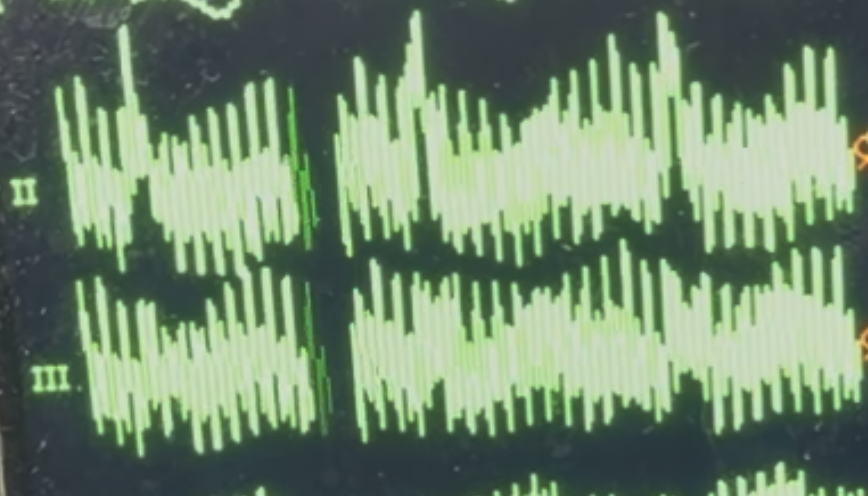
60Hz power line interference from ventilator power supply
What Is 60Hz Interference?
This is a specific type of electrical interference that occurs with alternating currents (AC). AC current in a pinch, is the push/pull movement of electricity through a wire. This allows us to transport electricity much farther and with less loss. The push/pull is the alternating part of the current — it's essentially an oscillation back and forth. Different countries use different standards for how quickly we alternate the current. Here in the US, our power from the wall is alternating current (AC) and runs at 60 cycles per second or 60Hz.
When our machines are in close proximity to either powerful AC devices or ones that are poorly shielded: the oscillation can be unintentionally picked up by ECG machines, which measure the difference in electrical voltage between two electrodes.
These oscillations get recorded as waves on our ECG, and waves that occur 60 times per second. That's a whopping 3,600 times per minute!
- Appearance: Fine, regular oscillations at 60 cycles/second
- Pattern: Too regular to be biological — perfectly consistent
- Timing: Does not correlate with patient movement or QRS complexes
- Response: Changes when equipment is moved or unplugged
The Ventilator Connection
In this case, the ventilator's power supply was generating electromagnetic interference (EMI) that was being picked up by the ECG leads. The power supply cable is located at the back of the ventilator and was in very close proximity to the monitor cables. The specific cable being the Left Leg lead. Unplugging the block, as seen in the video, resolves this problem immediately.
When troubleshooting 60Hz interference, don't just focus on the patient and electrodes. Consider the entire environment: where are power supplies, transformers, and electrical equipment relative to your lead wires? Sometimes the fix is as simple as rerouting cables or repositioning equipment.
Troubleshooting 60Hz Interference
When you encounter suspected power line interference, work through this systematic approach:
- Check the basics first: Electrode adhesion, skin prep, lead wire integrity
- Look at the environment: What equipment is near the patient? Near the lead wires?
- Test by elimination: Turn off nearby equipment one at a time (if safe to do so)
- Reposition: Move lead wires away from power cables and equipment
- Ground properly: Ensure all equipment is properly grounded
- Consider filters: Many monitors have 60Hz notch filters that can reduce interference
A Quick Note on Filters
Modern EKGs are great at filtering out a wide range of EMI. In this specific scenario, the 'EMS' filter was applied which is a very strong filter that covers 0.05-40Hz and 60Hz. Now, the next logical question would be: "well if there's a 60Hz filter applied, then why is there 60Hz interference?"
That's a great question! Well, these filters are only so powerful. So when a very powerful 60Hz signal is running in close proximity to your equipment, it is possible to get this interference. For our case, this ventilator's power supply not only seems to be a very powerful device but also likely has little to no insulation.
Even More Nuance
You might be wondering, "Why doesn't Lead I have any interference while every other lead does?"
To that I'd say: "Wow, great question!"
Let's take a gander at everyone's favorite diagram, Einthoven's triangle, to understand our 4-lead ECG.
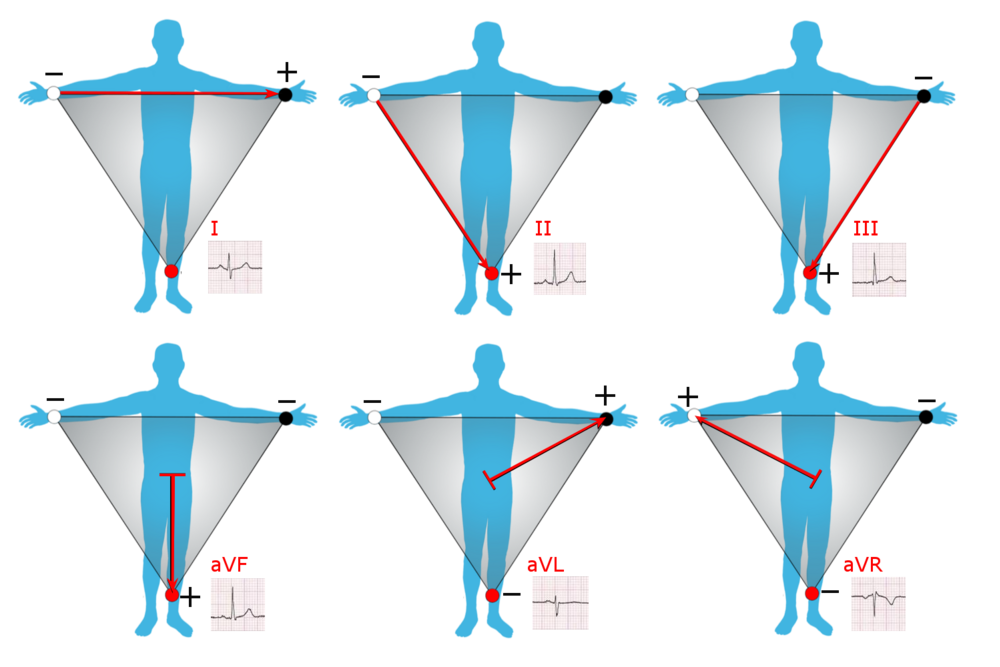
Looking at this diagram, we can see that Lead I is actually the only lead that does not use the left leg (LL) electrode at all. Lead I measures the electrical voltage purely between the right arm (RA) and left arm (LA).
So if the left leg electrode is being hit with 60Hz noise from the ventilator power cable, it stands to reason that the only lead that doesn't factor LL into its calculation (Lead I) would be the clean one, while the others have artifact.
Bipolar Limb Leads:
- Lead I = LA − RA
- Lead II = LL − RA
- Lead III = LL − LA
Augmented Limb Leads:
- aVR: Looks toward the Right arm; RA compared to the average of LA + LL
- aVL: Looks toward the Left arm; LA compared to the average of RA + LL
- aVF: Looks toward the Foot (inferior); LL compared to the average of RA + LA
Because aVR, aVL, and aVF all use averages which include LL, any noise on the left leg electrode will still bleed into those leads.
The Bottom Line
Not every electrical signal on the cardiac monitor comes from the heart. 60Hz power line interference is a common artifact that can be caused by nearby electrical equipment. In this case, equipment that we're using to treat the patient.
ECG Book. (n.d.). Electrodes and leads. https://www.ecgbook.com/electrodes-and-leads/