

Bedside Snapshot
- Recognize
- Infection with organ dysfunction (SOFA rise of 2 or more). Septic shock: vasopressor for MAP ≥65 mm Hg and lactate >2 mmol/L after fluid. Screen with NEWS2 or SIRS, not qSOFA.
- Red Flags
- MAP <65 mm Hg; SBP ≤100 with altered mentation or RR ≥22 (qSOFA-type, prognostic only); mottled or ashen skin; lactate >2 mmol/L
- First Actions
- Prenotify the hospital; two IVs or IO; cultures without delaying antibiotics; balanced crystalloid with reassessment; norepinephrine if hypotension persists
- Key Doses
- Crystalloid ≥30 mL/kg IV in 3 hr; norepinephrine to MAP 65 mm Hg; vasopressin per protocol (commonly 0.03 units/min fixed); hydrocortisone 200 mg/day, up to 7 days or ICU discharge (panel practice)
- Don't Miss
- Antibiotic delay; a negative qSOFA does not exclude sepsis (prehospital sensitivity 23.1%); fluid given without reassessment
- Escalate & Transport
- Antibiotics within 1 hr; ICU admission within 6 hr; vasopressin, then epinephrine, if MAP stays low on norepinephrine; hospital with ICU care
Definition & Pathophysiology
Sepsis is life-threatening organ dysfunction caused by the body's dysregulated response to infection. For clinical use, Sepsis-3 identifies it by an acute rise in the Sequential (Sepsis-related) Organ Failure Assessment (SOFA) score of 2 points or more. Septic shock is the sicker subset. Two things mark it: a vasopressor is needed to keep mean arterial pressure (MAP) at 65 mm Hg or higher, and serum lactate is above 2 mmol/L in the absence of hypovolemia (Sepsis-3).
The host response opens the vessels wide and lets fluid leak out of them. Perfusion pressure drops, and less oxygen reaches the tissue. Lactate marks cellular dysfunction, not just hypoperfusion, so you never read it alone. Read it with blood pressure and perfusion signs. Sepsis can start at any site. The source decides how much source control and empiric coverage you need.
- Certainty terms: SSC 2026 grades a suspected infection as definite (confirmed, alternative very unlikely), probable (sepsis most likely), possible (sepsis and another diagnosis both likely) or unlikely. The grade sets your treatment timing.
- Septic shock in practice: a vasopressor is needed for MAP at 65 mm Hg or higher, and lactate above 2 mmol/L persists after adequate fluid. Low pressure and poor perfusion are time-critical. Persistent hypotension is linked to worse outcomes in observational studies.
- Clinical course: deterioration can be rapid. The first hour decides how much organ injury piles up. Treatment starts at recognition, not after a confirmed diagnosis.
Recognition & Red Flags
Presentation
- Suspected infection with organ dysfunction: it looks septic, and the vitals back it up. Expect low pressure, a changed mental state, a racing heart, mottled or ashen skin, cyanosis or a falling sat. SSC 2026 names these as the unstable-shock features.
- Possible sepsis: you suspect it, but another diagnosis is in play too. Shock absent? Reassess fast before you commit to treatment decisions.
Screening Tools
- NEWS2, NEWS, MEWS or SIRS: pick one of these over qSOFA. SSC 2026 wants a single screen for acutely ill patients in hospital, and it names one of these. For patients moved by ambulance or flight, a standard screening tool is suggested.
- qSOFA: 2 or more of these point to a higher chance of a bad outcome: respiratory rate 22/min or more, altered mentation, or systolic BP 100 mm Hg or less (Sepsis-3). It predicts outcome. It does not screen for sepsis. Prehospital sensitivity was 23.1% in SSC 2026, against 73.1% for NEWS2.
Red Flags
- Hypotension: MAP below 65 mm Hg, or SBP 100 mm Hg or less with altered mentation or respiratory rate 22/min or more (the qSOFA-type combination; prognostic, not a screen)
- Hypoperfusion: mottled, ashen or cyanotic skin, or falling oxygen saturation; lactate above 2 mmol/L
- Deterioration: new altered mentation, rising respiratory rate, or new tachycardia with hypotension
Assessment & Diagnostics
Treatment starts from the bedside picture. Cultures and labs get drawn, but they never hold up the first antibiotic dose.
| Check | Why | Act If |
|---|---|---|
| BP and MAP | Vasopressor trigger and target | MAP below 65 mm Hg after fluid: vasopressor. Invasive BP monitoring is advised for intermediate-high or escalating vasopressor doses (SSC 2026 guideline) |
| Lactate | Hypoperfusion marker; septic shock definition | Measure in possible, probable or definite sepsis (suggested). Above 2 mmol/L with a vasopressor: septic shock. Trend serially to guide resuscitation, Lactate |
| Capillary refill time | Bedside perfusion adjunct | Use with lactate and mental status to guide resuscitation (SSC 2026 guideline) |
| Blood cultures | Source and pathogen | Collect as soon as possible, ideally before antibiotics. Do not delay antibiotics to collect them |
| Fluid responsiveness | Guides whether to give more fluid | Passive leg raise or a fluid bolus with stroke volume or pulse pressure variation, where available; preferred over the physical exam alone (SSC 2026 guideline) |
| Glucose | Insulin threshold | Insulin for glucose of 180 mg/dL (10 mmol/L) or higher, per SSC 2026. See Glucose |
Differential & Mimics
- Anaphylaxis: hives, wheeze, or lip or tongue swelling after an exposure, plus hypotension that responds to IM epinephrine. Treat it as anaphylaxis first. See Anaphylaxis.
- Adrenal crisis: the hypotension is out of proportion to the trigger, in a patient with adrenal insufficiency or recent steroid withdrawal. Hydrocortisone is the first step. Check Hydrocortisone for the dose.
- Hemorrhagic shock: trauma or bleeding with no infection source. Bleeding comes first. See Hemorrhage control.
- Cardiogenic shock: low output with signs of pump failure. SSC 2026 notes that cardiac dysfunction can coexist with septic shock, and it changes the vasopressor choice. Norepinephrine or epinephrine is first-line.
- Diabetic ketoacidosis: deep, fast breathing with hypotension and a high glucose. Check glucose and acid-base status. See Glucose.
- Pulmonary embolism: hypotension with hypoxia, tachycardia or right-heart strain. Neither fluids nor antibiotics treat it.
- Toxic ingestion: hypotension and altered mentation can come from beta-blocker, calcium-channel blocker or sedative toxicity.
BLS Management
- Recognize and screen: suspected infection with low BP, altered mentation, fast breathing or mottled skin is sepsis until proven otherwise. Use the local EMS sepsis screen; SSC 2026 suggests a standard screening tool in the ambulance.
- Oxygen and airway basics: measure oxygen saturation and give oxygen as protocol directs. SSC 2026 suggests pulse oximetry or arterial blood gas to measure oxygenation in sepsis.
- Prenotify the hospital with the screen result, suspected source, vital signs and estimated arrival time. Early notification shortens time to antibiotics.
- Reassess heart rate, BP, respiratory rate, SpO₂, mental status and skin perfusion, and repeat after each intervention.
- Transport priority: sepsis with hypotension is time-critical. Prenotification and the antibiotic timing below set the destination and the urgency.
- Report: symptom onset time, suspected source, antibiotic status, fluid volume in mL and mL/kg with times, and every response.
ALS Management
Doses vary by protocol; follow local protocols and medical direction. Sepsis runs on a clock. Call ahead early. Start fluid and get the antibiotic ready while you decide on a vasopressor.
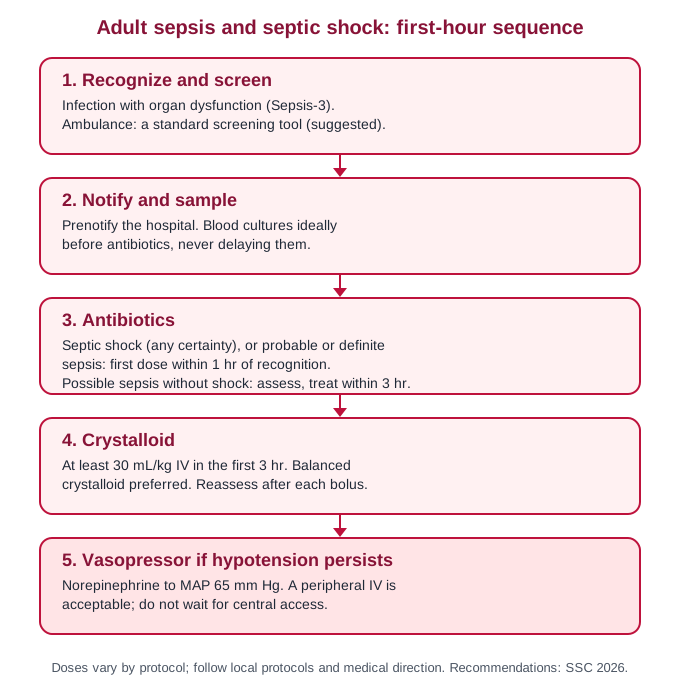
- IV or IO access (Paramedic/RN/CCT): IV or IO access per protocol. A peripheral line is fine for starting a vasopressor. Waiting on a central line is never the reason to delay access (SSC 2026 guideline). See IO Access.
- Blood cultures before antibiotics (Paramedic/RN/CCT): draw cultures only if the first dose is not held up. Lactate too, if your system runs it. See Lactate.
- Antibiotic (Paramedic/RN/CCT): the first dose is due within 1 hr of recognition for septic shock, and for probable or definite sepsis (SSC 2026 guideline). Possible sepsis without shock gets a time-limited assessment, with treatment inside 3 hr. Prehospital antibiotics are suggested once the projected delay to in-hospital evaluation passes 60 min and a sepsis screen is running. Agent and dose per local protocol or medical direction. Ceftriaxone is an example only. Ask about beta-lactam allergy before the first dose. Ceftriaxone lacks Pseudomonas and MRSA activity, so the spectrum you need depends on source, multidrug-resistance risk and local resistance.
- Crystalloid bolus (Paramedic/RN/CCT): at least 30 mL/kg IV in the first 3 hr for sepsis-induced hypoperfusion or septic shock (SSC 2026, low certainty). Choose a balanced crystalloid such as Lactated Ringer's over 0.9% saline, unless there is a head injury. Deliver it in boluses, and reassess after each one.
- Fluid reassessment (Paramedic/RN/CCT): stop or slow for overload: rising work of breathing, falling SpO₂, new crackles. Weight-based volume runs on actual weight. At a BMI above 30, adjusted or ideal weight applies instead.
- Vasopressor (Paramedic/RN/CCT): start one if hypotension persists after fluid, or right away with unstable shock features. Norepinephrine leads, titrated to MAP 65 mm Hg (SSC 2026 guideline). A peripheral start beats waiting, through a large proximal vein (SSC 2021 remark: short-term use, in a vein in or proximal to the antecubital fossa). Avoid leg veins in older patients or with leg vascular disease. Look at the site often. Blanching, swelling, burning or pain means stop the infusion and treat extravasation per protocol: phentolamine infiltration as soon as possible, per the Norepinephrine label (5 to 10 mg in 10 to 15 mL saline). For a long infusion or climbing doses, plan central access. Pump it, and taper the rate gradually when stopping. Only where ALS protocol includes vasopressors.
- Monitoring (Paramedic/RN/CCT): continuous monitoring per protocol. Recheck BP after every infusion change. Glucose per protocol.
ED & ICU Management
- Source control: find the source fast. Early source control is suggested, ideally within 6 hr, when a specific source needs it (SSC 2026 guideline).
- Antimicrobials: add MDR-pathogen coverage when the risk is high. Do not use empiric antifungals routinely. Add anaerobic cover only with specific risk factors. After the loading dose, beta-lactams go by prolonged infusion for maintenance. De-escalate once cultures allow. Use the shortest course that still has adequate source control (SSC 2026 guideline).
- First-line vasopressor: norepinephrine goes ahead of dopamine, epinephrine or selepressin (strong). Terlipressin is suggested against. Angiotensin II is not first-line.
- Add vasopressin (SSC 2026 guideline): add vasopressin when norepinephrine doses keep escalating, with no fixed cut-off. Dosing depends on the protocol. Many protocols use a fixed 0.03 units/min add-on. The FDA label starts septic shock at 0.01 units/min and titrates by 0.005 units/min every 10 to 15 min to target blood pressure. Keep titrating norepinephrine to MAP. Vasopressin does not replace it.
- Add epinephrine: if MAP stays inadequate on norepinephrine plus vasopressin, add epinephrine. Without vasopressin on hand, epinephrine can go on top of norepinephrine alone.
- Cardiac dysfunction with persistent hypoperfusion: once fluid and MAP are adequate, add dobutamine to norepinephrine, or use epinephrine alone. Levosimendan is suggested against.
- Corticosteroids: IV corticosteroids are suggested for septic shock (conditional, low certainty). Panel practice is hydrocortisone-equivalent 200 mg per 24 hr, mostly as intermittent doses, for 7 days or until ICU discharge. See Hydrocortisone. The SSC 2026 dose-response analysis showed no added benefit above 260 mg/day. The start time varies. SSC 2021 suggested starting when norepinephrine or epinephrine is 0.25 mcg/kg/min or higher for at least 4 hr. Hydrocortisone alone (ADRENAL) did not lower 90-day mortality. Hydrocortisone plus fludrocortisone (APROCCHSS) did.
- Arterial pressure: invasive monitoring comes in at intermediate-high or escalating vasopressor doses, or with frequent arterial sampling (SSC 2026 guideline). See Hemodynamic Monitoring.
- Fluid after resuscitation: after 30 mL/kg, with hypoperfusion that persists, choose a liberal or restrictive strategy by patient factors. Crystalloid is preferred over albumin. Starches and gelatin are suggested against. Active fluid removal is suggested after the acute phase.
- ICU admission: admit within 6 hr any patient who needs ICU care (suggested).
- Glucose and acid-base: insulin at 180 mg/dL (10 mmol/L) or higher (SSC 2026 guideline). Check glucose often once insulin starts, because the hypoglycemia risk is real. Protocols commonly target 144 to 180 mg/dL (8 to 10 mmol/L), per SSC 2021. Sodium bicarbonate is suggested against for hemodynamic benefit. It is suggested for pH 7.2 or lower with AKI score 2 or 3.
- Supportive care: restrictive transfusion (strong), with a typical hemoglobin trigger of 7 g/dL (70 g/L) per SSC 2021. Hemoglobin alone does not set it. Enteral nutrition within 72 hr is suggested. Pharmacologic VTE prophylaxis is given unless contraindicated, with LMWH preferred over unfractionated heparin. Use a PPI for stress-ulcer prophylaxis when GI bleeding risk factors are present.
Transport Considerations
- Destination: the nearest hospital that can give antibiotics within the 1-hour target and provide ICU care. Prenotify the sepsis screen result, the source and the planned antibiotic.
- Time targets: measure from recognition or from first medical contact. State which clock you are using at handoff. Antibiotics within 1 hr. ICU admission within 6 hr when needed (SSC 2026 guideline).
- En route: keep reassessing fluid and titrating the vasopressor to MAP 65 mm Hg. Check the peripheral vasopressor site at every reassessment and after each move. Any extravasation gets treated per protocol (see Pitfalls). Pump every vasopressor in mcg/kg/min or units/min as ordered. Do not use a bolus line to flush.
- Flight and vehicle: the same sequence and times apply in both. Prehospital antibiotics apply when the projected delay to in-hospital evaluation exceeds 60 min, with a structured screen in place.
- Handoff: total crystalloid in mL and mL/kg with times; vasopressor name, concentration, rate and start time; antibiotic and time; cultures drawn; corticosteroid given; vasopressor IV site status; lactate values; BP and response.
Special Populations
- Pediatrics: the 2026 SSC pediatric guideline is its own standard, separate from the adult one. Lactate at initial evaluation (strong). Antibiotics within 1 hr for suspected septic shock. With ICU access, up to 40–60 mL/kg in the first hour as 10–20 mL/kg boluses. Without ICU access and with hypotension, up to 40 mL/kg in the first hour, stopped for overload. Without hypotension and without ICU, no bolus while starting maintenance fluids. Peripheral vasoactive access is suggested. Add vasopressin or titrate catecholamines when high doses are needed. Hydrocortisone is suggested against when fluids and vasoactives restore stability. See Pediatric Sepsis, weight-based dosing and pediatric vital signs.
- Pregnancy: the norepinephrine label calls hypotension from septic shock in pregnancy a medical emergency. Untreated, it can be fatal. SSC 2026 gives no pregnancy-specific sepsis recommendation. The same antibiotic and fluid timing applies, with early obstetric notification per local protocol. After about 20 weeks of gestation, tilt the patient left or displace the uterus manually to the left per protocol. The goal is to relieve aortocaval compression. Peripartum and postpartum sepsis (for example endometritis or chorioamnionitis) is a common source. Ask about a recent delivery.
- Heart Failure or ESRD: these patients are at higher risk of fluid overload. Give boluses in smaller amounts. Reassess lung findings and oxygenation after each one, and stop for overload. Early vasopressor use may be needed instead of more large volumes (clinical judgement). Confirm dialysis plans with the receiving team.
- Older Adults: for patients 65 years or older, SSC 2026 suggests an initial MAP range of 60–65 mm Hg, instead of 65 mm Hg or higher.
- Renal Impairment: with AKI and no definitive indication, renal replacement therapy is suggested against. When it is indicated, continuous or intermittent therapy is suggested (SSC 2026 guideline). Sodium bicarbonate is suggested only for pH 7.2 or lower with AKI score 2 or 3.
- Hepatic Impairment: SSC 2026 makes no hepatic-specific recommendation. Read the lactate trend alongside perfusion signs.
- Obesity: fluid volume is based on actual body weight. Use adjusted or ideal body weight when BMI is above 30 kg/m² (SSC 2026 guideline).
- Immunocompromised: when the risk is high, add MDR-pathogen coverage (SSC 2026 guideline). Empiric antifungals are suggested against in all adults with sepsis.
- Patients on Anticoagulants: unless a contraindication exists, SSC 2026 recommends pharmacologic VTE prophylaxis. Bleeding risk and reversal go by the anticoagulant protocol.
- Patients on Beta-Blockers: beta-blockers are not a septic shock treatment. SSC 2026 suggests against them.
Pitfalls & Safety Checks
- Error: a fixed fluid volume with no reassessment. Give boluses, check after each, and stop for overload. At least 30 mL/kg is the suggested floor for hypoperfusion. It is not a ceiling.
- Error: waiting for central venous access before a vasopressor. Start norepinephrine peripherally to restore MAP (SSC 2026 guideline). Use a large vein, for a short period, check the site often, and plan for central access if the infusion runs long.
- Error: skipping the vasopressor IV site check. Norepinephrine can cause tissue necrosis if it extravasates. If blanching, swelling, burning or pain appears, stop the infusion and treat per protocol, with phentolamine infiltration per the Norepinephrine label.
- Error: holding antibiotics for cultures, lactate or imaging. Cultures go first only when they cause no delay.
- Error: using qSOFA as the only screen. A negative qSOFA does not exclude sepsis. Use the local EWS or SIRS screen.
- Error: mixing up vasopressor units. Norepinephrine is weight-based in mcg/kg/min. The label fixed-rate regimen is in mcg/min. Vasopressin is labeled in units/min. Some institutions express it in units/hr, so follow the protocol and pump library. Check concentration, units and pump rate at start and at every bag change.
- Caution: using vasopressin in place of titrating norepinephrine. Vasopressin dosing depends on the protocol. Many protocols use a fixed 0.03 units/min add-on. The FDA label starts septic shock at 0.01 units/min and titrates by 0.005 units/min every 10 to 15 min (limited data above 0.07 units/min). Either way, keep titrating norepinephrine to MAP (see Vasopressin).
- Error: treating lactate normalization as the fluid endpoint. SSC 2026 advises individualized fluid decisions, based on the lactate trend and perfusion. Not fluids until normal.
- Error: reaching for vitamin C, immunoglobulin or bicarbonate for hemodynamic support. SSC 2026 suggests against vitamin C and immunoglobulin, and against bicarbonate to improve hemodynamics.
Clinical Pearls
References
- Prescott HC, Antonelli M, Alhazzani W, et al. Surviving Sepsis Campaign: International Guidelines for Management of Sepsis and Septic Shock 2026. Crit Care Med. 2026;54(4):725–812. https://doi.org/10.1097/CCM.0000000000007075
- Prescott HC, Antonelli M, Alhazzani W, et al. Surviving Sepsis Campaign: international guidelines for management of sepsis and septic shock 2026. Intensive Care Med. 2026;52(5):863–936. https://doi.org/10.1007/s00134-026-08361-1
- Weiss SL, Peters MJ, Oczkowski SJW, et al. Surviving Sepsis Campaign International Guidelines for the Management of Sepsis and Septic Shock in Children 2026. Pediatr Crit Care Med. 2026;27(4):379–434. https://doi.org/10.1097/PCC.0000000000003927
- Singer M, Deutschman CS, Seymour CW, et al. The Third International Consensus Definitions for Sepsis and Septic Shock (Sepsis-3). JAMA. 2016;315(8):801–810. https://doi.org/10.1001/jama.2016.0287
- Venkatesh B, Finfer S, Cohen J, et al. Adjunctive Glucocorticoid Therapy in Patients with Septic Shock (ADRENAL trial). N Engl J Med. 2018;378:797–808 (landmark trial). https://doi.org/10.1056/NEJMoa1705835
- Annane D, Renault A, Brun-Buisson C, et al. Hydrocortisone plus Fludrocortisone for Adults with Septic Shock (APROCCHSS trial). N Engl J Med. 2018;378:809–818 (landmark trial). https://doi.org/10.1056/NEJMoa1705716
- Vasostrict (vasopressin) injection, prescribing information. Par Health USA. U.S. Food and Drug Administration label via DailyMed; revised 4/2026. https://dailymed.nlm.nih.gov/dailymed/drugInfo.cfm?setid=b1147beb-743e-4c62-8927-91192447f8b8
- Levophed (norepinephrine bitartrate) injection, prescribing information. Hospira, Inc. U.S. Food and Drug Administration label via DailyMed; revised 6/2025. https://dailymed.nlm.nih.gov/dailymed/drugInfo.cfm?setid=2c7dd2b0-cc10-4db6-bf56-6eb154ebeb10
- Evans L, Rhodes A, Alhazzani W, et al. Surviving Sepsis Campaign: International Guidelines for Management of Sepsis and Septic Shock 2021. Crit Care Med. 2021;49(11):e1063–e1143. https://doi.org/10.1097/CCM.0000000000005337
Medical Disclaimer
- For Educational Purposes Only: This content is intended for educational reference and should not be used for clinical decision-making.
- Not a Substitute for Professional Judgment: Always consult your local protocols, institutional guidelines, and supervising physicians.
- Verify Before Acting: Users are responsible for verifying information through authoritative sources before any clinical application.