

Bedside Snapshot
- Normal (Adult)
- Mass assay: men ≤4.9 ng/mL, women ≤2.9 ng/mL (same numbers in µg/L); assay-specific
Activity assay: typically <25 U/L and <5% of total CK - Critical Values
- No universal critical value: interpret by trend and clinical context. Troponin, not CK-MB, defines acute MI
- High Suggests
- MI, or heart injury after PCI, CABG or shocks
- Myocarditis, cardiac contusion
- Skeletal muscle injury: rhabdomyolysis, trauma, seizures
- Artifact: macro-CK, CK-BB
- Low Suggests
- Rarely clinically significant: a normal value does not exclude MI if drawn too early (under 4–9 h) or too late (after 48–72 h)
- Act Now If
- Ischemic symptoms or ECG changes, whatever the CK-MB: 12-lead, troponin, ACS or STEMI pathway per protocol; notify receiving/medical control
- Watch Out For
- A CK-MB higher than total CK is an assay artifact, not a massive MI. Check the relative index and troponin
Reference & Critical Ranges
Reference ranges
| Population | Conventional | SI | Notes |
|---|---|---|---|
| Adult men, mass assay | ≤4.9 ng/mL | ≤4.9 µg/L | Upper reference limit (URL) of one widely used immunoassay. Other analyzers differ; the Fourth Universal Definition of MI asks for the assay's sex-specific 99th percentile. |
| Adult women, mass assay | ≤2.9 ng/mL | ≤2.9 µg/L | Women run lower than men; use the sex-specific limit. |
| Adult, activity assay (immunoinhibition) | Typically <25 U/L; <5% of total CK activity | <0.42 µkat/L | Older method still in use. Prone to false elevation (see Interfering Factors); the mass assay is preferred. |
| Pregnancy | No separate interval | — | Values can rise around labor and delivery without heart injury. |
| Older adult | Same as adult | — | No age-specific interval in routine use. |
| Neonate (0–28 d) | ≤14.0 ng/mL | ≤14.0 µg/L | Highest values of life. Pediatric URLs (97.5th percentile) from one 2024 study of Chinese children on a single mass assay; confirm with your pediatric lab. |
| Infant | 29 d to <6 mo: ≤10.8 ng/mL; 6 mo to <1 y: ≤7.1 ng/mL | Same numbers in µg/L | Falls quickly through the first year. |
| Child | 1 to <4 y: ≤6.3; 4 to <7 y: ≤5.4; 7 to <13 y: ≤3.7 ng/mL | Same numbers in µg/L | Falls slowly after age 1. |
| Adolescent (13–18 y) | Boys ≤3.4 ng/mL; girls ≤2.7 ng/mL | Same numbers in µg/L | Sex difference appears in the teen years. |
Severity & critical values
| Level | Conventional | SI | What it means / typical findings |
|---|---|---|---|
| Normal | At or below the sex-specific URL | — | Does not exclude MI: the sample may be too early (under 4–9 h) or too late (after 48–72 h), or the infarct small. Troponin decides. |
| Above the URL | >URL (for example >4.9 ng/mL in a man on the assay above) | Same number in µg/L | Heart or skeletal muscle source. Check troponin, ECG, total CK and the relative index. |
| Rise and fall above the URL | Serial values crossing the URL | — | Supports acute MI only where no troponin assay is available (CK-MB mass assay as the fallback in the Fourth Universal Definition). |
| After PCI or CABG | ≥10 × URL, or ≥5 × URL with new Q waves in ≥2 contiguous leads or new LBBB | — | Clinically relevant periprocedural MI by the SCAI 2013 definition (normal baseline). Institutional definitions vary. |
| Critical | None defined | — | No panic value. Ischemic symptoms or ECG changes are acted on regardless of the number. |
Conversion: Mass: 1 ng/mL = 1 µg/L (same number). Activity: U/L × 0.0167 = µkat/L.
The commonly used cut-off is 2.5%. At or above it, the index favors a heart source. Cut-offs vary by lab and assay. A lower index with a high total CK favors skeletal muscle.
Under 5% is normal. After MI it is usually 6–25%, and rarely above 30%. Over 100% is an assay artifact: a CK-MB higher than the total CK.
Causes of Abnormal Results
High (above the sex-specific upper reference limit)
| Mechanism | Common causes | Bedside clue |
|---|---|---|
| Ischemic myocardial necrosis | Acute MI (type 1 plaque rupture; type 2 supply-demand mismatch) | Chest pain or equivalent, ischemic ECG, rising and falling troponin |
| Procedure or shock-related heart injury | PCI, CABG and other cardiac surgery, catheter ablation, cardioversion or defibrillation (multiple shocks), electrical injury | Recent procedure or shocks; value peaks within the first day |
| Non-ischemic myocardial injury | Myocarditis, pericarditis, cardiac contusion, pulmonary embolism, prolonged tachyarrhythmia | Viral prodrome, blunt chest trauma, hypoxia with right heart strain, sustained rapid rhythm |
| Acute skeletal muscle injury | Rhabdomyolysis, crush and other muscle trauma, seizures, intramuscular injections, hyperthermia | Very high total CK with a relative index under 2.5%; dark urine |
| Chronic or regenerating skeletal muscle | Muscular dystrophy, inflammatory myopathy, chronic heavy endurance training | Known myopathy or athlete; steady values, flat troponin |
| Systemic conditions | Chronic kidney failure, hypothyroidism, alcohol use disorder, connective tissue disease such as lupus | Chronically raised value without a rise-and-fall pattern |
| Peripartum | Labor and delivery | Recent delivery; the uterus contains CK-MB |
| Assay artifact (activity method) | CK-BB from brain injury, malignancy, severe shock or hypothermia; macro-CK | CK-MB close to or above total CK; persistent elevation with a normal troponin |
Low (below the reference limit)
A low CK-MB rarely matters clinically, and it has no diagnostic meaning. A normal value does not exclude MI, especially when it is drawn under about 9 hours from symptom onset, after 48–72 hours, or with a small infarct. Use high-sensitivity troponin.
Interpretation & Bedside Approach
Step-by-step approach
- Use troponin first: Troponin is what the 2025 ACC/AHA ACS guideline runs on. Go high-sensitivity if you can, and repeat it at 1–2 h (or 3–6 h on a conventional assay). When troponin is on hand, you do not need CK-MB to diagnose ACS.
- Is it real? Check which assay ran. Mass (ng/mL) and activity (U/L) are not the same measurement. CK-MB sitting near or above the total CK is an artifact, so ask the lab for a mass assay or CK isoenzyme electrophoresis.
- How sick is the patient? The patient sets the clock. Symptoms, the 12-lead and hemodynamics drive it. A STEMI or unstable patient never waits for a biomarker.
- Calculate the relative index: Pull the total CK on the same draw. An index of 2.5% or more is the commonly used sign of a heart source, though labs set their own cut-offs. Index low with a very high total CK? Think skeletal muscle.
- Place it on the timeline: Plot the draw time against symptom onset or the procedure. CK-MB returns to normal by 48–72 h. A late normal value therefore proves nothing.
- Classify with named criteria: For spontaneous MI, the Fourth Universal Definition of MI (2018) is built on troponin. Periprocedural MI follows your institution's definition (table below).
- Escalate or dispose: Troponin rising with ischemic features? That is the ACS pathway and cardiology. A muscle source sends you to the rhabdomyolysis workup: total CK, potassium, creatinine.
Pattern recognition
| Pattern | Suggests |
|---|---|
| CK-MB high, index ≥2.5%, troponin rising and falling, ischemic ECG | Acute MI (diagnosed on troponin) |
| CK-MB high, index under 2.5%, total CK very high, troponin flat | Skeletal muscle source: rhabdomyolysis, trauma, seizure, extreme exercise |
| CK-MB close to or above total CK (activity assay) | Artifact: macro-CK or CK-BB (brain injury, malignancy, shock, hypothermia) |
| Stable mild elevation over weeks, normal troponin | Chronic myopathy, kidney failure, hypothyroidism or macro-CK |
| New symptoms within 28 days of an MI | Possible reinfarction: measure troponin now and 3–6 h later (earlier with high-sensitivity assays); a rise of more than 20% from an elevated but stable or falling value is diagnostic |
Periprocedural MI definitions
| Definition | Biomarker threshold | Also required |
|---|---|---|
| Fourth Universal Definition, type 4a (PCI, ≤48 h) | Troponin >5 × 99th percentile URL | New ischemic ECG changes, new Q waves, imaging loss of viable myocardium, or a flow-limiting angiographic complication |
| Fourth Universal Definition, type 5 (CABG, ≤48 h) | Troponin >10 × 99th percentile URL | New Q waves, new graft or native vessel occlusion, or imaging loss of viable myocardium |
| SCAI 2013 (PCI or CABG) | CK-MB ≥10 × URL (troponin ≥70 × if CK-MB unavailable) | None; or CK-MB ≥5 × URL (troponin ≥35 ×) with new Q waves in ≥2 contiguous leads or new LBBB |
| Academic Research Consortium-2 (ARC-2), troponin criterion | Troponin ≥35 × URL (PCI and CABG) | Normal or stable/falling baseline; at least one ancillary criterion |
Older still is the SCAI 2013 CK-MB definition. The newer ones, the Fourth Universal Definition and ARC-2, both rely on troponin.
Timing & Kinetics
| Parameter | Value | Clinical implication |
|---|---|---|
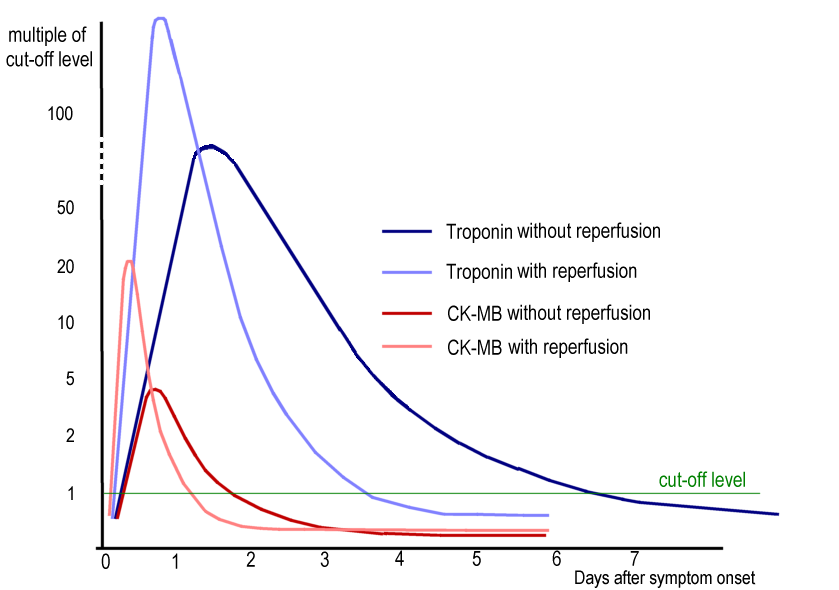
| Rise | 4–9 h after myocardial injury | An early draw can be normal during an evolving MI. |
| Peak | Within about 24 h; earlier and higher after successful reperfusion | Peak size correlates with infarct size and prognosis. |
| Return to baseline | 48–72 h | A late presenter can have a normal CK-MB despite an MI; troponin stays raised for days. |
| Best diagnostic window | ≥10–12 h after symptom onset, with serial samples over 24–48 h | Specificity is highest once enough time has passed; a single value is not diagnostic. |
| After PCI or CABG | Per institutional protocol, compared with the pre-procedure value | A raised baseline makes a new periprocedural MI hard to call. |
| Suspected reinfarction | Troponin at once and 3–6 h later | CK-MB is not the recommended test. |
Special Populations
| Population | What changes | Clinical implication |
|---|---|---|
| Neonates & infants | Highest values of life (URL about 14 ng/mL in the first month), falling quickly through the first year | Adult limits do not apply. Use the mass assay: activity methods are distorted by CK-BB and macro-CK. |
| Children & adolescents | Values keep falling with age; boys higher than girls from about 13 years | Use age-specific limits. Troponin is more specific and stays raised longer in suspected myocarditis or myocardial injury. |
| Pregnancy | No separate interval; the uterus contains CK-MB, and values can rise around delivery | A peripartum rise is not reliable evidence of MI; use troponin, ECG and echocardiography. |
| Older adults | No age-specific reference limits in routine use | Falls with muscle injury and kidney disease are common non-cardiac sources. |
| CKD / dialysis | Chronic kidney failure can raise CK-MB; troponin is often chronically raised | Look for a rise-and-fall pattern in troponin rather than a single high value. |
| Other | Endurance athletes carry more CK-MB in skeletal muscle; men have higher limits than women | Post-race rises can reflect muscle, not heart. Use sex-specific limits. |
Interfering Factors & Pitfalls
Collection & handling
| Factor | Effect | Why | Avoid / fix |
|---|---|---|---|
| Mixing assay types | ↑ or ↓ | Mass (ng/mL) and activity (U/L) results are different measurements | Trend on the same assay and lab; never compare ng/mL with U/L |
| Draw time unknown | Misread trend | CK-MB changes within hours | Label every sample with its draw time |
| Hemolysis | Assay-dependent; usually small for mass assays | Free hemoglobin and red-cell contents can interfere with some immunoassays | Check the lab's hemolysis index; ask for a redraw if the sample is grossly hemolysed |
Medications & supplements
| Factor | Effect | Why | Avoid / fix |
|---|---|---|---|
| Intramuscular injections | ↑ | Local skeletal muscle injury | Note recent IM injections; use troponin |
| High-dose biotin | ↓ (sandwich immunoassays) | Some mass assays use biotin-streptavidin capture | Ask about hair, skin and nail supplements; tell the lab when results do not fit |
Physiologic / biologic
| Factor | Effect | Why | Avoid / fix |
|---|---|---|---|
| Skeletal muscle injury | False + for heart injury | Skeletal muscle holds a small CK-MB fraction, more in regenerating or trained muscle | Calculate the relative index; check troponin |
| Macro-CK | False + (activity assay) | CK bound to immunoglobulin (type 1) or mitochondrial CK complexes (type 2) escape immunoinhibition | Mass assay or electrophoresis |
| CK-BB release | False + (activity assay) | Brain injury, malignancy, severe shock, hypothermia, newborns | Mass assay; suspect when CK-MB nears total CK |
Assay & device-specific
| Factor | Effect | Why | Avoid / fix |
|---|---|---|---|
| Immunoinhibition (activity) method | False + | Measures all non-M (B-subunit) activity and doubles it | Prefer a mass immunoassay |
| Single URL for both sexes | False − in women | Women's limits are lower | Use sex-specific limits |
Common misinterpretations
- "Normal CK-MB, so no MI": Wrong. It may be early, late or a small infarct. Troponin decides.
- "High CK-MB means heart damage": Trauma, seizures, rhabdomyolysis, shocks, delivery and an activity-assay artifact can all raise it. Heart damage is not the only answer.
- "Use CK-MB to time or detect reinfarction": That is legacy practice. Serial troponin is the standard.
- "CK-MB above total CK is a huge infarct": That is physically impossible. It marks an artifact.
Physiology & Test Basics
What it measures
This page covers creatine kinase MB (CK-MB), the heart-enriched isoenzyme of creatine kinase, measured in blood. Troponin is the heart-specific injury marker. Myoglobin is an early marker that is no longer recommended. Total CK tracks skeletal muscle injury, and CK-MB sits between them.
Physiology & regulation
- Enzyme: CK shuttles phosphate between creatine phosphate and ADP, keeping ATP supplied in high-energy tissue.
- Isoenzymes: Two subunits do the work: M (muscle) and B (brain). Combined, they make CK-MM, CK-MB and CK-BB.
- Heart: Roughly 20–45% of the heart's CK is MB. Estimates vary. The rest is MM.
- Skeletal muscle: Skeletal muscle holds only a few percent MB. Trained or regenerating muscle holds more.
- Other sources: uterus, tongue, diaphragm, small intestine and prostate.
- Release: It is a large molecule, so it shows up hours after injury and cannot pick up very small infarcts.
How it is measured
The mass immunoassay is preferred. It reports ng/mL (µg/L) on serum or plasma, in lithium-heparin (green-top), EDTA (lavender-top) or serum tubes, depending on the analyzer. The activity (immunoinhibition) assay blocks M-subunit activity, measures what is left and reports U/L. No fasting needed. Order it with total CK to calculate the relative index.
Why it matters
CK-MB was the standard MI marker before troponin. It still turns up on transfers, in cardiac surgery and in trial definitions of periprocedural MI. Know its short window and its many non-cardiac sources. That keeps you clear of both false reassurance and false alarms.
Clinical Pearls
References
- Thygesen, K., Alpert, J. S., Jaffe, A. S., Chaitman, B. R., Bax, J. J., Morrow, D. A., White, H. D., & ESC Scientific Document Group. (2019). Fourth universal definition of myocardial infarction (2018). European Heart Journal, 40(3), 237–269. https://doi.org/10.1093/eurheartj/ehy462
- Rao, S. V., O’Donoghue, M. L., Ruel, M., Rab, T., Tamis-Holland, J. E., Alexander, J. H., et al. (2025). 2025 ACC/AHA/ACEP/NAEMSP/SCAI guideline for the management of patients with acute coronary syndromes. Circulation, 151(13), e771–e862. https://doi.org/10.1161/CIR.0000000000001309
- Moussa, I. D., Klein, L. W., Shah, B., Mehran, R., Mack, M. J., Brilakis, E. S., Reilly, J. P., Zoghbi, G., Holper, E., & Stone, G. W. (2013). Consideration of a new definition of clinically relevant myocardial infarction after coronary revascularization: An expert consensus document from the Society for Cardiovascular Angiography and Interventions (SCAI) (landmark consensus definition). Journal of the American College of Cardiology, 62(17), 1563–1570. https://doi.org/10.1016/j.jacc.2013.08.720
- Paolucci, L., Nardi, G., Lombardi, M., Occhipinti, G., Mangiacapra, F., Vergallo, R., et al. (2025). Relationship between the current definitions of periprocedural myocardial infarction and clinical outcomes following percutaneous coronary revascularization. Reviews in Cardiovascular Medicine, 26(11), 43839. https://doi.org/10.31083/RCM43839
- Aydin, S., Ugur, K., Aydin, S., Sahin, İ., & Yardim, M. (2019). Biomarkers in acute myocardial infarction: Current perspectives. Vascular Health and Risk Management, 15, 1–10. https://doi.org/10.2147/VHRM.S166157
- Dong, K., Xing, J., Dai, Y., Song, X., Liu, J., Fu, M., Zhang, X., Zhang, L., & Yuan, E. (2024). Age- and sex-specific upper reference limits for cardiac biomarkers in Chinese children and adolescents: A prospective study. Scientific Reports, 14, 28295. https://doi.org/10.1038/s41598-024-77153-8
- Aengevaeren, V. L., Baggish, A. L., Chung, E. H., George, K., Kleiven, Ø., Mingels, A. M. A., et al. (2021). Exercise-induced cardiac troponin elevations: From underlying mechanisms to clinical relevance. Circulation, 144(24), 1955–1972. https://doi.org/10.1161/CIRCULATIONAHA.121.056208
- Garcia-Garcia, H. M., McFadden, E. P., Farb, A., et al. (2018). Standardized end point definitions for coronary intervention trials: The Academic Research Consortium-2 consensus document. European Heart Journal, 39(23), 2192–2207. https://doi.org/10.1093/eurheartj/ehy223
Medical Disclaimer
- For Educational Purposes Only: This content is intended for educational reference and should not be used for clinical decision-making.
- Not a Substitute for Professional Judgment: Always consult your local protocols, institutional guidelines, and supervising physicians.
- Verify Before Acting: Users are responsible for verifying information through authoritative sources before any clinical application.