

Bedside Snapshot
- Use It For
- Major or life-threatening warfarin bleeding (with 4F-PCC); INR above 10 without bleeding; newborn VKDB prophylaxis and treatment; vitamin K deficiency or rodenticide coagulopathy
- Adult Dose
- Major VKA bleed: 5–10 mg IV at ≤1 mg/min, + 4F-PCC
- Nonmajor bleed: 2–5 mg PO or IV
- INR above 10, no bleeding: 2.5–5 mg PO; hold warfarin
- Differs from FDA label: boxed warning avoids IV and IM unless subcut is not feasible
- Pediatric Dose
- Newborn prophylaxis: 1 mg IM once (label 0.5–1 mg; ≤1,500 g: 0.3–0.5 mg/kg IM); VKDB bleeding: 1 mg subcut or IM; child on warfarin: dose per pediatric hematology protocol, with 4F-PCC or plasma for significant bleeding
- Onset / Duration
- IV: detectable in 1–2 hr, INR often normal by 12–14 hr; PO: 6–10 hr; effect lasts until new factors are consumed, so the INR can rebound
- Do Not Give / Hold If
- Known hypersensitivity to phytonadione or excipients; never IV push (max 1 mg/min); reaction during infusion: stop; not for heparin or DOAC reversal
- Watch For
- Anaphylaxis during or just after IV/IM dose (flushing, dyspnea, hypotension); INR rebound after PCC; overcorrection with warfarin resistance in valve or clot patients
- Reversal / Rescue
- Reaction: stop infusion, IM epinephrine, airway and fluids. Inadequate response: recheck INR at 6–8 hr and repeat; add 4F-PCC or plasma 10–15 mL/kg for ongoing bleeding
- Must Remember
- Vitamin K takes hours, PCC takes minutes: for life-threatening warfarin bleeding give both, vitamin K 5–10 mg IV right after the 4F-PCC, or the INR rebounds when the PCC wears off
Indications
Emergency & Prehospital
- Major or life-threatening bleeding on warfarin or another vitamin K antagonist (VKA): intracranial hemorrhage, critical-site or hemodynamically significant bleeding; always given with 4F-PCC (or plasma if PCC is unavailable)
- Vitamin K deficiency bleeding (VKDB) in an infant: bruising, bleeding or signs of intracranial bleeding in a baby up to 6 months old, especially if the birth vitamin K shot was declined
- Long-acting anticoagulant rodenticide (superwarfarin) poisoning: brodifacoum and similar agents; high-dose, prolonged therapy guided by INR
ED / ICU / Transport
- Nonmajor bleeding on warfarin needing admission, a procedure or transfusion: low-dose oral or IV vitamin K without PCC
- INR above 10 on warfarin without bleeding: oral vitamin K with warfarin held; not routinely given for INR 4.5–10 without bleeding
- Warfarin reversal before an urgent procedure: IV vitamin K alongside 4F-PCC when the procedure cannot wait
- Hypoprothrombinemia from vitamin K deficiency: malabsorption (obstructive jaundice, biliary fistula, celiac disease, cystic fibrosis, bowel resection, inflammatory bowel disease), prolonged antibiotics, poor intake, or other drug interference such as high-dose salicylates
Other Uses
- Newborn VKDB prophylaxis: a single IM dose for every newborn at birth
- Coagulopathy of liver disease: a single trial dose (vitamin K deficiency range, protocol-dependent) only when deficiency may contribute, then recheck the INR; no benefit if synthetic function has failed
Dosing & Administration
The doses below come from ACC 2020, AHA/ASA 2022 and ASH 2018, wherever those guidelines name a dose. The INR above 10 row is not guideline-fixed. Differences from the FDA label are marked.
Available Forms
- Injectable emulsion, 10 mg/mL: 1 mL single-dose ampul (10 mg); adult strength; Hospira product contains polyoxyl 35 castor oil and benzyl alcohol 9 mg/mL
- Injectable emulsion, neonatal concentration 2 mg/mL: 1 mg/0.5 mL ampul, vial or prefilled syringe. Hospira's 1 mg/0.5 mL ampul contains benzyl alcohol (9 mg/mL); benzyl alcohol-free neonatal products exist (polysorbate 80 and propylene glycol vehicle). Check the label before giving it to a newborn
- Oral tablets: 5 mg, scored
- Usually stocked: the 10 mg/mL ampul in the ED, ICU and critical-care transport; the 1 mg/0.5 mL product in newborn care
Adult Dosing
| Indication | Dose & Route | Repeat / Max | Notes |
|---|---|---|---|
| Major or life-threatening bleeding on a VKA (incl. intracranial hemorrhage) | 5–10 mg IV, diluted, infused slowly (no faster than 1 mg/min) | Recheck INR after PCC and at 6–8 hr; repeat if INR rises. Label: up to 25–50 mg as a single dose; guidelines use 5–10 mg | Give with 4F-PCC (INR-based or fixed dose per protocol) or plasma 10–15 mL/kg if PCC is unavailable; give vitamin K right after PCC so the INR does not rebound. Differs from FDA label: the boxed warning says avoid IV and IM unless the subcutaneous route is not feasible |
| Nonmajor bleeding on a VKA needing admission, a procedure or transfusion | 2–5 mg PO or IV | Recheck INR (IV 6–8 hr, PO 12–48 hr); repeat if still high | Hold warfarin; local measures; no PCC |
| INR above 10, no bleeding | 2.5–5 mg PO | Recheck INR at 12–48 hr; repeat if still high | Hold warfarin. Low dose avoids overcorrection; dose is protocol-dependent |
| INR 4.5–10, no bleeding | Not routinely given: hold warfarin | — | ASH 2018: hold warfarin temporarily without vitamin K |
| Vitamin K deficiency (malabsorption, antibiotics, poor intake); trial in liver disease | 2.5–25 mg subcut, IM or IV; 2.5–25 mg PO if absorption is intact | Recheck INR at 6–8 hr (parenteral) or 12–48 hr (PO) and repeat; up to 50 mg as a single dose | Oral tablets need bile salts in biliary obstruction; use a parenteral route if absorption is poor. Liver disease: one trial dose per protocol; do not repeat large doses if the INR does not respond (label) |
| Long-acting anticoagulant rodenticide (superwarfarin) | High-dose PO for weeks to months, titrated to INR | No fixed max: case reports 25–600 mg/day | Poison center or toxicology consult; INR guides dose and duration; add PCC or plasma for active bleeding |
Pediatric Dosing
| Indication | Dose (per kg) & Route | Max Single / Max Total | Notes |
|---|---|---|---|
| Newborn prophylaxis, birth weight over 1,500 g | 1 mg IM once, within 6 hr of birth (label: 0.5–1 mg IM within 1 hr) | Single dose | Use the 1 mg/0.5 mL neonatal concentration, benzyl alcohol-free product when available; oral regimens are less effective |
| Newborn prophylaxis, 1,500 g or less | 0.3–0.5 mg/kg IM once | Single dose; a single IV dose is not recommended for prophylaxis | Benzyl alcohol-free product; premature infants are most vulnerable to benzyl alcohol and aluminum |
| VKDB with bleeding (newborn, or infant up to 6 months) | 1 mg subcut or IM (higher if the mother took oral anticoagulants) | Repeat per INR; INR should shorten within 2–4 hr | No response in 2–4 hr suggests another coagulation disorder. Severe or intracranial bleeding: add blood components (plasma or PCC) with pediatric hematology |
| Child on warfarin with high INR or bleeding (specialist use) | Dose per pediatric hematology or institutional protocol | Per protocol | Give with 4F-PCC or plasma for significant bleeding. The FDA label has not established safety and effectiveness in children 6 months to 17 years and gives no pediatric warfarin-reversal dose |
See weight-based dosing for pediatric calculations.
Preparation & Administration
- Dilution (IV): 0.9% sodium chloride, D5W or D5/0.9% sodium chloride only; the ACC pathway uses 25–50 mL normal saline over 15–30 min. Start immediately after dilution and discard the unused portion
- Push rate: never IV push; no faster than 1 mg/min
- Reaction readiness: Watch the patient the whole time, and just after the infusion, with anaphylaxis drugs at the bedside. Reactions happen despite dilution, and on the first dose.
- Light protection: keep ampuls in their tray or carton until use; protect from light at all times
- Subcut: a poor choice for urgent reversal. Absorption is unpredictable and too slow. For non-urgent correction, use oral.
- IM: the standard route for newborn prophylaxis. In bleeding or anticoagulated adults, avoid it because of hematoma
- PO: the tablet route for non-urgent correction. Absorption needs bile salts.
Dosing Notes:
- Use the lowest dose that works. Large doses overcorrect the INR, and the patient stays resistant to warfarin for days.
- In every order for VKA-associated major bleeding, name PCC and vitamin K together.
Contraindications & Precautions
Contraindications
- Hypersensitivity to phytonadione or any component (polyoxyl 35 castor oil, benzyl alcohol, polysorbate 80, depending on product)
Precautions
- Neonates and infants: preserved products contain benzyl alcohol, which carries the risk of gasping syndrome. Pick a benzyl alcohol-free formulation when it is available, and add up the benzyl alcohol from every source.
- High thrombotic risk (mechanical valve, recent VTE or stroke): too much correction brings back the original clot risk, and the patient becomes resistant to warfarin. Use the lowest effective dose.
- Liver disease: a poor response means the liver cannot make the factors. Repeated large doses are not warranted.
- Prolonged parenteral use in renal impairment or prematurity: over a long parenteral course, aluminum from the product can build up.
Hold / Reassess If
- Flushing, chest pain, dyspnea, cyanosis, sweating, tachycardia or hypotension during the infusion: stop and treat as anaphylaxis
- INR not falling 6–8 hr after a parenteral dose, or 12–48 hr after oral: repeat the dose or look for another cause
- Newborn INR not shortened 2–4 hr after a treatment dose: consider another coagulation disorder
- New eczematous or scleroderma-like skin lesions after a parenteral dose (onset up to a year later): stop
FDA Boxed Warning: Fatal hypersensitivity reactions, anaphylaxis included, have struck during and right after IV and IM injection. Diluted doses and first doses are not spared. Avoid IV and IM use unless the subcutaneous route is not feasible and the serious risk is justified, the label says. Differs from FDA label: for life-threatening warfarin bleeding, the guideline route is slow IV (ACC 2020, AHA/ASA 2022).
Adverse Effects & Toxicity
Common
- Flushing and sweating
- Altered taste (dysgeusia) and dizziness
- Tachycardia and hypotension
- Dyspnea or cyanosis (may herald anaphylaxis)
- Injection-site pain, swelling and tenderness
- The label lists these as the most common reactions, but no rates are given (postmarketing reports)
Serious / Life-Threatening
| Effect | Recognition | Management |
|---|---|---|
| Anaphylaxis or anaphylactoid reaction | During or just after IV or IM dose: flushing, chest pain, dyspnea, hypotension, shock, cardiorespiratory arrest | Stop infusion; IM epinephrine, airway, fluids; switch to PO or subcut if more vitamin K is needed |
| Thrombosis after overcorrection | New clot, valve thrombosis or stroke after full INR correction in a high-risk patient | Use lowest effective dose; restart anticoagulation when bleeding allows; heparin if warfarin is resisted |
| Benzyl alcohol toxicity (gasping syndrome) | Neonates and infants: gasping respirations, metabolic acidosis, CNS depression, hypotension | Benzyl alcohol-free product; total benzyl alcohol load from all drugs |
| Newborn hemolysis and hyperbilirubinemia | Jaundice and anemia after excessive doses, especially in premature infants | Correct dose and strength; follow bilirubin |
| Delayed cutaneous reactions | Eczematous plaques, urticaria, scleroderma-like patches 1 day to 1 year after parenteral use | Stop; dermatology management |
Overdose & Toxicity Management
- Adults: No specific toxic syndrome exists. The main harm from excess is overcorrection and temporary resistance to warfarin. That may call for higher warfarin doses or a switch to heparin.
- Newborns: Hemolysis, jaundice and hyperbilirubinemia. Premature infants are hit hardest. Management is supportive care and bilirubin monitoring.
- Antidote: There is no separate antidote. Vitamin K is itself the antidote for VKA and rodenticide anticoagulants.
Monitoring
| Parameter | When / How Often | Target / Act If |
|---|---|---|
| Clinical: vital signs and airway | Continuously during an IV infusion and for the period just after | Flushing, dyspnea, hypotension or chest pain: stop, treat as anaphylaxis |
| Clinical: bleeding and neuro checks | Every assessment; serial neuro exams in intracranial hemorrhage | Expanding hematoma or new deficit: repeat INR, more PCC per protocol, imaging |
| Laboratory: INR | Baseline; after PCC per protocol; 6–8 hr after IV vitamin K; 12–48 hr after PO | Not falling or rebounding: repeat vitamin K; persistent elevation: look for another cause (PT/INR) |
| Laboratory: Hgb, platelets, fibrinogen | Baseline and serially while bleeding | Falling Hgb: transfuse and find the source (hemoglobin, fibrinogen) |
| Laboratory: newborn INR | 2–4 hr after a VKDB treatment dose | Not shortened: consider another coagulation disorder; hematology consult |
| Laboratory: rodenticide INR | Serially through therapy and after each dose reduction or stop | INR rising again: resume or increase vitamin K; therapy may last months |
| Clinical: thrombosis | After reversal in mechanical valve, recent VTE or stroke | Plan restart of anticoagulation with the team once bleeding is controlled |
Interactions & Compatibility
Clinically Significant Interactions
| Drug / Class | Effect | What To Do |
|---|---|---|
| Warfarin and other VKAs, anticoagulant rodenticides | Vitamin K antagonizes them; large doses cause temporary warfarin resistance | Lowest effective dose; higher warfarin doses or a different anticoagulant class (heparin) may be needed when restarting |
| Heparin, enoxaparin | No effect on heparin anticoagulation | Protamine for heparin reversal |
| DOACs (apixaban, rivaroxaban, edoxaban, dabigatran) | Not reversed by vitamin K | Idarucizumab for dabigatran; 4F-PCC for factor Xa inhibitors (apixaban, rivaroxaban, edoxaban), per protocol. Andexanet alfa has not been sold in the US since December 2025 (FDA safety communication) |
| Prolonged broad-spectrum antibiotics, especially N-methylthiotetrazole (NMTT) side-chain cephalosporins such as cefotetan; high-dose salicylates | Can cause hypoprothrombinemia by interfering with vitamin K | Check INR in malnourished or prolonged-course patients; treat with vitamin K |
| Other benzyl alcohol-containing drugs (neonates, infants) | Additive benzyl alcohol load | Use a benzyl alcohol-free vitamin K product |
IV Compatibility
- Dilute only in 0.9% sodium chloride, D5W or D5/0.9% sodium chloride; avoid diluents that contain benzyl alcohol
- Start immediately after dilution; protect from light
- Give through its own line or a flushed line; no Y-site data supplied in the labeling
- Verify with an institutional compatibility resource.
Special Populations
- Pediatrics: the label only establishes use in neonates. Safety and effectiveness from 6 months to 17 years are not established, which makes pediatric warfarin reversal a hematology decision. Use benzyl alcohol-free products when available. See the Pediatric Dosing table.
- Neonates: newborns start with low vitamin K stores. Without the birth shot, an infant is 81 times more likely to get late VKDB. Late VKDB shows up between 1 week and 6 months, most often at 2–8 weeks. Of those late cases, 30–60% bleed into the brain. Exclusive breastfeeding, maternal anticonvulsants or isoniazid, liver disease and malabsorption all add risk.
- Pregnancy: published studies show no clear link to adverse developmental outcomes. Vitamin K crosses the placenta at lower levels than maternal plasma. Maternal deficiency raises bleeding risk at delivery, and it has been implicated in fetal intracranial hemorrhage. When it is indicated, give it, and prefer a benzyl alcohol-free product.
- Lactation: it is present in breast milk. There are no data on the breastfed infant or on milk production. Give it when indicated. The label recommends a preservative-free (benzyl alcohol-free) product.
- Older Adults: no specific adjustment is established, so start at the low end of the range. Many older adults carry high thrombotic risk (AF, valves). Avoid overcorrection.
- Renal Impairment: no dose adjustment is established. With prolonged use, aluminum in parenteral products can build up.
- Hepatic Impairment: no dose adjustment is set. The response depends on how much synthetic function remains. If the first dose fails, do not repeat large doses.
- Obesity / Dosing Weight: adult doses are fixed, not weight-based. No specific adjustment is established.
Field & Transport Considerations
- Scope: It is given in the ED, the ICU and during critical-care transport (RN/CCT). Ground EMS rarely carries it. Scope varies by state and agency protocol.
- Storage & Stability: Store at 20–25°C (68–77°F). Keep ampuls in their tray, protected from light. Once diluted, start the infusion right away.
- Carried Concentration: the adult ampul is 10 mg/mL. The neonatal product is 1 mg/0.5 mL (2 mg/mL). Confirm the strength before you draw up a newborn dose.
- Infusions in Transport: IV vitamin K and PCC may be running during an interfacility transfer for intracranial hemorrhage. Use a pump, keep the rate at or below 1 mg/min, and have epinephrine ready.
- Home Births and Sick Infants: for an infant with bruising, bleeding, vomiting, lethargy or seizures, ask whether vitamin K was given at birth. Then report it.
- Handoff Essentials: anticoagulant and last dose time, presenting INR with time, vitamin K dose, route and time, PCC or plasma dose and time, any reaction, and next INR due.
Clinical Pearls
Vitamin K Alone Is Too Slow: IV vitamin K takes hours to bring the INR down. For life-threatening warfarin bleeding, give 4F-PCC now, plus IV vitamin K. Skip the vitamin K, and the INR climbs again once the PCC factors get used up.
Exam Discriminator: Which Antidote?: Vitamin K reverses only the vitamin K antagonists. Match the antidote to the anticoagulant on board.
- Warfarin: 4F-PCC plus IV vitamin K
- Dabigatran: idarucizumab
- Apixaban, rivaroxaban or edoxaban: 4F-PCC per protocol (andexanet withdrawn from the US market, December 2025)
- Heparin: protamine
Ask About the Birth Shot: Unexplained bruising, vomiting, irritability or a seizure in a 2–8-week-old? That could be late VKDB with intracranial bleeding. Ask whether vitamin K was given. Most cases give no warning before the bleed.
Route: Subcut is too slow for this. Give 5–10 mg IV, diluted and no faster than 1 mg/min, with 4F-PCC, monitoring and anaphylaxis drugs at the bedside, per ACC 2020 and AHA/ASA 2022. For non-urgent correction, use oral. With no bleeding and an INR of 4.5–10, skip the vitamin K and hold warfarin, per ASH 2018. Differs from FDA label: the boxed warning says avoid IV and IM unless subcut is not feasible.
Less Is More After a Valve: Restarting warfarin with a mechanical valve? Give only enough vitamin K to control the bleeding. Large doses leave warfarin ineffective for days.
No Response Tells You Something: INR still high after adequate vitamin K? That tells you something. It points to liver failure, another coagulation disorder, an anticoagulant vitamin K cannot reverse (such as a DOAC) or an unrecognized superwarfarin. A superwarfarin needs far larger and longer dosing. Do not simply keep repeating standard doses.
Superwarfarin Rebound: Brodifacoum sticks around, with a half-life of 16–62 days. A short course of vitamin K lets the INR rebound. These patients need months of oral therapy, with the INR as the guide.
Pharmacology
Mechanism of Action
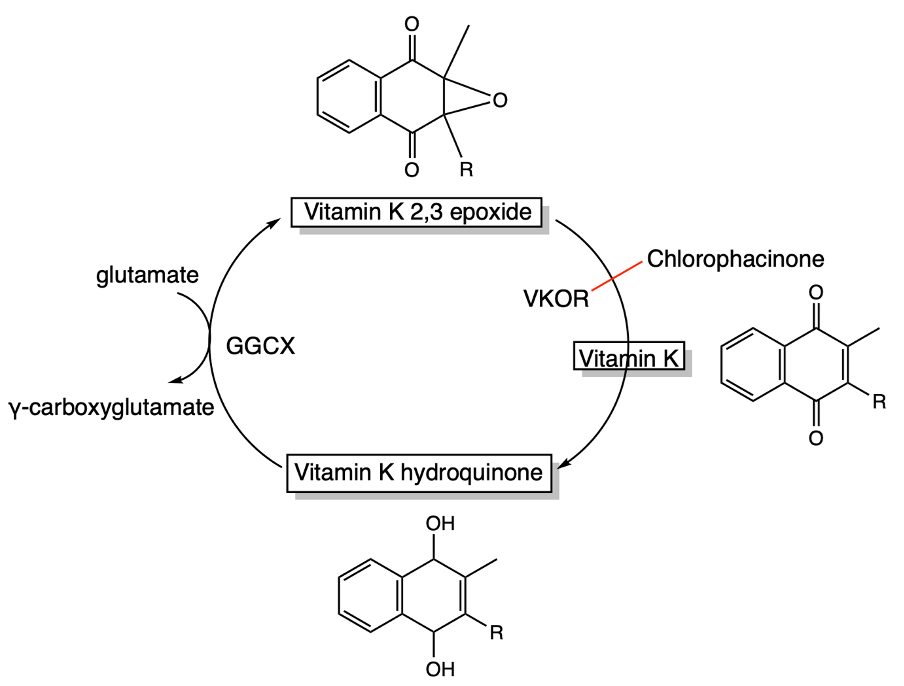
- Vitamin K is the cofactor for γ-glutamyl carboxylase. The enzyme carboxylates factors II, VII, IX and X, and proteins C and S. Once carboxylated, the factors bind calcium and phospholipid and become active.
- Carboxylation turns vitamin K into its epoxide. Vitamin K epoxide reductase (VKOR) recycles that epoxide. Warfarin and rodenticide anticoagulants block VKOR.
- Supplying vitamin K gets past the block, in a dose-dependent way. The liver then makes new functional factors over hours.
- Vitamin K does nothing to factors already circulating, to heparin or to DOACs. In people with normal vitamin K stores, it has virtually no activity.
Pharmacokinetics
| Route | Onset | Peak | Duration |
|---|---|---|---|
| IV | Detectable in 1–2 hr; INR falls by 4–6 hr | Bleeding controlled in 3–6 hr; INR often normal by 12–14 hr | Until the new factors are consumed; rebound if VKA persists |
| PO | 6–10 hr | INR falls over 18–24 hr | As for IV |
| Subcut | Unpredictable | Unpredictable | — |
| IM | Readily absorbed | — | Newborn: one dose protects against late VKDB |
- Half-life: terminal elimination about 14 hr (±6) after IV
- Absorption: oral bioavailability is about 50%, and it varies a lot. Bile salts are needed.
- Distribution: it concentrates in the liver first, then drops off quickly. Little builds up in tissues.
- Metabolism and elimination: poorly characterized. Almost no unchanged drug shows up in bile or urine.
Names & Classification
- Generic Name
- Phytonadione (vitamin K1; phytomenadione outside the US)
- Brand Names
- Vitamin K1 Injection (Hospira); Mephyton (oral tablets); most US products are generic
- Pharmacologic Class
- Fat-soluble vitamin (naphthoquinone); vitamin K replacement
- Therapeutic Class
- Warfarin (VKA) reversal agent; antidote for anticoagulant rodenticides; newborn VKDB prophylaxis
- Controlled Substance
- Not controlled
- ISMP High-Alert
- No
- Look-Alike / Sound-Alike
- None commonly reported; strength mix-up risk between the 1 mg/0.5 mL neonatal product and the 10 mg/mL adult ampul
References
- Hospira, Inc. (2026). Vitamin K1 Injection (phytonadione injectable emulsion, USP): Prescribing information. DailyMed, U.S. National Library of Medicine. https://dailymed.nlm.nih.gov/dailymed/drugInfo.cfm?setid=e8808230-2c44-44c6-8cab-8f29b6b34051
- Major Pharmaceuticals. (2026). Phytonadione tablets, USP: Prescribing information. DailyMed, U.S. National Library of Medicine. https://dailymed.nlm.nih.gov/dailymed/drugInfo.cfm?setid=54f23bc8-d8f3-40e8-a93d-3121cc581d54
- Tomaselli, G. F., Mahaffey, K. W., Cuker, A., et al. (2020). 2020 ACC expert consensus decision pathway on management of bleeding in patients on oral anticoagulants. Journal of the American College of Cardiology, 76(5), 594–622. https://doi.org/10.1016/j.jacc.2020.04.053
- Witt, D. M., Nieuwlaat, R., Clark, N. P., et al. (2018). American Society of Hematology 2018 guidelines for management of venous thromboembolism: Optimal management of anticoagulation therapy. Blood Advances, 2(22), 3257–3291. https://doi.org/10.1182/bloodadvances.2018024893
- Greenberg, S. M., Ziai, W. C., Cordonnier, C., et al. (2022). 2022 guideline for the management of patients with spontaneous intracerebral hemorrhage: A guideline from the American Heart Association/American Stroke Association. Stroke, 53(7), e282–e361. https://doi.org/10.1161/STR.0000000000000407
- Hand, I., Noble, L., & Abrams, S. A. (2022). Vitamin K and the newborn infant. Pediatrics, 149(3), e2021056036. https://doi.org/10.1542/peds.2021-056036
- Centers for Disease Control and Prevention. (2025). About vitamin K deficiency bleeding. https://www.cdc.gov/vitamin-k-deficiency/about/index.html
- Bekka, E., & Liakoni, E. (2025). Anticoagulation reversal (vitamin K, prothrombin complex concentrates, idarucizumab, andexanet-α, protamine). British Journal of Clinical Pharmacology, 91(3), 604–614. https://doi.org/10.1111/bcp.16142
- Food and Drug Administration. (2025). Update on the safety of Andexxa by AstraZeneca: FDA safety communication (December 18, 2025). https://www.fda.gov/safety/medical-product-safety-information/update-safety-andexxa-astrazeneca-fda-safety-communication
Medical Disclaimer
- For Educational Purposes Only: This content is intended for educational reference and should not be used for clinical decision-making.
- Not a Substitute for Professional Judgment: Always consult your local protocols, institutional guidelines, and supervising physicians.
- Verify Before Acting: Users are responsible for verifying information through authoritative sources before any clinical application.
AI Assistance Notice
AI was used to assist in organizing, paraphrasing, and formatting this information.