

Bedside Snapshot
- Indications
- Unresponsive patient with tongue or soft-tissue airway obstruction
- Snoring, gurgling or secretions the airway cannot clear
- Maintaining patency during bag-valve-mask ventilation
- Contraindications / Abort
- OPA: avoid if gag reflex is intact (vomiting, laryngospasm)
- NPA: avoid if basilar skull fracture is suspected
- NPA: prefer an OPA in severe coagulopathy (AHA 2025, COR 2a); use with care on anticoagulants or after nasal obstruction or nasal surgery
- Adult suction pass over 15 s (shorter in children), or SpO₂ falling: stop and oxygenate
- Critical Steps
- Head-tilt chin-lift; jaw thrust without head extension if trauma is suspected (head-tilt if that fails)
- Size the OPA from incisors to jaw angle, then check the fit
- Preoxygenate before suction when time allows
- Confirm & Monitor
- Chest rise and audible airflow after every maneuver
- Continuous SpO₂; reassess after every move
- Recovery position if breathing normally and no trauma
Key Numbers
Airway obstruction in an unresponsive patient is fixed by positioning first. Add an adjunct only when positioning fails, and suction only in short, controlled passes.
| Parameter | Value |
|---|---|
| Opening maneuver | Head-tilt chin-lift; jaw thrust without head extension when trauma is suspected, then head-tilt chin-lift if a jaw thrust with an adjunct does not open the airway (2025 AHA Part 7, COR 1) |
| Suction per pass | Adult: 15 s maximum (AARC 2022 artificial-airway limit) Child: shorter, per protocol (commonly about 10 s) Infant: shorter, per protocol (commonly about 5 s) |
| Suction vacuum limit | Set per device and local protocol. AARC artificial-airway limits (written as below −120 and −200 mmHg): vacuum no stronger than 120 mmHg in neonates and children, 200 mmHg in adults. |
| Oropharyngeal airway (OPA) size | Distance from upper incisors to angle of the jaw, then check the fit |
| OPA contraindication | Intact gag reflex: do not insert |
| Nasopharyngeal airway (NPA) contraindication | Suspected basilar skull fracture: avoid |
| Recovery position | Unresponsive with normal breathing and no trauma |
| Preoxygenation | Before suction when time allows (adult and pediatric) |
Overview & Principles
Basic airway management keeps the upper airway open and clear so the patient can breathe. Positioning, an oral or nasal adjunct and suction do the work. It is the first rung of airway care, ahead of bag-valve-mask (BVM) ventilation, a supraglottic airway or intubation.
How It Works
- Positions the airway: head-tilt chin-lift lifts the tongue off the back of the throat. Jaw thrust lifts the jaw without extending the neck.
- Holds the tongue back: an oropharyngeal airway (OPA) keeps the tongue from closing off the pharynx of an unresponsive patient.
- Offers a nasal route: with an intact gag reflex, a nasopharyngeal airway (NPA) is better tolerated than an OPA.
- Clears secretions: suction removes the vomit, blood and secretions the airway cannot clear on its own.
Where It Fits
Run it in order: position, adjunct, suction, then ventilate. When those fail, move up to bag-valve-mask (BVM) ventilation, a supraglottic airway or intubation. The intubation and cricothyrotomy pages cover the next rungs. Here's the catch: an OPA or NPA does not seal the airway. The recovery position guards against vomit and secretions, but the evidence is limited.
Indications & Contraindications
Indications
- Unresponsive patient whose tongue or soft tissues obstruct the airway, with snoring, gurgling or labored breathing.
- Vomit, blood or secretions the patient cannot clear, needing suction.
- Maintaining an open airway during bag-valve-mask ventilation, using an OPA or NPA as an adjunct (2025 AHA Part 7, COR 2b, LOE C-EO).
- Recovery position for an unresponsive patient with normal breathing and no trauma.
Absolute Contraindications
Nothing rules these out when the airway is obstructed. No contraindication applies to positioning or suction in an unresponsive patient who is not breathing adequately.
Relative Contraindications & Cautions
- OPA with an intact gag reflex: an OPA can provoke vomiting and laryngospasm. When no skull-base fracture is suspected, use an NPA instead. Picking an NPA over an OPA with an intact reflex is practice-level guidance. It is not AHA-sourced. AHA Part 7 rec 3 (COR 2b) supports airway adjuncts in unresponsive adults with no cough or gag reflex.
- NPA with suspected basilar skull fracture: not advisable. A midface fracture can also displace the maxilla and block the NPA route.
- Suspected spinal injury: reach for a jaw thrust without head extension, with the neck kept in line. If a jaw thrust with an adjunct still leaves the airway closed, switch to head-tilt chin-lift (2025 AHA Part 7, COR 1, LOE C-EO).
- Recovery position: for nontraumatic patients who are unresponsive and breathing. The 2022 systematic review (Douma et al.) looked at patients who did not need resuscitation. It found limited evidence. After return of circulation, follow local protocol.
- NPA with bleeding risk: with a known or suspected basilar skull fracture or severe coagulopathy, an OPA is the preferred device (2025 AHA Part 7, COR 2a, LOE C-LD). On anticoagulant therapy, or after nasal obstruction or recent nasal surgery, use an NPA with care. Epistaxis is the main complication.
Consider an Alternative
Once an adjunct fails to hold the airway, or the patient fails to oxygenate, change tack. The options are BVM with a two-person seal, a supraglottic airway or intubation, per protocol. For the advanced sequence, read the intubation page.
Abort / Stop Criteria
- Vomiting or laryngospasm after an OPA: remove the device and turn the patient to the recovery position if no trauma is suspected.
- Adult suction pass longer than 15 s (shorter limit for children per protocol), or SpO₂ falling during suction.
- Airway still obstructed despite positioning and an adjunct: escalate per protocol.
Scope & Team Roles
| Provider Level | Typical Role | Notes |
|---|---|---|
| EMR | Performs (protocol/credentialing required) | Scope is set by state. The 2019 National EMS Scope of Practice Model was not checked; confirm locally. |
| EMT | Performs (protocol/credentialing required) | Positioning, suction and OPA or NPA only as state protocol allows. |
| AEMT | Performs (protocol/credentialing required) | Same airway skills as EMT, under local protocol. |
| Paramedic | Performs | Positioning, suction and adjuncts; advanced airways are a separate scope. |
| RN (ED/ICU) | Performs | Positioning, suction and adjuncts per facility policy. |
| Critical Care Transport (CFRN / CTRN / FP-C / CCP-C) | Performs | Maintains the airway during transport; credentialing per program. |
| Physician / APP | Performs | Escalates to advanced airway management. |
Team Roles During the Procedure
- Airway operator: positions the head or jaw and places the adjunct.
- Suction operator: runs the suction, times each pass and watches the vacuum.
- Monitor and recorder: watches SpO₂ and breathing, times suction and documents.
Pre-Procedure Assessment
Two questions tell you which tools are safe. Is the patient breathing adequately? Is the gag reflex intact?
Responsiveness and Breathing
- Look, listen and feel: noisy, gurgling or absent breathing points to obstruction or a secretion problem.
- Gag reflex and consciousness: an OPA is for the patient without a gag reflex. An intact reflex points you to an NPA or another approach.
Trauma and Spine
When spinal injury is suspected, the jaw thrust comes first, with no head extension and the neck kept in line. If it does not open the airway, go to head-tilt chin-lift (2025 AHA Part 7, COR 1). Suspect a skull-base or midface fracture? Then no NPA. Look in the mouth for blood, vomit, loose teeth or dentures.
Anatomy & Landmarks
Responsiveness, gag reflex and trauma status pick the maneuver or device. Start there.
| Site | Best For | Landmark or Check | Size or Depth | Avoid If |
|---|---|---|---|---|
| Head-tilt chin-lift | Unresponsive patient, no trauma suspected | Hand on forehead; fingertips under the bony chin | Tilt the head back to lift the chin | Spinal injury suspected (use jaw thrust), unless a jaw thrust with an adjunct fails to open the airway (2025 AHA Part 7, COR 1) |
| Jaw thrust | Trauma with spinal injury suspected | Angles of the lower jaw, behind the ears | Lift the jaw forward, head stays in line | No trauma suspected: head-tilt is the standard first step. If a jaw thrust with an adjunct does not open the airway, use head-tilt chin-lift (2025 AHA Part 7, COR 1) |
| Oropharyngeal airway | Unresponsive, no gag reflex | Upper incisors to angle of the jaw | Size from that distance (ERC method); too large reaches the epiglottis | Intact gag reflex (vomiting, laryngospasm) |
| Nasopharyngeal airway | Intact gag reflex, airway needs an adjunct | Nostril and the device size chart | Little-finger diameter; length from nostril tip to tragus; device chart governs | Suspected basilar skull or midface fracture; bleeding risk (use with care) |
Head Position
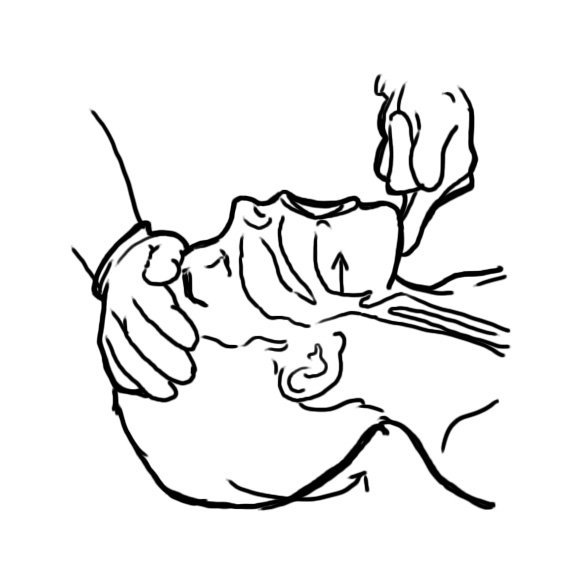
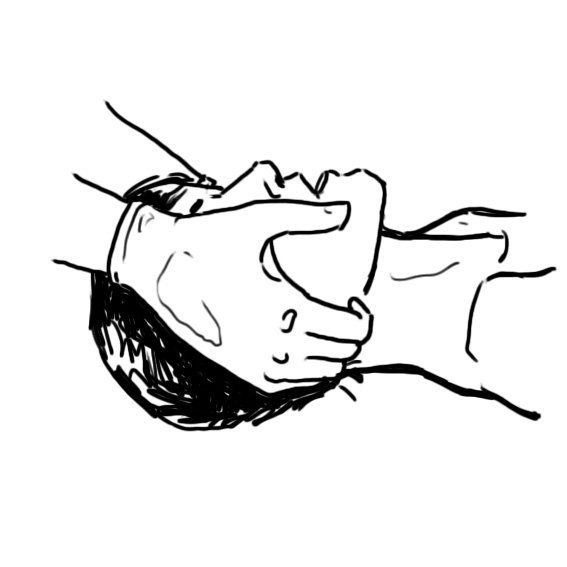
Oropharyngeal Airway (Mouth)
- Confirm the indication: unresponsive patient with no gag reflex. Suction the mouth first.
- Measure: measure from the upper incisors to the angle of the jaw. This distance selects the size.
- Insert: tip toward the palate, then rotate 180° as the device passes the tongue (Figure 3). This is for adults and larger children; see Pediatric for infants and small children.
- Check the fit: the tip should sit behind the tongue without touching the epiglottis. A tip that touches the epiglottis suggests the device is too large.
- Reassess: look for chest rise and check SpO₂. Remove the OPA if it provokes gagging.
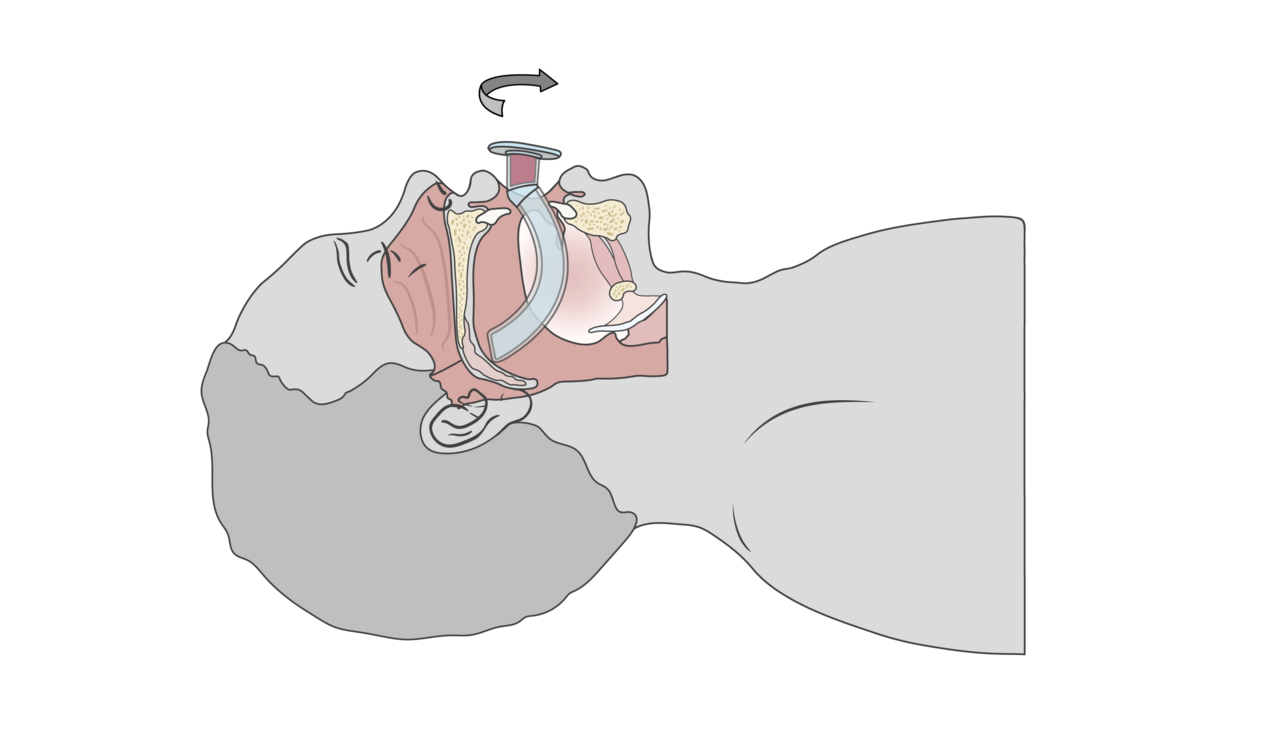
Pediatric
Measure the same way, from incisor to angle. In infants and small children, go in along the natural curve with a tongue depressor guiding the tongue. Don't rotate it 180°. Rotation risks palatal and soft-tissue trauma. A 2023 MRI study of 94 children (mean age 4.7 years) found that 47.9% of OPAs sized this way were proper, 23.4% were undersized and 28.7% were oversized. Size alone will not tell you the fit, so check the tongue position.
Nasopharyngeal Airway (Nose)
- Confirm the indication: intact gag reflex and no suspected skull-base or midface fracture.
- Choose the size: use the device chart. As a check, the diameter should be about the patient's little finger, and the length should run from the nostril tip to the tragus (ear opening).
- Insert gently: lubricate the tube, use the more patent nostril, and direct the bevel toward the septum. Advance straight back along the floor of the nose, per the device instructions. Stop and reassess if there is resistance.
- Reassess: confirm chest rise, breath sounds and SpO₂. Check for bleeding from the nostril.
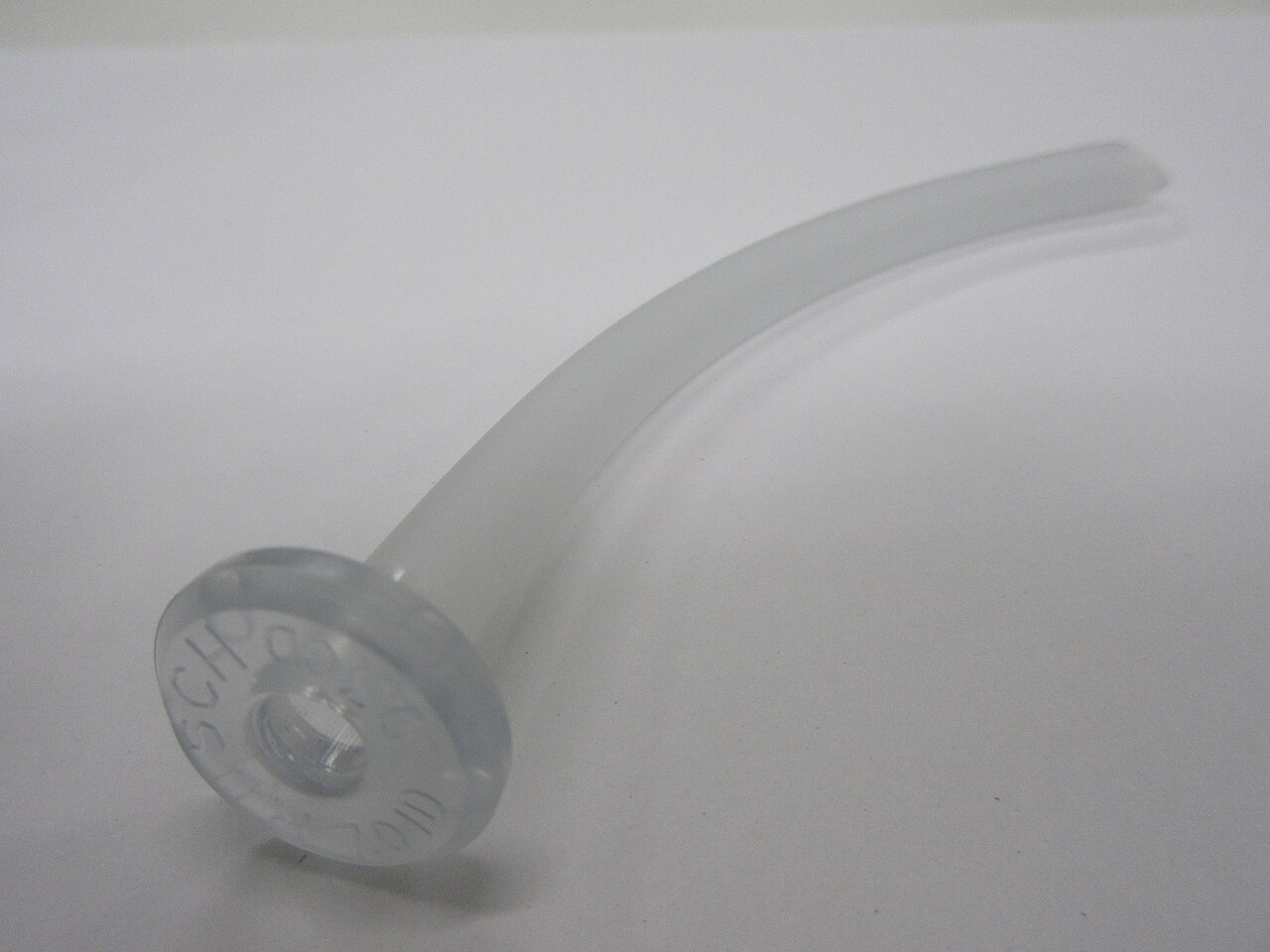
Pediatric
For a child, size from the device chart, then run the same nostril-tip-to-tragus check. Follow your pediatric protocol.
Equipment & Preparation
Equipment
| Item | Size / Spec | Notes |
|---|---|---|
| Oropharyngeal airways | Set of sizes from the device chart | Measure first; keep one size up and one size down. |
| Nasopharyngeal airways | Set of sizes, flanged | Lubricant ready. Keep a smaller size available. |
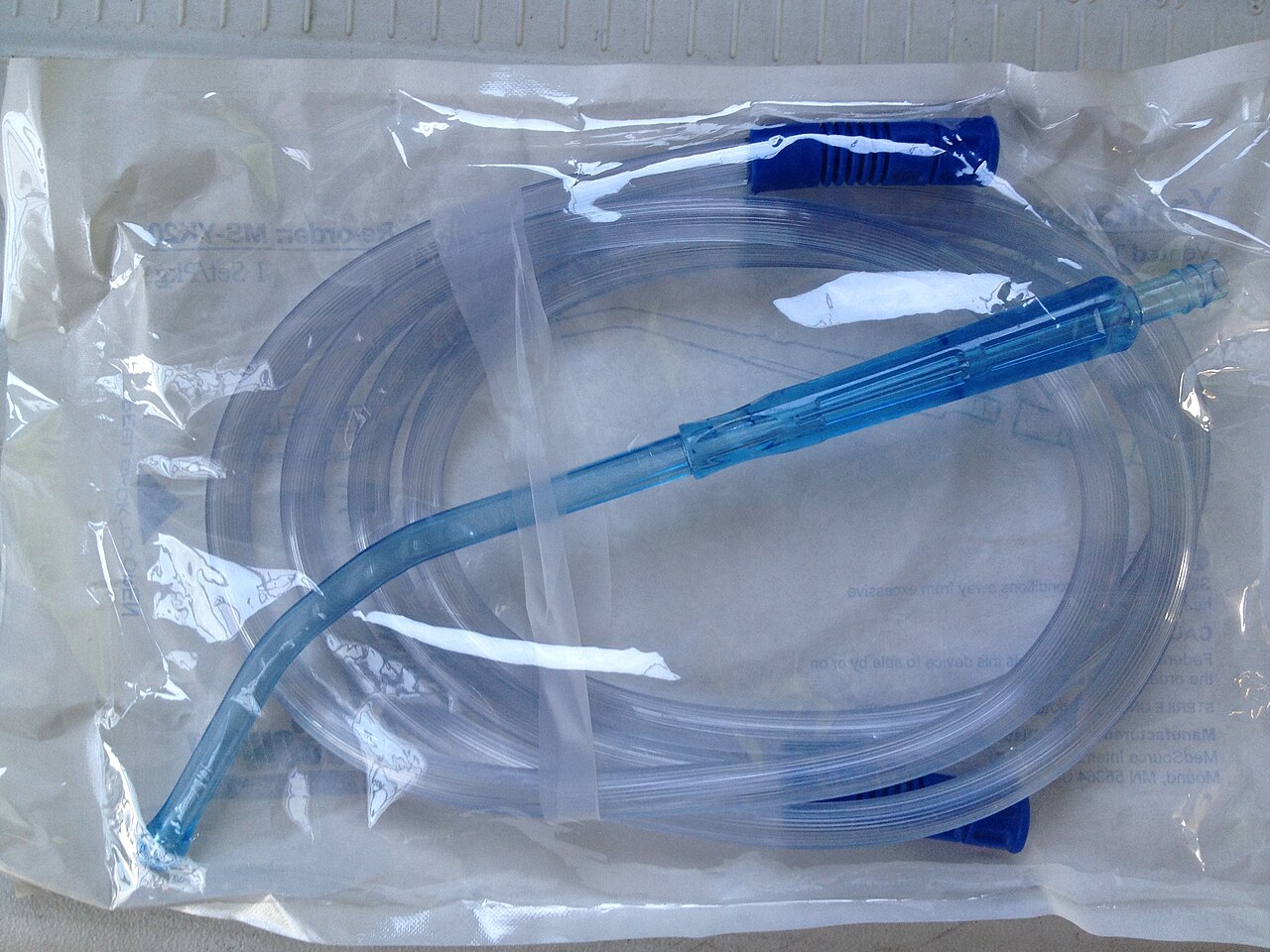
| Rigid suction tip | Yankauer, curved | Use for the mouth. Check the tip is intact before use. |
| Flexible suction catheter | Sized to the patient per protocol | Use only where your protocol calls for it. |
| Suction unit with vacuum gauge | Adjustable vacuum | Set the vacuum within the limits in Key Numbers before use. |
| Bag-valve-mask and oxygen | Adult and pediatric sizes | Ready for ventilation as soon as the adjunct is placed. |
| Pulse oximeter | Continuous SpO₂ | Monitor from the start to handoff. |
Sizing and Limits
| Item | Adult | Pediatric |
|---|---|---|
| OPA | Upper incisors to jaw angle, matched to the device chart | Same distance; no 180° rotation in infants and small children; fit checked by tongue position |
| NPA | Device chart; check little-finger diameter and nostril-to-tragus length | Device chart by size; follow protocol |
| Suction time per pass | 15 s maximum (AARC 2022 artificial-airway limit) | Shorter per protocol (commonly about 10 s in children, 5 s in infants) |
| Suction vacuum | Per device and protocol; AARC artificial-airway ceiling 200 mmHg (not an oral-suction limit) | Per device and protocol; AARC artificial-airway ceiling 120 mmHg for neonates and children (not an oral-suction limit) |
Settings vary by protocol. Follow local protocols and medical direction. Avoid routine saline instillation before suction per the AARC 2022 guideline.
Patient Positioning & Preparation
Keep the patient supine unless spinal injury is suspected or the recovery position is needed. Preoxygenate with high-flow oxygen before suction when time allows.
Pre-Procedure Checklist
- Patient responsiveness and breathing checked; help called.
- Gag reflex status and trauma (spinal or facial) known.
- Suction unit tested and the vacuum set within limits.
- Rigid suction tip and tubing connected and intact.
- OPA sizes measured from incisor to jaw angle and laid out.
- NPA sizes ready, lubricant at hand, skull-base screen done.
- Bag-valve-mask connected to oxygen as a backup.
- Pulse oximeter on and reading.
- Plan stated to the team, including escalation.
Step-by-Step Procedure
Phase 1: Prepare
- Check responsiveness: look, listen and feel for breathing. Call for help.
- Decide the maneuver: if spinal injury or facial trauma is suspected, plan a jaw thrust.
- Check suction: test the unit and set the vacuum within the limits in Key Numbers.
- Preoxygenate when time allows: give high-flow oxygen before suctioning the mouth when time allows (AARC 2022 recommends preoxygenation before airway suction).
Phase 2: Open the Airway
- Head-tilt chin-lift: place one hand on the forehead, tilt the head back and lift the chin with the fingertips under the bony chin.
- Jaw thrust (trauma): place the fingers behind the angles of the lower jaw and lift the jaw forward without moving the head. If the airway still will not open with a jaw thrust and an adjunct, use head-tilt chin-lift (2025 AHA Part 7, COR 1).
Phase 3: Clear and Add an Adjunct
- Suction the mouth: insert the rigid tip under direct view with suction off, then apply suction while withdrawing. Keep each adult pass to 15 s or less, and children's passes shorter per protocol.
- Measure and insert the OPA: use the incisor-to-jaw-angle distance and insert as in the anatomy steps. Do this only when the gag reflex is absent.
- Choose an NPA when the reflex is intact: confirm no skull-base fracture, lubricate and insert gently through the nostril.
- Reassess: confirm chest rise, breath sounds and SpO₂ (see Confirmation & Monitoring).
Alternative Technique: Recovery Position
This is for the unresponsive patient who is breathing normally, with no trauma suspected. Roll the patient in one movement, and keep watching the breathing the whole time.
- Position the arms: bend the arm nearest you at a right angle to the body, elbow bent and palm up. This near arm stays out as a stabiliser. Bring the far arm across the chest and place the back of that hand against the cheek nearest you. Hold it there: the far hand supports the head through the roll.
- Position the legs: extend the supporting leg and bend the top knee to 90°.
- Roll the patient: turn onto the side, keeping the head supported and the airway open.
- Keep watching: check breathing continuously; start CPR per protocol if breathing stops.
Confirmation & Monitoring
Primary Confirmation
Three signs tell you the airway is open: chest rise with each breath, airflow you can hear at the mouth or nose, and a stable or rising SpO₂. Reassess after every move. The tongue can fall back again.
Secondary Confirmation
- Snoring or gurgling stops after the maneuver or adjunct.
- The patient becomes more responsive or starts to move.
- Secretions are cleared between suction passes.
| Finding | Success | Failure / Problem |
|---|---|---|
| Chest rise | Symmetric with each breath | Absent or uneven: reposition, check the adjunct |
| Breath sounds | Audible airflow at mouth or nose | Snoring or gurgling: tongue or secretions; suction, reposition |
| SpO₂ | Stable or rising | Falling: stop suction, reposition, oxygenate, escalate per protocol |
| Gag reflex after OPA | Absent; device tolerated | Gagging or vomiting: remove the OPA |
Ongoing Monitoring
- SpO₂: continuous from the start to handoff.
- Breathing and effort: reassess after every move and at the interval your protocol requires.
- Secretions: check the mouth after each suction pass.
Troubleshooting
| Problem | Likely Cause | Fix |
|---|---|---|
| Snoring after head-tilt | Tongue or soft palate blocking the airway | Re-tilt the head; jaw thrust if trauma; add an OPA or NPA per contraindications |
| Gagging or vomiting after OPA | Gag reflex intact, or device the wrong size | Remove the OPA; turn to recovery position if no trauma; use an NPA if no skull-base fracture is suspected |
| OPA tip touches the epiglottis | Device too large | Choose a smaller size measured from incisor to jaw angle |
| Weak or no suction | Blocked catheter, kinked tubing or low vacuum | Check tubing and connections; replace the catheter; set the vacuum within limits |
| SpO₂ falls during suction | Pass too long or no preoxygenation | Stop suction; oxygenate; keep adult passes to 15 s or less |
| Obstruction persists after adjunct | Beyond what basic devices can clear | Escalate per protocol: BVM with two-person seal, supraglottic airway or intubation |
| Vomit at the mouth | Aspiration risk with a reduced gag | Suction the mouth; recovery position if no trauma is suspected |
Complications
| Complication | Recognition | Prevention | Management |
|---|---|---|---|
| Immediate: vomiting and aspiration | Vomit at the mouth, gurgling, falling SpO₂ | Check the gag reflex before an OPA; recovery position when appropriate | Suction the mouth; recovery position if no trauma; reassess breathing |
| Immediate: laryngospasm | Noisy or absent airflow, falling SpO₂ | Do not place an OPA with an intact gag reflex | Remove the device; support oxygenation per protocol |
| Immediate: hypoxemia during suction | SpO₂ falls during a suction pass | Preoxygenate; keep adult passes to 15 s or less | Stop suction; oxygenate; resume with a break |
| Immediate: neck injury from head extension | Movement of the head in a trauma patient | Jaw thrust when trauma is suspected | Keep the neck in line; reassess spinal precautions per protocol |
| Immediate: epistaxis and blood aspiration | Blood at the nostril or in the mouth; falling SpO₂ | Lubricate, insert gently through the more patent nostril; prefer an OPA in severe coagulopathy (2025 AHA Part 7, COR 2a); caution with anticoagulants | Suction the blood; remove the NPA if bleeding obstructs the airway; reassess |
| Rare: intracranial NPA placement | Not visible at the bedside; suspect after head trauma | Avoid an NPA when skull-base fracture is suspected | Do not force or leave the device; escalate per protocol |
Special Populations
Pediatrics
- Head position: head-tilt chin-lift unless cervical spine injury is suspected. With cervical spine injury suspected, use a jaw thrust without head tilt, and head-tilt chin-lift if the jaw thrust does not open the airway (2025 AHA Part 6, COR 1, LOE C-EO). An infant's large occiput tends to flex the neck. A padded shoulder roll or occiput pad gets you to a neutral or slightly sniffing position. Avoid over-extension.
- OPA size and insertion: measure incisor to angle, then insert along the curve with no rotation in infants and small children. In a 2023 MRI study, only 47.9% of child OPAs sized this way were proper. Check the tongue position.
- Suction: shorter than the adult limit, per protocol (commonly about 10 s per pass in children and 5 s in infants). The AARC 2022 artificial-airway vacuum ceiling is 120 mmHg for neonates and children. That is not an oral-suction limit. The 15 s figure also applies to artificial airways.
- Recovery position: for children who are unresponsive, breathing normally and not injured. Use it per local pediatric protocol.
- Infants and neonates: this page does not teach neonatal airway technique. Follow neonatal resuscitation guidance.
Read the pediatric airway and equipment sizing pages next.
Trauma and Cervical Spine
- Use a jaw thrust without head extension, keep the head in line and avoid extending the neck when spinal injury is suspected. If the jaw thrust does not open the airway, use head-tilt chin-lift. Airway patency comes before spinal movement (2025 AHA Part 7, COR 1).
- Do not insert an NPA when a skull-base fracture is suspected.
Pregnancy
- The airway is more swollen and fragile, and aspiration risk is higher. Nasal swelling makes NPA bleeding more likely, so use the smallest effective size.
- After about 20 weeks, displace the uterus to the left and suction early.
Obesity
- Ramp the patient with the head and torso raised, until the ear lines up with the sternal notch. That improves oxygenation and airway alignment.
Edentulous Patients
- Remove loose or broken dentures. A well-fitting denture can stay in, because it helps the BVM seal.
Seizure and Decreased Responsiveness
- Put the patient on the side, not prone. The 2022 systematic review of recovery-position studies (Douma et al.) found limited evidence. Within its included case series, prone positioning was the position most commonly associated with sudden unexpected death in epilepsy.
Post-Procedure Care & Transport
Immediate Aftercare
- Reassess breathing, SpO₂ and the device after every move.
- Remove an OPA per protocol when the patient begins to gag.
- Keep the recovery position for normal breathing without trauma, and monitor until handoff.
Ongoing Maintenance
- Suction only as needed, in passes of 15 s or less (shorter for children).
- Keep the head aligned and recheck the airway after transfers.
Transport Considerations
- Secure the adjunct; movement can dislodge or push out an OPA.
- Reassess the airway at each transfer: stretcher, ambulance, stairs.
- In noise and vibration, rely on SpO₂ trend and breathing observation.
Document & Hand Off
- Time, the maneuver used (head-tilt chin-lift or jaw thrust), and the device type and size.
- Number of suction passes, duration and vacuum setting.
- Gag reflex, SpO₂ trend, breathing pattern and patient response.
- Escalation steps taken and whether the recovery position was used.
Clinical Pearls & Pitfalls
Pearls
- Position first: in an unresponsive patient, the tongue is the usual obstruction. Fix the position before you add a device.
- Jaw thrust for trauma: it keeps the neck in line when spinal injury is suspected. If a jaw thrust and adjunct cannot open the airway, switch to head-tilt chin-lift (2025 AHA Part 7, COR 1).
- Measure, then check: the incisor-to-angle distance picks the OPA size. The fit still needs checking after that.
- Size matters in both directions: an endoscopic study of anesthetized adults found that size 7 and 8 OPAs let the tongue obstruct the airway. Size 10 and 11 touched or passed the epiglottis in men.
- Short suction passes: 15 s per pass at most for adults and shorter for children. Preoxygenate first.
Common Pitfalls
- Pitfall: inserting an OPA into a patient with an intact gag reflex → fix: check the reflex first; use an NPA when no skull-base fracture is suspected.
- Pitfall: using an NPA after head trauma → fix: avoid it when a skull-base fracture is suspected.
- Pitfall: long suction passes → fix: stop at 15 s (adults) or the child limit, oxygenate and reassess.
- Pitfall: rotating an OPA in an infant or small child → fix: insert directly in the curve with a tongue depressor.
- Pitfall: extending the neck in trauma → fix: use the jaw thrust with the neck in line.
References
- Kleinman ME, Buick JE, Huber N, et al. 2025 AHA Guidelines for CPR and ECC, Part 7: Adult Basic Life Support. Circulation. 2025;152(suppl 2):S448–S478. doi:10.1161/CIR.0000000000001369. https://cpr.heart.org/en/resuscitation-science/cpr-and-ecc-guidelines/adult-basic-life-support
- Joyner BL, Dewan M, Bavare A, et al. 2025 AHA Guidelines for CPR and ECC, Part 6: Pediatric Basic Life Support. Circulation. 2025;152(suppl 2):S424–S447. doi:10.1161/CIR.0000000000001370. https://cpr.heart.org/en/resuscitation-science/cpr-and-ecc-guidelines/pediatric-basic-life-support
- Lim SH, Leong BS, Loke JH, Ng KC. Singapore Basic Cardiac Life Support and Automated External Defibrillation Guidelines 2026. Singapore Med J. 2026. doi:10.4103/singaporemedj.SMJ-2026-319. https://doi.org/10.4103/singaporemedj.SMJ-2026-319
- Ong GY, Ngiam N, Tham LP, Menon AP, Pek JH, et al. Singapore Paediatric Life Support Guidelines 2026. Singapore Med J. 2026. doi:10.4103/singaporemedj.SMJ-2026-318. https://doi.org/10.4103/singaporemedj.SMJ-2026-318
- Jang YS, Cho GC, Cho Y, Na SG, Kim DK, et al. 2025 Korean Guidelines for Cardiopulmonary Resuscitation: Part 3. Adult basic life support. Clin Exp Emerg Med. 2026. doi:10.15441/ceem.26.095. https://doi.org/10.15441/ceem.26.095
- Douma MJ, Handley AJ, MacKenzie E, Raitt J, Orkin A, et al. The recovery position for maintenance of adequate ventilation and the prevention of cardiac arrest: a systematic review. Resusc Plus. 2022. doi:10.1016/j.resplu.2022.100236. https://doi.org/10.1016/j.resplu.2022.100236
- Nemeth M, Ernst M, Asendorf T, Wilmers S, Pancaro C, et al. Guedel oropharyngeal airway: the validation of facial landmark-distances to estimate sizing in children, visualisation by magnetic resonance imaging (GUEDEL-I): a prospective observational study. Resuscitation. 2023. doi:10.1016/j.resuscitation.2023.109702. https://doi.org/10.1016/j.resuscitation.2023.109702
- Kim HJ, Kim SH, Min JY, Park WK. Determination of the appropriate oropharyngeal airway size in adults: assessment using ventilation and an endoscopic view. Am J Emerg Med. 2017. doi:10.1016/j.ajem.2017.04.029. https://doi.org/10.1016/j.ajem.2017.04.029
- Blakeman TC, Scott JB, Yoder MA, Capellari E, Strickland SL. AARC clinical practice guidelines: artificial airway suctioning. Respir Care. 2022. doi:10.4187/respcare.09548. https://doi.org/10.4187/respcare.09548
Medical Disclaimer
- For Educational Purposes Only: This content is intended for educational reference and should not be used for clinical decision-making.
- Not a Substitute for Professional Judgment: Always consult your local protocols, institutional guidelines, and supervising physicians.
- Verify Before Acting: Users are responsible for verifying information through authoritative sources before any clinical application.