

Bedside Snapshot
- Indications
- Severe obstruction: cannot speak, cry or breathe
- Weak or silent cough with cyanosis or falling consciousness
- Cough not clearing the object after a witnessed choking episode
- Contraindications / Abort
- Strong cough or speech: encourage coughing; no thrusts
- Infant under 1 year: no abdominal thrusts
- Unresponsive: stop thrusts; call and start CPR
- Critical Steps
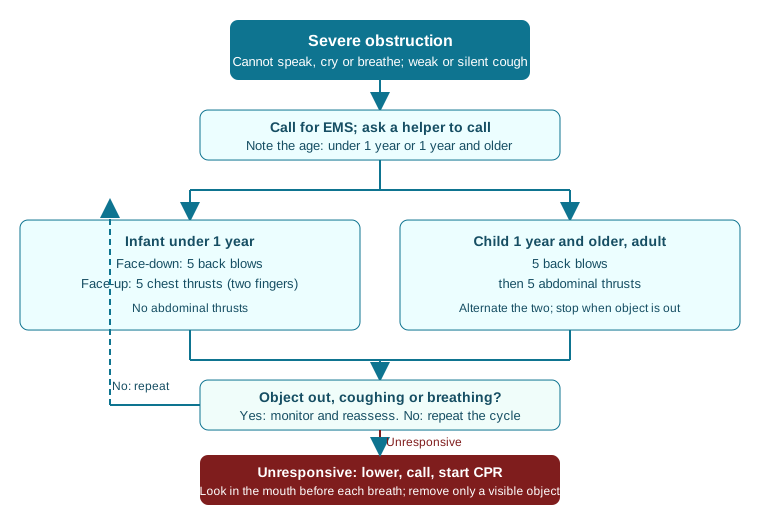
- Adult and child: 5 back blows, then 5 abdominal thrusts
- Infant: 5 back blows, then 5 chest thrusts
- Repeat the cycle; call EMS early
- Confirm & Monitor
- Effective cough, speech and breathing
- Color, SpO₂ if available, consciousness
- Look in the mouth before each breath if unresponsive
Key Numbers
Relieve a severe obstruction in the order below. Time-critical: a patient who cannot cough or speak is losing air now. Reassess after every cycle and call EMS early.
| Parameter | Value |
|---|---|
| Severe obstruction (act) | Cannot speak, cry or breathe; weak or silent cough; cyanosis or falling consciousness |
| Mild obstruction (watch) | Strong cough, speech or cry: encourage coughing and reassess; no thrusts |
| Child 1 year and older, adult | 5 back blows, then 5 abdominal thrusts; alternate the two |
| Infant under 1 year | 5 back blows, then 5 chest thrusts (two fingers on the lower half of the breastbone, as for infant compressions). No abdominal thrusts |
| Repeat | Until the object is expelled, the patient breathes and speaks, or the patient becomes unresponsive |
| Unresponsive | Call for help and start CPR. Look in the mouth before each breath; remove only a visible object |
| Button battery (esophagus) | Not an airway emergency: urgent ED transfer. Esophageal removal preferably within 2 hours |
| Multiple magnets | Urgent ED referral: risk of bowel obstruction and perforation |
Overview & Principles
Foreign body airway obstruction (FBAO), or choking, means an object is blocking the airway. It got there by being inhaled or swallowed. Young children are most at risk. The pediatric airway page gives the peak age and the sudden-onset pattern.
How It Works
- Partial obstruction: some air still gets through. The patient coughs, speaks or cries. That cough is the first line of clearance.
- Severe obstruction: little or no air gets through. The cough is weak or silent. The patient cannot speak.
- Back blows and thrusts: sudden force is what moves the object. Abdominal and chest thrusts squeeze the chest to push air out.
- Unresponsive patient: the airway may still be blocked. CPR and a look in the mouth come first.
Where It Fits
Bystander first aid comes first, and EMS basic life support follows it. Advanced airway steps wait on the local protocol, and they come in only if the obstruction is not relieved (Figure 1).
Indications & Contraindications
Indications
- Severe obstruction: cannot speak, cry or breathe
- Weak or silent cough with cyanosis or falling consciousness
- Suspected obstruction after a witnessed choking episode, when the cough is not clearing the object
Absolute Contraindications
None when severe obstruction is present.
Relative Contraindications & Cautions
- Mild obstruction: a strong cough or speech means air is moving. Encourage coughing. No thrusts
- Infant under 1 year: no abdominal thrusts
- Known or suspected rib or abdominal injury: thrusts carry a risk of injury. Use the sequence per protocol
- Pregnancy or large abdomen: chest thrusts replace abdominal thrusts (see Special Populations)
Consider an Alternative
- Button battery or magnet ingestion: not an airway obstruction. Urgent ED transfer (see Special Populations)
- Airway not relieved after the sequence: advanced airway per protocol. See Supraglottic Airway and Endotracheal Intubation
Scope & Team Roles
| Provider Level | Typical Role | Notes |
|---|---|---|
| EMT | Performs | Back blows and thrusts; CPR per protocol |
| AEMT | Performs | Same sequence as EMT; advanced airway steps per protocol |
| Paramedic | Performs | Advanced airway per protocol; direct-laryngoscopy removal of a visible object where protocol and credentialing allow |
| RN (ED/ICU) | Performs | Same sequence; reassess and document after each cycle |
| Critical Care Transport (CFRN / CTRN / FP-C / CCP-C) | Performs | Reassess after every move; laryngoscopic removal per credentialing |
| Physician / APP | Performs (protocol/credentialing required) | Laryngoscopic removal with Magill forceps; surgical airway only if all else fails |
Team Roles During the Procedure
- Rescuer: gives the back blows and thrusts
- Caller: activates EMS and tells the crew the time and age
- Monitor: watches color, SpO₂ if available, and level of consciousness
- Recorder: counts cycles and records the object and response
Pre-Procedure Assessment
Severity Check
| Finding | Meaning | Action |
|---|---|---|
| Strong cough, speech or crying | Partial obstruction | Encourage coughing; watch closely |
| Weak or silent cough; cannot speak | Severe obstruction | Back blows, then thrusts, now |
| Cyanosis or falling consciousness | Severe and worsening | Act now; call EMS |
| Unresponsive | Airway not relieved | Call for help; start CPR |
Age Check
- Infant (under 1 year): back blows and chest thrusts
- Child (1 year and older) and adult: back blows and abdominal thrusts
- Witnessed or unwitnessed: sudden choking while eating or playing is a witnessed event. A cough or wheeze that shows up later, with one-sided breath sounds, needs a foreign-body check
Anatomy & Landmarks
| Technique | Age | Landmark | Key Point |
|---|---|---|---|
| Back blows | Infant, child, adult | Between the shoulder blades | Support the chest; lean the patient forward |
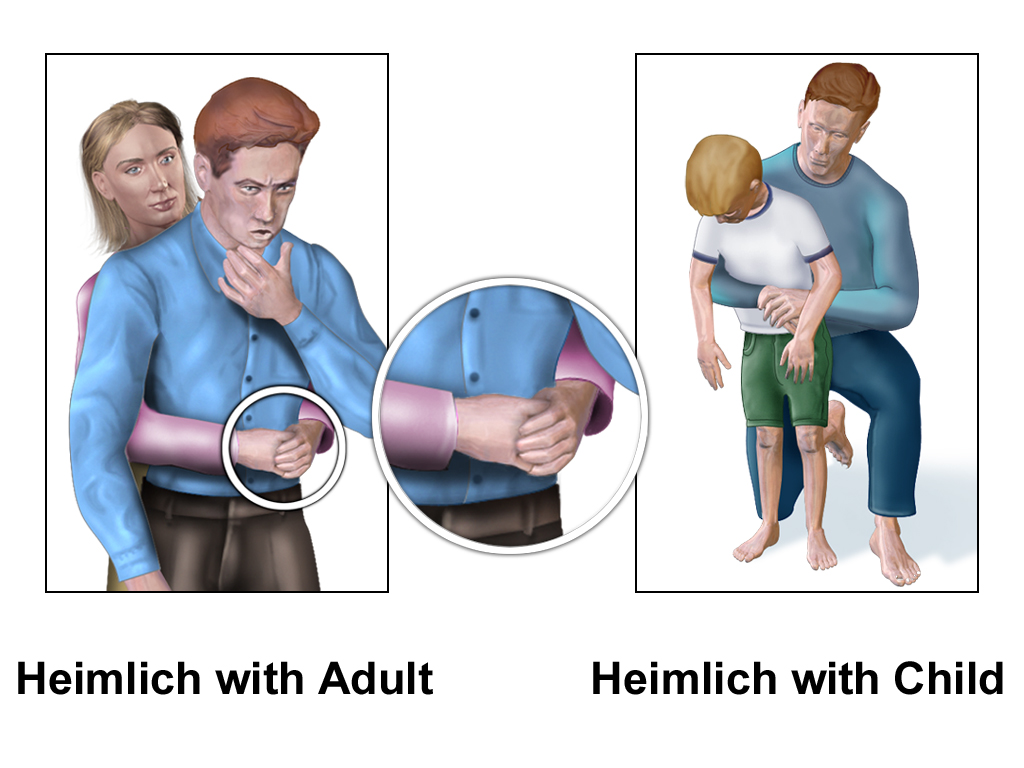
| Abdominal thrusts | Child (1 year and older), adult | Above the navel, below the lower rib margin | Stand behind; fist thumb-side in; upward thrust |
| Chest thrusts | Infant (under 1 year) | Lower half of the breastbone | Two fingers, as for infant compressions; no abdominal thrusts |
Equipment & Preparation
Equipment
- No equipment is needed for back blows or thrusts
- Suction, if available and in the protocol, for a visible object in the mouth
- Pulse oximeter and EtCO₂ capnography, if available, for monitoring after relief
- Magill forceps: an airway-team tool used under direct laryngoscopy, not a first-aid item
Patient Positioning
- Conscious child or adult: stand or kneel behind the patient, arms around the waist for thrusts
- Infant: face-down along the forearm, supported on the thigh, head lower than the chest
Pre-Procedure Checklist
- Confirm severe obstruction (no speech, weak or silent cough)
- Note the patient age: under 1 year or 1 year and older
- Call EMS early or send a caller
- Position the patient for back blows
- Start the cycle count: 5 and 5
- Assign a monitor for color and consciousness
Step-by-Step Procedure
Phase 1: Recognize and Call
- Check for severe obstruction: ask "Are you choking?" A patient who nods but cannot speak or cough is severely obstructed.
- Call for EMS: call early; a caller stays with the patient.
Phase 2: Perform (Child 1 Year and Older, Adult)
- Give 5 back blows: strike firmly between the shoulder blades with the heel of the hand while supporting the chest.
- Check after each blow: look for the object, a cough, or speech. Stop the cycle as soon as the object is expelled or the patient coughs or breathes effectively. Otherwise complete the 5 blows, then move to the thrusts.
- Give 5 abdominal thrusts: if the object is still in place, place a fist above the navel and thrust sharply inward and upward.
- Alternate and repeat: 5 back blows then 5 abdominal thrusts, until the object is out or the patient becomes unresponsive.
Phase 3: Perform (Infant Under 1 Year)
- Position face-down: support the infant along your forearm with the head lower than the chest.
- Give 5 back blows: between the shoulder blades, with the heel of the hand.
- Turn face-up and give 5 chest thrusts: two fingers on the lower half of the breastbone, as for infant compressions.
- Alternate and repeat: never give abdominal thrusts to an infant.
Phase 4: Unresponsive Patient
- Lower to the floor and start CPR: call for help and start CPR per BLS or ACLS protocol.
- Look before each breath: open the mouth and remove only a visible object. Do not perform blind finger sweeps.
Confirmation & Monitoring
Primary Confirmation
The object is out, or the patient coughs, speaks and breathes effectively. That is how you confirm relief.
Secondary Confirmation
- Color improving; SpO₂ rising if measured
- Clear voice or crying; no stridor on inspiration
- Level of consciousness normal or improving
| Finding | Success | Failure or Next Step |
|---|---|---|
| Cough and speech | Strong, speaks | Weak or silent: continue sequence |
| Breathing | Effective breaths | Absent or gasping: CPR |
| Object | Expelled and removed | Still present: repeat cycle; check the mouth |
| Consciousness | Alert or improving | Decreasing: call, lower, start CPR |
Ongoing Monitoring
- Reassess after every 5-and-5 cycle
- Check SpO₂ and mental status until handover, if available
- Re-check the airway after each move during transport
Troubleshooting
| Problem | Likely Cause | Fix |
|---|---|---|
| Object not moving after several cycles | Hand position or force; object lodged deeper | Check hand position; continue the sequence; call EMS and follow advanced airway protocol |
| Patient becomes unresponsive | Complete obstruction; loss of consciousness | Lower to the floor; call; start CPR; look in the mouth before each breath |
| Object visible in the mouth | Object within reach | Remove only if visible; do not sweep blindly |
| Rescuer cannot reach around the patient | Patient size or position | Use back blows; if the patient is pregnant or too large to reach around, use chest thrusts in place of abdominal thrusts (see Special Populations) |
| Patient is quieter but still short of breath | Fatigue or deeper obstruction | Treat as ongoing obstruction; reassess and call EMS |
If It Still Fails
- Continue the cycle and call EMS: do not stop while the patient is still obstructed.
- Start CPR when unresponsive: per BLS or ACLS protocol.
- Advanced airway per protocol: see Supraglottic Airway, Endotracheal Intubation and Cricothyrotomy.
Complications
| Complication | Recognition | Prevention | Management |
|---|---|---|---|
| Immediate: rib fracture or abdominal organ injury | Pain, tenderness, bruising, shock | Hands between navel and lower ribs; controlled force | Monitor; transport for evaluation |
| Immediate: cardiac arrest | Unresponsive, no normal breathing | Early EMS and early relief | CPR per BLS or ACLS protocol |
| Delayed: button battery injury | Witnessed or suspected ingestion | Keep batteries out of reach of children | Urgent ED transfer; removal preferably within 2 hours |
| Delayed: multiple magnet injury | Witnessed or suspected ingestion of more than one magnet | Keep magnets out of reach of children | Urgent ED referral; bowel obstruction and perforation risk |
Special Populations
Pediatrics
Age decides the sequence. An infant under 1 year gets back blows and chest thrusts, and never abdominal thrusts. From age 1 year up, the child follows the adult sequence.
| Age | Sequence | Note |
|---|---|---|
| Infant (under 1 year) | 5 back blows, then 5 chest thrusts (two fingers on the lower half of the breastbone, as for infant compressions) | No abdominal thrusts |
| Child (1 year and older) | 5 back blows, then 5 abdominal thrusts | Same as adult |
When a child goes unresponsive, the pediatric cardiac arrest pathway takes over. Respiratory distress has its own cause-by-cause approach in Respiratory Distress and Failure.
Pregnancy or Large Abdomen
- In late pregnancy, or with a patient too large to reach around, abdominal thrusts may be hard to deliver or may not be appropriate
- Substitute chest thrusts: chest thrusts take the place of abdominal thrusts. Hands go on the lower half of the breastbone, as for adult CPR compressions. The rescuer may need to stand or kneel beside the patient
- Follow local protocol for the exact technique and cycle count
Ingested Button Batteries and Magnets (Not an Airway Obstruction)
- Button battery: localization can't wait. Esophageal removal is preferably within 2 hours (ESPGHAN 2021 position paper). Call Poison Help at 1-800-222-1222 (US) or your regional poison center (poison.org) and follow medical direction. Home remedies are outside this page
- Multiple magnets: urgent ED referral; bowel obstruction and perforation risk
- EMS action: urgent transfer; do not attempt removal in the field
Post-Procedure Care & Transport
Immediate Aftercare
- Relief does not end the risk: reassess breathing and color until handover
- Any patient who needed thrusts, or whose object was not seen to leave, should be assessed in hospital
Ongoing Maintenance
- Observe breathing, color and consciousness
- Keep the patient positioned upright if breathing is comfortable
Transport Considerations
- Reassess the airway after every move
- Rely on monitors and reassessment in noisy vehicles
- Re-obstruction can occur: be ready to repeat the sequence
Document & Hand Off
- Time of onset and time of first aid
- Age and witnessed or unwitnessed event
- Sequence used and number of cycles
- Object seen and removed, if any
- Response: breathing, speech, consciousness; CPR start time if used
- Ingestion details: product, number, time, if any
Clinical Pearls & Pitfalls
Pearls
- Cough first: a strong cough is the most effective clearance. Encourage it.
- Count the cycles: 5 and 5, then reassess. The count keeps the sequence going.
- Infants differ: no abdominal thrusts.
- Silence is worse than coughing: a silent patient cannot move air.
- Batteries are urgent: an esophageal button battery is not a watch-and-wait case.
Common Pitfalls
- Blind finger sweeps → look first, and remove only a visible object
- Thrusts on a limp patient → lower to the floor and start CPR
- Abdominal thrusts for an infant → use chest thrusts with back blows
- Quiet patient taken as improving → reassess the airway and breathing
Education & Skill Maintenance
Skill Maintenance
- Practice the 5-and-5 sequence on adult and infant manikins at least once per training cycle
- Rehearse the transition from thrusts to CPR when the patient becomes unresponsive
- Debrief timing, cycle count and the look-in-the-mouth step
Patient & Family Teaching
- Keep button batteries and magnets out of reach of young children
- Cut food into small pieces for young children and supervise eating
References
- American Heart Association. Part 7: Adult Basic Life Support: 2025 American Heart Association Guidelines for Cardiopulmonary Resuscitation and Emergency Cardiovascular Care. Circulation. 2025;152(16 suppl 2). https://doi.org/10.1161/CIR.0000000000001369
- American Heart Association and American Academy of Pediatrics. Part 6: Pediatric Basic Life Support: 2025 American Heart Association and American Academy of Pediatrics Guidelines for Cardiopulmonary Resuscitation and Emergency Cardiovascular Care. Circulation. 2025;152(16 suppl 2). https://doi.org/10.1161/CIR.0000000000001370
- American Heart Association and American Academy of Pediatrics. Part 6: Pediatric Basic Life Support: 2025 American Heart Association and American Academy of Pediatrics Guidelines for Cardiopulmonary Resuscitation and Emergency Cardiovascular Care. Pediatrics. 2026;157(1). Published online December 15, 2025. https://doi.org/10.1542/peds.2025-074350
- Igarashi Y, Norii T, Nakae R, Tagami T, Sklar DP, Yokobori S. Efficacy of abdominal thrusts and back blows for patients with foreign body airway obstruction: MOCHI registry analysis. Resusc Plus. 2025;25:101016. https://doi.org/10.1016/j.resplu.2025.101016
- Mubarak A, et al. (ESPGHAN Button Battery Task Force). Diagnosis, Management, and Prevention of Button Battery Ingestion in Childhood: A European Society for Paediatric Gastroenterology Hepatology and Nutrition Position Paper. J Pediatr Gastroenterol Nutr. 2021;73(1):129-136. https://doi.org/10.1097/MPG.0000000000003048
- Nezhentsev A, Neville JJ, Hall NJ. Diagnosis and management of paediatric magnet ingestion: a systematic review of clinical practice guidelines. Emerg Med J. 2026;43(3):167-173. Published online December 11, 2025. https://doi.org/10.1136/emermed-2024-214794
Medical Disclaimer
- For Educational Purposes Only: This content is intended for educational reference and should not be used for clinical decision-making.
- Not a Substitute for Professional Judgment: Always consult your local protocols, institutional guidelines, and supervising physicians.
- Verify Before Acting: Users are responsible for verifying information through authoritative sources before any clinical application.