

Bedside Snapshot
- Indications
- Any medical complaint or change in breathing or mental status
- Abnormal vital signs or a patient who looks unwell
- Priority decisions across several patients or problems
- Reassessment after treatment, a change, or handoff
- Contraindications / Abort
- Unsafe scene: withdraw and call for help
- Arrest or airway emergency: treat first, assess during treatment
- Child: adult NEWS2 bands do not apply
- Normal SpO₂ with CO exposure: still treat as hypoxemic
- Critical Steps
- Airway, breathing, circulation, mental status (GCS 3–15)
- Full vital signs with SpO₂ waveform and glucose when indicated
- SAMPLE history and OPQRST for each complaint
- Focused exam, then reassess after each intervention
- Confirm & Monitor
- SpO₂ 94–98% (88–92% if hypercapnia risk)
- NEWS2 aggregate 5 or more: urgent response (hospital score)
- Repeat vitals and GCS after every change
- Trend across sets, not one value
Key Numbers
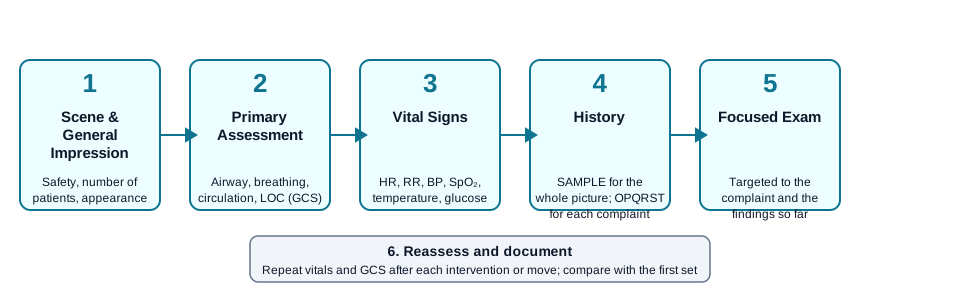
Adult assessment runs as a timed sequence: airway, breathing, circulation and mental status first, then vital signs, history and a focused exam. Repeat every measurement after an intervention; the trend matters more than one value.
| Parameter | Value |
|---|---|
| SpO₂ target, most acutely ill adults | 94–98% (BTS guideline, patients over 16 years) |
| SpO₂ target, COPD or hypercapnia risk | 88–92% pending blood gas; adjust to 94–98% if PCO₂ is normal, unless there is a history of previous hypercapnic respiratory failure, when 88–92% is kept (BTS guideline) |
| NEWS2 SpO₂ Scale 2 | Only for confirmed hypercapnic respiratory failure, set by a competent clinician (not by the assessor alone). 88–92% on air scores 0; otherwise use Scale 1. Any supplemental oxygen adds 2 points (RCP) |
| NEWS2 aggregate 5–6 | Key threshold for urgent response (hospital score; use your protocol trigger) |
| NEWS2 aggregate 7 or more | High clinical risk: urgent or emergency response |
| NEWS2 single parameter scoring 3 | Urgent response even when the total is lower (RCP; use your service's trigger). Triggers: RR ≤8 or ≥25/min; SpO₂ ≤91% (Scale 1); SBP ≤90 or ≥220 mmHg; HR ≤40 or ≥131/min; temperature ≤35.0 °C; new confusion, or V, P or U on AVPU (RCP NEWS2 chart, reference 3) |
| NEWS2 zero-point bands | RR 12–20/min HR 51–90/min SBP 111–219 mmHg Temperature 36.1–38.0 °C SpO₂ 96% or more on air (Scale 1) |
| Consciousness | Alert = 0 points; new confusion, voice, pain or unresponsive (CVPU) = 3 points |
| Glucose, hypoglycemia levels | Level 1: <70 mg/dL (<3.9 mmol/L) and ≥54 mg/dL Level 2: <54 mg/dL (<3.0 mmol/L) Level 3: altered status needing help, at any glucose (ADA Standards of Care 2026, people with diabetes) |
| Glasgow Coma Scale | 3–15 total (Teasdale and Jennett scale) |
Overview & Principles
Assessment is not a form to fill in. It is a structured, repeated search for the time-critical problem. You collect the airway, breathing, circulation, mental status, vital signs, history and focused exam, then you collect them again. That repetition sets your priorities and shows whether treatment is working.
How It Works
- Priority first: Threats to life come first. The primary survey finds them before any history is taken.
- Numbers in context: Don't read a vital sign alone. Set it against the patient's appearance, baseline and trend. One abnormal value is a reason to look again.
- History with a frame: SAMPLE covers the whole patient. OPQRST pins down each complaint.
- Focused exam: Examine what the complaint and findings point to. You don't need every system on every patient.
- Reassess: Reassess after every intervention, move and change in condition. Repeat the vital signs and mental status each time.
Where It Fits
Protocol decides the next move: treat now, transport, or evaluate further. NEWS2 is a hospital early-warning score. It turns vital signs into points. EMS and ED/ICU services run their own triggers, so apply the one your protocol names. Early-warning scores have limits too. Do not use qSOFA alone as a sepsis screen (Surviving Sepsis Campaign guidance, reference 4).
Indications & Contraindications
Indications
- Any medical complaint, including a change in breathing, mental status or pain
- Abnormal vital signs, or a patient who looks unwell even with normal numbers
- Need to prioritize between several patients or several problems
- Reassessment after treatment, a change in condition, or before every transfer of care
Absolute Contraindications
Nothing stops an assessment the patient needs. Scene and crew safety come first. Do not enter an unsafe scene to assess.
Relative Contraindications & Cautions
- Children: Adult NEWS2 bands do not fit a child, and neither do the adult BTS oxygen targets. The BTS guideline covers patients over 16 years only. Use the pediatric pages.
- Darker skin pigmentation: Oximeters can be less accurate on darker skin (FDA).
- Carbon monoxide exposure: Don't let a normal SpO₂ rule out hypoxemia.
- Anaemia or abnormal blood gas: SpO₂ can read normal while pH or PCO₂ is abnormal, or while oxygen content is low from anaemia (BTS guideline).
- No history available: Use family, bystanders and medication containers, and document what is unknown.
Consider an Alternative
A child needs a different starting point. Begin with the Pediatric Assessment Triangle and the Pediatric Vital Signs reference, then apply the age-based ranges.
Abort / Stop Criteria
- Immediate threat found in the primary survey: Treat it now (airway, breathing or circulation), then return to the history and focused exam.
- Arrest: Start resuscitation per current protocol; assessment continues during treatment.
Scope & Team Roles
| Provider Level | Typical Role | Notes |
|---|---|---|
| EMT | Performs | Primary survey, vital signs and history per local protocol; glucose testing varies by state |
| AEMT | Performs | Per state and agency protocol; glucose and 12-lead vary by state |
| Paramedic | Performs | Full assessment and interpretation of findings; 12-lead interpretation and glucose vary by state; follow local protocol |
| RN (ED/ICU) | Performs | Per facility policy and competency |
| Critical Care Transport (CFRN / CTRN / FP-C / CCP-C) | Performs | Reassessment during transport; per transport program protocol |
| Physician / APP | Performs | Diagnostic reasoning and disposition decisions |
Typical roles, not verified against the National EMS Scope of Practice Model. State and agency rules decide which skills each level may perform.
Team Roles During the Assessment
- Assessor: Leads the primary survey, the history and the focused exam.
- Airway and oxygen manager: Watches breathing and the airway and sets oxygen to target.
- Monitor and recorder: Applies the pulse oximeter and cuff, times each set, records GCS and glucose.
- Scene and safety: Keeps the scene safe, manages PPE, and requests help early.
Equipment & Preparation
Equipment
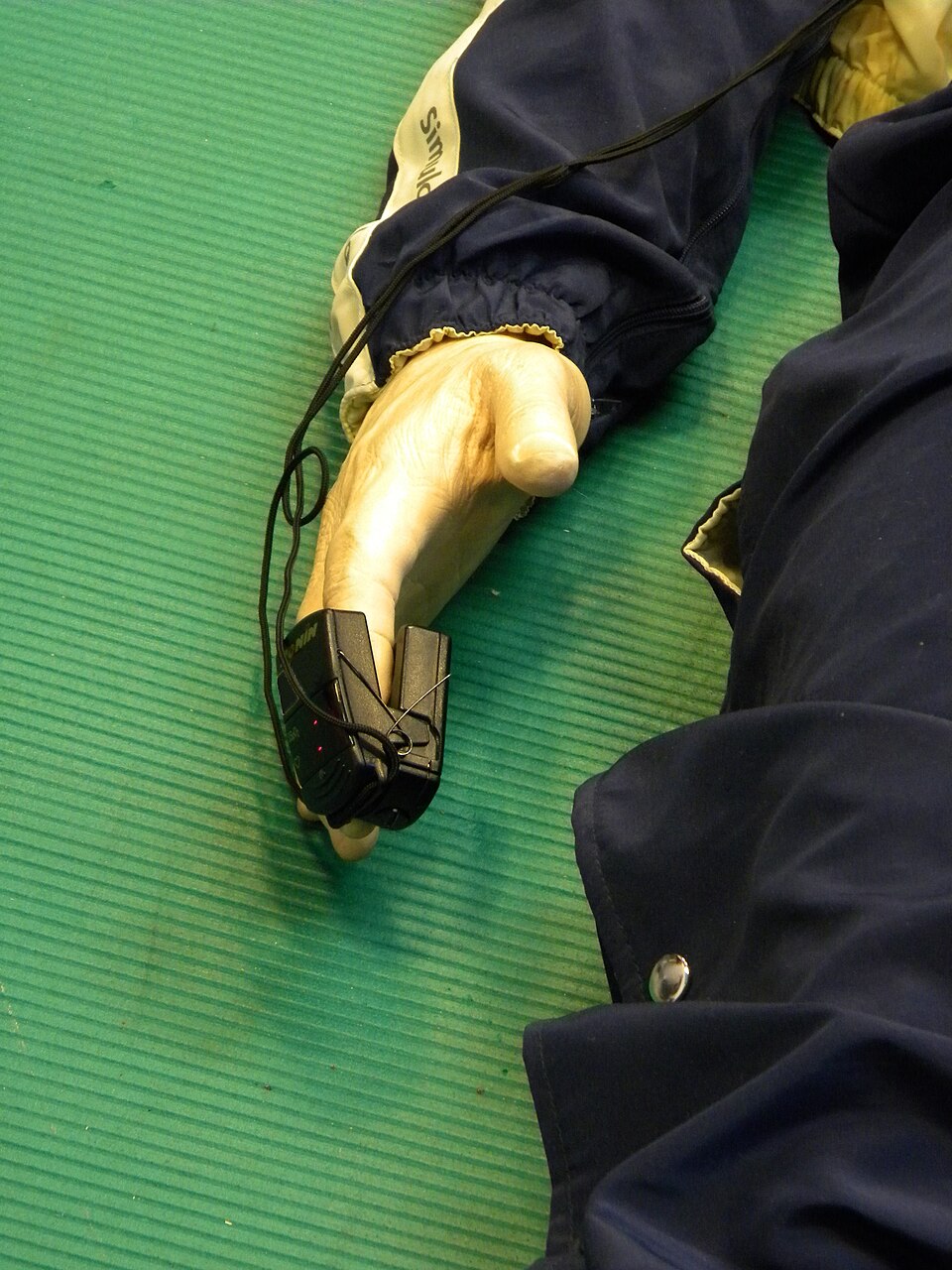
- Pulse oximeter with a visible plethysmograph waveform
- Blood pressure cuff in several sizes, or a manual set with stethoscope
- Thermometer suited to the patient's age and site
- Glucometer with test strips within expiry
- Penlight or pupil gauge and a GCS reference card
- Cardiac monitor and 12-lead ECG per protocol (see the 12-lead page)
- PPE and standard precautions
Sizing
Choose the BP cuff by arm size, following the manufacturer's sizing. Match the SpO₂ probe to the site and device. For children, use the pediatric size and range references.
Pre-Procedure Checklist
- Scene is safe; PPE and standard precautions in place
- Number of patients counted; help requested if needed
- Oximeter, cuff and thermometer ready and working
- Glucometer and strips checked
- Stethoscope and penlight available
- Medication containers, medical alert ID and family located for history
- Time of arrival and time of each set of vital signs recorded
- 12-lead ECG ready per protocol for chest pain or syncope
Step-by-Step Procedure
Phase 1: Prepare & Size Up
- Confirm scene safety: Check hazards, PPE and the number of patients before you approach.
- Form a general impression: Note appearance, work of breathing, color and responsiveness from the doorway.
- Request help early: Call for resources when the general impression is poor, before you start the detailed exam.
Phase 2: Perform
- Assess the airway: Check for speech, noisy breathing or obstruction, and act per protocol.
- Assess breathing: Count the rate, depth and effort. Give oxygen to the target range: 94–98% for most adults, 88–92% for hypercapnia risk.
- Assess circulation: Palpate the pulse and check rate and rhythm, skin color and temperature, and bleeding. Press the nail bed and time the capillary refill.
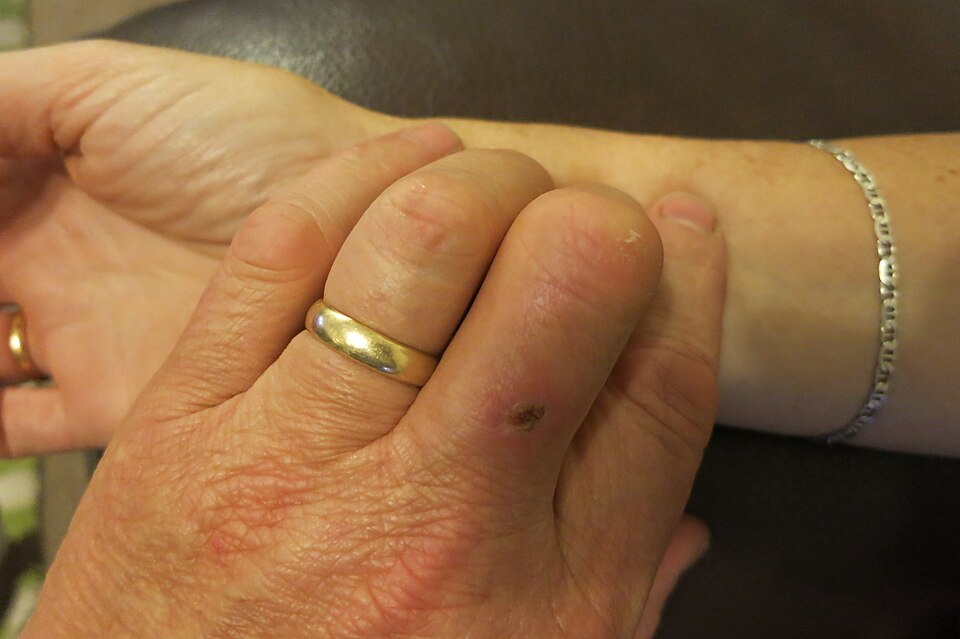
Figure 2: Palpating the radial pulse on the wrist. Source: Wikimedia Commons, John Campbell, CC0 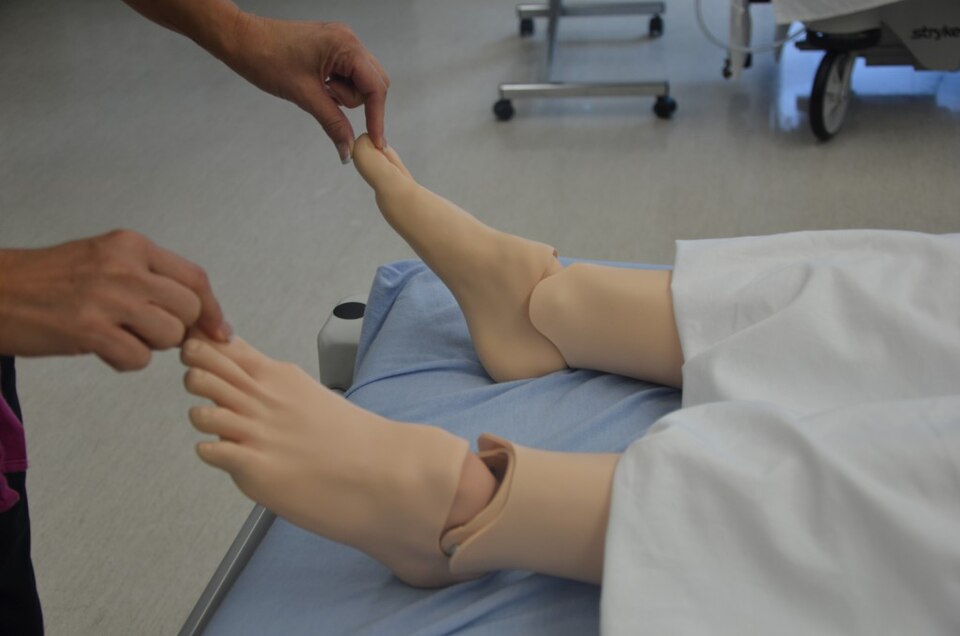
Figure 3: Capillary refill test on the toe of a training manikin (technique illustration; a real patient shows blanching and colour return). Source: Wikimedia Commons, Glynda Rees Doyle and Jodie Anita McCutcheon, CC BY 4.0 - Assess mental status: Use AVPU or the GCS (3–15). Record the GCS total with each component when you can.
- Take a full set of vital signs: Heart rate, respiratory rate, blood pressure with the correct cuff, SpO₂ with a clean waveform, temperature (note the site, as oral, tympanic and temporal readings differ), and glucose when mental status or diabetes makes it relevant.
- Take a SAMPLE history: Signs and symptoms, Allergies, Medications, Pertinent history, Last oral intake, Events leading to the call.
- Characterize each complaint with OPQRST: Onset, Provocation, Quality, Radiation, Severity (0–10) and Time.
- Perform a focused exam: Target the exam to the complaint and the findings so far, using the table below.
- Reassess after each intervention: Repeat vital signs, GCS and glucose, and compare with the first set.
Phase 3: Reassess & Document
- Compare with the trigger: Calculate the NEWS2 total if your service uses it, or apply your protocol's trigger, and note any single parameter scoring 3.
- Decide the priority: Treat now, transport or evaluate further per protocol, and record the reasoning in one line.
Focused Exam by Complaint
| Complaint | Ask and Elicit | Examine | Act Now If |
|---|---|---|---|
| Chest pain or pressure | OPQRST; radiation to arm, jaw or back; dyspnea, sweating, nausea; cardiac history | Vital signs with BP in both arms if tearing pain; lung sounds; skin; peripheral pulses | 12-lead ECG acquired and reviewed for STEMI within 10 minutes of arrival (AHA/ACC 2021 chest pain guideline, Class 1); tearing pain, unequal arm pressures or pulses, a neurologic deficit, or hypotension |
| Shortness of breath | Onset and speed; speech in sentences; lung or heart disease; inhaler and oxygen use | Work of breathing, accessory muscle use, lung sounds (wheeze, crackles, absent sounds), SpO₂ with the stated oxygen, leg swelling | Cannot speak in sentences, silent chest, falling SpO₂, or drowsiness (possible CO₂ retention) |
| Altered mental status | Baseline mental status; time of change; causes to ask about: alcohol, epilepsy, insulin, opioids, uremia, infection, trauma, stroke (AEIOU-TIPS) | Glucose, GCS, pupils, focal deficits, neck stiffness, temperature, signs of opioid toxidrome | Glucose low or not yet checked; hypoxia; opioid toxidrome (naloxone per protocol); focal deficit (stroke pathway below) |
| Abdominal pain | Location, onset, character, radiation; vomiting, bleeding, bowel and urine changes; pregnancy status and last menstrual period | Palpation for guarding, rigidity and rebound (peritoneal signs); pulsatile mass; skin color; distension | Peritoneal signs, shock, bleeding, or pain with pregnancy at any gestation; pulsatile mass with back or flank pain |
| Syncope or near-syncope | Prodrome; exertion; palpitations; chest pain; medicines (antihypertensives, sedatives); glucose; family history of sudden death | Rhythm on the monitor; glucose; signs of bleeding or dehydration; orthostatic vitals if safe | Syncope with exertion, palpitations, chest pain, an abnormal rhythm, or any focal deficit |
Orthostatic vitals (syncope, dehydration, bleeding): Get BP and pulse lying or seated first. Repeat both standing at 1 and 3 minutes. A positive test means SBP falls 20 mmHg or more, DBP falls 10 mmHg or more, or symptoms appear within 3 minutes of standing (Freeman R et al., Clin Auton Res 2011;21:69–72, doi 10.1007/s10286-011-0119-5). Stop the moment symptoms appear or the stand is unsafe.
Stroke Screen (BE-FAST)
Any new focal complaint gets a stroke screen. Write down the time last known well. This site has no separate stroke scale page. BE-FAST is a screen, not a diagnosis, and a positive screen starts the stroke pathway per local protocol. For early management of acute ischemic stroke, see the 2026 AHA/ASA guideline (reference 8).
- Balance: sudden loss of balance or coordination
- Eyes: sudden vision loss or double vision
- Face: one-sided droop when the patient smiles
- Arm: one arm drifts down or cannot be lifted
- Speech: slurred, absent or wrong words
- Time: last known well time; notify the receiving stroke center early, per your local stroke system
Check glucose before the stroke pathway is confirmed. Oral intake waits until swallowing is screened, per protocol. Hypoglycemia can mimic stroke, so correct a low glucose and examine again. Pick your system's validated prehospital stroke scale (for example CPSS or LAPSS), along with any large-vessel occlusion triage tool your service uses. Transport is not held up for the scoring.
Confirmation & Monitoring
Primary Confirmation
Confirmation starts with a full set of vital signs: a waveform-verified SpO₂, a GCS, and a glucose when indicated. Repeat it. Stable or improving findings on the repeat set mean the trend is on your side.
Secondary Confirmation
- Consistency: The history, the exam and the vital signs should tell the same story. If one disagrees, look again.
- Perfusion: Look at the skin. Color, temperature and capillary refill should match the pulse and BP.
- Pain: Record a 0–10 numeric score at each set, and reassess it after treatment. When the patient cannot self-report, use a validated observational scale, per protocol.
| Finding | Reassuring | Concerning |
|---|---|---|
| SpO₂ | In target with a clean waveform | Below target, or falls by 3% or more (BTS guideline: reassess clinically) |
| Heart rate and BP | Within NEWS2 zero-point bands; stable trend | Outside the bands, or the trend is worsening |
| Respiratory rate | 12–20/min and unlabored | ≤11/min (1 point; ≤8 scores 3) or ≥21/min (21–24 scores 2; ≥25 scores 3), or increasing work of breathing |
| Mental status | Alert, or GCS unchanged | Any fall in GCS or new confusion |
| Glucose | 70 mg/dL or higher | <70 mg/dL, or any low value with altered mentation (treat per protocol) |
| Temperature | 36.1–38.0 °C | ≤35.0 °C (3 points) or ≥39.1 °C (2 points) on NEWS2 |
Ongoing Monitoring
- Vital signs: Repeat at the interval your protocol sets and after every intervention.
- SpO₂: Keep the probe on and watch the waveform while on oxygen and in transport.
- GCS: Repeat whenever mental status changes.
- Capnography: Waveform ETCO₂ adds to monitoring in sedated, ventilated or transported patients, per protocol.
- Trend: Record each set so the change over time is visible to the next clinician.
Troubleshooting
| Problem | Likely Cause | Fix |
|---|---|---|
| SpO₂ low or no reading | Poor waveform, motion, cold or poorly perfused finger, probe not seated | Check the waveform; warm the site, reseat the probe or move it; repeat before you act on the number |
| SpO₂ does not match the patient | Pulse oximetry accuracy can be reduced in darker skin pigmentation (FDA) | Treat the patient; use clinical signs and a blood gas where available |
| Normal SpO₂ with breathlessness or CO exposure | Oximetry cannot separate carboxyhaemoglobin from oxyhaemoglobin | Give high-concentration oxygen by reservoir mask at 15 L/min; see Complications |
| BP unobtainable or implausible | Cuff too small, wrong site, patient moving | Use the correct cuff, support the arm at heart level, repeat; manual reading if needed |
| Glucose does not fit the picture | Test error, poor strip, or a non-glucose cause | Repeat the test with a new strip; then assess for other causes per protocol |
| No history available | Patient cannot communicate or is altered | Use family, bystanders, medication bottles and medical ID; interpreter per protocol |
| Mental status worsening | Hypoxia, hypoglycemia, drug effect or the underlying illness | Recheck SpO₂ and glucose, treat per protocol; for suspected opioid effect see the naloxone page |
| Vital signs conflict | Measurement error or a real change | Repeat the set; read the trend with perfusion and mental status |
Complications
| Complication | Recognition | Prevention | Management |
|---|---|---|---|
| Immediate: Missed hypoxemia | Breathlessness or confusion with a reassuring SpO₂ | Check the waveform; ask about fuel-burning sources and enclosed spaces | High-concentration oxygen and transport per protocol; blood gas where available |
| Immediate: Missed hypoglycemia | Altered mental status without a clear cause | Check glucose in every altered patient, per protocol | |
| Delayed: Missed sepsis | Infection signs with abnormal vital signs or a worsening trend | Repeat the vital signs; do not rely on qSOFA alone (Surviving Sepsis Campaign, reference 4) | Sepsis pathway per protocol; reassess after each treatment step |
| Delayed: Anchoring on one complaint | Findings that do not fit the working diagnosis | Complete the primary survey and full vital signs first | Re-examine when a new finding appears; update the priority |
| Rare: Missed focal neurologic deficit | New weakness, facial droop or speech change | Record the time last known well | Stroke protocol per local system |
Suspected carbon monoxide poisoning with a normal SpO₂
- Suspect CO: Look for a fuel-burning device or an enclosed space. The SpO₂ can still read normal or high.
- Give oxygen: Reach for a reservoir mask at 15 L/min, aiming for 100% whatever the oximeter reads (BTS guideline).
- Check carboxyhaemoglobin: If a blood CO-oximetry test is available, send it.
- Transport: Per protocol. Reassess after every move.
Special Populations
Pediatrics
Adult bands do not fit a child. The BTS oxygen guideline covers patients over 16 years only. Build the assessment on the age-based references and your pediatric protocol.
- Vital signs: Age-specific ranges in Pediatric Vital Signs
- Appearance first: Pediatric Assessment Triangle before a detailed exam
- Fever: ≥38.0 °C (100.4 °F) rectal, per the pediatric vital signs reference
- Doses and sizing: Weight-Based Dosing and the Broselow reference
Older Adults
- Atypical presentation: Chest pain, sepsis and stroke can look like confusion, weakness, falls or vague abdominal pain.
- Blunted responses: Fever and pain may be muted. A normal temperature does not rule out infection.
- Rate control: Beta-blockers and other rate-control drugs can blunt the heart rate response. A normal rate does not rule out shock, so check BP, perfusion and mental status.
- Baseline: Before you judge a change, find out the usual mental status and mobility from family or care staff.
Pregnancy
- Normal changes: Heart rate rises and blood pressure falls mildly. A value that looks reassuring can still matter.
- Positioning: From about 20 weeks, the uterus can press on the great vessels when supine and cause hypotension. Use left lateral positioning per protocol.
- History: Ask about pregnancy status and gestation with every abdominal, chest and syncope complaint.
- Priorities: Treat hypoxia and hypotension promptly. Both affect the fetus.
Skin Pigmentation
The FDA says pulse oximeters may be less accurate on darker skin pigmentation. Its draft guidance, "Pulse Oximeters for Medical Purposes", was issued January 7, 2025. The FDA page still showed it as a draft when checked for this revision. Keep the clinical picture ahead of the number.
Low Oxygen Content and Carbon Monoxide
- Anaemia: Low oxygen content can hide behind a normal SpO₂ (BTS guideline).
- Carbon monoxide: Don't trust a normal or high SpO₂ here. Treat the exposure (see Complications).
Post-Procedure Care & Transport
Immediate Aftercare
- Record a full set of vital signs, GCS and glucose before the first move.
- Hand off the trend across sets, not only the last value.
Ongoing Maintenance
- Reassess after every change in condition, intervention or medication.
- Repeat vital signs at the protocol interval, and after each oxygen change.
Transport Considerations
- Reassess after every move. Vibration and noise can make SpO₂ and BP harder to read; repeat and check the waveform.
- Reassess mental status and breathing whenever sedation, oxygen or a medication changes.
- Keep the SpO₂ probe on and the oxygen device checked at each handover.
Document & Hand Off
- Handoff structure: SBAR, or the MIST or IMIST-AMBO format your service uses
- Time of each set of vital signs, with the source and cuff size
- SpO₂ with the oxygen device and flow rate
- GCS total and glucose, with the time measured
- SAMPLE and OPQRST summary for each complaint
- Focused exam findings and any NEWS2 score or protocol trigger
- Interventions given and the patient's response
- Time of handoff and the reassessment due
Clinical Pearls & Pitfalls
Pearls
- Trend beats one number: Compare each set with the one before it. The change tells you more than any single number.
- Waveform first: No clean plethysmograph waveform, no trust. A reading without one is not a reliable SpO₂.
- Check glucose in altered patients: Measure it before you settle on another cause, per protocol.
- One red parameter is enough: One parameter scoring 3 on NEWS2 calls for urgent response (RCP chart), even when the total is low. Use your service's trigger.
- Oxygen to target: Titrate to 94–98% in most adults. Use 88–92% when hypercapnia is a risk.
Common Pitfalls
- Trusting a normal SpO₂ in CO exposure → Treat the exposure with high-concentration oxygen.
- Using adult ranges for a child → Switch to the pediatric references.
- Using qSOFA alone for sepsis → Use the trend and your protocol's screening trigger (Surviving Sepsis Campaign, reference 4).
- Taking one set of vital signs → Repeat after every intervention.
- Starting with the history before the primary survey → Airway, breathing, circulation and mental status first.
Education & Skill Maintenance
Skill Maintenance
- Practice a timed primary survey with a partner, then repeat it with a new problem added.
- Rehearse SAMPLE and OPQRST histories on scenario cards with a different complaint each time.
- Practice repeat vital signs and a GCS after a simulated intervention, and compare the trend.
- Check your GCS scoring against a partner's score on the same patient.
- Hold a short debrief after each scenario: what the primary survey found and what changed the priority.
References
- Teasdale G, Jennett B. Assessment of coma and impaired consciousness: a practical scale. Lancet. 1974;2(7872):81–84 (landmark paper). https://doi.org/10.1016/S0140-6736(74)91639-0
- O'Driscoll BR, Howard LS, Earis J, Mak V. BTS guideline for oxygen use in adults in healthcare and emergency settings. Thorax. 2017;72(Suppl 1):ii1–ii90. https://doi.org/10.1136/thoraxjnl-2016-209729
- Royal College of Physicians. National Early Warning Score (NEWS) 2: Standardising the assessment of acute-illness severity in the NHS. London: RCP; 2017. https://www.rcp.ac.uk/improving-care/resources/national-early-warning-score-news-2/
- Surviving Sepsis Campaign: International Guidelines for Management of Sepsis and Septic Shock 2026. Crit Care Med. 2026. https://doi.org/10.1097/ccm.0000000000007075
- American Diabetes Association Professional Practice Committee. 6. Glycemic Goals, Hypoglycemia, and Hyperglycemic Crises: Standards of Care in Diabetes—2026. Diabetes Care. 2026;49(Suppl 1):S132–S149. https://doi.org/10.2337/dc26-S006
- U.S. Food and Drug Administration. Pulse Oximeters for Medical Purposes: draft guidance (issued January 7, 2025; still in draft as checked for this revision). https://www.fda.gov/medical-devices/products-and-medical-procedures/pulse-oximeters
- Gulati M, Levy PD, Mukherjee D, et al. 2021 AHA/ACC/ASE/CHEST/SAEM/SCCT/SCMR Guideline for the Evaluation and Diagnosis of Chest Pain. Circulation. 2021. https://doi.org/10.1161/CIR.0000000000001029
- Prabhakaran S, Gonzalez NR, Zachrison KS, Adeoye OM, Alexandrov AW, et al. 2026 Guideline for the Early Management of Patients With Acute Ischemic Stroke: A Guideline From the American Heart Association/American Stroke Association. Stroke. 2026;57(8). https://doi.org/10.1161/str.0000000000000513
Medical Disclaimer
- For Educational Purposes Only: This content is intended for educational reference and should not be used for clinical decision-making.
- Not a Substitute for Professional Judgment: Always consult your local protocols, institutional guidelines, and supervising physicians.
- Verify Before Acting: Users are responsible for verifying information through authoritative sources before any clinical application.