

Bedside Snapshot
- Indications
- Obstruction: no air through the tube, stridor, rising work of breathing
- Accidental decannulation or dislodgement of the tube
- Bleeding from the stoma or tube, possible tracheoinnominate fistula
- Cuff leak or blocked tube that stops ventilation
- Contraindications / Abort
- Blind reinsertion into a stoma under about 7 days: intubate from above
- Laryngectomy: no pharyngeal route; the stoma is the only airway
- Capping or fitting a speaking valve with the cuff inflated
- Critical Steps
- Oxygen to the face and stoma if in doubt; stoma only for a laryngectomy
- Remove valve or cap, then the inner cannula; suction; deflate the cuff
- Still blocked or no air moves: remove the tube; oxygen to the stoma
- Patent airway: intubate from above. Laryngectomy: stoma only
- Confirm & Monitor
- Waveform EtCO₂ and chest rise, with breath sounds
- SpO₂ trend and work of breathing after each step
- Bleeding at the stoma; cuff pressure per protocol
- Document tube type, size, stoma age and route used
Key Numbers
Three facts decide most tracheostomy emergencies: blockage, stoma age and bleeding. Use this table for the first decisions.
| Parameter | Value |
|---|---|
| Stoma maturity | About postoperative day 7. NTSP advises no tube change for 7–10 days after a percutaneous tracheostomy where possible. Before that, do not reinsert blindly |
| Cuff pressure | NTSP routine range 15–25 cm H₂O (10–18 mmHg), never above 35 cm H₂O. ICU protocols often use 20–30 cm H₂O. Measure with a manometer |
| Emergency ETT | Adult: 6.0 cuffed; go smaller if it will not pass. Do not match it to the tracheostomy size Peds: per pediatric protocol |
| Spare tubes | Same size and one size smaller, at the bedside, for tube replacement only |
| Obstruction order | Speaking valve or cap off, inner cannula out, suction, deflate cuff. If still blocked or no air moves, remove the tube |
| Late bleeding | After about day 4 (NTSP late category). Innominate artery erosion occurs in under 1% of tracheostomies and carries high mortality |
| First bleeding step | Sit up, give oxygen, check vitals and grade the volume. Under 10 mL bright blood contained in the dressing: urgent review and surgeon. Active or over 10 mL: emergency response |
| Temporary tamponade | Cuff hyperinflation or digital pressure, as a bridge to expert care only. Do not deflate an inflated cuff until expert help arrives |
| Confirmation | Waveform EtCO₂ with chest rise and breath sounds |
| Laryngectomy route | Stoma only: no pharyngeal route for ventilation or intubation |
Overview & Principles
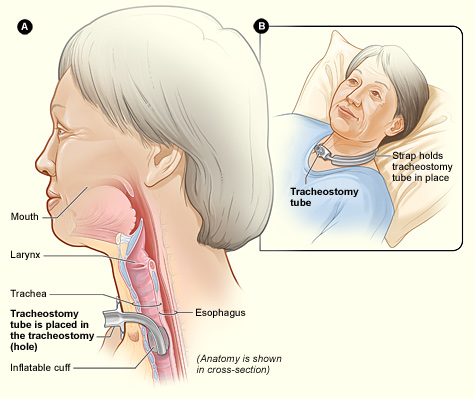
A tracheostomy is an opening through the anterior neck into the trachea. A tube in the stoma keeps it open. A laryngectomy removes the larynx, so the stoma becomes the permanent airway. Tracheostomy emergencies are uncommon but serious. Three of them carry the greatest threat: decannulation, obstruction and hemorrhage.
| Feature | Tracheostomy | Laryngectomy stoma |
|---|---|---|
| Upper airway | Intact: mouth and nose connect to the trachea | No connection from pharynx to trachea |
| Ventilate and oxygenate | Stoma, mouth or nose; occlude the stoma when ventilating the face | Stoma only |
| Intubate | From above, or through the stoma | Through the stoma only |
How It Works
- Bypasses the upper airway: a tube below the larynx puts ventilation and oxygen straight into the trachea.
- Inner cannula keeps the lumen open: it comes out for cleaning. In obstruction it is the next thing out, right after any external device.
- Cuff seals the trachea: it lets you ventilate under positive pressure and limits aspiration. Overinflation injures the mucosa.
- Stoma is immature early on: before about postoperative day 7, the tract can close. It can also form a false passage.
- Waveform capnography confirms placement: see the capnography page.
Where It Fits
Every tracheostomy emergency runs in the same order. Oxygen to the face and stoma comes first. Then clear or replace the tube. Then intubate from above, or move to a surgical airway (see cricothyrotomy). The National Tracheostomy Safety Project (NTSP) emergency algorithms, reproduced from the 2012 McGrath guideline, lay out that sequence for adults. The branch point is whether the upper airway is patent.
Indications & Contraindications
Indications
- Obstruction: no air through the tube, stridor, rising work of breathing, falling SpO₂ or lost EtCO₂
- Decannulation or dislodgement: tube out, especially in a stoma under about 7 days
- Bleeding: from the stoma or the tube, at any time; late bleeding after about day 4 is the dangerous category
- Cuff failure: leak or loss of seal with loss of ventilation
Absolute Contraindications
When the airway is at risk, there are none. Losing oxygenation outweighs every caution below.
Relative Contraindications & Cautions
- Stoma under about 7 days: do not blindly reinsert. Intubate from above or follow local protocol
- Laryngectomy: No route runs from the mouth or nose to the trachea. Oxygen and intubation go through the stoma
- Uncuffed tube: It can leak under positive pressure. A patent uncuffed tube is normal in many long-term patients and in many children. Do not exchange a working tube in an emergency (see Special Populations)
- Speaking valve or cap in place: Take it off first in any obstruction workup
- Fistula risk factors: Low placement, excessive tube movement, an overinflated cuff and a suboptimal tube position all raise fistula risk (NTSP). Anticoagulants, antiplatelet drugs and thrombocytopenia raise bleeding risk
Consider an Alternative
If the tube is patent and the patient is oxygenating, troubleshoot before you replace it. The stoma won't take a tube but the upper airway is open? Intubate from above. Cannot intubate, cannot oxygenate (CICO)? Go to the cricothyrotomy page.
Scope & Team Roles
| Provider Level | Typical Role | Notes |
|---|---|---|
| EMT | Assists | Recognize obstruction, oxygen to face and stoma, call for help. Tube handling per state protocol |
| AEMT | Assists | Support oxygenation and suction per state protocol until the paramedic arrives |
| Paramedic | Performs (protocol/credentialing required) | Not in national model: state/agency credentialing |
| RN (ED/ICU) | Performs | Suction, cuff checks and stoma care; emergency tube change per unit policy |
| Critical Care Transport (CFRN / CCT / FP-C / CCP-C) | Performs (protocol/credentialing required) | Agency-specific; same limits as paramedic |
| Physician / APP | Performs | Operator for tube replacement, bleeding control and ENT referral |
Team Roles During the Procedure
- Operator: decides on tube replacement or intubation from above
- Airway and oxygen manager: keeps oxygen on the face and the stoma throughout
- Tube and suction support: holds the spare tube, obturator and suction catheter
- Monitor and recorder: reads EtCO₂ and SpO₂, times each step and calls out changes
- Escalation: calls ENT or surgery early for bleeding, fistula or a tube that cannot be replaced
Pre-Procedure Assessment
Anatomic Difficulty
| Finding | Assess | Concerning Finding |
|---|---|---|
| Tube type and size | Flange, pilot balloon, cuff, inner cannula | Size unknown; fenestrated outer tube or inner cannula; cuff that will not hold a seal |
| Stoma age | Date of tracheostomy or last tube change | Under about 7 days |
| Upper airway | Mouth and nose patency | Obstruction, swelling or bleeding |
| Secretions | Response to suction | Thick plugs that will not clear |
| Neck and stoma | Stoma, flange and ties | Fresh bleeding, a loose flange or a dark tract |
Physiologic Risk
- Hypoxemia: SpO₂ falling despite oxygen to the face and stoma
- Hemodynamics: With bleeding, hypotension or tachycardia makes the procedure more urgent
- Work of breathing: Rising effort, stridor or accessory muscle use points to a blocked airway
Site / Device Check
- Equipment: spare tube, obturator, inner cannula, suction and a cuffed ETT are at hand before you start
- Capnography: connected and reading before any manipulation
Anatomy & Landmarks
The target is the stoma, the opening between skin and trachea, held open by the tube. In an emergency, route matters more than site.
| Site | Best For | Avoid If |
|---|---|---|
| Tracheostomy stoma | Obstruction or dislodgement with a mature stoma | Stoma under about 7 days: intubate from above |
| Laryngectomy stoma | Only airway for a laryngectomy patient | Never a route for the mouth or nose |
| Cricothyrotomy | CICO with no usable stoma or upper airway | Age limits: see the cricothyrotomy page |
Tracheostomy Stoma
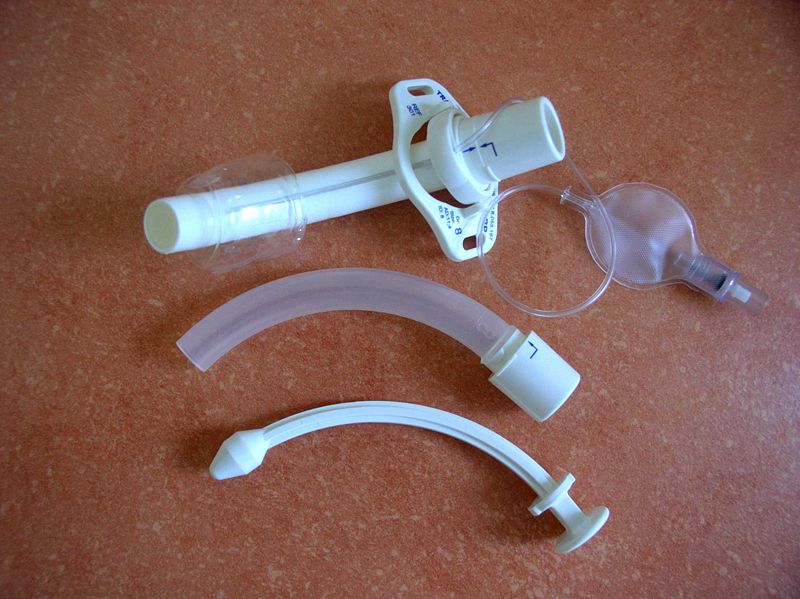
- Read the flange: size and brand are printed on it; a pilot balloon means a cuffed tube.
- Look at the stoma: check for blood, swelling and a dark or granular tract.
- Check flange and ties: the flange should sit flat on the neck and the ties should hold.
- Note the stoma age: the date of placement decides whether to reinsert or intubate from above.
Laryngectomy Stoma
A laryngectomy patient has no pharynx-to-trachea connection. The stoma is the only route for oxygen, bag ventilation and intubation. Do not try to intubate from above.
Do not remove a tracheo-oesophageal puncture (TEP) prosthesis (NTSP).
Equipment & Preparation
Equipment
| Item | Size / Spec | Notes |
|---|---|---|
| Spare tracheostomy tube | Same size and one size smaller | Check cuff and flange before use; keep at the bedside |
| Obturator | Matches the tube | Used during placement or exchange; check it is with the tube |
| Inner cannula | Matches the tube | Remove first in obstruction; clean or replace per protocol |
| Suction catheter | Sterile, soft, graduated | Pass through the tube after the inner cannula is out; never beyond the tube tip |
| Cuffed ETT | Adult 6.0 cuffed (see Sizing) | For intubation from above or through the stoma; go smaller if it will not pass. Advance only until the cuff is just inside the trachea (too deep risks endobronchial placement) |
| BVM with oxygen | Adult or pediatric | Connect to the tube or the face; occlude the stoma when ventilating the face |
| Capnography | Waveform | Confirms placement after every change |
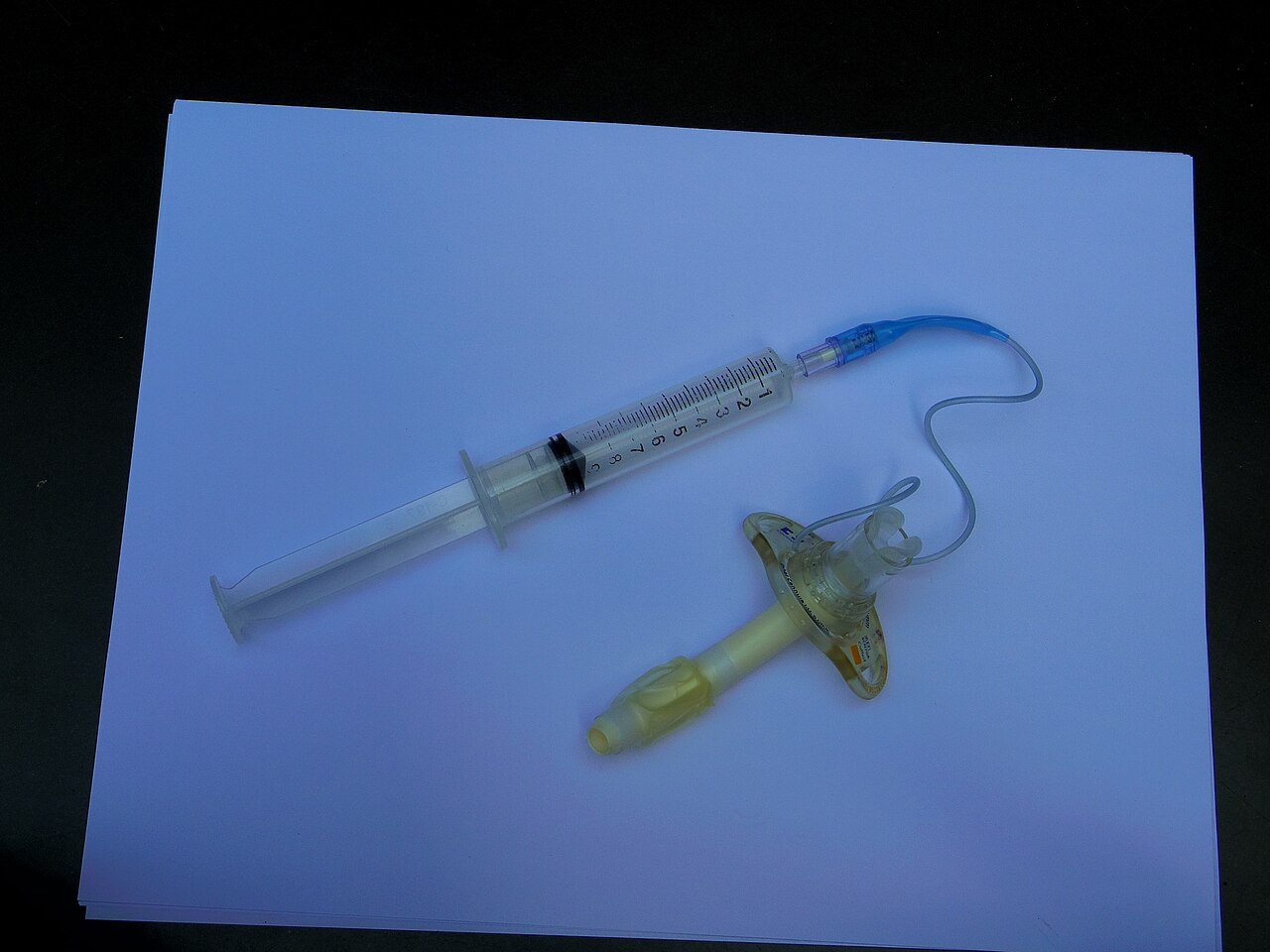
| Cuff manometer and syringe | Pilot balloon | Sets cuff pressure per protocol |
Sizing
- Adult emergency ETT: 6.0 cuffed, for intubation from above or through the stoma (NTSP). Go smaller if it will not pass
- Tracheostomy tube: Each maker has its own sizing, including inner and outer diameter. Check the flange and label first. Do not pick an ETT size off the tracheostomy size
- Cuffed or uncuffed: A pilot balloon means there is a cuff
- Pediatric: Children are sized by age or weight under the pediatric protocol. The adult rule does not apply to children
Patient Positioning & Preparation
Put oxygen on the stoma, and on the face too while you're in doubt. Position the head as protocol says. Hook up capnography before you touch any tube.
Pre-Procedure Checklist
- Oxygen flowing to the face and the stoma
- Spare tube in hand: same size, and one size smaller
- Within reach: obturator, inner cannula, suction and a cuffed ETT
- Waveform capnography hooked up and reading
- Check the flange and ties
- Write down the stoma age
- Have the cuff manometer ready
- Call ENT or surgery early for bleeding or fistula
Step-by-Step Procedure
Phase 1: Recognize & Oxygenate
- Declare the problem: say it aloud (obstruction, dislodgement or bleeding) and call for help.
- Oxygenate the face and the stoma: give oxygen to both while the stoma type is in doubt. Once a laryngectomy is confirmed, oxygen goes to the stoma only. If you ventilate through the face, occlude the stoma with gauze.
- Check the tube and the stoma age: cuffed or uncuffed, size, date of placement and whether a speaking valve or cap is fitted.
Phase 2: Clear the Tube
- Remove external devices: speaking valve, cap or any attachment. Never cap or fit a speaking valve with the cuff inflated.
- Remove the inner cannula: inspect it for plugs and reinsert a clean one per protocol.
- Pass a soft suction catheter: through the tube, not beyond its tip. If it passes, suction and reassess.
- Deflate the cuff: then reassess SpO₂, EtCO₂ and work of breathing. Before relying on the mouth or nose, confirm the upper airway is patent. A laryngectomy has no upper-airway route.
- Remove the tube if it is still blocked: if the catheter will not pass, air will not move or the patient is not improving, remove the tracheostomy tube now. A blocked tube offers no benefit, so do not keep trying to clear it.
Phase 3: Oxygenate, Replace or Intubate
- Oxygenate through the stoma: a paediatric face mask or laryngeal mask (LMA) held over the stoma. Close the mouth and nose if there is a large leak. Ventilate through the tube or stoma where possible.
- Patent upper airway (tracheostomy, not laryngectomy): intubate from above by mouth or nose, using a long uncut tube advanced beyond the stoma, or reinsert a tube through a mature stoma (about day 7 or later) with the spare tube and obturator. Do not force a tube into an immature stoma.
- Laryngectomy, or obstructed or difficult upper airway: intubate or ventilate through the stoma only, with a small tracheostomy tube or 6.0 cuffed ETT. Use an Aintree catheter, fibreoptic scope, bougie or airway exchange catheter where available. Advance a stoma ETT only until the cuff is just inside the trachea; too deep risks endobronchial placement. Confirm with waveform EtCO₂ and bilateral chest rise. If this fails, go to a surgical airway (see cricothyrotomy).
- Confirm placement and call ENT or surgery: use waveform EtCO₂ and chest rise (see Confirmation & Monitoring). Call ENT or surgery for any tube that cannot be replaced or a stoma that will not take a tube.
Alternative Technique: Stoma Bleeding (Possible Fistula)
- Grade the bleed and call for help: sit the patient up, give oxygen, check vital signs and measure the volume. Bright blood under 10 mL contained in the dressing needs urgent review and the surgeon who placed the tube. Active, pulsatile or over 10 mL bleeding needs the emergency response now.
- Hyperinflate the cuff as a temporary tamponade: for a cuffed tube, hyperinflate the cuff as a bridge only. Do not deflate an inflated cuff until expert help is present, because it may be tamponading the vessel.
- Apply direct digital pressure and secure the airway: if bleeding persists, press on the bleeding point. For the Utley maneuver, remove the tube and press a finger into the stoma against the manubrium over the innominate artery. A clinician with advanced airway skills then intubates past the bleed under direct vision.
- Call surgery or interventional radiology and plan transport: call the thoracic, ENT or vascular surgeon and the interventional radiology team now. Transfer to an operating room or IR suite under the direction of the treating surgeon. Before transport: two large-bore IV or IO lines, suction ready, blood products or the massive transfusion protocol per local protocol, and digital pressure kept in place.
Confirmation & Monitoring
Primary Confirmation
Sustained waveform EtCO₂ over several breaths is the primary check. Pair it with bilateral chest rise, breath sounds, and an SpO₂ and work-of-breathing response. Chest rise alone is not enough.
Secondary Confirmation
- Bilateral breath sounds on auscultation
- No cuff leak on a sealed bag or ventilator
- Flange seated flat and ties holding
- No bleeding around the stoma
| Finding | Success | Failure / Malposition |
|---|---|---|
| EtCO₂ waveform | Present and sustained | Absent or flat: tube blocked, out of place or wrong route |
| Chest rise | Bilateral with each breath | Unilateral or none |
| Cuff | Seals; no leak | Leak: underinflated, overinflated or wrong tube |
| Stoma | Patent, dry | Bleeding, swelling or a false passage |
Ongoing Monitoring
- Continuous: waveform EtCO₂ and SpO₂
- After every move or suction pass: re-check EtCO₂, seal and flange
- Each shift or per protocol: cuff pressure, bleeding and stoma condition
In arrest, a low or absent EtCO₂ can mean low pulmonary blood flow, not misplacement. Judge the tube by chest rise, breath sounds and the other checks instead.
Troubleshooting
| Problem | Likely Cause | Fix |
|---|---|---|
| No air through the tube | Inner cannula blocked by secretions | Remove the inner cannula, then suction |
| Suction will not pass | Plug, or a tube blocked at its tip | Deflate the cuff. If still blocked or air will not move, remove the tube and oxygenate the stoma |
| Bag ventilation through the tube is difficult | Uncuffed tube leaking under pressure, cuff leak or blocked lumen | Occlude the mouth, nose or stoma as needed. Replace the tube only if it is blocked, displaced or ventilation fails |
| Leak when ventilating the face | Stoma left open | Occlude the stoma with gauze |
| Tube will not pass into the stoma | Immature stoma, under about 7 days | Do not force it. Patent airway: intubate from above. Laryngectomy: call ENT and oxygenate the stoma |
| Cuff inflated with a speaking valve or cap | Total obstruction | Remove the valve or cap and deflate the cuff |
| Bleeding at the stoma | Stoma bleed or innominate artery fistula | Grade the volume: small needs urgent review and surgeon; active or over 10 mL needs emergency response. See Complications |
| Tube dislodges | Loose ties, flange not seated | Secure the flange and ties; reassess the stoma |
If It Still Fails
- Declare CICO: Stoma and upper airway both failing? That is CICO. Move to a surgical airway. See the cricothyrotomy page.
- Laryngectomy patient: The stoma is the only door for ventilation and intubation. Call ENT now.
- Keep oxygen flowing to the stoma (and the face while in doubt) while the team sets up.
Complications
Tracheostomy complications are common overall, and most are minor. The serious ones are uncommon, but they can be fatal. That is why the sequence above matters.
| Complication | Recognition | Prevention | Management |
|---|---|---|---|
| Immediate: decannulation | Tube out; no EtCO₂; stoma open | Secure flange and ties; avoid pulling on the tube | Intubate from above if under about 7 days; reinsert a spare if mature, per protocol |
| Immediate: obstruction | Stridor, rising work of breathing, no EtCO₂ | Suction and secretion care per protocol | Follow the obstruction sequence |
| Immediate: false passage | No EtCO₂; no chest rise with ventilation | Reinsert under visual or flange guidance | Remove and intubate from above |
| Immediate: stoma bleeding | Blood at the stoma or in the tube | Avoid cuff overinflation; check position; treat a pulsating tube as an emergency | Grade by volume. Under 10 mL contained: urgent review and surgeon. Active or over 10 mL: emergency response (see Step-by-Step) |
| Delayed: tracheal stenosis | Stridor or dyspnea after recovery | Avoid cuff overinflation | ENT referral |
| Rare: tracheoinnominate fistula | Sentinel bleed, then major bleeding | Cuff care; watch high-risk patients (low placement, tube movement, overinflated cuff) | See the emergency box below |
Tracheoinnominate Fistula
- Recognize: Bleeding after about day 4 may be erosion into the innominate artery, a late complication. Small-volume bleeding can come before major haemorrhage (NTSP).
- Act: Active or over 10 mL bleeding calls for emergency response. Hyperinflate the cuff as a temporary tamponade, press on the bleeding point, and have an advanced airway clinician secure the airway.
- Escalate: Call surgery or interventional radiology now. Plan transfer to an operating room or IR suite.
Special Populations
Pediatrics
- Separate paediatric guidance: NTSP has its own paediatric emergency pages. The adult algorithms here stop at the adult patient. Follow the pediatric airway page and local protocol.
- Tube size by age or weight: Forget the adult 6.0 cuffed rule for kids. Use pediatric equipment sizing.
- Uncuffed tubes: Plenty of children run uncuffed tubes. Patent and working? Leave it in an emergency. Occlude and bag through it. Swap it only when it is blocked or displaced.
- Suction: keep pressures low. NTSP (adapted from GOSH) gives maximum suction pressures of about 60–75 mmHg (preterm to 1 month), 75–90 mmHg (0–3 years), 90–112 mmHg (3–10 years) and 112–150 mmHg (10–16 years). The catheter should be less than half the size of the tube.
- Cuff pressure: The pediatric protocol sets it. Adult numbers do not belong on a child.
- Cricothyrotomy age limits: see the cricothyrotomy page.
Laryngectomy Patients
- Stoma only once confirmed: Confirm the laryngectomy first. After that, oxygen, bagging and intubation all run through the stoma. Before confirmation, oxygen goes to the face and stoma.
- Stoma oxygenation: Hold a paediatric face mask or LMA over the stoma. Do not use the face mask or the oral route in a total laryngectomy.
- No oral route: do not attempt intubation from above.
- Devices stay in: Leave the TEP prosthesis in. Do not remove it.
- Partial laryngectomy: The upper airway may be open. Settle the route with ENT. Don't guess in either direction.
- ENT early: call for help at first recognition.
Fenestrated and Speaking-Valve Tubes
- Fenestrated tubes: Before positive-pressure ventilation or suction, fit a non-fenestrated inner cannula (NTSP).
- Speaking valves and caps: Take them off before ventilation or obstruction work. Never fit one with the cuff inflated.
Home Ventilator Patients
- Spare tubes: keep a same-size and one-size-smaller spare with the ventilator
- Stoma is the back-up airway: If the ventilator fails, bag ventilation goes through the tube and stoma
Physiologically Difficult
Chronic steroids, a recent tracheostomy, an overinflated cuff and a high-riding innominate artery all raise fistula risk. Here, bleeding after about day 4 may be a sentinel bleed. Grade it, get urgent surgical review, and treat active or over 10 mL bleeding as fistula. A very large neck girth or obesity may need an adjustable-flange tube (NTSP).
Post-Procedure Care & Transport
Immediate Aftercare
- Check the position with waveform EtCO₂ and chest rise. Then document it
- Press on the skin around the stoma to control bleeding, not the tube. Grade the volume as in Complications
- If the patient is awake or paralyzed, start sedation and analgesia per protocol
Ongoing Maintenance
- Security: Hold it with ties or a holder. Check the seal again after every move
- Cuff: Measure it with a manometer, per protocol. NTSP's routine range is 15–25 cm H₂O and never above 35 cm H₂O. ICU protocols often land on 20–30 cm H₂O
- Suction: Stop the catheter at the tube tip. For adults, negative pressure is no more than −150 mmHg (−20 kPa) (NTSP)
- Stoma: look for bleeding, swelling and infection
Decannulation Readiness (weaning, outside emergency scope)
These criteria are examples from one 2026 narrative review. Each study and local protocol sets its own thresholds.
- Secretions manageable (example): suctioning about 4 times or fewer in 24 hours
- Cough strong enough (example): peak cough flow above 160 L/min
- Swallow assessment completed; upper airway patency confirmed by fiberoptic exam
Transport Considerations
- Reassess after each move by checking EtCO₂, SpO₂ and chest rise
- Vibration and noise can mask dislodgement. Trust waveform EtCO₂
- Carry the spare tube, obturator and suction all the way through transport
- Plan the definitive airway: The tracheostomy buys time. It does not fix every problem
Handoff & Documentation
Document & Hand Off
- Log when the problem was declared, and when each step happened
- Record tube type, size, cuff, flange and stoma age
- Note the cause and the route used (stoma, mouth or nose, or surgical)
- Write down how you confirmed the tube, and the EtCO₂ readings
- Cuff pressure, and any bleeding
- How the patient responded, the transport plan, and whether ENT was contacted
Clinical Pearls & Pitfalls
Pearls
- Inner cannula early: Take off any external device first. The inner cannula is the next thing out when the airway blocks.
- Oxygen to both while in doubt: Oxygen goes to the face and the stoma both, until someone confirms a laryngectomy.
- Emergency ETT is not the tracheostomy size: The adult emergency tube is a 6.0 cuffed. Size down if it won't pass (NTSP).
- Stoma age decides reinsertion: Young stoma, under about 7 days? Blind reinsertion is off the table. With a patent airway, go from above.
- Grade bleeding by volume: Bleeding after about day 4 can be a sentinel bleed, so grade it and call for urgent surgical review. Anything active or over 10 mL gets treated as fistula.
Common Pitfalls
- Forcing a tube into a young stoma: Do not force it. With a patent airway, intubate from above.
- Suctioning repeatedly without removing the inner cannula: Pull the inner cannula, and only then suction.
- Ventilating the face with the stoma open: Seal the stoma with gauze.
- Overinflating the cuff by habit: Check it with a manometer. Overinflation belongs to temporary tamponade, not routine care.
- Exchanging a patent uncuffed tube for bagging: Seal it and bag through it. Swap only if it is blocked, displaced or ventilation fails.
- Fitting a speaking valve or cap with the cuff inflated: Let the cuff down before anything else.
Education & Skill Maintenance
Skill Maintenance
- Drill the obstruction sequence on a trainer. Inner cannula, suction, cuff, tube removal, then the route for this airway
- Drill tube identification: flange size, cuffed or uncuffed, and stoma age
- Run a bleeding scenario. Include the Utley maneuver and a call to surgery
- Check spare tubes and obturators at every shift
- Debrief each case. Was the route chosen by stoma age? Was the spare found quickly?
References
- Mitchell RB, Hussey HM, Setzen G, Jacobs IN, Nussenbaum B, Dawson C, et al. Clinical consensus statement: tracheostomy care. Otolaryngol Head Neck Surg. 2013;148(1):6-20. https://doi.org/10.1177/0194599812460376
- McGrath BA, Bates L, Atkinson D, Moore JA; National Tracheostomy Safety Project. Multidisciplinary guidelines for the management of tracheostomy and laryngectomy airway emergencies. Anaesthesia. 2012;67(9):1025-1041. https://doi.org/10.1111/j.1365-2044.2012.07217.x
- National Tracheostomy Safety Project. Emergency algorithms: emergency tracheostomy management (patent upper airway) and emergency laryngectomy management. Reproduced from McGrath et al. (2012); NTSP website, 2026. https://tracheostomy.org.uk/storage/files/Emergency%20tracheostomy%20management.pdf; https://tracheostomy.org.uk/storage/files/Emergency%20laryngectomy%20management.pdf
- National Tracheostomy Safety Project. Tracheostomy emergencies: bleeding. Adapted from TRAMS tracheostomy-related bleeding guidance (Austin Health, July 2017); NTSP website, 2026. https://tracheostomy.org.uk/storage/files/Bleeding.pdf
- National Tracheostomy Safety Project. Day-to-day management of tracheostomies and laryngectomies: cuff management; NTSP website, 2026. https://tracheostomy.org.uk/storage/files/Cuff%20management.pdf
- National Tracheostomy Safety Project. Comprehensive tracheostomy care (includes paediatric suction guidance adapted from GOSH) and emergency care (child) pages; NTSP website, 2026. https://tracheostomy.org.uk/storage/files/Comprehensive%20Tracheostomy%20Care.pdf; https://tracheostomy.org.uk/healthcare-staff/emergency-care-child
- Bontempo LJ, Manning SL. Tracheostomy emergencies. Emerg Med Clin North Am. 2019;37(1):109-119. https://doi.org/10.1016/j.emc.2018.09.010
- Zhang J, Zhao X, Tao M, Zeng H, Yuan L, Mensah E, et al. Respiratory rehabilitation and decannulation in adults with prolonged mechanical ventilation after tracheostomy: a narrative review. Healthcare (Basel). 2026. https://pmc.ncbi.nlm.nih.gov/articles/PMC13299066/
Medical Disclaimer
- For Educational Purposes Only: This content is intended for educational reference and should not be used for clinical decision-making.
- Not a Substitute for Professional Judgment: Always consult your local protocols, institutional guidelines, and supervising physicians.
- Verify Before Acting: Users are responsible for verifying information through authoritative sources before any clinical application.