

Bedside Snapshot
- Recognize
- Dyspnea with pulmonary congestion (crackles, raised jugular venous pressure, edema, orthopnea), often with hypoxemia. Natriuretic peptides support the diagnosis; they never replace the exam.
- Red Flags
- SpO₂ <90% or respiratory rate above 25/min; SBP <90 mmHg or cool, mottled skin with confusion; hypertensive pulmonary edema (SCAPE); chest pain or ST change on ECG
- First Actions
- Sit upright; oxygen if SpO₂ <95%; CPAP early (per protocol); 12-lead ECG and IV access; IV furosemide; IV nitroglycerin if hypertensive
- Key Doses
- Furosemide 40 mg IV over 1–2 min, then 80 mg IV if no satisfactory response within 1 hr; nitroglycerin IV 5 mcg/min, increase by 5 mcg/min every 3–5 min. Doses vary by protocol.
- Don't Miss
- ACS or arrhythmia as the trigger; a cold, hypotensive patient who needs an inotrope, not more diuretic; PDE-5 inhibitor use before any nitrate
- Escalate & Transport
- Falling SpO₂ or tiring on CPAP: NIV, then intubation; cold shock: inotrope or vasopressor in ED or ICU; ACS or STEMI: PCI-capable center; treated patients go to the ED
Definition & Pathophysiology
Heart failure that gets worse fast is an emergency. Clinicians call it acute decompensated heart failure (ADHF). The usual drivers are congestion, low cardiac output, or both. The most abrupt version is flash pulmonary edema, also called acute cardiogenic pulmonary edema (ACPE). Fluid crosses into the lung faster than the lung can clear it, and gas exchange stops working. The sources for this page never settle on one universal definition. Working definition, then: new or worsening breathlessness with pulmonary congestion, needing urgent therapy.
- Mechanism: Left-sided filling pressure goes up. It pushes fluid into the interstitium and alveoli. A sympathetic surge raises afterload and can drive a sudden rise in blood pressure. That is the sympathetic crashing acute pulmonary edema (SCAPE) pattern.
- Triggers: acute coronary syndrome or ischemia, atrial or ventricular arrhythmia (especially a fast ventricular rate), uncontrolled hypertension, missed diuretic or salt and fluid overload, infection, and acute valve dysfunction.
- Clinical profile: Congestion (wet or dry) and perfusion (warm or cold) sort the patient. Vasodilators go to one group. Inotropes or vasopressors go to the other. Treating the wrong profile is the main drug-selection error.
Recognition & Red Flags
Presentations
- Hypertensive pulmonary edema (SCAPE): Sudden, severe dyspnea. Orthopnea, diaphoresis and crackles, with high blood pressure. This one usually responds to afterload reduction.
- Cold, low-output pattern: Edema or raised jugular venous pressure (JVP) comes with cool extremities, a narrowing pulse pressure or confusion. Blood pressure may be normal or low. This pattern needs perfusion support, not only diuresis.
- Known heart failure with gradual decline: Leg swelling, weight gain and reduced exercise tolerance. Less respiratory distress than the flash form.
Red Flags
- SpO₂ below 90% or respiratory rate above 25/min: meets the respiratory-distress threshold for noninvasive ventilation (NIV) in European guidance.
- SBP below 90 mmHg (protocol threshold), cool or mottled skin, or new confusion: possible cardiogenic shock.
- Severe hypertension with pulmonary edema (SCAPE): a vasodilator candidate.
- Chest pain, ST-segment change on ECG, or a new arrhythmia: acute coronary syndrome (ACS) or rhythm trigger.
- Frothy sputum, inability to speak in full sentences, or a rising PaCO₂: impending respiratory failure.
Assessment & Diagnostics
Acute heart failure is a clinical diagnosis. Natriuretic peptides, the ECG and imaging support it. Don't wait on a result to treat respiratory distress.
| Check | Why | Act If |
|---|---|---|
| SpO₂, respiratory rate, work of breathing | Hypoxemia and fatigue set the need for NIV | SpO₂ below 95%: oxygen. SpO₂ below 90% or rate above 25/min: CPAP or NIV per protocol. Check the arterial or venous gas if hypercapnia is suspected (see PaCO₂) |
| Blood pressure, perfusion and mentation | Separates the vasodilator pattern from the low-output pattern | Hypertensive and perfusing: nitrate pathway. SBP below 90 mmHg, cool skin or confusion: inotrope or vasopressor pathway. Check lactate in suspected shock |
| 12-lead ECG | Ischemia and arrhythmia are common triggers | ST elevation: STEMI pathway (see STEMI Recognition). Atrial fibrillation or a fast rate: treat the trigger |
| BNP or NT-proBNP | Supports the diagnosis; a normal value makes acute HF unlikely | Below the acute rule-out values on the BNP page: look for another cause. Above them: treat as HF while the exam is completed |
| Troponin | ACS is a common trigger and a common mimic | Rising or falling pattern with symptoms: ACS pathway. See Troponin |
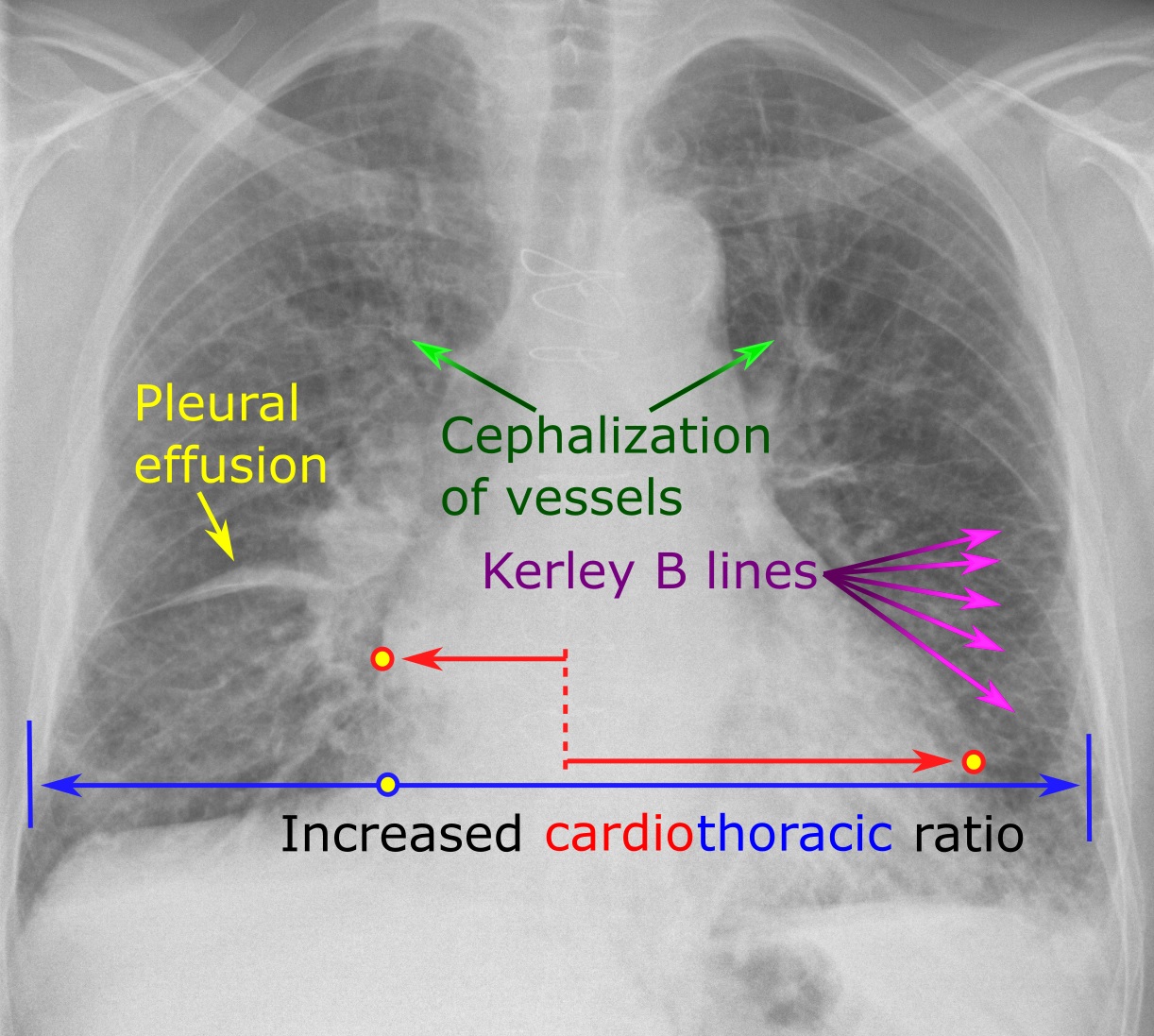
| Chest radiograph or lung ultrasound | Congestion, effusion and alternative causes; ultrasound can replace the film in suitable patients | Kerley B lines, effusions or B-line pattern: congestion. Consolidation or pneumothorax: look for another cause |
| Creatinine, potassium and sodium | Baseline kidney and electrolyte status before diuretics; diuresis changes them |
Differential & Mimics
- Asthma or COPD exacerbation: Prolonged expiration with wheeze and few crackles. No hypertensive surge. Little response to diuretic.
- Pulmonary embolism: Pleuritic pain, hemoptysis, tachycardia or right-heart strain on imaging. No response to diuresis.
- Pneumonia or ARDS: Fever, focal consolidation or signs of sepsis. Diuretic and nitrate therapy do not treat them.
- Anaphylaxis: Skin or mucosal signs and an exposure history. Give epinephrine first. See Epinephrine IM.
- ACS presenting as pulmonary edema: Ischemic ECG changes or a troponin pattern. Treat the ischemia.
- Fluid overload without heart failure: A large IV volume load or renal failure. Check the history and trend the pattern.
BLS Management
- Sit the patient upright with legs down if blood pressure allows; do not lay a dyspneic patient flat.
- Oxygen when SpO₂ is below 95%, titrated to 94–98%. Sources differ on the threshold. Miro 2025 (reference 2) uses below 95%. Other guidance uses below 90%. Avoid hyperoxia and follow the local protocol. See Oxygen.
- CPAP early for respiratory distress when the agency is credentialed (EMT scope varies; per local protocol). See Noninvasive Ventilation.
- Monitor SpO₂, respiratory rate, BP, heart rate and mental status; get a 12-lead ECG when the monitor allows.
- Patient's own nitroglycerin: assist only if prescribed and SBP is adequate per protocol, and only if the patient has not used a PDE-5 inhibitor (sildenafil, tadalafil, vardenafil or avanafil) or riociguat.
- Call for ALS and transport promptly; reassess every 5 minutes.
ALS Management
Doses vary by protocol; follow local protocols and medical direction.
- CPAP or NIV (Paramedic/RN/CCT): Start CPAP at 5 cmH₂O and increase to 7.5–10 cmH₂O according to response. NIV ventilator settings follow the protocol. CPAP needs no ventilator. It is the simpler prehospital option. See Noninvasive Ventilation.
- Nitroglycerin IV (Paramedic/RN/CCT): For hypertensive pulmonary edema, start 5 mcg/min. Increase by 5 mcg/min every 3–5 min while blood pressure and breathing respond. No response at 20 mcg/min? The label allows increments of 10 or 20 mcg/min. Reduce increments once a response starts. The label gives no blood-pressure threshold. The protocol sets the SBP below which the drug is not started, and the level at which it is stopped or reduced. Stop or reduce for symptomatic hypotension. Avoid or reduce it in volume-depleted patients (label: monitor these patients). Give by infusion pump with nonadsorptive tubing. See Nitroglycerin.
- High-dose nitroglycerin in SCAPE: Doses of 100 mcg/min and above are used in some protocols. The evidence is a low-versus-high dosing comparison (Henry 2025, reference 6). It is retrospective and single-center. It is not a dosing standard. Sublingual and spray nitroglycerin for pulmonary edema depends on the protocol. Sublingual labeling is for angina.
- IV furosemide (Paramedic/RN/CCT where the protocol allows): 40 mg IV slowly over 1–2 min is the label's usual initial dose. The label does not address patients already on a loop diuretic (see ED & ICU Management). No satisfactory response within 1 hour? Increase to 80 mg IV slowly over 1–2 min. Never run furosemide in the same line as milrinone. The two precipitate in one line. See Furosemide.
- IV access, 12-lead ECG and glucose check on every patient with dyspnea and congestion.
- Cold, hypotensive patients: Do not give a nitrate. The inotrope or vasopressor pathway is an ED or ICU decision. Prehospital crews hand off the BP trend and the response to fluids and diuretic.
ED & ICU Management
- Measure the diuretic response: Check urine output and natriuresis shortly after the first diuretic bolus. A poor response calls for a higher dose. Some centers add acetazolamide or a thiazide-type diuretic. This page does not cite the evidence for those strategies.
- Diuretic dose intensity: In the DOSE trial, 2.5 times the previous oral daily furosemide dose gave more diuresis than 1 times. The creatinine rose transiently, with no significant difference in symptom scores. Titrate to diuretic response and renal function. For a patient already taking a loop diuretic, the 40 mg label dose may underdose them. The initial IV dose is commonly at least the home oral daily dose. In SCAPE, the excess fluid has mostly moved into the lungs. So the diuretic plays a secondary role to afterload reduction and NIV. See Furosemide.
- Dobutamine for low output (ED/ICU): Start 0.5–1 mcg/kg/min IV and titrate. Usual range 2–20 mcg/kg/min, rarely up to 40. Heart rate and blood pressure rise with it. It can speed AV conduction in atrial fibrillation. Hypotension and ventricular arrhythmia are the main risks. Watch rhythm and BP closely. See Dobutamine.
- Milrinone (ED/ICU, renal dose): An optional 50 mcg/kg IV load over 10 min (labeled for the 1 mg/mL vial only), then 0.375–0.75 mcg/kg/min. Reduce the rate in renal impairment. The label indication is short-term treatment of acute decompensated heart failure. In practice, reserve it for low output with poor perfusion. Hypotension and arrhythmia are the main risks. Watch BP and rhythm closely. Do not mix or co-infuse furosemide with milrinone. The two precipitate. Use a separate line or flush. See Milrinone.
- Vasopressor for hypotension in cardiogenic shock: add a vasopressor such as norepinephrine to maintain perfusion pressure. See Norepinephrine.
- Escalate respiratory support: Keep NIV going while it works. If the work of breathing or mental status fails, the most experienced operator intubates. See RSI.
- Mechanical support: In refractory cardiogenic shock, cardiology decides on an intra-aortic balloon pump or an Impella device. See Balloon Pump and Impella.
- Find and treat the trigger: ischemia (ACS pathway), arrhythmia, hypertension, infection or valve failure.
- Disposition: Admit or discharge based on risk stratification, once the trigger is treated and oral therapy has started. Don't discharge a patient who still needs CPAP or an infusion.
Transport Considerations
- Destination: The emergency department. A PCI-capable center for STEMI or ACS. An ICU or cardiac unit for cardiogenic shock, per the regional system.
- Continue in transit: Keep CPAP or NIV running and check SpO₂, respiratory rate and mental status. A nitroglycerin infusion runs on a pump at a constant rate. Don't use gravity.
- Reassess every 5 minutes: BP, SpO₂, respiratory rate, rhythm, lung sounds and mental status. Stop or reduce the nitrate for a falling BP. Reassess before any repeat dose.
- Handoff: time and dose of each drug, CPAP pressure and start time, BP trend, urine output, rhythm and the response to each intervention.
- Equipment: suction for frothy secretions, a working pump, CPAP with spare masks, and drugs at hand for a sudden BP drop.
Special Populations
- Pediatrics: Furosemide initial dose 1 mg/kg IV (slowly) or IM. If the response is unsatisfactory, increase by 1 mg/kg no sooner than 2 hours after the previous dose. Doses above 6 mg/kg are not recommended (label). These are the label's general diuretic doses. They are not an acute pulmonary edema regimen. The sources used here do not establish nitroglycerin or inotrope doses for pediatric acute pulmonary edema. Use pediatric cardiology guidance and weight-based dosing.
- Pregnancy: Pulmonary edema in pregnancy or the postpartum period needs assessment for preeclampsia and other obstetric causes first. Only then is it managed as routine heart failure. Treat severe hypertension per the Hydralazine page and the obstetric protocol. Diuretic, nitrate and inotrope decisions are made with obstetric and cardiology input.
- Older Adults: The initial diuretic effect of furosemide is smaller in older adults (label). Reassess the response early.
- Renal Impairment: Avoid dehydration with diuresis (label). Rapid furosemide injection raises the risk of hearing loss, and so does severe renal impairment (label). Milrinone infusion rates may need reduction (label).
- Hepatic Impairment: With cirrhosis and ascites, furosemide is best started in hospital. In hepatic coma, don't start it until the basic condition improves (label).
- Patients on PDE-5 Inhibitors or Riociguat: Nitrates are contraindicated (label). Ask about sildenafil, tadalafil, vardenafil, avanafil or riociguat before any nitrate. The Nitrostat label gives no hour window after a PDE-5 dose. The protocol sets the window.
Pitfalls & Safety Checks
- Error: nitrate given after a PDE-5 inhibitor or riociguat. The label lists both as contraindications. They cause severe hypotension, syncope or ischemia. Ask before the first dose. Then follow the protocol's time window after the last PDE-5 dose.
- Error: nitrate in pericardial tamponade, restrictive cardiomyopathy or constrictive pericarditis. Cardiac output depends on venous return in these conditions. The IV label contraindicates nitroglycerin in them and in raised intracranial pressure.
- Error: nitroglycerin dose set by the published starting dose. Older studies started at 25 mcg/min, using PVC tubing that absorbs the drug. The label notes this. With nonadsorptive tubing, the label starts at 5 mcg/min.
- Error: rapid IV furosemide push. Rapid injection and severe renal impairment are linked to ototoxicity (label). For high-dose infusions, the label says a rate of about 4 mg/min has been used in adults. Use a controlled infusion.
- Error: over-diuresis in a cold patient. Too much diuresis can cause profound water and electrolyte depletion, along with dehydration and hypotension (label warnings). Check potassium, sodium and creatinine during diuresis.
- Error: vasodilator alone for cold, hypotensive pulmonary edema. Vasodilators suit the congested, hypertensive phenotype. Cardiogenic shock needs an inotrope or vasopressor.
- Error: anchoring on heart failure. If the response to standard therapy is poor, reconsider ACS, pulmonary embolism, pneumonia and asthma or COPD.
- Error: inotrope without a plan for stopping. Labeled experience with dobutamine and milrinone does not go past 48 hours. Plan the transition early.
Clinical Pearls
References
- Heidenreich, P. A., Bozkurt, B., Aguilar, D., et al. (2022). 2022 AHA/ACC/HFSA Guideline for the Management of Heart Failure. Circulation, 145, e895–e1032. https://doi.org/10.1161/CIR.0000000000001063
- Miró, Ò., Chioncel, O., Mebazaa, A., et al. (2025). Early diagnosis and treatment of acute heart failure in prehospital and emergency settings. Part 1 of the International Expert Opinion Series on acute heart failure management. European Journal of Emergency Medicine, 32(6), 392–404. https://doi.org/10.1097/MEJ.0000000000001270
- Masip, J., Peacock, W. F., Price, S., et al. (2018). Indications and practical approach to non-invasive ventilation in acute heart failure. European Heart Journal, 39(1), 17–25. https://pubmed.ncbi.nlm.nih.gov/29186485/
- Gray, A., Goodacre, S., Newby, D. E., et al. (2008). Noninvasive ventilation in acute cardiogenic pulmonary edema (3CPO trial; landmark trial). New England Journal of Medicine, 359, 142–151. https://pubmed.ncbi.nlm.nih.gov/18614781/
- Felker, G. M., Lee, K. L., Bull, D. A., et al. (2011). Diuretic strategies in patients with acute decompensated heart failure (DOSE trial; landmark trial). New England Journal of Medicine, 364, 797–805. https://pubmed.ncbi.nlm.nih.gov/21366472/
- Henry, K., Pelsue, B., Hartman, H., & Gulbis, B. (2025). Low versus high dosing strategies of intravenous nitroglycerin for the management of sympathetic crashing acute pulmonary edema. American Journal of Emergency Medicine, 98, 41–45. https://doi.org/10.1016/j.ajem.2025.08.017
- Baxter Healthcare Corporation. (2026). Nitroglycerin in 5% dextrose injection: prescribing information. DailyMed. https://dailymed.nlm.nih.gov/dailymed/drugInfo.cfm?setid=457a026c-ebce-4701-9deb-2d7652759a99
- Hospira, Inc. (2026). Furosemide injection: prescribing information. DailyMed. https://dailymed.nlm.nih.gov/dailymed/drugInfo.cfm?setid=39fd32f2-6bb7-4a65-d298-e48d26bc80c7
- Hospira, Inc. (2026). Dobutamine in 5% dextrose injection: prescribing information. DailyMed. https://dailymed.nlm.nih.gov/dailymed/drugInfo.cfm?setid=9943a961-3b50-4847-8a84-d8414ce38daa
- Hikma Pharmaceuticals USA Inc. (2026). Milrinone lactate injection: prescribing information. DailyMed. https://dailymed.nlm.nih.gov/dailymed/drugInfo.cfm?setid=88f78780-399f-4780-be19-205739db1682
Medical Disclaimer
- For Educational Purposes Only: This content is intended for educational reference and should not be used for clinical decision-making.
- Not a Substitute for Professional Judgment: Always consult your local protocols, institutional guidelines, and supervising physicians.
- Verify Before Acting: Users are responsible for verifying information through authoritative sources before any clinical application.