

Bedside Snapshot
- Recognize
- Muscarinic signs (secretions, miosis, GI cramps, bradycardia) plus nicotinic weakness and twitching, after an OP insecticide or nerve agent exposure. Carbamates look similar.
- Red Flags
- Chest tightness or breathing failure; copious secretions; convulsions or coma; progressive weakness; bradycardia or tachycardia
- First Actions
- Protect yourself; decontaminate (remove and bag clothing, wash hair and skin); suction and ventilate; atropine IV/IO; pralidoxime; benzodiazepine for seizures; reassess every 3–5 min
- Key Doses
- Atropine 2–3 mg IV/IO, then repeat to endpoints
- Pralidoxime adult 1–2 g IV over 15–30 min; repeat at 1 hr if weak
- DuoDote IM: 1 (mild) or 3 (severe) injections, over 41 kg
- Child: atropine 0.02 mg/kg; pralidoxime 20–50 mg/kg (max 2 g)
- Don't Miss
- Atropine does not reverse weakness; pralidoxime is not for carbamates; intermediate syndrome at 24–96 hr; prolonged paralysis with succinylcholine
- Escalate & Transport
- ICU and ventilation early; toxicology consult; observe at least 48–72 hr. Transport to an ED with ICU and toxicology access per local protocol
Definition & Pathophysiology
Organophosphates (OPs) are insecticides, and they are also military nerve agents: sarin, soman, tabun, VX and the Novichok class. Both block acetylcholinesterase. With the enzyme phosphorylated, nothing clears acetylcholine. It piles up at muscarinic and nicotinic synapses and in the brain. Carbamate insecticides block the same enzyme and look much the same. Pralidoxime is still not indicated for them.
Pralidoxime can reactivate the enzyme, but only before it “ages.” Aging is a further chemical change that makes the enzyme resist reactivation. The DuoDote label states the limit. Pralidoxime does not reactivate every agent (soman is named), and it cannot reactivate aged enzyme. Atropine blocks the muscarinic effects. It does nothing for the nicotinic weakness.
- Exposure routes: The routes are ingestion, skin or eye contact, and inhaling vapor or aerosol. Ingestion is the usual pattern for pesticides, whether intentional or accidental. Nerve agent exposure is treated the same way as an OP insecticide.
- Course: Vapor acts fast. After inhaling nerve agent, symptoms can develop very quickly, and death can come within minutes. After skin exposure, the onset of signs may be delayed. In some patients, intermediate syndrome follows the cholinergic crisis. It usually starts 24–96 hours after exposure, with proximal limb and neck weakness, cranial nerve palsies and respiratory failure. Weeks later, delayed polyneuropathy (OP-induced delayed polyneuropathy) can follow: a distal axonal neuropathy with sensory and motor loss and ataxia.
- Observation: The Protopam label is clear on time. Keep the patient under observation for at least 48–72 hours. Keep some degree of atropinization for at least 48 hours too.
Recognition & Red Flags
Presentations
Early on, you see two families of signs. Muscarinic signs are the secretions and the GI and eye symptoms. Nicotinic signs are the twitching and the weakness. The DuoDote and Protopam labels both sort the signs into mild or severe, and that sorting decides how many autoinjectors or injections you give.
| Domain | Mild | Severe |
|---|---|---|
| Eyes and secretions | Blurred vision, miosis; teary eyes; runny nose; sudden drooling | Wheezing, coughing or increased airway secretions; copious secretions from lungs or airway |
| Chest and breathing | Chest tightness or difficulty breathing | Severe difficulty breathing |
| Heart | — | Tachycardia or bradycardia |
| Gut and bladder | Nausea, vomiting, acute stomach cramps | Involuntary urination and defecation |
| Muscles and brain | Tremors throughout the body or muscular twitching | Strange or confused behavior; severe muscular twitching and general weakness; convulsions; unconsciousness |
Red Flags
- Respiratory failure: secretions keep climbing or suction does not clear them, or SpO₂ falls while breathing is weak.
- Airway resistance: bronchoconstriction and secretions make the bag fight you. Suction first, then watch the chest rise instead of trusting the bag.
- Weakness: proximal limb weakness that keeps getting worse is the warning sign of intermediate syndrome.
- Seizures or coma: convulsions or unconsciousness after exposure.
- Heart rate: Bradycardia is a cholinergic sign, and atropine treats it. HR above 80/min is one of the atropine endpoints. Atropine can drive the heart rate up, and that tachycardia can cause ischemia (see Special Populations).
Assessment & Diagnostics
The work-up happens at the bedside and early in the hospital. Treatment does not wait on the lab.
| Check | Why | Act If |
|---|---|---|
| Airway, breathing, SpO₂ and EtCO₂ | Secretions and respiratory muscle weakness cause failure | Suction, then bag-valve-mask ventilation with oxygen; advanced airway if ventilation fails. See Capnography |
| Heart rate and rhythm (12-lead ECG) | Atropine can cause tachyarrhythmias and ischemia in coronary disease (DuoDote label) | Bradycardia: atropine to endpoints. Ischemia or arrhythmia: treat per protocol; see 12-Lead ECG Acquisition |
| Glucose | Hypoglycemia mimics the altered mental status and seizures | Treat low glucose per protocol. See Glucose |
| RBC or plasma cholinesterase | May confirm OP exposure. The Protopam label says these tests may be normal despite clinically significant poisoning | Send the sample; do not wait for it before starting atropine or pralidoxime |
| Toxicology panel and co-ingestants | OP products are often taken with other drugs | Treat the co-ingestant per its own page. See Toxicology Panel |
| Mental status and seizures | Seizures are a sign of severe central toxicity | Benzodiazepine per the ALS section; see Status Epilepticus |
Differential & Mimics
- Atropine toxicity: flushing, dry skin, widely dilated pupils, fever, tachycardia and delirium are the mirror image of the OP picture. They mean the atropine dose is too high. They do not mean you need more (DuoDote overdosage section).
- Carbamate insecticides: the cholinergic signs look alike. The Protopam label is firm that pralidoxime is not indicated for carbamate pesticides. It may increase carbaryl toxicity.
- Muscarinic mushroom poisoning: atropine is the antidote here too, which is why the two treatments overlap.
- Hypoglycemia, opioid and sedative toxicity: each one can also produce altered mental status and seizures. Check glucose first. See Toxidromes.
BLS Management
At the BLS level you handle scene safety, decontamination of the patient and rescuers, airway and breathing support, and helping the patient use their own autoinjector. Every step follows local protocol and the hazmat team's direction.
- Scene safety: do not enter an unknown chemical scene without the protective level and hazmat direction required by local protocol. Look for the source before approaching.
- Decontaminate: remove all contaminated clothing and bodily fluids and bag them safely; the umbrella review notes that this also protects healthcare workers. Wash the patient's hair and skin thoroughly as soon as possible. The Protopam label specifies sodium bicarbonate or alcohol, and the 2026 umbrella review uses soap and water. Follow the hazmat team's agent-specific direction, including PPE level.
- Airway and breathing: position for drainage, suction the secretions and give oxygen. Bag-valve-mask ventilation if breathing is poor. See Bag-Valve-Mask Ventilation.
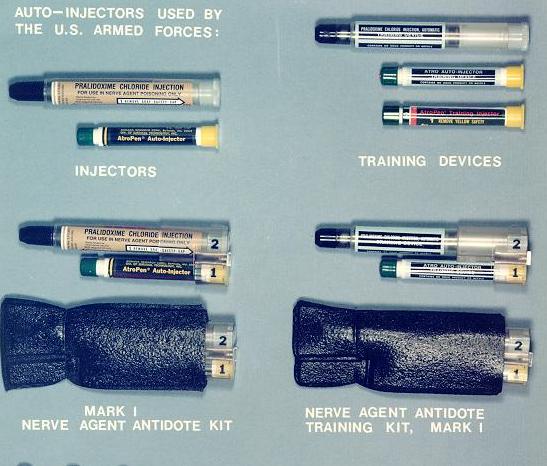
- Autoinjector assist: if the patient carries DuoDote or ATNAA, help them use it. Inject into the mid-lateral thigh. Two or more mild signs: one injection. Any severe sign: three injections in rapid succession (DuoDote label). Note the number and time of each dose. Children 41 kg or less: DuoDote is not labeled; see ALS Management.
- Seizures and self-protection: protect the patient from injury and keep the airway open. Do not restrain a seizing patient.
- Transport priority: notify ALS early with the exposure, decontamination status and autoinjector count.
ALS Management
Anything tagged (Paramedic/RN/CCT) goes beyond BLS. Doses vary by protocol; follow local protocols and medical direction.
- Access and monitor (Paramedic/RN/CCT): Get IV or IO access, then run continuous ECG, SpO₂ and EtCO₂, with suction at the bedside. See IV Insertion and IO Access.
- Atropine (Paramedic/RN/CCT): Start with 2–3 mg IV/IO, the labeled dose for the organophosphate indication (Hospira label, while the Protopam label gives 2–4 mg). Give oxygen and ventilate first. Give atropine as soon as significant hypoxia is corrected, because the Protopam label warns that atropine during significant hypoxia risks ventricular fibrillation. Titrate until the chest is clear, the bronchorrhea has resolved and HR is above 80/min. If those targets are not reached within 3–5 minutes, double the dose and repeat, as the umbrella review describes. The two labels differ on the repeat interval: Hospira at 20–30 minutes, Protopam at 5–10 minutes. Local protocol sets the interval. Child: 0.02 mg/kg IV/IO, titrated the same way (umbrella review). The Hospira label offers only a generic initial range of 0.01–0.03 mg/kg and no OP-specific pediatric regimen. See Atropine.
- DuoDote or ATNAA (Paramedic/RN/CCT): one injection for two or more mild signs; three in rapid succession for any severe sign; reassess 10–15 minutes after the first dose. DuoDote is labeled for adults and children over 41 kg. A patient who cannot self-inject still gets the autoinjector, per protocol.
- Children 41 kg or less (Paramedic/RN/CCT): DuoDote is not labeled. Atropine by weight with AtroPen: under 7 kg 0.25 mg (yellow); 7–18 kg 0.5 mg (blue); 18–41 kg 1 mg (red); over 41 kg 2 mg (green). Use one injection for mild signs and three in rapid succession for severe signs, as the AtroPen label directs. Pralidoxime IM under 40 kg: 15 mg/kg per injection, three injections in rapid succession for severe signs, with a total of 45 mg/kg per course (Protopam label). A 600 mg autoinjector exceeds 15 mg/kg for any child under 40 kg, so skip it for a child. The Protopam IM dose comes from a reconstituted vial. The Protopam label moves to adult IM dosing at 40 kg. DuoDote and AtroPen use 41 kg. In the 40–41 kg band, follow local protocol and poison center direction.
- Pralidoxime (Paramedic/RN/CCT): adults: 1–2 g IV over 15–30 minutes in 100 mL normal saline. For fluid restriction or pulmonary edema, give 50 mg/mL by slow IV injection over at least 5 minutes, no faster than 200 mg/minute (1 g over at least 5 minutes; 2 g over at least 10 minutes). Repeat 1–2 g about 1 hour after the first dose if weakness persists. Give it after atropine has started. Children: 20–50 mg/kg IV over 15–30 minutes, maximum 2 g per dose. See Pralidoxime.
- Seizures (Paramedic/RN/CCT): Benzodiazepines are the treatment for OP-induced seizures (umbrella review, which rates the evidence as likely beneficial). Midazolam 10 mg IM once is the labeled dose for status epilepticus in adults (Rafa autoinjector label, adults only). Pediatric safety and effectiveness are not established. Watch the boxed warning on opioid co-use: profound sedation, respiratory depression, coma and death. Monitor SpO₂ and EtCO₂ continuously and be ready to ventilate, since the label warns of hypoventilation, airway obstruction and apnea. An IV benzodiazepine is given per protocol. See Midazolam and Diazepam.
- Airway (Paramedic/RN/CCT): Go advanced when ventilation is failing, or when secretions atropine cannot control are still building. Prolonged paralysis has been reported when succinylcholine is given alongside anticholinesterase drugs. Use it with caution. See Rapid Sequence Intubation and Succinylcholine.
- Avoid: morphine, theophylline, aminophylline, reserpine and phenothiazine tranquilizers in OP poisoning (Protopam label). Benzodiazepines are the exception. You use them for seizures and for sedation, with airway support ready.
- Bradycardia: the atropine endpoints are above. If the bradycardia persists after atropine, see Adult Bradycardia.
ED & ICU Management
- Diagnostics: Send RBC and plasma cholinesterase, glucose and a toxicology screen. Treatment does not wait for any of them. Don't let a normal cholinesterase reassure you. The Protopam label says those levels may read normal despite clinically significant poisoning, so repeat the cholinesterase only to track recovery.
- Atropine maintenance: run a continuous infusion at 10–20% of the total loading dose per hour (secondary source: 2026 umbrella review, and no product label supports it). Titrate to endpoints. Cut the infusion back as secretions clear, and keep some atropinization for at least 48 hours (Protopam label).
- Pralidoxime infusion: adults: a 1–2 g IV load over 15–30 minutes, then either repeat dosing or a protocol-dependent continuous infusion of about 500 mg/hour (the umbrella review uses a 2 g load then 500 mg/hour; adult case reports used 400–600 mg/hour). The Protopam label has no adult mg/kg/hour rate. Stay in the case-report range unless toxicology directs otherwise. Children: 20–50 mg/kg IV over 15–30 minutes, maximum 2 g per dose, then 10–20 mg/kg/hour (Protopam label, pediatric section). Keep going while the weakness keeps coming back.
- Relapse: After ingestion with ongoing absorption, fatal relapses can follow an initial improvement. In that setting, the Protopam label says additional doses may be needed every 3–8 hours, titrated for as long as signs recur. Otherwise, repeat 1–2 g about 1 hour after the first dose if weakness persists, then every 10–12 hours as needed. Observe for at least 48–72 hours.
- Decontamination in the ED: Activated charcoal 50 g without a cathartic may be given to a cooperative or intubated patient when the presentation is early and the airway is protected (secondary source: 2026 umbrella review).
- Not routine: The umbrella review finds gastric lavage doubtful and possibly harmful, so it stays out of routine care. It recommends against routine magnesium sulfate, lipid emulsion, hemofiltration, plasma exchange with hemoperfusion and alkalinization in OP self-poisoning. Don't make any of them standard therapy.
- Ventilation and intermediate syndrome: Watch for respiratory failure and proximal weakness from 24–96 hours. Plan ICU ventilation early.
- Stockpile: CHEMPACK containers hold nerve agent antidotes in all 50 states, mostly in hospitals and fire stations. State and local officials decide when they get deployed, and there is no federal request process. Access runs through state and local emergency and healthcare coordination (ASPR).
- Consults: Call toxicology or the poison center. For a suspected nerve agent, notify public health or hazmat too, per local protocol.
Transport Considerations
- Destination: Take them to the nearest ED with ICU, ventilation and toxicology access, per local protocol. Before you roll, confirm the receiving team can run pralidoxime infusions and watch for intermediate syndrome.
- Atropine in transit: Keep titrating to endpoints. Suction stays ready, and watch for rising secretions and falling SpO₂. Reassess after every dose.
- Pumps: Run pralidoxime infusions on a pump, and set the rate in mg/hour, not mL/hour.
- Decontamination status: Say out loud whether decontamination is complete and which clothing is bagged. Contaminated clothing stays out of the cab, and the crew follows hazmat protocol.
- Handoff: Give every atropine and autoinjector dose with its time, then the pralidoxime dose and rate, any benzodiazepine, and the endpoints you reached.
Special Populations
- Pediatrics: Start atropine at 0.02 mg/kg IV/IO and titrate to the same endpoints (secondary source: 2026 umbrella review). The Hospira label offers only a generic initial range of 0.01–0.03 mg/kg. It also says pediatric dosing has not been well studied, and it gives no OP-specific pediatric regimen. Pralidoxime runs 20–50 mg/kg IV over 15–30 minutes, maximum 2 g per dose, then 10–20 mg/kg/hour (Protopam label). DuoDote is not labeled at 41 kg or less. For smaller children, use the AtroPen and pralidoxime IM plan in ALS Management. IM midazolam pediatric safety is not established. Dose by weight: Weight-Based Dosing and Vital Signs.
- Pregnancy: Atropine readily crosses the placenta. The DuoDote label says there are no adequate data on pralidoxime, or on the combination, in pregnancy. The Hospira label is clear that life-sustaining therapy for the pregnant woman should not be withheld because of fetal concerns. Treat the patient as an adult, bring the obstetric team in early, and monitor the fetus per protocol.
- Lactation: Midazolam is excreted in human milk. Watch an infant exposed through breast milk for sedation, poor feeding and poor weight gain (midazolam label).
- Older Adults: The DuoDote label gives an atropine half-life of about 3 hours in adults and about 10 hours in patients 65–75 years. That means the effects last longer. Titrate carefully and watch for atropine toxicity.
- Renal Impairment: Pralidoxime leaves the body in urine, so blood levels climb as renal function drops. The Protopam label says the dose should be reduced in renal insufficiency. The DuoDote label says severe renal impairment may need less frequent doses after the first. Don't delay the first dose.
- Hepatic Impairment: With severe hepatic impairment, the DuoDote label says less frequent doses may be needed after the initial dose.
- Coronary Artery Disease: The Hospira label limits recurrent atropine in coronary artery disease. The total dose should stay at 2–3 mg (maximum 0.03–0.04 mg/kg) to limit tachycardia and myocardial oxygen demand. In life-threatening organophosphate poisoning, though, that limit does not mean leaving secretions untreated. Titrate to endpoints on continuous ECG, treat ischemia or arrhythmia as it shows up, and bring in medical direction early. The DuoDote label warns that atropine-induced tachycardia can cause ischemia, extend infarcts or trigger ventricular ectopy in recent MI or severe coronary disease.
- Myasthenia Gravis: The Protopam label warns that pralidoxime may bring on myasthenic crisis. Use it with great caution.
- Chronic Lung Disease: Atropine can thicken bronchial secretions until they form viscid plugs. The DuoDote label says to monitor respiratory status closely.
Pitfalls & Safety Checks
- Error: Giving one 1 mg bradycardia dose and stopping. OP poisoning needs repeated, larger atropine doses, titrated to endpoints.
- Error: Holding atropine to wait for pralidoxime. Pralidoxime follows atropine. It is never given instead of it.
- Error: Giving pralidoxime for a carbamate exposure. The Protopam label says it is not indicated for carbamate pesticides, and it may increase carbaryl toxicity.
- Error: Treating weakness with atropine. Atropine does nothing for paralysis, weakness, fasciculations or tremors. Pralidoxime is the drug meant for them.
- Error: Discharging a patient at 24 hours because they're breathing. Intermediate syndrome can start at 24–96 hours. Observe for at least 48–72 hours.
- Error: Making routine gastric lavage, magnesium sulfate, lipid emulsion or alkalinization standard therapy (2026 umbrella review).
- Error: Using succinylcholine without warning about prolonged paralysis after an anticholinesterase exposure (Protopam label).
Clinical Pearls
References
- Baxter Healthcare Corporation (2026). PROTOPAM Chloride (pralidoxime chloride) for injection, prescribing information, revised April 2026. DailyMed. https://dailymed.nlm.nih.gov/dailymed/drugInfo.cfm?setid=2741d8fd-51c2-46be-880b-99f2b20a6137
- Meridian Medical Technologies (2022). DuoDote (atropine and pralidoxime chloride) injection autoinjector, prescribing information. DailyMed. https://dailymed.nlm.nih.gov/dailymed/drugInfo.cfm?setid=241f42a0-1a33-40e8-8221-201767d999e5
- Meridian Medical Technologies (2022). ATROPEN (atropine) auto-injector, prescribing information. DailyMed. https://dailymed.nlm.nih.gov/dailymed/drugInfo.cfm?setid=e2d4307d-da8f-49f5-aac0-02355dd9ffb7
- Hospira, Inc. (2026). Atropine Sulfate Injection, prescribing information (DailyMed listing updated May 2026). https://dailymed.nlm.nih.gov/dailymed/drugInfo.cfm?setid=ad8916e7-206e-409e-2582-30d072845dd4
- Rafa Laboratories, Ltd. (2026). Midazolam Injection 10 mg autoinjector, prescribing information (status epilepticus; DailyMed listing updated February 2026). https://dailymed.nlm.nih.gov/dailymed/drugInfo.cfm?setid=d7362b4d-68a3-99a0-e053-2995a90a4f60
- Chauhan V, Goyal D, Thakur S, Galwankar S, Peredy TR (2026). Therapeutic interventions in organophosphate poisoning: an umbrella review of systematic reviews. West J Emerg Med 27(3):819–830. https://doi.org/10.5811/westjem.50823
- Khanal K, Poudel S (2026). Predictors of intermediate syndrome after organophosphorus poisoning and its management in Nepal. Acute Crit Care 41(2):262–269. https://doi.org/10.4266/acc.002825
- Thiermann H, Worek F, Horn G (2025). Approaches to the treatment of nerve agent poisoning with oximes: from experimental studies to the intensive care unit. Clin Toxicol. https://doi.org/10.1080/15563650.2025.2501266
- Jokanović M, Kosanović M, Brkić D, Vukomanović P (2011). Organophosphate induced delayed polyneuropathy in man: an overview. Clin Neurol Neurosurg 113:7–10. https://doi.org/10.1016/j.clineuro.2010.08.015
- Administration for Strategic Preparedness and Response (ASPR) (2026). CHEMPACK Program, Strategic National Stockpile (web page, accessed October 2026). https://www.aspr.gov/readiness-response/medical-countermeasures-biodefense/sns/stockpile-products/chempack
Medical Disclaimer
- For Educational Purposes Only: This content is intended for educational reference and should not be used for clinical decision-making.
- Not a Substitute for Professional Judgment: Always consult your local protocols, institutional guidelines, and supervising physicians.
- Verify Before Acting: Users are responsible for verifying information through authoritative sources before any clinical application.