

Bedside Snapshot
- Use It For
- Severe hypoglycemia when IV dextrose cannot be given right away; β-blocker poisoning with bradycardia or hypotension (adjunct); refractory anaphylaxis in a patient taking a β-blocker
- Adult Dose
- Hypoglycemia: 1 mg IM/subcut/IV or 3 mg IN; repeat once after 15 min if no response
- β-blocker poisoning: 2–10 mg IV over 3–5 min (e.g. 5 mg, repeat once, max 10 mg), then infusion 1–15 mg/hr
- Pediatric Dose
- Hypoglycemia: 0.5 mg IM/subcut/IV if <20–25 kg, 1 mg if heavier; Baqsimi 3 mg IN from age 1 yr. β-blocker poisoning: 0.05–0.15 mg/kg IV (max 5 mg/dose, poison-center practice)
- Onset / Duration
- IM/subcut: glucose rises within 10 min; IM/IV effect lasts 60–90 min; IN: treatment success at a mean 12–16 min in adult trials (IM 10–12 min); IV: glucose peaks in 5–20 min
- Do Not Give / Hold If
- Pheochromocytoma; insulinoma; prior hypersensitivity. Expect little effect with depleted glycogen (starvation, adrenal insufficiency): give dextrose
- Watch For
- Vomiting and aspiration (side-lying, suction ready); recurrent hypoglycemia (recheck glucose); hypertension and tachycardia; low K⁺ with high doses
- Reversal / Rescue
- No response at 15 min: second dose and IV/IO dextrose. Severe hypertension (pheochromocytoma): phentolamine 5–10 mg IV
- Must Remember
- Glucagon buys time; it does not fix hypoglycemia: it needs liver glycogen and wears off in 60–90 min, so follow with oral carbohydrate or IV dextrose
Indications
Emergency & Prehospital
- Severe (level 3) hypoglycemia: altered mental status, seizure, or a patient who cannot swallow safely, when IV/IO dextrose is not an option right away. Give IM, subcut or IN at any age. Product labels set the age or weight limits.
- Bystander and caregiver rescue: Ready-to-use nasal and autoinjector products let bystanders and caregivers act. They are for people with diabetes who are at risk of severe hypoglycemia.
ED / ICU / Transport
- β-blocker poisoning with bradycardia or hypotension: a high-dose IV bolus, then an infusion. It is an adjunct to vasopressors and high-dose insulin, not a replacement for them (off-label; AHA 2025 COR 2a, LOE C-LD).
- Calcium channel blocker (CCB) poisoning: Same regimen, but the benefit is uncertain (off-label; AHA 2025 COR 2b, LOE C-EO). Calcium, vasopressors and high-dose insulin come first.
- Anaphylaxis refractory to epinephrine in a patient taking a β-blocker: Reach for it after an epinephrine infusion and adequate IV fluids (off-label).
- Cardiac arrest from anaphylaxis with suspected or confirmed β-blocker use: May be reasonable when standard ALS or PALS drugs fail (off-label; AHA 2025 COR 2b, LOE C-EO).
- Severe hypoglycemia in hospital: Give 1 mg IV or IM while IV dextrose is being set up.
Other Uses
- Radiology diagnostic aid: Temporarily slows gut motility in adults for imaging. Labeled, with procedure-specific dosing.
- Mini-dose glucagon: Impending hypoglycemia in children with diabetes who cannot eat during illness. Off-label, under a diabetes-team plan.
- Esophageal food bolus impaction: Sometimes tried before endoscopy. The evidence does not show benefit over placebo. Off-label, and not recommended routinely.
Dosing & Administration
Hypoglycemia doses come from the FDA label. β-blocker and CCB doses come from AHA 2025 Part 10 Table 4, and they are off-label.
Available Forms
- Glucagon emergency kit (vial + diluent syringe): 1 mg powder; reconstitute with the 1 mL diluent to 1 mg/mL and use immediately. IM, subcut or IV. The usual EMS and hospital stock.
- Baqsimi nasal powder: 3 mg single-dose intranasal device; ready to use, no priming.
- Gvoke: 0.5 mg/0.1 mL and 1 mg/0.2 mL HypoPen autoinjectors, 1 mg/0.2 mL prefilled syringe, and 1 mg/0.2 mL vial-and-syringe kit; subcut only. Gvoke VialDx (1 mg/0.2 mL) is for IV radiology use only.
- Zegalogue (dasiglucagon): 0.6 mg/0.6 mL autoinjector and prefilled syringe; subcut only. US marketing is ending: Drugs@FDA lists both presentations as discontinued, and the NDC marketing end date is August 31, 2027, so stock may be limited.
Adult Dosing
| Indication | Dose & Route | Repeat / Max | Notes |
|---|---|---|---|
| Severe hypoglycemia: vial kit | 1 mg IM/subcut/IV (1 mL of 1 mg/mL) into upper arm, thigh or buttock | If no response after 15 min, one more 1 mg dose from a new kit (2 doses total) | IV by health care providers only. Start IV/IO dextrose once access is available; oral carbohydrate once able to swallow. |
| Severe hypoglycemia: Baqsimi | 3 mg IN, one device into one nostril | If no response after 15 min, one more 3 mg dose from a new device | No inhalation needed, so it works in an unresponsive patient; colds and decongestants did not change absorption. |
| Severe hypoglycemia: Gvoke | 1 mg subcut (lower abdomen, outer thigh or outer upper arm) | If no response after 15 min, one more dose from a new device | Ready-to-use liquid; subcut only. Never draw it up for IV use. |
| Severe hypoglycemia: Zegalogue | 0.6 mg subcut (lower abdomen, buttock, thigh or outer upper arm) | If no response after 15 min, one more dose from a new device | Dasiglucagon, a stable glucagon analog; subcut only. |
| β-blocker poisoning with bradycardia or hypotension (off-label) | 2–10 mg IV/IO slow push over 3–5 min; e.g. 5 mg (AHA 2025 Table 4) | No response in 5–10 min: repeat once (max 10 mg in boluses). Responder: infusion 1–15 mg/hr (AHA 2025 Table 4), titrated to the effective bolus dose per hour | Differs from FDA label: the glucagon label gives no overdose dose for β-blocker or CCB poisoning (off-label use). Adjunct to vasopressors and high-dose insulin. Expect vomiting and tachyphylaxis: protect the airway, suction ready; consider an antiemetic (e.g. ondansetron) before the bolus if time allows, but never delay glucagon for it. Call a toxicologist or poison center (1-800-222-1222). |
| CCB poisoning (off-label) | Same regimen as β-blocker poisoning | Same limits; stop if no hemodynamic response | Usefulness uncertain (AHA 2025 COR 2b, LOE C-EO). Prioritize calcium, vasopressors and high-dose insulin. |
| Anaphylaxis refractory to epinephrine, patient on a β-blocker (off-label) | AHA 2025: 1–5 mg IV. Resuscitation Council UK: 1 mg IV | UK regimen: repeat, or follow with an infusion of 1–2 mg/hr titrated to response | Give after an epinephrine infusion and adequate IV fluids have failed. Do not let it delay standard ALS care. Watch for vomiting, low K⁺, low Ca²⁺ and high glucose. |
Pediatric Dosing
| Indication | Dose (per kg) & Route | Max Single / Max Total | Notes |
|---|---|---|---|
| Severe hypoglycemia: vial kit | IM/subcut/IV. Kits with a 20 kg cut-off (e.g. Amphastar): under 20 kg, 0.5 mg (or 20–30 mcg/kg); 20 kg or more, 1 mg. Fresenius Kabi kit: under 25 kg (or under 6 yr if weight unknown), 0.5 mg; over 25 kg (or 6 yr and older if weight unknown), 1 mg | Max 1 mg/dose. If no response after 15 min, repeat the same dose once from a new kit: 0.5 mg below the kit's weight cut-off, 1 mg above it | Read the kit label: the cut-off is product-specific, and only the 20 kg labels offer the 20–30 mcg/kg option. The International Society for Pediatric and Adolescent Diabetes (ISPAD) 2022 guideline uses 25 kg; the age rule for unknown weight is from the Fresenius Kabi label only. |
| Severe hypoglycemia: Baqsimi | Age 1 yr and older: 3 mg IN (fixed dose) | 3 mg/dose; one repeat after 15 min | Not established under 1 yr. US labeling widened from 4 yr to 1 yr in 2025; older references still say 4 yr. |
| Severe hypoglycemia: Gvoke | Age 2 to under 12 yr: 0.5 mg subcut if under 45 kg, 1 mg if 45 kg or more. Age 12 yr and older: 1 mg | Max 1 mg/dose; one repeat after 15 min | Not established under 2 yr. |
| Severe hypoglycemia: Zegalogue | Weight 20 kg or more: 0.6 mg subcut | 0.6 mg/dose; one repeat after 15 min from a new device | Not established under 20 kg. The June 2026 label replaced the old "6 yr and older" age rule with this weight rule; older references still say 6 yr. |
| Mini-dose glucagon (impending hypoglycemia during illness; specialist use) | Age 2 yr or younger: 20 mcg subcut. Age 3–15 yr: 10 mcg per year of age subcut | Max initial dose 150 mcg (15 units). If glucose has not risen after 30 min, repeat at twice the initial dose | Caregiver use under a diabetes-team plan; U-100 insulin syringe, 1 unit ≈ 10 mcg of reconstituted glucagon. |
| β-blocker poisoning (off-label; specialist use) | 0.05–0.15 mg/kg IV/IO slow push (about 1 mg/min) | Max 5 mg/dose and 10 mg total in boluses (poison-center practice, no guideline value); infusion 0.05–0.1 mg/kg/hr, max 5–10 mg/hr (poison-center practice, no guideline value) | AHA 2025 Table 4 gives only the bolus range, 0.05–0.15 mg/kg. Get toxicologist or poison center guidance for the caps and infusion. Expect vomiting; protect the airway. |
| Anaphylaxis refractory to epinephrine, child on a β-blocker (off-label) | 20–30 mcg/kg IV push | Max 1 mg/dose; may repeat every 5 min (UK regimen) | Same dose in AHA 2025 and Resuscitation Council UK. See weight-based dosing. |
Preparation & Administration
- Reconstitution: Inject the whole diluent syringe into the vial. Swirl gently until it is clear, then use it at once. Cloudy or particulate? Discard it. Never exceed 1 mg/mL.
- Push rate (high dose): Go slowly, over 3–5 min (about 1 mg/min). Rapid boluses cause more vomiting. An antiemetic before the bolus helps if time allows. Do not delay glucagon for it.
- Infusion: Dilute in D5W. For example, 10 mg (10 mL reconstituted) added to 90 mL D5W gives 100 mL at 0.1 mg/mL (institution-specific). Use a volumetric pump. Mix only a 1–2 hr supply, because glucagon is unstable once reconstituted.
- Positioning: After an IM, subcut or IN rescue, place the patient on their side. Vomiting on waking is common.
- After response: Once the patient can swallow safely, give oral carbohydrate. It restores liver glycogen and helps prevent recurrence.
Contraindications & Precautions
Contraindications
- Pheochromocytoma: Glucagon can make the tumor dump catecholamines, and that can cause a large blood pressure rise.
- Insulinoma: Glucose rises first. Then insulin release is exaggerated, and hypoglycemia follows.
- Prior hypersensitivity to glucagon or an excipient. Vial kits contain lactose.
- Glucagonoma: Contraindicated for diagnostic use. The risk is secondary hypoglycemia.
Precautions
- Depleted liver glycogen: Starvation, adrenal insufficiency, chronic hypoglycemia, malnutrition or heavy alcohol use leave the liver with little glycogen. The patient may respond little or not at all. Treat with dextrose.
- Cardiac disease: It raises heart rate, blood pressure and myocardial oxygen demand. Monitor.
- Reduced airway protection: Nausea and vomiting are common, especially after high-dose IV boluses.
- Long-acting causes: Hypoglycemia from a sulfonylurea or long-acting insulin may come back once the 60–90 min glucagon effect fades. Plan dextrose and observation. For sulfonylurea toxicity, give a dextrose infusion and consider octreotide per toxicologist or poison center advice.
- Continuous infusion: Necrolytic migratory erythema, a scaly, blistering rash, has been reported. It clears when the glucagon stops.
- Latex: Zegalogue caps contain dry natural rubber.
Hold / Reassess If
- No clinical response or glucose still <70 mg/dL 15 min after a rescue dose: give the second dose and get IV/IO dextrose
- No hemodynamic response after 10 mg of boluses in β-blocker or CCB poisoning: stop escalating and move to other therapies: high-dose insulin, vasopressors, pacing for bradycardia, and early contact with an ECMO center for refractory cardiogenic shock (see ECMO)
- Sudden severe hypertension (possible pheochromocytoma): stop; phentolamine 5–10 mg IV per label
- Vomiting with a falling level of consciousness: secure the airway before further boluses
Adverse Effects & Toxicity
Common
- Nausea: 26% with Baqsimi; 57% with dasiglucagon in adult trials
- Vomiting: 15% with Baqsimi; 25% with dasiglucagon; more frequent with 2 mg and high IV doses
- Headache: 18% with Baqsimi; 11% with dasiglucagon
- Nasal and eye effects (IN): upper airway irritation 12%; watery eyes, congestion and itching when asked about directly
- Others: injection-site reactions, transient tachycardia and hypertension, dizziness, diarrhea
Serious / Life-Threatening
| Effect | Recognition | Management |
|---|---|---|
| Vomiting with aspiration | Emesis on waking or during high-dose bolus; gurgling, falling SpO₂ | Side-lying position, suction; secure the airway in obtunded overdose patients; slow the push |
| Recurrent hypoglycemia | Relapse of confusion or low glucose after the initial response; insulinoma, sulfonylurea, long-acting insulin | Oral carbohydrate or IV dextrose; serial glucose; transport for observation per protocol; sulfonylurea toxicity: dextrose infusion and consider octreotide per poison center |
| Hypertensive crisis | Severe hypertension and tachycardia, especially with undiagnosed pheochromocytoma | Phentolamine 5–10 mg IV per label |
| Hypersensitivity | Generalized rash; rarely anaphylactic shock with breathing difficulty and hypotension | Stop; treat as anaphylaxis with IM epinephrine |
| Hypokalemia, hyperglycemia (high dose) | Falling K⁺, rising glucose during infusion, especially with high-dose insulin | Check K⁺ and glucose; replace K⁺; rising glucose may be useful during high-dose insulin |
Overdose & Toxicity Management
- Signs: nausea, vomiting, inhibited GI motility, raised blood pressure and heart rate, falling potassium.
- Management: supportive care; monitor and correct K⁺; phentolamine for a dramatic blood pressure rise; poison center 1-800-222-1222.
- Antidote: None specific. The effects are short-lived.
Monitoring
| Parameter | When / How Often | Target / Act If |
|---|---|---|
| Clinical: point-of-care glucose | Before the dose, at 15 min, and repeatedly until the patient has eaten and is stable | <70 mg/dL or no improvement at 15 min: second dose and IV/IO dextrose (see glucose) |
| Clinical: mental status and airway | Continuously until awake and swallowing | Vomiting or aspiration risk: side-lying position, suction; nothing by mouth until fully alert |
| Clinical: HR, BP, ECG rhythm | Continuous during high-dose IV boluses and infusion | No rise in HR or BP after 10 mg of boluses: escalate other therapies; severe hypertension: stop |
| Laboratory: potassium | Baseline and during high-dose infusion, especially with high-dose insulin | Low K⁺: replace and recheck |
| Laboratory: calcium | When glucagon is given for refractory anaphylaxis, or with repeated high doses | Low ionized Ca²⁺: replace and recheck |
| Laboratory: glucose during infusion | Frequently during high-dose glucagon or insulin therapy | Hyperglycemia: adjust dextrose and insulin per toxicology protocol |
| Observation: recurrence | After rescue, longer for sulfonylurea or long-acting insulin | Recurrent hypoglycemia: dextrose infusion and admission per protocol |
Interactions & Compatibility
Clinically Significant Interactions
| Drug / Class | Effect | What To Do |
|---|---|---|
| β-blockers (metoprolol, propranolol) | Transient rise in pulse and blood pressure | May need treatment in coronary artery disease; the same effect is the basis for its antidote use |
| Indomethacin | Glucagon may fail to raise glucose or may even cause hypoglycemia | Monitor glucose; give dextrose if no response |
| Warfarin | Increased anticoagulant effect | Watch for bleeding; check INR after repeated dosing |
| Anticholinergics | Additive GI motility inhibition and GI adverse effects | Avoid combining for diagnostic use |
| Insulin (including high-dose insulin therapy) | Opposing glucose effects | Monitor glucose; adjust dextrose |
IV Compatibility
- Diluent: Use the diluent supplied in the kit to reconstitute. For infusions, dilute further in D5W.
- Y-site: The compatibility data are lacking. Give it through a dedicated line.
- Ready-to-use products (Baqsimi, Gvoke HypoPen, PFS and Kit, Zegalogue) are not for IV use.
- Verify with an institutional compatibility resource.
Special Populations
- Pediatrics: Vial kits are labeled for all ages, with a weight cut-off. Baqsimi starts at 1 yr. Gvoke starts at 2 yr. Zegalogue is for children who weigh 20 kg or more. In its pediatric trial, dasiglucagon caused nausea in 92% of adolescents. See the Pediatric Dosing table.
- Neonates: There is no labeled neonatal dose. Manage neonatal hypoglycemia per the neonatal protocol and specialist advice.
- Pregnancy: Decades of case reports and small studies show no drug-associated risk of birth defects, miscarriage or adverse outcomes. Pancreatic glucagon does not appear to cross the placenta in early pregnancy. The bigger danger is severe hypoglycemia, so treat it.
- Lactation: There are no data on milk transfer. As a peptide, it should be digested in the infant gut, so harm is unlikely.
- Older Adults: No age-specific differences are reported. Cardiac disease makes the heart rate and blood pressure rises matter more.
- Renal Impairment: No specific adjustment has been established for short-term use.
- Hepatic Impairment: No dose adjustment is established. Depleted glycogen can blunt the glucose response, so IV dextrose is the more reliable rescue.
- Obesity / Dosing Weight: Adult rescue doses are fixed, not weight-based. Pediatric kit dosing uses a weight cut-off. Weight-based antidote doses stop at the adult maximum.
- Adrenal Insufficiency, Starvation, Chronic Hypoglycemia: The glycogen may not be there. Give glucose instead.
Field & Transport Considerations
- Scope: AEMT and above. Glucagon is on the model's AEMT medication list, and the IM, IN and subcut routes are AEMT level. EMT: not in the national model. State scope rules vary, so check your state and agency protocol. Caregivers and lay rescuers use ready-to-use products. High-dose IV therapy for beta-blocker or calcium-channel-blocker overdose is paramedic, RN and critical-care transport (CCT) work, with medical direction. Varies by state and agency protocol.
- Storage & Stability: Vial kits and Gvoke: 20–25°C (68–77°F); do not freeze (Gvoke: do not refrigerate; excursions 15–30°C). Baqsimi: up to 30°C (86°F) in its sealed tube. Zegalogue: refrigerate at 2–8°C, or store at 20–25°C for up to 12 months; never return it to the refrigerator after room-temperature storage; do not freeze. Avoid hot vehicle compartments.
- Carried Concentration: reconstituted kit = 1 mg/mL; Gvoke = 1 mg/0.2 mL (5 mg/mL); Zegalogue = 0.6 mg/0.6 mL. Do not convert a subcut device into an IV dose.
- High-Dose Supply: Each kit holds only 1 mg. That means a 5–10 mg β-blocker overdose bolus empties 5–10 kits. Pre-alert the receiving facility so pharmacy can gather stock.
- Infusions in Transport: Use a volumetric pump on a dedicated line. Mix only a 1–2 hr supply. Have suction and an antiemetic ready. Verify the concentration and mg/hr rate at handoff.
- Handoff Essentials: product, dose, route and time; glucose before and after; whether oral carbohydrate was taken; cause (insulin type, sulfonylurea, overdose); for antidote use, total bolus mg, current rate and hemodynamic response.
Clinical Pearls
No glycogen, no glucose: Glucagon has nothing to work with if the liver is empty. Starving, malnourished, heavy-drinking or adrenal-insufficient patients may not respond at all. No response at 15 min? Stop waiting and get IV/IO dextrose.
Glucagon buys time: The glucose effect lasts 60–90 min. That is time, not a cure. Feed the patient as soon as they can swallow safely. Expect a relapse after sulfonylureas or long-acting insulin.
High dose means vomiting: A bradycardic, drowsy β-blocker overdose patient is an aspiration risk. Push slowly. Keep suction in hand. If mental status is falling, secure the airway before the bolus.
Exam discriminator: why it works in β-blocker overdose: Glucagon works through its own receptor, and that raises cardiac cAMP without going through the β-receptor. AHA 2025 rates it reasonable (2a) for β-blocker poisoning, but of uncertain use (2b) for CCB poisoning.
Rescue products compared:
- Vial kit: you mix it first. 1 mg (0.5 mg in small children). IM, subcut or IV
- Baqsimi: 3 mg IN, age 1 yr and older. Nothing to inhale.
- Gvoke: ready-to-use subcut 0.5 or 1 mg, age 2 yr and older
- Zegalogue: dasiglucagon 0.6 mg subcut, 20 kg and heavier. Refrigerate, or keep at room temperature up to 12 months and never return it to the fridge. US marketing is ending.
Food bolus: The evidence is thin. The 2020 Cochrane review found only one small trial: IV diazepam then glucagon versus placebo. Disimpaction was 38% vs 32%, low-certainty evidence, with no adverse-event data. Glucagon itself commonly causes nausea and vomiting. Never let it delay endoscopy, especially in a patient who cannot swallow their own saliva.
Pharmacology
Mechanism of Action
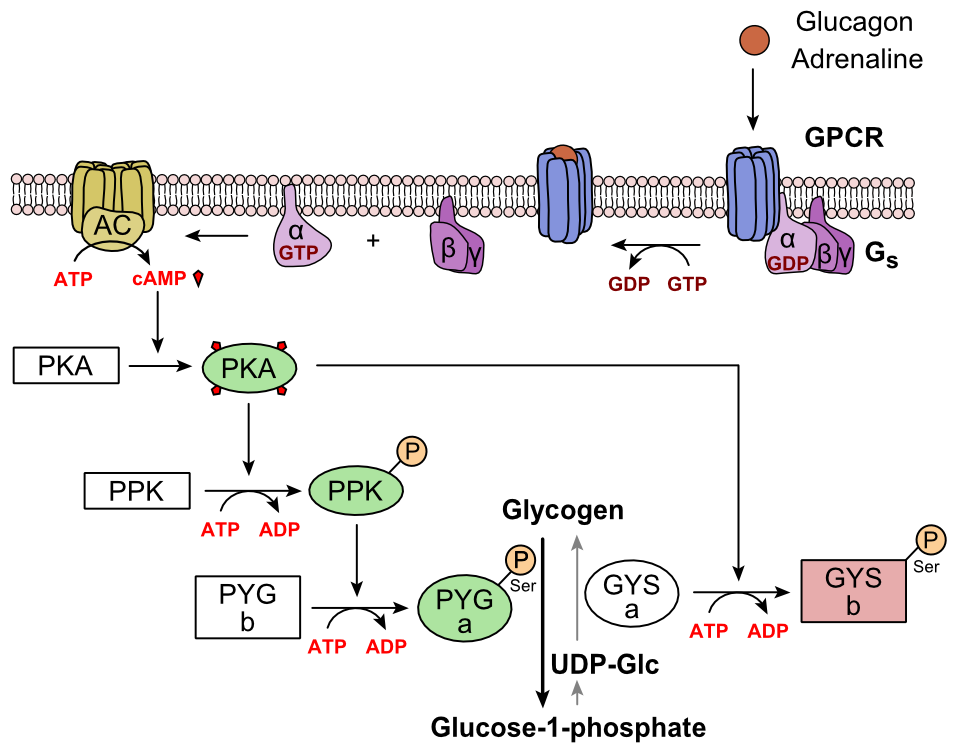
- Hepatic glucagon receptor (Gs-coupled) → adenylyl cyclase → cAMP → protein kinase A → glycogen breakdown and glucose release; requires liver glycogen.
- Cardiac glucagon receptors → cAMP rises without the β-receptor → positive inotropy and chronotropy despite β-blockade; tachyphylaxis can develop.
- It relaxes gastrointestinal smooth muscle, from stomach to colon. That relaxation is behind the radiology use and the nausea.
Pharmacokinetics
| Route | Onset | Peak | Duration |
|---|---|---|---|
| IV | Glucose rises within minutes (GI relaxation within 45 s–1 min) | Glucose peak 5–20 min (0.25–0.5 mg dose) | 60–90 min (glucose) |
| IM | Glucose rises within 10 min | Glucose peak about 26–30 min | 60–90 min |
| Subcut | Glucose rises within 10 min | Glucose peak about 30–50 min (kit labels differ) | Not stated in labeling |
| IN (Baqsimi) | Treatment success at a mean 12–16 min (adult trials) | Plasma peak about 15 min | Not stated in labeling |
- Half-life: 8–18 min (label; route not stated); apparent 26 min IM and 42 min subcut; about 35 min IN; Gvoke 32 min; dasiglucagon about 30 min.
- Metabolism: proteolysis in liver, kidney and plasma.
- Distribution: volume about 0.25 L/kg.
Names & Classification
- Generic Name
- Glucagon (synthetic or recombinant human glucagon, as hydrochloride); dasiglucagon (glucagon analog)
- Brand Names
- Baqsimi (nasal powder); Gvoke HypoPen, PFS, Kit and VialDx; Zegalogue (dasiglucagon; both presentations discontinued per Drugs@FDA, NDC marketing end date August 31, 2027); generic Glucagon Emergency Kit (Amphastar, Fresenius Kabi and others); GlucaGen HypoKit (discontinued in the US in 2024)
- Pharmacologic Class
- Pancreatic peptide hormone; glucagon receptor agonist
- Therapeutic Class
- Antihypoglycemic; antidote (β-blocker poisoning, off-label); gastrointestinal motility inhibitor (diagnostic)
- Controlled Substance
- Not controlled
- ISMP High-Alert
- No
- Look-Alike / Sound-Alike
- None on the ISMP list of confused drug names
References
- Amphastar Pharmaceuticals. (2026). Glucagon for injection (emergency kit for low blood sugar) [prescribing information] (DailyMed version 4, August 2026). DailyMed, National Library of Medicine. https://dailymed.nlm.nih.gov/dailymed/drugInfo.cfm?setid=8cc40354-b5ac-45b6-a211-93b44444f2a3
- Fresenius Kabi USA. (2019). Glucagon for injection (Glucagon Emergency Kit for Low Blood Sugar) [prescribing information]. DailyMed, National Library of Medicine. https://dailymed.nlm.nih.gov/dailymed/drugInfo.cfm?setid=c5c431b4-5618-4ff4-954e-4c0fbfed67b6
- Amphastar Pharmaceuticals. (2025). BAQSIMI (glucagon) nasal powder [prescribing information] (revised April 2025). DailyMed, National Library of Medicine. https://dailymed.nlm.nih.gov/dailymed/drugInfo.cfm?setid=f1f5df9b-872f-44e5-a18f-f0b68e7e9254
- Xeris Pharmaceuticals. (2026). GVOKE (glucagon) injection and GVOKE VialDx [prescribing information]. DailyMed, National Library of Medicine. https://dailymed.nlm.nih.gov/dailymed/drugInfo.cfm?setid=92385737-dbad-98c5-e053-2995a90a2805
- Novo Nordisk. (2026). ZEGALOGUE (dasiglucagon) injection [prescribing information] (revised June 2026, NDA 214231/S-004). U.S. Food and Drug Administration. https://www.accessdata.fda.gov/drugsatfda_docs/label/2026/214231s004lbl.pdf
- U.S. Food and Drug Administration. (2026). Zegalogue (dasiglucagon) marketing status and NDC marketing end dates. Drugs@FDA, NDA 214231 (both presentations listed as Discontinued); openFDA NDC Directory (marketing end date 2027-08-31 for NDC 0169-1912 and 0169-1913). https://api.fda.gov/drug/drugsfda.json?search=openfda.application_number:%22NDA214231%22; https://api.fda.gov/drug/ndc.json?search=brand_name:%22Zegalogue%22 (accessed 2026-10-15).
- Cao, D., Arens, A. M., Chow, S. L., Easter, S. R., Hoffman, R. S., Lagina, A. T., et al. (2025). Part 10: Adult and pediatric special circumstances of resuscitation: 2025 American Heart Association Guidelines for Cardiopulmonary Resuscitation and Emergency Cardiovascular Care. Circulation, 152(16 Suppl 2), S578–S672. https://doi.org/10.1161/CIR.0000000000001380
- Abraham, M. B., Karges, B., Dovc, K., Naranjo, D., Arbelaez, A. M., Mbogo, J., et al. (2022). ISPAD Clinical Practice Consensus Guidelines 2022: Assessment and management of hypoglycemia in children and adolescents with diabetes. Pediatric Diabetes, 23(8), 1322–1340. https://doi.org/10.1111/pedi.13443
- Resuscitation Council UK. (2021). Emergency treatment of anaphylaxis: Guidelines for healthcare providers. https://www.resus.org.uk/sites/default/files/2021-05/Emergency%20Treatment%20of%20Anaphylaxis%20May%202021_0.pdf
- National Highway Traffic Safety Administration. (2021). National EMS Scope of Practice Model, including Change Notices 1.0 and 2.0 (DOT HS 813 151). U.S. Department of Transportation. https://mn.gov/oems/assets/National_EMS_Scope_of_Practice_Model_2021_%20%28002%29_tcm1221-744908.pdf
- National Association of State EMS Officials. (2022). National Model EMS Clinical Guidelines, version 3.0. Iowa HHS copy. https://hhs.iowa.gov/media/198/download
- Hardman, J., Sharma, N., Smith, J., & Nankivell, P. (2020). Conservative management of oesophageal soft food bolus impaction. Cochrane Database of Systematic Reviews, CD007352.pub3. https://doi.org/10.1002/14651858.CD007352.pub3
Medical Disclaimer
- For Educational Purposes Only: This content is intended for educational reference and should not be used for clinical decision-making.
- Not a Substitute for Professional Judgment: Always consult your local protocols, institutional guidelines, and supervising physicians.
- Verify Before Acting: Users are responsible for verifying information through authoritative sources before any clinical application.
AI Assistance Notice
AI was used to assist in organizing, paraphrasing, and formatting this information.