

Bedside Snapshot
- Indications
- Apnea, or inadequate breathing, with a pulse present
- Cardiac arrest, until an advanced airway is in place
- Oxygenation between induction and laryngoscopy
- Rescue after failed intubation or supraglottic airway (Plan C)
- Contraindications / Abort
- Mask seal cannot be made: leak or high resistance
- Stomach swelling: slow the breath, lower the volume, re-seal
- Three failed attempts with one technique: escalate
- Critical Steps
- Open the airway: head tilt–chin lift, or jaw thrust if trauma
- Seal with two hands; squeeze each breath over 1 s
- Rate: 30:2 in CPR; 1 breath every 6 s with an advanced airway
- Stop squeezing at chest rise
- Confirm & Monitor
- Visible chest rise with every breath
- Waveform EtCO₂ when capnography is connected
- SpO₂ trend and abdomen, watching for distension
Key Numbers
BVM ventilation is time-critical once oxygenation falls. Match the rate to whether an advanced airway is in place, and stop squeezing at visible chest rise. Ratios and rates follow the 2025 AHA Guidelines for CPR and ECC (Parts 6–9).
| Parameter | Value |
|---|---|
| Adult CPR, no advanced airway | 30 compressions : 2 breaths (2025 AHA Guidelines for CPR and ECC, Part 7, COR 2a) |
| Adult CPR, advanced airway in place | 1 breath every 6 s (10/min), compressions continuous (2025 AHA Guidelines for CPR and ECC, Part 9, COR 2b) |
| Adult with pulse, needs assisted breathing | 1 breath every 6 s (10/min) (2025 AHA Guidelines for CPR and ECC, Part 7, COR 2a) |
| Each breath | Over about 1 s, just enough for visible chest rise (2025 AHA Guidelines for CPR and ECC, Part 7) |
| Child CPR before advanced airway | 30 : 2 (one rescuer); 15 : 2 (two rescuers) (2025 AHA Guidelines for CPR and ECC, Part 6, COR 2a) |
| Child with pulse, inadequate breathing | Infants and children: 20–30/min (1 breath every 2–3 s) (2025 AHA Guidelines for CPR and ECC, Part 6, COR 2a) |
| Child rate with advanced airway | Infants and children: 20–30/min, adjusted for age and clinical state; avoid hyperventilation (2025 AHA Guidelines for CPR and ECC, Part 8, COR 2b) |
| Bag volume | Infants: at least 450–500 mL Larger children and adolescents: 1,000 mL |
| Oxygen during CPR | Children during CPR: 100% (2025 AHA Guidelines for CPR and ECC, Part 6, COR 2a). After adult ROSC: 100% until SpO₂ or PaO₂ can be reliably measured (2025 AHA Guidelines for CPR and ECC, Part 11, COR 1) |
| Attempts | Three per technique, then one more by a more skilled clinician; test ventilation after each attempt |
Overview & Principles
Bag-valve-mask (BVM) ventilation pushes air into the lungs with a self-inflating bag and a face mask. You reach for it when the patient cannot breathe well enough on their own. You also use it in cardiac arrest, until an advanced airway is in place.
How It Works
- Seal: the mask has to lock onto the face. Leak and high resistance are the usual reasons mask ventilation fails.
- Airway: open it first. Use a head tilt–chin lift, or a jaw thrust if trauma is suspected. Add an oral or nasopharyngeal airway when the patient needs one.
- Breath: squeeze over about 1 second, and stop when the chest rises. Extra volume does not reach the lungs. It goes to the stomach.
- Oxygen: run high flow with the reservoir attached, about 15 L/min. For pediatric CPR the AHA recommends 100% oxygen (2025 AHA Guidelines for CPR and ECC, Part 6, COR 2a).
Where It Fits
Where does BVM sit in the plan? The Difficult Airway Society (DAS) 2015 algorithm puts mask ventilation at Plan C. You reach it after a failed intubation (Plan A) and a failed second-generation supraglottic airway (Plan B). When the mask cannot work at all, you need paralysis to avoid critical hypoxia. A cannot-intubate, cannot-oxygenate (CICO) call sends you to front-of-neck access (Plan D). Plan C is written for anaesthesia. In US EMS, the same step is rescue ventilation under local protocol. In adult cardiac arrest, bag-mask ventilation or an advanced airway may be considered. The call depends on the situation and the professional's skill set (2025 AHA Guidelines for CPR and ECC, Part 9, COR 2b). For out-of-hospital pediatric arrest, bag-mask ventilation is reasonable rather than an advanced airway (2025 AHA Guidelines for CPR and ECC, Part 8, COR 2a).
Indications & Contraindications
Indications
- Apnea, or breathing too inadequate to oxygenate or ventilate, with a pulse present
- Cardiac arrest, until an advanced airway is in place
- Oxygenation between induction and laryngoscopy in critically ill adults (PREVENT trial)
- Rescue ventilation after failed intubation or supraglottic airway placement (DAS Plan C)
Absolute Contraindications
None when the patient needs ventilation. Do not hold BVM while you wait for a different device.
Relative Contraindications & Cautions
- A mask seal that cannot be made: fix the seal or change the route
- Beard, facial trauma or burns, missing teeth, or obesity. Expect a poor seal. Add a second rescuer and an airway adjunct early.
- Upper-airway obstruction, such as a foreign body. Clear the airway first. Squeezing the bag will not move it.
- High airway pressure from poor lung compliance or high resistance. Air goes to the stomach. Lower the volume and slow each breath.
- Suspected spinal injury: keep the head in line and use a jaw thrust, not head tilt
Consider an Alternative
Once BVM cannot hold oxygenation, move to an advanced airway. Pick intubation when a tube is feasible. Or use a supraglottic airway (Plan B). If CICO is declared, see cricothyrotomy.
Abort / Stop Criteria
- No chest rise after one reposition and re-seal. Change the technique, not the force.
- Three failed attempts with one technique: move to the next plan, with one more try by a more skilled clinician
Scope & Team Roles
| Provider Level | Typical Role | Notes |
|---|---|---|
| EMT | Performs | Core airway skill with oxygen and adjuncts; confirm in your state scope document. |
| AEMT | Performs | Same skill; advanced airways only where protocol allows. |
| Paramedic | Performs | Leads failed-ventilation escalation under protocol. |
| RN (ED/ICU) | Performs | Common in resuscitation; two-person technique when the team is available. |
| Critical Care Transport (CFRN / CTRN / FP-C / CCP-C) | Performs | Reassess the seal and EtCO₂ after each move. |
| Physician / APP | Performs | Operator for failed-airway and surgical escalation. |
Team Roles During the Procedure
- Airway holder: seals the mask and holds the jaw up with two hands in the two-person technique.
- Bag operator: squeezes each breath over about 1 second to visible chest rise.
- Monitor and counter: watches EtCO₂, SpO₂ and the abdomen, and keeps the rate.
- Equipment support: has suction, oral and nasopharyngeal airways and the rescue device ready.
Pre-Procedure Assessment
Ventilation Difficulty
| Component | Assess | Concerning Findings |
|---|---|---|
| Mask seal | Fit the mask over the mouth and nose; hold the seal | Air leak at the cheeks or lips; mask does not sit flat |
| Gas leak | Watch the circuit and the bag refill | Audible leak, falling EtCO₂, poor chest rise |
| Resistance | Feel the squeeze; watch chest rise | Bag hard to squeeze, no rise, high pressure |
| Airway patency | Head position, jaw, secretions | Tongue or secretions block flow; clear before escalating |
The 2022 ASA guideline defines difficult mask ventilation by three problems. An inadequate seal. Excessive gas leak. Excessive resistance.
Physiologic Risk
- Hypoxemia: in critically ill adults, severe hypoxemia (SpO₂ below 80%) hit 10.9% of patients given BVM between induction and laryngoscopy. With no ventilation at all, the rate was 22.8%.
- Gastric inflation: when airway patency fails, air goes down the esophagus. That raises aspiration risk.
Site / Device Check
Confirm the bag and mask are the right sizes, the reservoir is attached, oxygen is running, suction is ready and capnography is connected.
Equipment & Preparation
Equipment
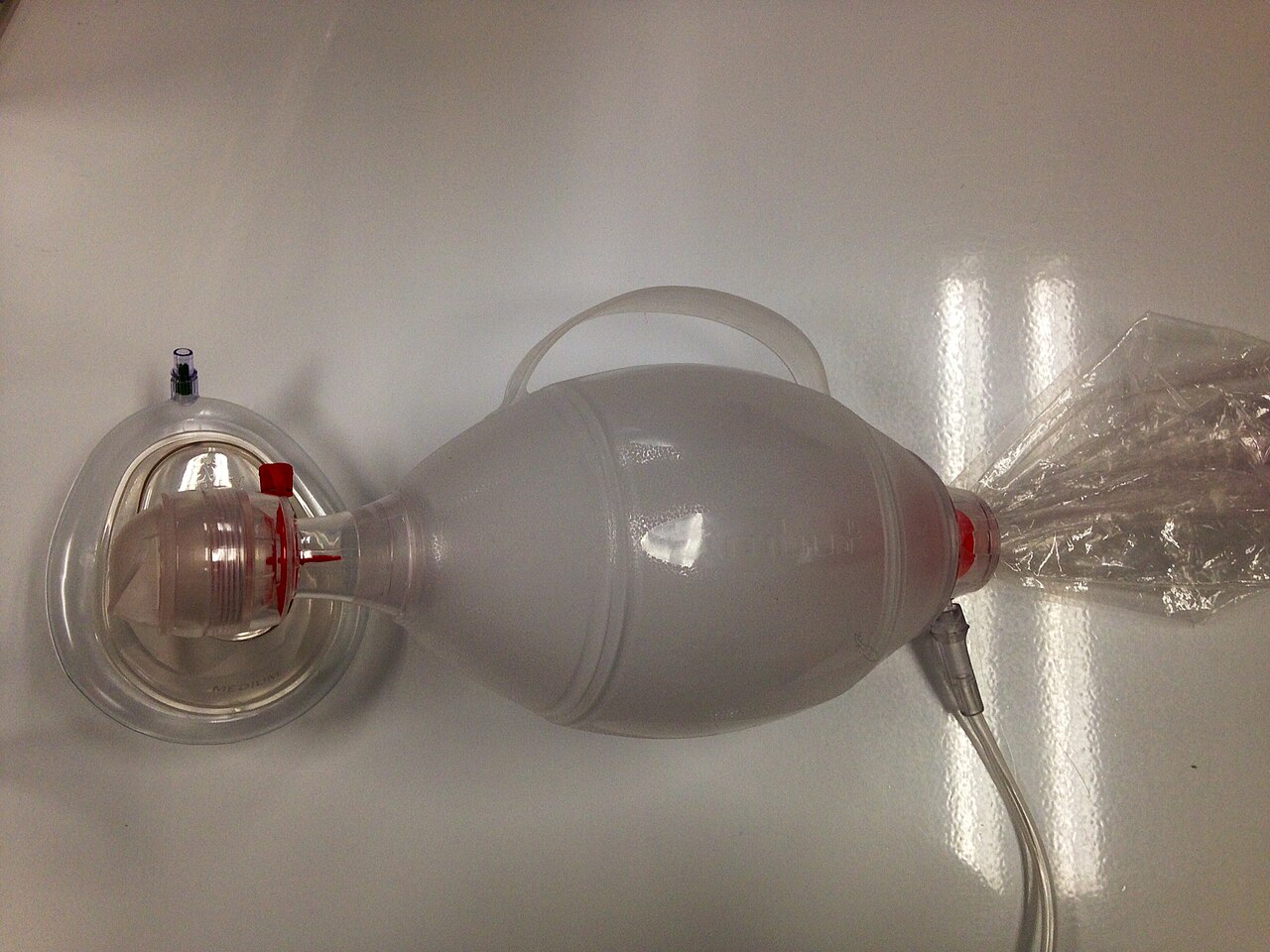
| Item | Size / Spec | Notes |
|---|---|---|
| Self-inflating bag | Infant: at least 450–500 mL; adult: 1,000 mL | Smaller bags may not deliver adequate tidal volume to term newborns and infants |
| Face masks | Several sizes matched to the face | The seal decides success; test it before the patient needs it |
| Oral and nasopharyngeal airways | Patient-sized set | Keep an adjunct within reach for a hard seal |
| Oxygen and reservoir | About 15 L/min to fill the reservoir | Adjust to the device and local protocol |
| HEPA filter | On the device exhaust where available | Use when a high-consequence respiratory pathogen is suspected (2025 AHA Guidelines for CPR and ECC, Part 10, COR 1) |
| Suction | Rigid tip and large-bore catheter | On and tested before the mask goes on |
| Waveform capnography | Adapter in the circuit | Confirms ventilation when available |
| Supraglottic airway, tube, surgical kit | At the bedside | Rescue if mask ventilation fails |
Sizing
| Patient | Bag | Mask and Adjunct |
|---|---|---|
| Term newborn and infant | At least 450–500 mL | Infant mask sized to the face; oral or nasal airway by size |
| Child and adolescent | 1,000 mL for larger children and adolescents | Mask sized to the face; airway sized by protocol |
| Adult | 1,000 mL | Adult mask; oral or nasopharyngeal airway as needed |
Patient Positioning & Preparation
Use the sniffing position. More pharyngeal room means better mask ventilation, per DAS 2015. Trauma or a suspected spinal injury gets a jaw thrust. Anyone else gets a head tilt–chin lift.
Pre-Procedure Checklist
- Indication confirmed and roles assigned
- Suction on and tested
- Bag assembled, reservoir attached, oxygen flowing
- Mask in the right size, with the seal checked
- Oral and nasopharyngeal airways sized and at hand
- Capnography connected to the circuit
- Supraglottic airway and surgical kit at the bedside
Step-by-Step Procedure
Phase 1: Prepare
- Assign roles: one person seals and holds the jaw, one squeezes the bag, one monitors and counts. Call for help early.
- Check the set: suction on, bag assembled, reservoir attached, oxygen running at high flow, capnography connected.
- Position the patient: flat, head in a sniffing position, mask size chosen before you start.
Phase 2: Perform
- Open the airway: head tilt–chin lift. Use a jaw thrust when trauma or spinal injury is suspected.
- Insert an airway adjunct: an oral or nasopharyngeal airway if the patient tolerates it and the seal needs it.
- Seal the mask: one rescuer seals with one hand and squeezes the bag with the other, or uses both hands on the mask when the seal is hard. Confirm the seal before the first breath.
- Squeeze over about 1 second: give each breath just enough to make the chest rise. Release the bag so the chest can deflate.
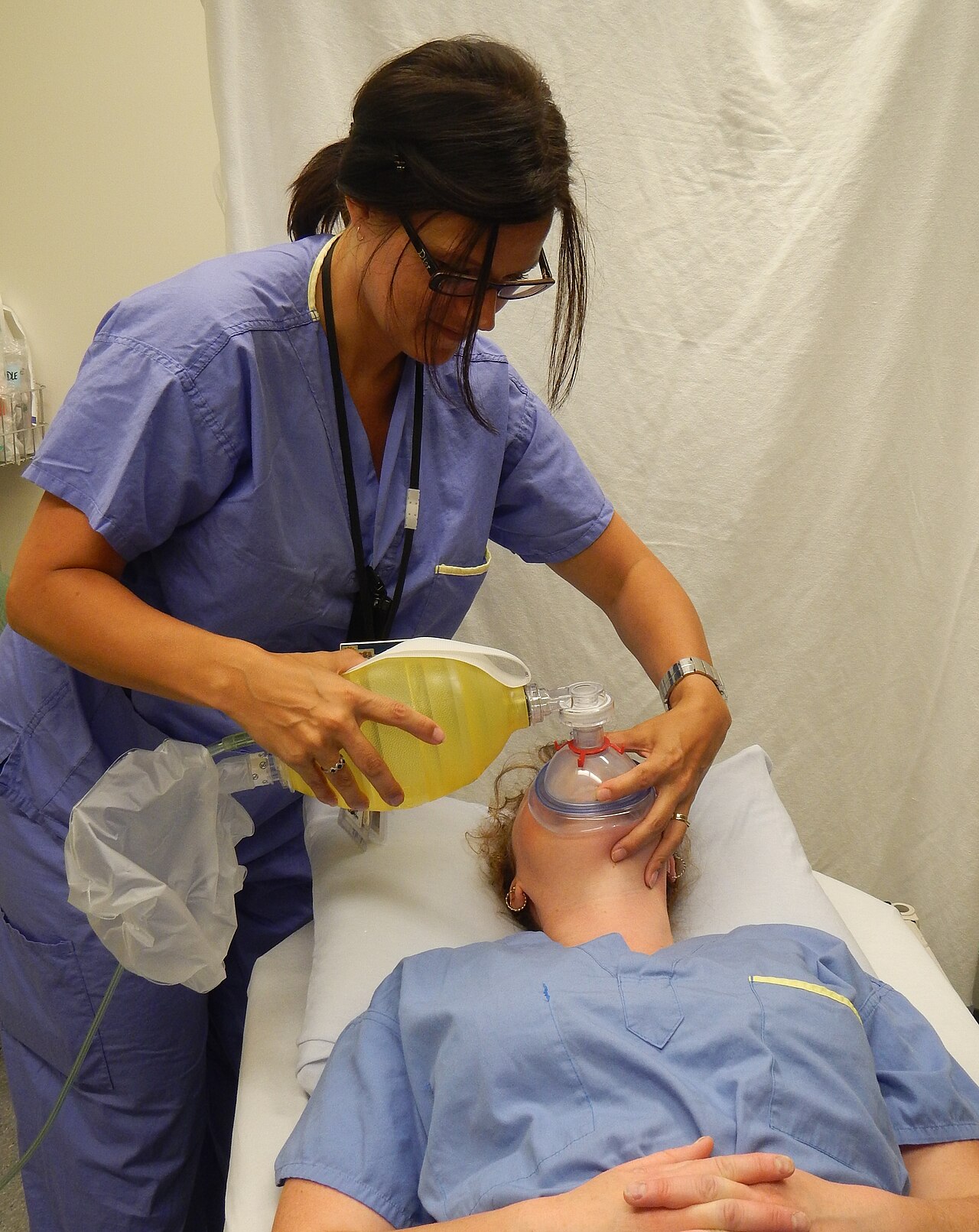
- Set the rate: 30 : 2 with compressions and no advanced airway; 1 breath every 6 s (10/min) once an advanced airway is placed, with compressions continuing.
- Watch the abdomen and the pressure: if the stomach swells or the bag turns hard to squeeze, re-seal, reposition and reduce the volume.
- Read the EtCO₂ waveform: a sustained waveform shows that air is reaching the lungs (see Confirmation & Monitoring).
Phase 3: Confirm & Secure
- Confirm lung inflation: visible chest rise with every breath, plus the SpO₂ and EtCO₂ trend.
- Hand off to the advanced airway: once a tube or supraglottic airway is in, ventilate at the advanced rate without pausing compressions. Confirm again after every move.
- Document: time, adjuncts, bag and mask sizes, rate, EtCO₂, SpO₂ and any problems (see Handoff & Documentation).
Alternative Technique: Two-Person Mask Seal
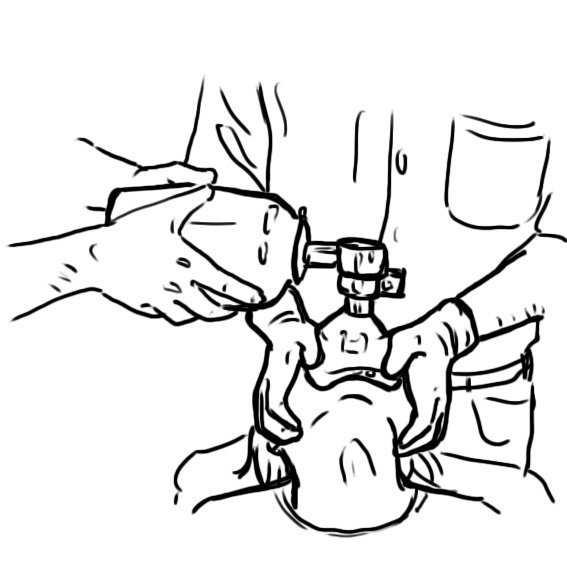
Two hands on the mask, one rescuer keeping the airway open. A second rescuer squeezes the bag. Both check for visible chest rise. The E-C grip works like this: thumbs and index fingers seal the mask while the other fingers lift the jaw into it. With no advanced airway in place, two rescuers beat one. It suits severe airway obstruction, poor lung compliance or a hard seal.
Adjunct: PEEP Valve
A PEEP valve on the bag holds some pressure in the lungs between breaths. When hypoxemia lingers despite a good seal, that can help oxygenation. Use it per local protocol. The catch: higher pressure raises the risk of gastric inflation. Keep an eye on the belly and the bag pressure.
Confirmation & Monitoring
Primary Confirmation
How do you know the air got in? Chest rise on every breath, and a sustained waveform EtCO₂ once capnography is connected. The 2022 ASA guideline advises capnography to confirm adequate ventilation when possible.
Secondary Confirmation
- SpO₂ steady or rising, not falling
- Abdomen flat or only slightly rising
- Bag squeezes without high resistance
| Finding | Success | Failure / Malposition |
|---|---|---|
| Chest rise | Visible with each 1-second breath | No rise: seal leak, obstruction or breath not reaching the lungs |
| EtCO₂ waveform | Sustained through the breaths | Absent or low: no ventilation, leak, or low output during CPR |
| Abdomen | Flat or minimal rise | Distended: excess volume or pressure, air in the stomach |
| SpO₂ | Steady or rising | Falling: seal, airway or ventilation failure |
| Bag resistance | Squeezes easily | Hard to squeeze: obstruction, secretions or kinked tubing |
Ongoing Monitoring
- EtCO₂ continuously while ventilating, when available
- Seal and chest rise after every reposition or move
- Breaths counted each minute against the rate in Key Numbers
Troubleshooting
| Problem | Likely Cause | Fix |
|---|---|---|
| No chest rise | Mask leak, airway not open, tongue | Re-seal, jaw thrust, add an airway adjunct, suction |
| Chest rises, EtCO₂ low | Leak or air going to the stomach; low output during CPR | Check the seal and abdomen; assess perfusion per protocol |
| Stomach swells | Excess volume or fast squeezes; air into the esophagus | Shorten each squeeze to about 1 s, use less volume, re-seal |
| Bag hard to squeeze | Secretions, obstruction or kinked tubing | Suction, reposition, check tubing and reservoir |
| Mask leaks | Wrong size or poor grip | Change mask size; two-hand grip; add a second rescuer |
| SpO₂ falling | Seal or airway failure | Re-oxygenate, fix the seal, escalate per plan |
| Rate too fast | Rapid bagging, hyperventilation | Use a metronome or spoken count to hold the rate |
If It Still Fails
- Optimize: suction, reposition, two-hand mask grip, and an oral or nasal airway per ASA 2022.
- Escalate: place a supraglottic airway or tube per protocol. Limit each technique to three attempts, with one more by a more skilled clinician.
- Declare CICO: if face-mask ventilation is impossible, paralyse under medical direction; if oxygenation still fails, start front-of-neck access, see cricothyrotomy.
Complications
| Complication | Recognition | Prevention | Management |
|---|---|---|---|
| Immediate: gastric inflation | Swollen abdomen, rising pressure, falling EtCO₂ | 1-second breaths; lowest volume that makes the chest rise | Stop, reposition, reduce volume; decompress per protocol |
| Immediate: aspiration | Vomit, gurgling, new hypoxemia | Suction ready; avoid gastric distension | Suction, reposition, escalate the airway per protocol |
| Delayed: hyperventilation and lower venous return | Low EtCO₂ and poor perfusion during CPR; hypotension | Rate per Key Numbers; no fast squeezes | Slow the rate; check EtCO₂ and perfusion |
| Delayed: hypoxemia from a leaking seal | Falling SpO₂ between breaths | Two-person seal; frequent seal checks | Re-seal, add a second rescuer, escalate |
Special Populations
Pediatrics
- Bag size: at least 450–500 mL for term newborns and infants; 1,000 mL for larger children and adolescents.
- Ratio before an advanced airway: 30 : 2 with one rescuer, 15 : 2 with two (2025 AHA Guidelines for CPR and ECC, Part 6, COR 2a).
- Breath length: give each breath over 1 second. No rise? Reposition the head, seal tightly and retry.
- Cricoid pressure: do not use it routinely during bag-mask ventilation (2025 AHA Guidelines for CPR and ECC, Part 8, COR 3: No Benefit). If you do use it, stop as soon as it interferes with ventilation (COR 3: Harm).
- After cardiac arrest: it may be reasonable to target normoxemia and a PaCO₂ suited to the child's condition. The aim is to limit exposure to both hypercapnia and hypocapnia (2025 AHA Guidelines for CPR and ECC, Part 8, COR 2b).
Once an advanced airway is in, or when a child has a pulse but breathes inadequately, the rate is 20–30 breaths/min (1 breath every 2–3 s) (2025 AHA Guidelines for CPR and ECC, Part 6, COR 2a; Part 8, COR 2b). Observational work linked at least 30 breaths/min in children under 1 year with ROSC, which is why the rate moves with age and clinical state.
For sizing and dosing, read equipment sizing, pediatric airway, Broselow and weight-based dosing.
Trauma and C-Spine
- In children, use a jaw thrust if trauma, especially cervical spine injury, is suspected. If it is inadequate and the situation is life-threatening, revert to head tilt–chin lift.
Pregnancy
- Left uterine displacement: when the fundal height is at or above the umbilicus, displace the uterus manually to the left with compressions (2025 AHA Guidelines for CPR and ECC, Part 10, COR 1, LOE C-LD). Lying supine lowers cardiac output in pregnancy.
- Aspiration risk: airway management comes early, per protocol. Keep suction ready (2025 AHA Guidelines for CPR and ECC, Part 10, COR 1, LOE C-LD).
- Resuscitative delivery (formerly perimortem cesarean): indicated when the fundal height is at or above the umbilicus and ROSC is not achieved with standard resuscitation (2025 AHA Guidelines for CPR and ECC, Part 10, COR 1, LOE B-NR). Start preparing at recognition. The goal is to complete delivery by 5 minutes.
Toxicology: Opioid Overdose
- Respiratory arrest with a pulse: ventilate at 10/min with BVM (2025 AHA Guidelines for CPR and ECC, Part 7, COR 2a). Give an opioid antagonist (2025 AHA Guidelines for CPR and ECC, Part 10, COR 1, LOE B-NR). Adult: ventilate first, then naloxone 0.2–2 mg IV/IO/IM or 2–4 mg IN, repeat every 2–3 min, titrate to breathing (2025 AHA Guidelines for CPR and ECC, Part 10, Table 4). Differs from FDA label: the label starts at 0.4 mg. Pediatric: 0.1 mg/kg IV/IO (max 2 mg; IN max 4 mg per NASEMSO), repeat every 2–3 min (2025 AHA Guidelines for CPR and ECC, Part 10, Table 4). Differs from FDA label: the label starts at 0.01 mg/kg.
- Opioid-related cardiac arrest: an opioid antagonist may be reasonable if high-quality CPR is not interrupted (2025 AHA Guidelines for CPR and ECC, Part 10, COR 2b; LOE B-NR adults, C-EO children). The evidence is very low. Never delay compressions or breaths for it.
Physiologically Difficult Patients
- In critically ill adults, BVM between induction and laryngoscopy reduced severe hypoxemia. Operator-reported aspiration did not rise significantly (2.5% vs 4.0%, P = 0.41).
- Before induction, preoxygenate everyone. DAS 2015 recommends it for all patients.
Post-Procedure Care & Transport
Immediate Aftercare
- Once a tube or supraglottic airway is confirmed, ventilate at the advanced rate and check EtCO₂.
- After adult ROSC: 100% oxygen until SpO₂ or PaO₂ can be reliably measured, then titrate FiO₂ to SpO₂ 90–98%. If the patient remains comatose, keep PaCO₂ within 35–45 mm Hg (2025 AHA Guidelines for CPR and ECC, Part 11, COR 1 and 2a).
- Keep the bag on the device until the airway is confirmed and secured.
Ongoing Maintenance
- Keep the HEPA filter in the circuit where one is used.
- Recheck the seal and the rate at every handoff and move.
Transport Considerations
- Reassess the seal, chest rise and EtCO₂ after every move or turn.
- Use a metronome or spoken count to hold the rate on long transports.
Document & Hand Off
- Time started and who ventilated (one or two person)
- Mask and bag sizes; oral or nasopharyngeal airway used
- Rate and breaths per minute; chest rise and EtCO₂ values
- SpO₂ trend, abdominal distension or regurgitation
- Advanced airway placed, if any, and the response
Clinical Pearls & Pitfalls
Pearls
- Chest rise is the endpoint: stop squeezing when the chest rises. Extra volume goes to the stomach.
- Two people beat one: the two-person technique works better when no advanced airway is in place.
- Bag before laryngoscopy: gentle BVM between induction and laryngoscopy cut severe hypoxemia in critically ill adults.
- Escalate on time: three attempts per technique, then the next plan.
Common Pitfalls
- Squeezing hard and fast: hard, fast squeezes push air into the stomach. Use about 1-second breaths to chest rise, at a set rate.
- One-person grip on a hard seal: add a second person for a two-hand grip.
- Routine cricoid pressure during bagging: not recommended in adults (2025 AHA Guidelines for CPR and ECC, Part 7, COR 3: No Benefit) or children (2025 AHA Guidelines for CPR and ECC, Part 8, COR 3: No Benefit).
- Trusting the bag over the waveform: confirm with chest rise and EtCO₂.
- Trying past three attempts: escalate to the next plan.
References
- 2025 AHA Guidelines for CPR and ECC, Part 6: Pediatric Basic Life Support. Circulation. 2025. https://cpr.heart.org/en/resuscitation-science/cpr-and-ecc-guidelines/pediatric-basic-life-support
- 2025 AHA Guidelines for CPR and ECC, Part 7: Adult Basic Life Support. Circulation. 2025. https://cpr.heart.org/en/resuscitation-science/cpr-and-ecc-guidelines/adult-basic-life-support
- 2025 AHA Guidelines for CPR and ECC, Part 8: Pediatric Advanced Life Support. Circulation. 2025. https://cpr.heart.org/en/resuscitation-science/cpr-and-ecc-guidelines/pediatric-advanced-life-support
- 2025 AHA Guidelines for CPR and ECC, Part 9: Adult Advanced Life Support. Circulation. 2025. https://cpr.heart.org/en/resuscitation-science/cpr-and-ecc-guidelines/adult-advanced-life-support
- 2025 AHA Guidelines for CPR and ECC, Part 10: Adult and Pediatric Special Circumstances of Resuscitation. Circulation. 2025. https://cpr.heart.org/en/resuscitation-science/cpr-and-ecc-guidelines/adult-and-pediatric-special-circumstances-of-resuscitation
- 2025 AHA Guidelines for CPR and ECC, Part 11: Post-Cardiac Arrest Care. Circulation. 2025. https://cpr.heart.org/en/resuscitation-science/cpr-and-ecc-guidelines/post-cardiac-arrest-care
- Frerk C, Mitchell VS, McNarry AF, et al. Difficult Airway Society 2015 guidelines for management of unanticipated difficult intubation in adults. Br J Anaesth. 2015;115(6):827-848. https://doi.org/10.1093/bja/aev371
- Apfelbaum JL, Hagberg CA, Connis RT, et al. 2022 American Society of Anesthesiologists practice guidelines for management of the difficult airway. Anesthesiology. 2022;136(1):31-81. https://doi.org/10.1097/ALN.0000000000004002
- Casey JD, Janz DR, Russell DW, et al. Bag-mask ventilation during tracheal intubation of critically ill adults (landmark trial). N Engl J Med. 2019;380(9):811-821. https://doi.org/10.1056/NEJMoa1812405
Medical Disclaimer
- For Educational Purposes Only: This content is intended for educational reference and should not be used for clinical decision-making.
- Not a Substitute for Professional Judgment: Always consult your local protocols, institutional guidelines, and supervising physicians.
- Verify Before Acting: Users are responsible for verifying information through authoritative sources before any clinical application.