

Bedside Snapshot
- Indications
- Anaphylaxis with airway, breathing or circulation involvement
- Nerve-agent poisoning with muscarinic signs (DuoDote, over 41 kg)
- Organophosphate poisoning per protocol
- Contraindications / Abort
- Never inject into a buttock, digit, hand or foot
- Never repeat at the same site (vasoconstriction, necrosis)
- Device strength outside the weight band: do not use
- Critical Steps
- Confirm drug, mg/mL, dose in mg and mL, and weight band
- Outer thigh, 90°, push until the device fires, hold per label
- Rotate sites; repeat epinephrine in 5–10 min if needed
- Confirm & Monitor
- Airway, breathing and blood pressure after each dose
- Record drug, dose, site, time and device
- Second device if symptoms continue (EpiPen label)
Key Numbers
Give IM epinephrine at the first sign of anaphylaxis involving airway, breathing or circulation. Antidote autoinjectors treat nerve-agent or organophosphate poisoning with muscarinic signs.
| Parameter | Value |
|---|---|
| Adults and children 30 kg or more (vial, IM) | 0.3–0.5 mg (0.3–0.5 mL of 1 mg/mL), anterolateral thigh; max 0.5 mg per injection |
| Children under 30 kg (vial, IM) | 0.01 mg/kg (max 0.3 mg) for children under 30 kg |
| Repeat interval (vial) | Every 5–10 min as needed; never at the same site |
| Autoinjector strength | 0.3 mg for 30 kg or more; 0.15 mg for 15–30 kg (EpiPen Jr); 0.1 mg for 7.5–15 kg (Auvi-Q) Weight cut-offs follow the product label; protocols vary near 25–30 kg, so follow local protocol |
| DuoDote (nerve agent) | Mild (2 or more mild symptoms): 1 device IM; wait 10–15 min; if any severe symptom develops, 2 more devices in rapid succession Severe (any severe symptom): 3 devices immediately in rapid succession Patients over 41 kg |
| Hold time | EpiPen 3 s; Auvi-Q 2 s after the click; DuoDote about 10 s |
| Adult IM needle, thigh | 1.5 in (38 mm) at the adult thigh (CDC); 1 in only if skin is stretched tight and tissue not bunched |
| SC needle | ⅝ in (16 mm), 23–25 gauge, inserted at 45° (CDC) |
Overview & Principles
No IV? Or no need for one? Intramuscular (IM) and subcutaneous (SC) injection put the drug into muscle or fat. An autoinjector is a spring-loaded device. It delivers one fixed dose.
How It Works
- Route: IM lands in muscle, which has good blood flow. SC lands in fat, and absorption is slower.
- Angle and needle: IM is perpendicular, at 90°. SC is shallower, at 45° (CDC).
- Aspiration: Not recommended at the standard IM sites. No large vessels sit there (CDC).
- Autoinjector: Press firmly on the thigh until it fires. Then hold for the labeled time.
- Labels: The EpiPen and Adrenalin labels allow IM or SC in the anterolateral thigh. DuoDote specifies IM.
Where It Fits
- Anaphylaxis: IM epinephrine comes first. An IV epinephrine infusion is for refractory cases, under protocol (see epinephrine 0.1 mg/mL (IV/IO)).
- Nerve agents and organophosphates: Atropine with pralidoxime. It is given by autoinjector (DuoDote) or by vial, per the poisoning protocol. See atropine and pralidoxime.
Indications & Contraindications
Indications
- Anaphylaxis from any trigger with airway, breathing or circulation involvement. The drug is IM epinephrine, labeled for Type I allergic reactions, including anaphylaxis.
- Nerve-agent exposure (sarin, soman, tabun, VX) with muscarinic symptoms. DuoDote's label covers organophosphorus nerve agents and insecticides in patients over 41 kg.
- Organophosphate insecticide poisoning with muscarinic or nicotinic signs. The antidote is given per protocol.
Absolute Contraindications
When the injection is truly indicated, there are none. The DuoDote label lists no contraindications.
Relative Contraindications & Cautions
- Injection site: keep the needle out of the buttock, a digit, a hand or a foot (EpiPen and Auvi-Q labels).
- Sulfite content: the single-dose 1 mg/mL vial contains sodium metabisulfite, a sulfite. That is not a reason to withhold or delay epinephrine in anaphylaxis. The label says its presence should not preclude use in serious allergic or other emergency situations (Adrenalin label 5.8).
- Weight outside the device band: EpiPen Jr is labeled for 15–30 kg. For a dose under 0.15 mg, the EpiPen label says another injectable epinephrine should be used.
- Repeated epinephrine doses: More than two sequential doses should come only under direct medical supervision (EpiPen label).
Scope & Team Roles
| Provider Level | Typical Role | Notes |
|---|---|---|
| EMT (EMR where state scope allows) | Performs (protocol/credentialing required) | Epinephrine autoinjector for anaphylaxis, per state scope and agency protocol |
| AEMT | Performs (protocol/credentialing required) | IM epinephrine per protocol |
| Paramedic | Performs (protocol/credentialing required) | Vials, autoinjectors and nerve-agent kits per protocol |
| RN (ED/ICU) | Performs | IM and SC injection; nerve-agent kits per hospital protocol |
| Critical Care Transport (CFRN / CTRN / FP-C / CCP-C) | Performs (protocol/credentialing required) | Antidote and epinephrine per transport protocol |
| Physician / APP | Performs | Orders the drug, dose and route |
Team Roles During the Procedure
- Operator: confirms indication, drug, strength and site, then gives the injection.
- Medication clinician: reads back the drug, mg/mL, dose in mg and mL, and device weight band.
- Monitor and recorder: starts the time record and reports airway, breathing and blood pressure after each dose.
- Airway and oxygen manager: maintains oxygenation and ventilation during anaphylaxis or nerve-agent toxicity.
Anatomy & Landmarks
| Site | Best For | Landmark | Angle / Depth | Avoid If |
|---|---|---|---|---|
| Anterolateral thigh (IM) | Epinephrine vial and autoinjectors; DuoDote | Middle third of the outer thigh over the vastus lateralis | 90°; 1.5 in (CDC); 1 in only if skin is stretched tight | Buttock, digit, hand or foot |
| Deltoid (IM) | Vaccines and IM drugs where the deltoid is preferred (CDC) | Deltoid muscle | 90°; 5/8–1.5 in by age and weight (CDC) | Bunched tissue at the needle length; buttock is not a site |
| Upper-outer triceps (SC) | SC injection, age 12 months and older | Upper-outer arm over the triceps | 45°; ⅝ in (CDC) | Bruised or infected skin |
| Anterior thigh (SC) | SC injection, infants under 12 months | Anterior thigh | 45°; ⅝ in (CDC) | Bruised or infected skin |
Anterolateral Thigh (IM)
- Expose the outer thigh: or inject through clothing if needed, with pockets empty (DuoDote label).
- Locate the site: middle third of the outer thigh, over the vastus lateralis.
- Position the device: tip perpendicular to the skin at 90°.
- Bunch the thigh if little fat: per the DuoDote label, so the tip reaches muscle.
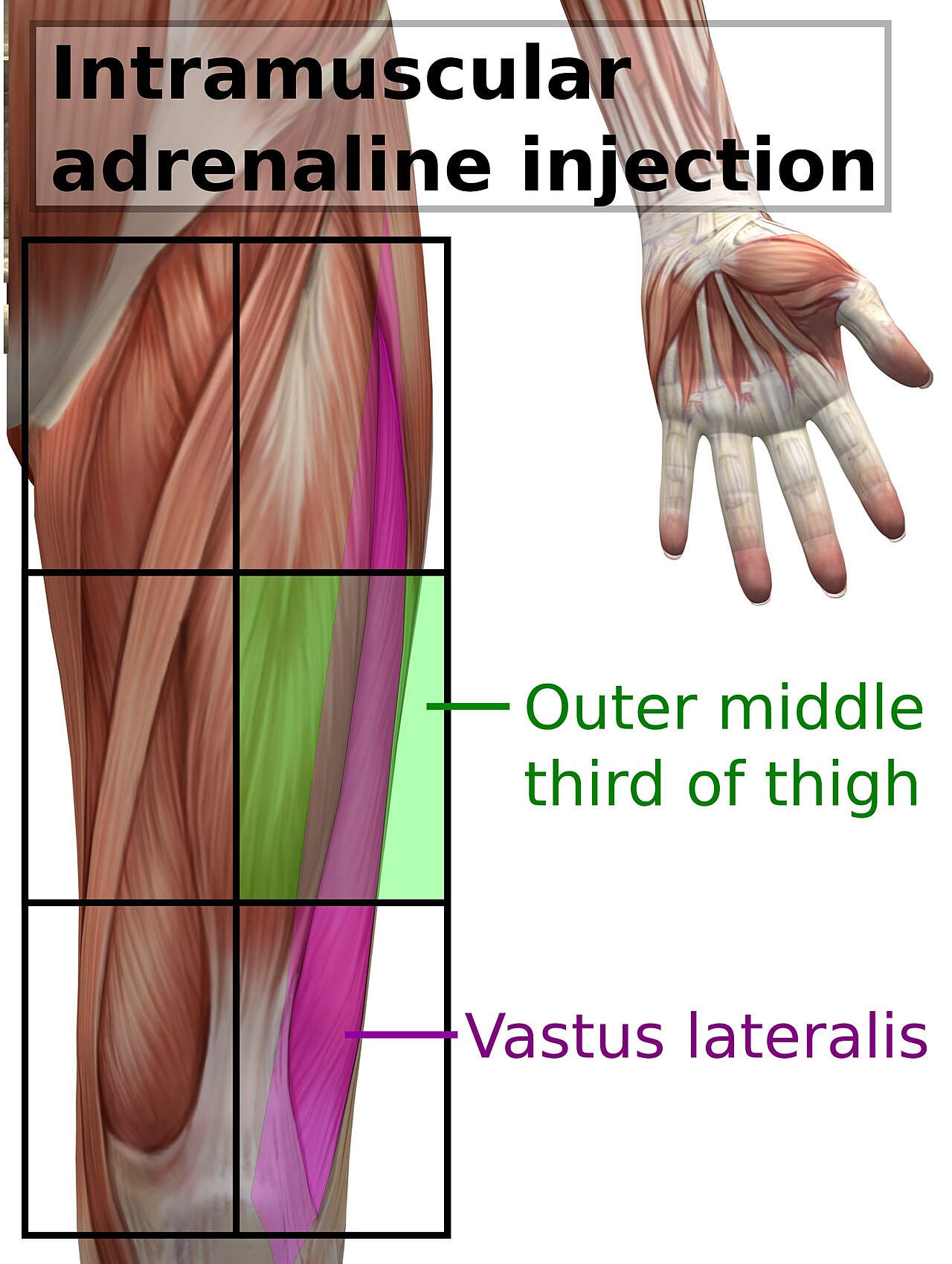
Pediatric
- Infants 1–12 months: 1 in (25 mm) needle (CDC).
- Toddlers 1–2 years and children 3–10 years: 1–1.25 in (25–32 mm) at the thigh (CDC).
- Adolescents 11–18 years: 1–1.5 in (25–38 mm) at the thigh (CDC).
Deltoid (IM)
- Identify the deltoid: the muscle over the upper arm.
- Choose the needle by age and weight: CDC gives 5/8–1 in for children, 1 in for adults under 60 kg (5/8 in only if the skin is stretched tight and tissue is not bunched), and up to 1.5 in for heavier adults.
- Inject at 90°: do not aspirate.
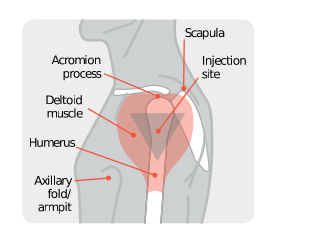
Pediatric
- Children 3–10 years and adolescents 11–18 years: 5/8–1 in (16–25 mm) on the deltoid, preferred site (CDC).
Subcutaneous (Upper-Outer Triceps or Anterior Thigh)
- Pinch the skin: use a fold of tissue at the chosen site.
- Insert the needle: ⅝ in, 23–25 gauge, at 45° (CDC).
- Use the anterior thigh for infants under 12 months: upper-outer triceps from 12 months (CDC).
Equipment & Preparation
Equipment
| Item | Size / Spec | Notes |
|---|---|---|
| Epinephrine 1 mg/mL vial | 1 mL (1 mg) single-dose; 30 mL multiple-dose | Check the label for in-use dating |
| Epinephrine autoinjector | 0.1, 0.15 or 0.3 mg | Pick strength by weight band |
| DuoDote autoinjector | Atropine 2.1 mg and pralidoxime chloride 600 mg per device | Carry three devices for a severe patient (label) |
| IM syringe and needle | 1 mL syringe; 22–25 gauge needle (CDC) | Length by site and weight (see Sizing) |
| SC needle | ⅝ in, 23–25 gauge (CDC) | For SC injection at 45° |
| Sharps container | Within reach | Dispose of the device or needle at once; do not recap |
Sizing
| Group | IM Site (CDC) | Needle Length |
|---|---|---|
| Neonates (first 28 days) | Anterolateral thigh | 5/8 in (16 mm)* |
| Infants, 1–12 months | Anterolateral thigh | 1 in (25 mm) |
| Toddlers, 1–2 years | Anterolateral thigh (preferred) | 1–1.25 in (25–32 mm) |
| Toddlers, 1–2 years (deltoid option) | Deltoid | 5/8–1 in (16–25 mm)* |
| Children, 3–10 years | Deltoid (preferred) | 5/8–1 in (16–25 mm)* |
| Children, 3–10 years (thigh option) | Anterolateral thigh | 1–1.25 in (25–32 mm) |
| Adolescents, 11–18 years | Deltoid (preferred) | 5/8–1 in (16–25 mm)* |
| Adolescents, 11–18 years (thigh option) | Anterolateral thigh | 1–1.5 in (25–38 mm) |
| Adults, under 60 kg | Deltoid | 1 in (25 mm)* |
| Adults, 60–70 kg | Deltoid | 1 in (25 mm) |
| Men 70–118 kg, women 70–90 kg | Deltoid | 1–1.5 in (25–38 mm) |
| Men over 118 kg, women over 90 kg | Deltoid | 1.5 in (38 mm) |
| Adults, any weight | Anterolateral thigh | 1.5 in (38 mm); 1 in only if skin is stretched tight and tissue is not bunched |
*The shorter needle is acceptable only when the skin is pulled taut and the tissue is not pinched up (CDC).
Patient Positioning & Preparation
Get the patient seated or lying so the outer thigh is in reach. An autoinjector may go through clothing, but the pockets must be empty (DuoDote label). Before use, check the device for expiry and damage.
Pre-Procedure Checklist
- Confirmed indication: anaphylaxis, or nerve-agent or organophosphate poisoning
- Weight in kg matched to the device strength
- Read back the drug, the strength in mg/mL, and the dose in mg and mL
- Expiry date checked. Device undamaged and not discolored
- Site picked: outer thigh, and not the buttock, digit, hand or foot
- Second device or syringe at hand, if protocol allows
- Sharps container in reach
- Record the injection time
Medications & Settings
Doses vary by protocol; follow local protocols and medical direction.
Available Forms
- Epinephrine 1 mg/mL vial: 1 mL single-dose and 30 mL multiple-dose; the vial EMS draws up for IM use.
- Epinephrine autoinjectors: 0.15 mg and 0.3 mg (EpiPen, EpiPen Jr); 0.1, 0.15 and 0.3 mg (Auvi-Q). Single fixed dose per device.
- DuoDote: atropine 2.1 mg and pralidoxime chloride 600 mg in two chambers, delivered through one needle (civilian EMS). Figure 3 shows the older Mark I kit, not this device.
- ATNAA: the military version. Same contents, labeled for adults.
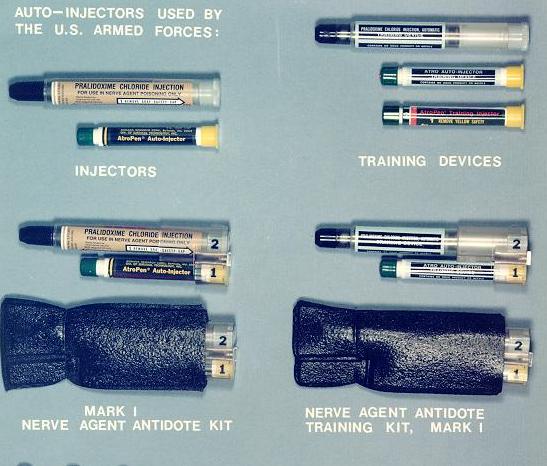
Adult and Pediatric Dosing
| Drug | Adult Dose | Pediatric Dose | Onset / Duration | Notes |
|---|---|---|---|---|
| Epinephrine 1 mg/mL vial (IM) | 0.3–0.5 mg (0.3–0.5 mL) IM, anterolateral thigh, every 5–10 min as needed (max 0.5 mg per injection) | 0.01 mg/kg IM (max 0.3 mg) for children under 30 kg | IM: minutes | Adrenalin label; never repeat at the same site. High-alert when diluted for IV |
| Epinephrine autoinjector | 0.3 mg IM, thigh, for 30 kg or more (one device per dose) | 0.15 mg for 15–30 kg (EpiPen Jr); 0.1 mg for 7.5–15 kg (Auvi-Q) | IM: device-dependent hold time | Give a second device if symptoms continue (EpiPen label). More than two sequential doses only under direct supervision. Weight cut-offs follow the label; protocols vary near 25–30 kg, so follow local protocol |
| DuoDote (atropine 2.1 mg and pralidoxime 600 mg) | Mild (2 or more mild symptoms): 1 device IM, mid-lateral thigh; wait 10–15 min; if any severe symptom develops, 2 more devices in rapid succession. Severe (any severe symptom): 3 devices immediately in rapid succession | Not established at 41 kg or less; use weight-based atropine and pralidoxime per protocol (see sibling pages) | IM; hold about 10 s | Patients over 41 kg. Carry three devices per at-risk patient (label) |
Vial doses for atropine and pralidoxime are on the atropine and pralidoxime pages. Dosing for the CANA (military) diazepam autoinjector sits on the diazepam page.
Step-by-Step Procedure
Phase 1: Prepare
- Confirm the indication and the weight band: anaphylaxis or nerve-agent or organophosphate poisoning, with the patient's weight in kg.
- Check the device: drug, strength, expiry date and no damage.
- Expose the outer thigh: or plan for injection through clothing with pockets empty.
Phase 2: Perform
- Remove the cap: as the device directs, without touching the needle end.
- Place the tip on the outer thigh: at 90° to the skin, middle third of the thigh.
- Push firmly until the device fires: hold for the labeled time: EpiPen 3 s, Auvi-Q 2 s after the click, DuoDote about 10 s.
- Note the time: record the dose time and device strength.
- Reassess and repeat if needed: repeat IM epinephrine in 5–10 min at a different site if symptoms continue, or give a second device per protocol.
Alternative Technique: IM Vial Injection
- Draw up the dose: 0.3–0.5 mL of undiluted 1 mg/mL epinephrine for an adult; state the mg and mL aloud.
- Choose the site and needle: thigh 1.5 in for adults (1 in only if skin is stretched tight), or deltoid by age and weight (see Sizing).
- Inject at 90°: do not aspirate. Rotate sites for repeat doses.
Alternative Technique: Subcutaneous
- Pinch a fold of skin: at the upper-outer triceps or anterior thigh.
- Insert at 45°: with a ⅝ in, 23–25 gauge needle (CDC).
Phase 3: Confirm & Secure
- Dispose of the device: place it in the sharps container without recapping.
- Reassess the patient: airway, breathing and blood pressure, then continue care per protocol (see Confirmation & Monitoring).
Confirmation & Monitoring
Primary Confirmation
Look at the patient: airway, breathing and blood pressure improving after the dose, and the dose time recorded.
Secondary Confirmation
- Device fired: You want a click, a hiss or a voice cue (Auvi-Q). No click means the dose may not have been delivered.
- Site: outer thigh, 90°, without injection into the buttock, digit, hand or foot.
- Record: drug, mg and mL, site, time and device lot or strength.
| Finding | Success | Failure / Malposition |
|---|---|---|
| Device fire | Click or hiss; voice cue on Auvi-Q | No click or hiss: treat the dose as not confirmed; second device or vial per protocol |
| Site | Outer thigh at 90° | Buttock, digit, hand or foot: stop and treat per Complications |
| Response | Airway, breathing and blood pressure improving | No improvement within 5–10 min: repeat per protocol |
Ongoing Monitoring
- Vital signs and SpO₂: continuous or per protocol after each dose.
- Airway: reassess after every dose, most of all in anaphylaxis with swelling or stridor.
- Nerve agents: reassess secretions, bronchospasm and muscle twitching after each DuoDote dose.
Troubleshooting
| Problem | Likely Cause | Fix |
|---|---|---|
| No click or hiss from the device | Tip not at 90° or not pressed firmly | Check the cap is off and the tip is at 90°. Treat the dose as uncertain: give a second device or vial per protocol |
| Symptoms persist after one dose | Dose too low for the response, or delayed onset | Repeat in 5–10 min at a different site; second autoinjector if symptoms continue (EpiPen label) |
| Wrong strength for weight | Device chosen by age, not weight | Match to the weight band; below 15 kg, use vial dosing per protocol |
| Injected into a digit, hand or foot | Hand near the tip or wrong site | Obtain emergency care at once; the label warns of loss of blood flow |
| Tissue injury at a repeated site | Same site reused | Rotate sites; never repeat at the same site (Adrenalin label) |
| Secretions persist after DuoDote | Single device given for severe symptoms | Give three devices in rapid succession for severe symptoms (label); keep airway support |
| Needle too short for adult thigh | Using a short needle for an adult | Use 1.5 in for the adult thigh (1 in only if skin is stretched tight and tissue is not bunched), or deltoid length by weight per CDC sizing |
| Vial read as 0.1 mg/mL | Concentration mix-up | Stop; read the concentration and dose in mg and mL with a second clinician |
If It Still Fails
- Anaphylaxis not responding to IM doses: move to an IV epinephrine infusion per protocol (details in epinephrine 0.1 mg/mL (IV/IO)), and set up IV access per IV insertion or IO access.
- Nerve agent with respiratory failure: support the airway and ventilation per basic airway management. Antidote doses keep going per protocol.
Complications
| Complication | Recognition | Prevention | Management |
|---|---|---|---|
| Immediate: injection into a digit, hand or foot | Pain, pallor, or change in color or sensation in the digit | Outer thigh only; keep hands clear of the tip | Obtain emergency care at once (EpiPen label) |
| Immediate: excess adrenergic effects | Tachycardia, palpitations, anxiety, headache | Match strength to weight band; no duplicate doses | Monitor per protocol; reassess the dose need |
| Delayed: tissue injury at a repeated site | Pain, swelling, skin change at the site | Rotate sites; never repeat at the same site (Adrenalin label) | Local wound care per protocol; document and monitor |
| Delayed: DuoDote in a non-poisoned person | Atropine and pralidoxime effects: tachycardia, dry mouth, flushing | Confirm the diagnosis before injecting | Avoid overheating and vigorous activity (DuoDote label, section 6.4) |
| Rare: sulfite reaction | Hives, wheeze, or worsening after the vial dose | Do not delay epinephrine for a sulfite history: sulfite content is not a reason to withhold it in anaphylaxis (Adrenalin label 5.8) | Treat as anaphylaxis per protocol |
Special Populations
Pediatrics
| Product | Weight Band | Dose |
|---|---|---|
| Epinephrine vial (IM) | Under 30 kg | 0.01 mg/kg, max 0.3 mg |
| EpiPen Jr autoinjector | 15–30 kg | 0.15 mg |
| Auvi-Q autoinjector | 7.5 kg to under 15 kg | 0.1 mg |
| DuoDote | 41 kg or less | Not established at 41 kg or less; use weight-based atropine and pralidoxime per protocol (see sibling pages) |
- Autoinjector gap: EpiPen's label does not establish safety in children under 15 kg. For a dose under 0.15 mg, consider another injectable epinephrine.
- Needle sizing: go by the Sizing table. Infants get 1 in on the thigh, and children get 5/8–1 in on the deltoid (CDC).
Pediatric dosing and sizing live on their own pages. Pull up weight-based dosing, equipment sizing, Broselow, pediatric vascular access and pediatric airway.
Obesity
- Adult IM needle: Heavier adults need longer needles. For men over 118 kg and women over 90 kg, it is 1.5 in (38 mm) (CDC).
- Thigh at any weight: For adults at the anterolateral thigh, CDC says 1.5 in, at any weight. Use 1 in only if the skin is stretched tight and tissue is not bunched.
Post-Procedure Care & Transport
Immediate Aftercare
- Dispose of the device: sharps container, no recapping.
- Keep the patient under observation: reassess airway, breathing and blood pressure after the last dose.
- Emergency care: The EpiPen label tells patients to get emergency medical help right away, even after use.
- Every patient who receives epinephrine needs emergency medical care right away. One device does not change that (EpiPen label 5.1 and patient leaflet).
- Positioning: Keep the patient lying down if breathing allows. The EpiPen and Adrenalin labels say symptoms usually subside with rest and recumbency (section 17). Don't let them stand or walk after a dose (standard teaching, and if breathing is difficult, position per protocol).
- Adjuncts do not replace epinephrine: Antihistamines and corticosteroids cannot stand in for it. The EpiPen label calls epinephrine the preferred treatment for serious allergic reactions. It says alternatives may not be satisfactory in a life-threatening situation (section 5.4).
- Beta-blockers: They work against epinephrine's cardiostimulating and bronchodilating effects (EpiPen label, section 7). Expect a weaker response. Escalate per protocol. Don't withhold epinephrine.
- Pregnancy: Epinephrine is the first-line medication for anaphylaxis in pregnancy. Life-sustaining therapy should not be withheld (Adrenalin label 8.1).
- Heart disease and older patients: Neither is a reason to withhold epinephrine (EpiPen label 5.5). Go carefully, and reassess the cardiac and blood pressure response after each dose.
- Nerve-agent exposure: a convulsion is treated with a benzodiazepine per protocol (see diazepam). Rescuers avoid contact with the victim's clothing (DuoDote label). Get definitive care right away. Supervise closely for at least 48–72 h (DuoDote label 2.1).
Ongoing Maintenance
- Sites: rotate; do not repeat at the same site.
- Devices: keep spare devices with the patient or in the kit per protocol; check expiry dates.
Transport Considerations
- Reassess after every move: airway and breathing change during transport.
- Keep devices with the patient: a second device if symptoms continue, per protocol.
Document & Hand Off
- The time of each dose, the drug, mg and mL, and device strength
- Site, angle, and confirmation that the device fired
- How many devices were given, and the second dose time
- How airway, breathing and blood pressure responded after each dose
- Complications, including any injection into a digit, hand or foot
Clinical Pearls & Pitfalls
Pearls
- Thigh first: the outer thigh works through clothing, per the autoinjector labels. Empty the pockets first (DuoDote label).
- Rotate sites: Repeat doses go to a new site. Never the same one (Adrenalin label).
- Autoinjector is one fixed dose: Pick the device by weight band, not by age.
- Hold time differs: EpiPen 3 s, Auvi-Q 2 s after the click, DuoDote about 10 s.
- Write mg and mL: A vial dose in mL can be read as mg. Write both.
Common Pitfalls
- Waiting for hypotension? Give IM epinephrine at the first airway, breathing or circulation sign.
- Buttock or hand injection? Thigh only, hands clear of the tip.
- One DuoDote device for severe symptoms: give three in rapid succession, per label.
- Repeat at the same site: rotate sites.
- Withholding epinephrine for pregnancy, heart disease, age or a sulfite history: none of these is a reason to withhold it (labels).
Education & Skill Maintenance
Skill Maintenance
- Trainer devices: Practice the hold and click on trainers before you touch a real device.
- Checklists: Rehearse the weight band and mg/mL read-back every shift.
- Debriefing: Walk through each dose time, site and response in simulation or after a real call.
Patient & Family Teaching
- Carry two devices: keep a second device on hand in case symptoms continue (EpiPen label).
- Get help after use: Get emergency care right away, even after using a device (EpiPen label).
- Thigh only: Keep the needle out of the buttock, hand, foot or digit.
- Check the expiry: Swap out any device past its labeled expiry date.
References
- Centers for Disease Control and Prevention. (2024). Vaccine administration, General Best Practice Guidelines for Immunization (dated June 18, 2024). https://www.cdc.gov/vaccines/hcp/imz-best-practices/vaccine-administration.html
- Par Health USA, LLC. (2026). Adrenalin (epinephrine) injection, 1 mg/mL: Prescribing information (revised June 2026). DailyMed, National Library of Medicine. https://dailymed.nlm.nih.gov/dailymed/drugInfo.cfm?setid=3b7a4364-668d-4eb2-a20c-04adc35aabe4
- Viatris Specialty LLC. (2023). EpiPen and EpiPen Jr (epinephrine injection), auto-injector: Prescribing information (revised February 2023). DailyMed, National Library of Medicine. https://dailymed.nlm.nih.gov/dailymed/drugInfo.cfm?setid=7560c201-9246-487c-a13b-6295db04274a
- kaléo, Inc. (2025). Auvi-Q (epinephrine injection) auto-injector 0.1 mg, 0.15 mg, 0.3 mg: Prescribing information (revised April 2025). DailyMed, National Library of Medicine. https://dailymed.nlm.nih.gov/dailymed/drugInfo.cfm?setid=6180fb40-7fca-4602-b3da-ce62b8cd2470
- Meridian Medical Technologies LLC. (2022). DuoDote (atropine and pralidoxime chloride) auto-injector: Prescribing information (revised June 2022). DailyMed, National Library of Medicine. https://dailymed.nlm.nih.gov/dailymed/drugInfo.cfm?setid=241f42a0-1a33-40e8-8221-201767d999e5
- Golden, D. B. K., Wang, J., Waserman, S., et al. (2024). Anaphylaxis: a 2023 practice parameter update. Annals of Allergy, Asthma & Immunology, 132(2), 124–176. https://doi.org/10.1016/j.anai.2023.09.015
Medical Disclaimer
- For Educational Purposes Only: This content is intended for educational reference and should not be used for clinical decision-making.
- Not a Substitute for Professional Judgment: Always consult your local protocols, institutional guidelines, and supervising physicians.
- Verify Before Acting: Users are responsible for verifying information through authoritative sources before any clinical application.