

Bedside Snapshot
- Indications
- Cardiac arrest when IV is unsuccessful or not feasible
- Shock or major trauma after the failed-IV trigger
- Pediatric arrest or shock when IV is not obtained promptly (local protocol)
- Time-critical drugs or fluids that cannot wait for IV
- Contraindications / Abort
- Fracture or infection at the site
- IO in the same bone within 48 h
- Orthopedic hardware at site; excess tissue, no landmarks
- Flush resists or swells: stop and re-site
- Critical Steps
- Choose site by weight, landmarks and local protocol
- Needle: 15 mm (about 3–39 kg), 25 mm (3 kg+)
- 45 mm: proximal humerus at 40 kg+, or excess tissue at any site
- Confirm 5 mm line before drilling
- Confirm & Monitor
- Stable needle; flush without resistance or swelling
- Lidocaine if awake: adult 40 mg over 120 s, dwell 60 s
- Check site and limb; IO authorized up to 24 h, then replace with IV
- Drugs at IV dose; infuse under pressure
Key Numbers
IO access gives a route for drugs and fluids when IV access fails or is not feasible. Delay in placement is the main danger in arrest and shock.
| Parameter | Value |
|---|---|
| Failed-IV trigger | Set by local protocol |
| Needle 15 mm (pink) | About 3–39 kg (infant and child) |
| Needle 25 mm (blue) | 3 kg and up |
| Needle 45 mm (yellow) | Proximal humerus at 40 kg and up, or excess tissue at any site |
| Depth check | 5 mm black line visible above the skin before drilling |
| Flush | Adult 5–10 mL normal saline Child 2–5 mL normal saline |
| Lidocaine (awake patient) | Adult: 40 mg over 120 s, dwell 60 s, then flush; 20 mg over 60 s if needed Child: 0.5 mg/kg over 120 s (max 40 mg); then half that dose over 60 s |
| Insertion angle | Proximal humerus 45°; tibia and distal femur 90° |
| Dwell | Up to 24 hours (template), then plan replacement with IV access as soon as feasible |
| Same bone again | No IO attempt within 48 hours |
Overview & Principles
IO access puts a needle through the cortex of a long bone and into the marrow cavity. Marrow venous sinuses drain into the central circulation. So drugs and fluids given into the marrow reach the heart without a peripheral vein. This page covers the powered EZ-IO method from the manufacturer procedure template. Spring-loaded and sternal devices are outside it.
How It Works
- Entry: Skin and cortex go first. The EZ-IO driver then advances the needle into the marrow space.
- Circulation: The marrow sinuses empty into the central venous system. That is why the route works.
- Dosing: Same dose, same rate, same concentration as a peripheral IV.
- Pressure: Infuse under pressure for optimal flow. Check patency before each infusion.
- Limit: The template authorizes IO use for up to 24 hours. Plan the switch to conventional IV access.
Where It Fits
The 2025 AHA Guidelines for CPR and ECC, Part 9 (adult advanced life support), put IV access first for drugs in cardiac arrest (COR 1, LOE A). IO gets a reasonable rating once initial IV attempts are unsuccessful or not feasible (COR 2a, LOE A). PARAMEDIC-3 is a UK randomized trial of 6,082 adults in cardiac arrest. Starting with IO or with IV gave similar 30-day survival (4.5% vs 5.1%, adjusted odds ratio 0.94, 95% CI 0.68–1.32). Any return of spontaneous circulation came in lower for IO-first (36.0% vs 39.1%, adjusted odds ratio 0.86, 95% CI 0.76–0.97). It was a secondary outcome, and it was not adjusted for multiplicity. For children, Part 8 (section 7.1) of the same 2025 AHA set asks for rapid IV or IO access for drugs in cardiac arrest (COR 1, LOE C-LD). The first route is picked on availability, expertise and timeliness (COR 1, LOE C-EO). The 2025 ILCOR consensus applies too. Sizing here begins at the template's 3 kg. Local protocol sets the IO trigger.
Indications & Contraindications
Indications
- Cardiac arrest when IV access is unsuccessful or not feasible
- Shock or major trauma after the failed-IV trigger in your protocol
- Pediatric resuscitation or shock when IV access is not obtained promptly under local protocol
- Time-critical drug or fluid delivery that cannot wait for an IV
Absolute Contraindications
- Fracture in the target bone
- Infection at the insertion site
- Prior IO or attempted IO in the same bone within 48 hours
- Orthopedic surgery at the site, or a prosthetic limb or joint
- No landmarks: excessive tissue (severe obesity) or inadequate anatomic landmarks
Relative Contraindications & Cautions
- Excess soft tissue: Excess tissue at any site: use the longer 45 mm needle, or choose another site.
- Awake patient in pain: Pain does not rule it out. Pre-treat with lidocaine (Medications & Settings).
Consider an Alternative
When the bone or site is unusable, your protocol sets the next access route. See IV Insertion.
Abort / Stop Criteria
- Flush resists or causes swelling: Stop, remove the needle, re-site.
- Needle loose or cannot be stabilized: Re-site.
- Fracture or prior IO in the same bone found: Choose another site.
Scope & Team Roles
| Provider Level | Typical Role | Notes |
|---|---|---|
| EMT | Not in scope | Outside the basic EMT scope |
| AEMT | Performs (protocol/credentialing required) | Only where the state protocol includes IO |
| Paramedic | Performs | Core advanced vascular access; follow local protocol |
| RN (ED/ICU) | Performs (protocol/credentialing required) | Per facility policy and competency |
| Critical Care Transport (CFRN / CTRN / FP-C / CCP-C) | Performs (protocol/credentialing required) | Per transport program protocol |
| Physician / APP | Performs | Operator for difficult sites |
Team Roles During the Procedure
- Operator: Selects the site and needle, inserts and drills.
- Limb stabilizer: Holds the limb steady and keeps the arm or leg in position.
- Medication clinician: Prepares lidocaine, flushes and drugs at the IV dose.
- Monitor and recorder: Times the attempt, records depth check, flush result and totals.
Anatomy & Landmarks
| Site | Best For | Landmark | Angle | Avoid If |
|---|---|---|---|---|
| Proximal humerus | Adults; children | 1–2 cm above the surgical neck, on the greater tubercle | 45° | Fracture, infection, prior orthopedic surgery, prosthesis |
| Proximal tibia | Adults; children | Adult 2 cm medial to the tuberosity; child 1 cm | 90° | Tibial fracture, knee surgery or prosthesis, infection |
| Distal tibia | Adults; children | Adult 3 cm, child 1–2 cm, proximal to medial malleolus | 90° | Ankle fracture, infection, prior surgery |
| Distal femur | Children | Just proximal to the patella (max 1 cm), 1–2 cm medial to midline | 90° | Femur fracture, knee injury, infection |
Local protocol and operator experience pick the site. The manufacturer template lists the adult sites but does not rank them.
1. Proximal Humerus
- Position the arm: Place the hand on the abdomen with the arm close to the body, which rotates the humerus internally.
- Find the landmark: Palpate the greater tubercle down to the surgical neck; the site is 1–2 cm above the neck.
- Set the angle: Point the needle 45° to the anterior plane, angled posteromedially.
- Check depth: Touch the tip to bone and confirm the 5 mm line is visible above the skin before drilling.
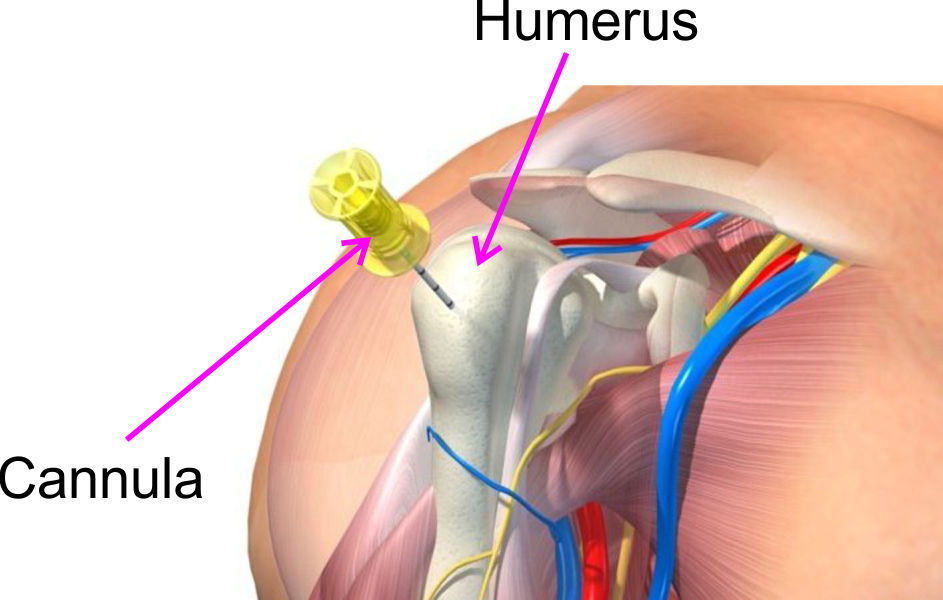
Pediatric
For infants and children, the template uses the same proximal humerus landmarks. Needle size follows weight (see Special Populations).
2. Proximal Tibia
- Extend the leg: Keep the knee straight.
- Find the landmark: Adult: about 2 cm medial to the tibial tuberosity, or 3 cm below the patella and 2 cm medial.
- Set the angle: Aim 90° to the bone on the flat anteromedial surface.
- Check depth: Confirm the 5 mm line before drilling.
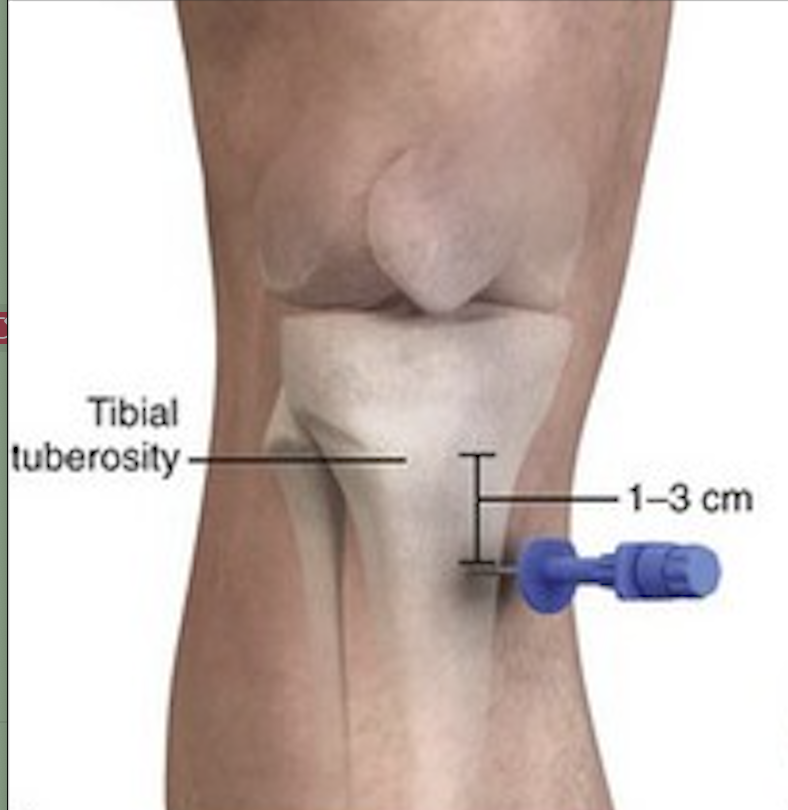
Pediatric
In children, aim about 1 cm medial to the tuberosity. Or go just below the patella (about 1 cm) and slightly medial (about 1 cm). Pinch the tibia to find its borders, and stay on the flat anteromedial surface.
3. Distal Tibia
- Find the malleolus: Locate the medial malleolus.
- Find the landmark: Adult: about 3 cm proximal to the malleolus.
- Confirm the surface: Palpate the anterior and posterior borders to confirm the flat centre of the bone.
- Set the angle and depth: Aim 90° and confirm the 5 mm line before drilling.
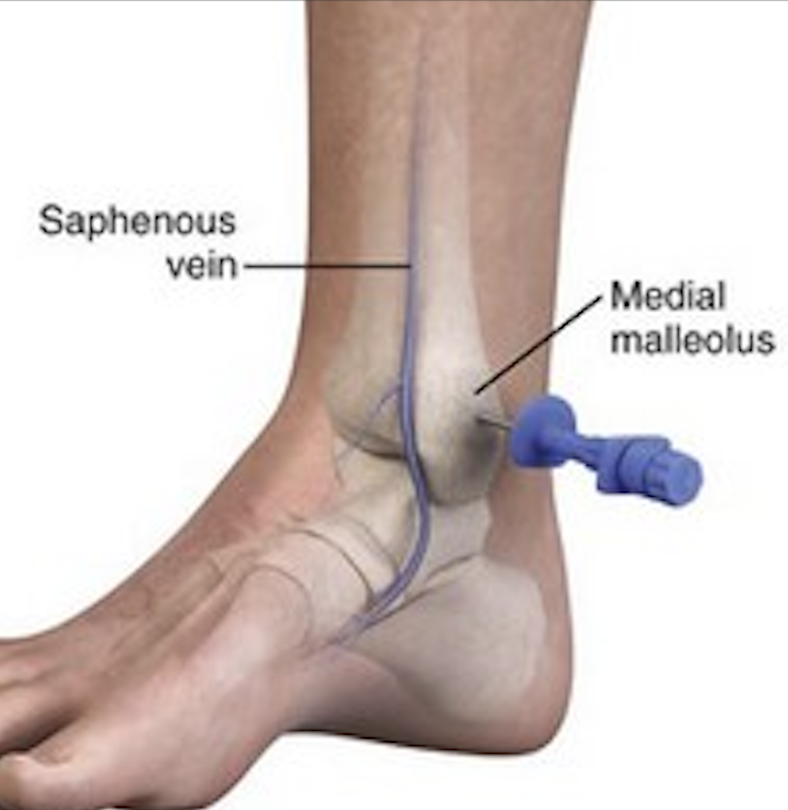
Pediatric
In children, the site sits about 1–2 cm proximal to the medial malleolus. The rest of the technique is the same.
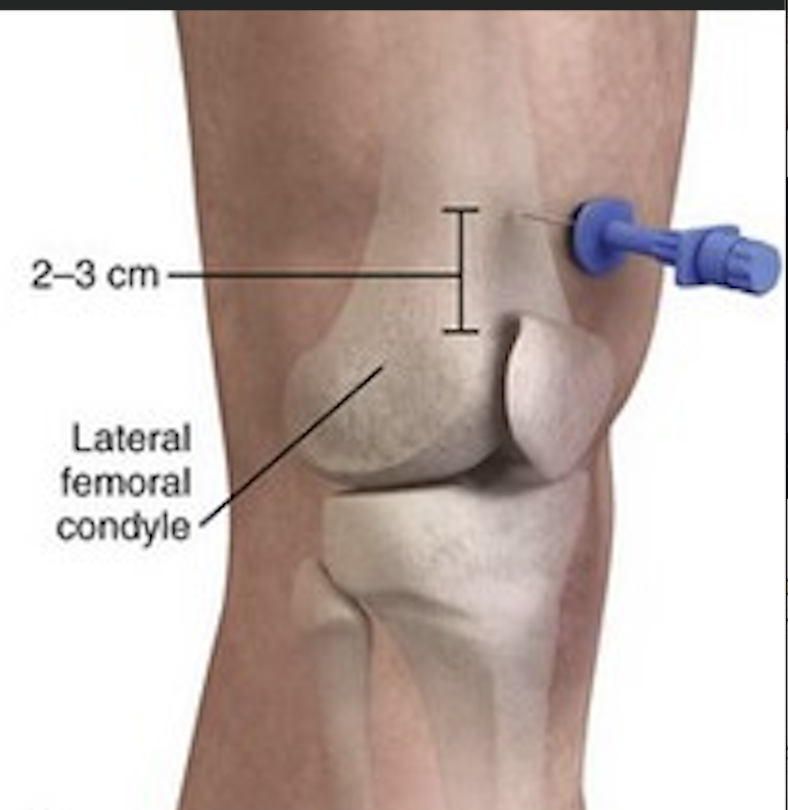
4. Distal Femur (Children)
- Straighten the leg: Keep the knee straight so it cannot bend.
- Find the landmark: Palpate the patella; the site is just proximal to it (no more than 1 cm) and 1–2 cm medial to midline.
- Set the angle: Aim 90° to the bone and confirm the 5 mm line before drilling.
- Secure: Keep the leg straight on a board after insertion.
Equipment & Preparation
Equipment
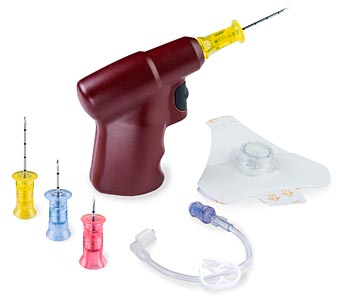
- EZ-IO power driver and needle sets (15, 25 and 45 mm; see sizing)
- EZ-Connect extension set (priming volume about 1.0 mL)
- EZ-Stabilizer dressing
- Luer-lock syringe with sterile normal saline: 5–10 mL adult; 2–5 mL infant or child
- 2% preservative-free, epinephrine-free lidocaine for awake patients, per protocol
- Infusion pressure bag or pump, tubing and a 3-way stopcock
- Gloves, cleansing agent and sharps block
Sizing
| Needle | Hub Colour | Length | Use |
|---|---|---|---|
| Pediatric | Pink | 15 mm | About 3–39 kg |
| Standard | Blue | 25 mm | 3 kg and up |
| Large | Yellow | 45 mm | Proximal humerus at 40 kg and up, or excess tissue at any site |
Patient Positioning & Preparation
Position the patient supine. For the proximal humerus, place the arm across the abdomen. For the distal femur, keep the leg straight. Prime the extension set with lidocaine for an awake patient, or with saline for an unresponsive patient, before attaching it to the hub.
Pre-Procedure Checklist
- Indication documented; failed-IV trigger met or IV not feasible
- No fracture, infection, orthopedic hardware or prior IO in the same bone within 48 hours
- Site and needle chosen by weight and tissue depth
- Aseptic technique; site cleaned per protocol
- Driver charged; needle set and stabilizer dressing open
- Extension set primed (lidocaine if awake, saline if not)
- Flush drawn up: 5–10 mL adult or 2–5 mL child
- Pressure bag or pump ready
- Lidocaine dose calculated for an awake patient (adult 40 mg; child 0.5 mg/kg, max 40 mg)
Medications & Settings
Treat these as typical adult and pediatric references. Confirm them against local protocol and current drug labeling. Doses vary by protocol; follow local protocols and medical direction.
| Drug | Adult Dose | Pediatric Dose | Onset / Duration | Notes |
|---|---|---|---|---|
| Lidocaine 2%, preservative-free and epinephrine-free (IO pain) | 40 mg IO over 120 s; dwell 60 s; flush 5–10 mL NS; then 20 mg IO over 60 s if needed |
0.5 mg/kg IO over 120 s, max 40 mg first dose; flush 2–5 mL; then half the first dose over 60 s |
Dwell 60 s before the flush |
Awake patients only. Off-label for IO use; follow the manufacturer template. Check for amide local-anesthetic hypersensitivity, a labeled contraindication. Antiarrhythmic lidocaine labeling also excludes severe sinoatrial, AV or intraventricular block without a pacemaker; check the labeling for your product. Priming the extension set (about 1.0 mL, or 20 mg of 2%) puts drug in the line before the dose; confirm per protocol whether it counts toward the 40 mg dose. Counts toward total lidocaine; see lidocaine. |
| Resuscitation drugs (e.g., epinephrine, amiodarone) | Same dose, rate and concentration as IV |
Same as IV; weight-based (see weight-based dosing) |
Same as IV |
High-alert Flush after each drug; verify patency first. |
| Crystalloid fluids and blood products | Per order; infuse under pressure for optimal flow |
Boluses 10–20 mL/kg with reassessment |
Under pressure, immediate |
Use caution with hypertonic solutions, chemotherapy and vesicant drugs. |
Step-by-Step Procedure
Phase 1: Prepare
- Confirm the indication: IV access has failed the local trigger, or IV is not feasible in an urgent patient.
- Check contraindications: No fracture, infection, orthopedic hardware, or IO in the same bone within 48 hours.
- Choose the site and needle: Follow local protocol and operator experience for the site (adult sites: proximal humerus, proximal tibia, distal tibia); size the needle by weight and tissue depth (Anatomy & Landmarks).
- Prime the extension set: Lidocaine if the patient is awake and responsive to pain; saline if not.
Phase 2: Perform
- Position and clean: Stabilize the limb with your hand clear of the insertion site and needle path. Clean the site per protocol, using aseptic technique.
- Locate the landmarks: Palpate the site as described in Anatomy & Landmarks.
- Attach the needle set: Connect it to the driver and remove the safety cap.
- Set the angle and depth: Press gently until the tip touches bone and the 5 mm line is visible above the skin.
- Drill: Squeeze the trigger and apply gentle, steady pressure. Release the trigger when the hub reaches the skin or you feel a sudden loss of resistance; do not keep drilling.
- Stabilize the hub: Hold the hub steady, remove the driver, and place the stylet in a sharps container.
- Dress the site: Place the EZ-Stabilizer dressing over the hub.
- Connect the extension set: Attach the primed set and keep the clamp open.
Phase 3: Confirm & Secure
- Flush to confirm: Flush 5–10 mL (adult) or 2–5 mL (child) of saline. It must run without resistance or swelling (see Confirmation & Monitoring).
- Treat pain if awake: Lidocaine per the Medications table, with a 60-second dwell before flushing.
- Infuse under pressure: Verify patency before each drug or fluid. Give drugs at the IV dose and rate.
- Secure and monitor: Immobilize the limb, check the site and limb, and document the time and details.
Confirmation & Monitoring
Primary Confirmation
The needle stays put, and a saline flush runs with no resistance and no swelling. This flush test is the primary check. Repeat it before each infusion.
Secondary Confirmation
- Site: No swelling, leakage or fluid under the skin around the hub.
- Dressing: EZ-Stabilizer secure and the extension set clamp open.
- Aspirate: Marrow may or may not come back. No aspirate does not mean failure.
| Finding | Success | Failure / Malposition |
|---|---|---|
| Flush | Runs freely without resistance | Resistance: re-check depth; if it persists, re-site |
| Site | No swelling; dry dressing | Swelling or fluid under the skin: extravasation, stop and re-site |
| Needle | Stable and upright | Loose or moving: re-stabilize, or re-site if it cannot be fixed |
Ongoing Monitoring
- Before every infusion: Verify patency with a flush.
- At each reassessment: Check the site and limb for swelling, pain, pallor and pain on passive movement.
- Replacement: The template authorizes IO use for up to 24 hours. Plan the switch to IV access.
Troubleshooting
| Problem | Likely Cause | Fix |
|---|---|---|
| Flush resists | Needle not seated in marrow, kinked tubing, clot | Re-check the depth line and tubing; flush gently. If it still resists, remove and re-site. |
| Swelling with flush or infusion | Extravasation through the cortex or from a displaced needle | Stop the infusion; remove the needle; re-site on another bone per protocol |
| Needle loose | Insufficient depth or unstable hub | Re-check the 5 mm line; re-dress the hub. Do not drill further to fix it; re-site if it cannot be stabilized |
| 5 mm line not visible | Needle too short for the tissue depth | Use a longer set: 45 mm for the proximal humerus at 40 kg and up, or for excess tissue at any site |
| Driver fails | Driver fault | Disconnect the driver; grasp the hub and advance by hand, twisting back and forth |
| Slow infusion | Low pressure, kinked line or closed clamp | Infuse under pressure; check clamps and tubing |
| Pain with infusion (awake) | Marrow pressure from infusion | Give IO lidocaine per the sequence; treat pain systemically if it persists |
If It Still Fails
- Second IO site: Go to another site, per protocol. The same bone stays off limits for 48 hours.
- No usable IO site: Your protocol names the alternative vascular route. See IV Insertion.
Complications
| Complication | Recognition | Prevention | Management |
|---|---|---|---|
| Immediate: Extravasation | Swelling, resistance, or flush into tissue | Confirm with a flush before infusing; secure the hub | Stop the infusion; remove the needle; re-site per protocol |
| Immediate: Pain on infusion | Pulling away, grimacing or agitation when awake | Lidocaine pre-treatment for an awake patient | Give lidocaine per the sequence; treat pain systemically |
| Immediate: Dislodgement | Needle moves or the site swells | Stabilize the limb and dressing | Remove and re-site |
| Delayed: Compartment syndrome | Severe pain, tight swelling, pallor, pain on passive stretch | Stop at the first swelling; monitor the limb | Remove the IO; urgent surgical evaluation |
| Delayed: Infection | Fever, redness or pain at the site | Aseptic technique; dwell up to 24 hours (template), then replace with IV access | Remove the needle; treat per protocol |
| Delayed: Growth plate injury (children) | Limb deformity or limp after insertion | Stay in the metaphysis; avoid the growth plate | Refer per protocol |
| Rare: Air embolism | Air in the tubing | Prime the tubing fully before connecting | Per protocol |
Special Populations
Pediatrics
| Weight | Needle | Notes |
|---|---|---|
| About 3–39 kg | 15 mm pink | Infant and child set |
| 3 kg and up | 25 mm blue | Manufacturer template range |
| 40 kg and up | 45 mm yellow | Proximal humerus, or excess tissue at any site |
The template's 15 mm range starts at about 3 kg, so a neonate under 3 kg falls outside this table. Newborns who need emergency vascular access: the 2025 AHA Guidelines for CPR and ECC, Part 5 (neonatal resuscitation), recommend an umbilical vein catheter (COR 1, LOE C-LD). Intraosseous devices can help when IV access fails or is not feasible (COR 2a, LOE C-LD). The template says nothing about sizing neonatal devices. Use the neonatal device set and local protocol.
- Guideline: 2025 AHA Guidelines for CPR and ECC, Part 8, section 7.1: rapid IV or IO access is recommended for drugs in infants and children in cardiac arrest (COR 1, LOE C-LD). The initial route (IV or IO) depends on availability, expertise and timeliness (COR 1, LOE C-EO). Follow local protocol for the sequence.
- Sites: For children, the template lists the proximal humerus, proximal tibia, distal tibia and distal femur.
- Lidocaine (awake child): 0.5 mg/kg IO, max 40 mg first dose, then half the first dose; see Medications.
- Fluid boluses: 10–20 mL/kg with reassessment after each bolus.
- Sizing and dosing: See Equipment Sizing, Weight-Based Dosing and Pediatric Vascular Access.
Obesity
- Extra tissue may call for the 45 mm needle or a different site.
- No palpable landmarks in severe obesity: that counts as a contraindication.
Physiologically Difficult Patients
- In shock, infuse under pressure. Flow depends on the pressure you apply.
- Use caution with hypertonic, chemotherapy and vesicant drugs. A vesicant that leaks can injure soft tissue. Stop at the first swelling.
Post-Procedure Care & Transport
Immediate Aftercare
- Secure the limb: For the humerus, keep the arm across the abdomen or adducted; for the distal femur, keep the leg straight on a board.
- Dress the site: EZ-Stabilizer over the hub; extension set clamp open.
Ongoing Maintenance
- Verify patency before every infusion; monitor the site and limb.
- Removal: Remove the extension set and lift the dressing. Attach a sterile luer-lock syringe to the hub as a handle, rotate clockwise while pulling straight up. Do not rock or bend the catheter.
Transport Considerations
- Reassess the site and limb after every move.
- Keep the limb immobilized; do not reposition the arm or leg in transit without rechecking.
- Use the pressure bag or pump for every infusion.
Document & Hand Off
- Time of insertion and site (side and bone)
- Needle length and colour; depth line confirmed
- Flush result and extravasation check
- Lidocaine given (dose and time) and cumulative total
- Drugs given via the IO and fluid volumes
- Limb and site status at handoff; replacement due time
Clinical Pearls & Pitfalls
Pearls
- Same drugs, same doses: IO drugs run at the IV dose, rate and concentration.
- The flush is the test: Placement is confirmed by a flush that runs with no resistance and no swelling. Aspirate is optional.
- Pressure for flow: Push it under pressure, and check patency before every infusion.
- Count the lidocaine: IO lidocaine counts toward the total on the lidocaine page.
- Clock the dwell: Note the insertion time. The template's ceiling is 24 hours, so plan the IV replacement.
- Check the line: The 5 mm black line confirms needle length before you drill.
Common Pitfalls
- Waiting too long for IV → go to IO at your protocol's trigger.
- Reusing the same bone within 48 hours → choose another site.
- Infusing into swelling → stop, remove the needle, re-site.
- Skipping lidocaine in an awake patient → pre-treat, then flush.
- Oversizing the needle in a child → size by weight and tissue depth.
References
- Wigginton JG, Agarwal S, Bartos JA, et al. Part 9: Adult Advanced Life Support: 2025 American Heart Association Guidelines for Cardiopulmonary Resuscitation and Emergency Cardiovascular Care. Circulation. 2025;152(16 suppl 2):S538–S577. https://doi.org/10.1161/CIR.0000000000001376. Guideline page: https://cpr.heart.org/en/resuscitation-science/cpr-and-ecc-guidelines/adult-advanced-life-support
- Scholefield BR, Acworth J, Ng KC, et al. Pediatric Life Support: 2025 International Liaison Committee on Resuscitation Consensus on Science With Treatment Recommendations. Circulation. 2025;152(16 suppl 1):S116–S164. https://doi.org/10.1161/CIR.0000000000001362
- Couper K, Ji C, Deakin CD, et al. A Randomized Trial of Drug Route in Out-of-Hospital Cardiac Arrest (PARAMEDIC-3). N Engl J Med. 2025;392(4):336–348. https://doi.org/10.1056/NEJMoa2407780
- Teleflex Incorporated. Arrow EZ-IO Intraosseous Vascular Access System: Procedure Template (MCI-2019-0395). 2020. https://www.teleflex.com/global/clinical-resources/documents/MCI-2019-0395_Arrow_EZ-IO_Intraosseous_Procedure_Template_LR.pdf
- Lasa JJ, Dhillon GS, Duff JP, et al. Part 8: Pediatric Advanced Life Support: 2025 American Heart Association and American Academy of Pediatrics Guidelines for Cardiopulmonary Resuscitation and Emergency Cardiovascular Care. Circulation. 2025;152(16 suppl 2). https://doi.org/10.1161/CIR.0000000000001368. Guideline page: https://cpr.heart.org/en/resuscitation-science/cpr-and-ecc-guidelines/pediatric-advanced-life-support
- Lee HC, Strand ML, Finan E, et al. Part 5: Neonatal Resuscitation: 2025 American Heart Association and American Academy of Pediatrics Guidelines for Cardiopulmonary Resuscitation and Emergency Cardiovascular Care. Circulation. 2025;152(16 suppl 2). https://doi.org/10.1161/CIR.0000000000001367. Guideline page: https://cpr.heart.org/en/resuscitation-science/cpr-and-ecc-guidelines/neonatal-resuscitation
- Hospira, Inc. Lidocaine hydrochloride injection (local anesthetic): prescribing information. DailyMed set ID 3b2dd84e-cee8-4e58-d494-395a65a353a0; accessed October 14, 2026. https://dailymed.nlm.nih.gov/dailymed/drugInfo.cfm?setid=3b2dd84e-cee8-4e58-d494-395a65a353a0
- Hospira, Inc. Lidocaine hydrochloride injection (ventricular antiarrhythmic labeling): prescribing information. DailyMed set ID ad1ef0a8-88db-4648-c098-d009eaeb4e5b; accessed October 14, 2026. https://dailymed.nlm.nih.gov/dailymed/drugInfo.cfm?setid=ad1ef0a8-88db-4648-c098-d009eaeb4e5b
Medical Disclaimer
- For Educational Purposes Only: This content is intended for educational reference and should not be used for clinical decision-making.
- Not a Substitute for Professional Judgment: Always consult your local protocols, institutional guidelines, and supervising physicians.
- Verify Before Acting: Users are responsible for verifying information through authoritative sources before any clinical application.