

Bedside Snapshot
- Indications
- Any injured patient, including one who looks well after a high-energy mechanism
- Any red or yellow criterion in the 2021 field triage guideline
- Altered mental status after a reported injury
- Contraindications / Abort
- Unsafe scene: do not enter until hazards are controlled
- Exsanguinating bleeding: control it before the rest of the survey
- Airway obstruction: clear it before the breathing check
- Critical Steps
- Scene safety, mechanism and number of patients first
- xABCDE in order: bleeding, airway, breathing, circulation, GCS, exposure
- Secondary survey head to toe with DCAP-BTLS, both sides
- Confirm & Monitor
- Repeat vitals, GCS and pupils after each intervention and move
- Red criteria: highest-level trauma center available
- Children: hypotension is a late sign; watch perfusion and mental status
Key Numbers
Use these objective thresholds to decide urgency and destination. Life threats come first: control bleeding, secure the airway, then survey.
| Parameter | Value |
|---|---|
| Motor GCS | <6 (cannot follow commands): high-risk. Total GCS ranges 3–15 |
| Systolic BP | Age 10 y and older: <90 mm Hg (high-risk) Age 65 y and older: <110 mm Hg (high-risk) Age 0–9 y: <70 mm Hg + (2 × age in years) (high-risk) |
| Heart rate vs. systolic BP | Heart rate > systolic BP, age 10 y and older (high-risk; a field proxy for shock index above 1.0) |
| Respiratory rate | <10 or >29 breaths/min, all ages (high-risk) Respiratory distress or need for respiratory support (high-risk) |
| Room-air SpO₂ | <90% (high-risk) |
| Active bleeding | Needing tourniquet or wound packing with continuous pressure (high-risk) |
| Fall height | >10 ft, all ages (moderate-risk) |
| Vehicle and pedestrian | Rider separated from a motorcycle, ATV or horse with significant impact (moderate-risk) Pedestrian or bicyclist thrown, run over, or with significant (>20 mph) impact (moderate-risk) Intrusion >12 in at occupant site or >18 in any site (moderate-risk) |
| Occupant (vehicle) | Ejection (partial or complete); extrication of any duration; death of another occupant in the same passenger compartment; vehicle telemetry consistent with severe injury (all moderate-risk) |
| Child restraint | Age 0–9 y unrestrained or in an unsecured child seat (moderate-risk) |
| Pregnancy | >20 weeks (moderate-risk, EMS judgment) |
Overview & Principles
Trauma assessment finds the life threats and treats them in a fixed order. Every other injury comes after. Start the survey over after every intervention, every move and every change in the patient.
How It Works
- Primary survey (xABCDE): x is exsanguinating hemorrhage. Next comes the airway, with cervical spine protection, then breathing, circulation, disability (Glasgow Coma Scale [GCS], pupils, glucose) and exposure. Treat each threat the moment you find it.
- Secondary survey: a head-to-toe exam with DCAP-BTLS. You do it once the primary survey is done and the patient can take a fuller exam.
- Reassessment: vitals, GCS and bleeding get checked again after every intervention, move and change.
- Scene size-up: scene safety, mechanism and energy, number of patients, and any need for extrication or more resources. Sort all of it out before you touch the patient.
Where It Fits
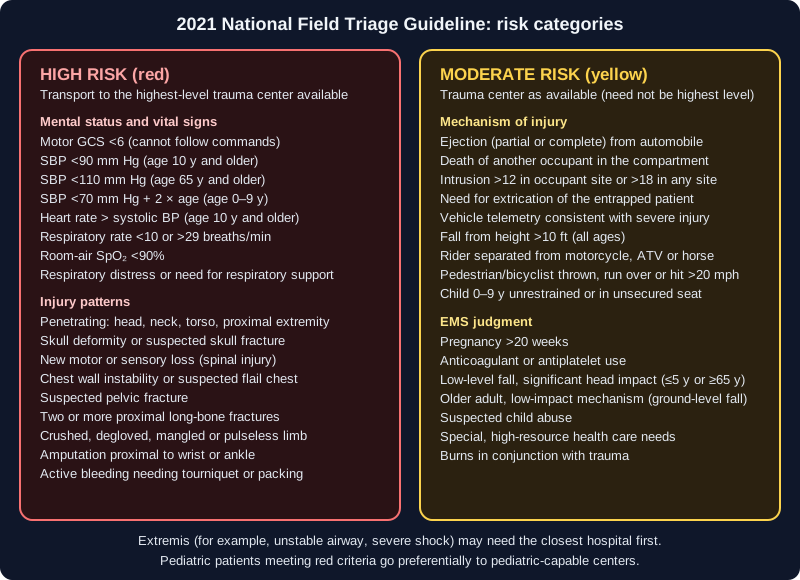
Field triage picks the destination. The 2021 National Guideline for the Field Triage of Injured Patients sorts findings into high-risk (red) and moderate-risk (yellow). Where does a red patient go? The highest-level trauma center available within the regional system. Yellow goes to a trauma center as available, and that center does not have to be the highest level. Patients who meet only EMS-judgment criteria go to a trauma center or a hospital that can evaluate them in a timely and thorough way. Patients in extremis may need the closest hospital first, to stabilize them.
Indications & Contraindications
Indications
- Any injured patient, including one who looks well after a high-energy mechanism
- Any red or yellow criterion in the field triage guideline (Overview)
- Altered mental status after a reported injury, or an injury of unknown mechanism
Absolute Contraindications
There is no absolute contraindication once the patient is injured. Never withhold the survey. Its order and depth change with the scene and the patient.
Relative Contraindications & Cautions
- Unsafe scene: stay out until traffic, fire, violence or hazardous materials are under control, per agency policy.
- Ongoing resuscitation: the survey runs alongside the intervention. Don't hold an intervention for a complete exam.
- Spinal precautions: apply per protocol. Never hold up airway or hemorrhage control to finish immobilizing.
Abort / Stop Criteria
- Scene still unsafe: stop entry, request resources and wait.
- In extremis (unstable airway or severe shock)? Stabilize the bleeding and the airway, then move. Finish the rest of the survey en route.
Scope & Team Roles
| Provider Level | Typical Role | Notes |
|---|---|---|
| EMT | Performs | Primary and secondary survey, GCS, vital signs and bleeding control per protocol |
| AEMT | Performs | Same assessment; adds protocol-based interventions as findings require |
| Paramedic | Performs | Full assessment; airway, IV/IO and pain decisions per protocol and credentialing |
| RN (ED/ICU) | Performs | Assessment in the ED or ICU; team leadership varies by facility policy |
| Critical Care Transport (CFRN / CTRN / FP-C / CCP-C) | Performs | Reassessment during interfacility transport; procedure limits as for Paramedic |
| Physician / APP | Performs | Directs the trauma team; decides on imaging, procedures and transfer |
Team Roles During the Procedure
- Assessor: leads the xABCDE sequence and calls each finding aloud.
- Hemorrhage and airway: controls bleeding and manages the airway and spinal precautions.
- Monitor and recorder: applies monitors, records vital signs, GCS and times, and tracks interventions.
- Communicator: prepares the destination, the radio report and the handoff.
Equipment & Preparation
Equipment
- Pulse oximeter, capnography where available, and ECG monitor
- Automated blood pressure cuff in adult and pediatric sizes
- Glucometer and penlight
- Tourniquet, pressure dressings and wound packing
- Suction, oxygen and airway adjuncts
- Cervical collar or immobilization device per protocol
- Blankets and a warming barrier for the exposed patient
Sizing
Cuff size follows the limb. Adult or pediatric, checked against the manufacturer's sizing chart. Pediatric equipment sizes live on the equipment sizing page.
Patient Positioning & Preparation
Lay the patient supine. When you use spinal precautions, keep head and neck in line. The back exam needs a log roll. Uncover the chest, abdomen, pelvis and limbs. Protect privacy and warmth.
Pre-Procedure Checklist
- Scene safety confirmed; personal protective equipment on
- Number of patients and resources requested
- Monitor applied: SpO₂, ECG and blood pressure
- Hemorrhage kit open: tourniquet, packing and pressure dressing
- Suction and airway equipment ready; oxygen connected
- Glucometer and penlight at hand
- Blankets ready for the exposed patient
- Destination chosen from the field triage criteria
Step-by-Step Procedure
Phase 1: Prepare
- Confirm scene safety: enter only when hazards are controlled, per agency policy.
- Size up the scene: note mechanism and energy (speed, height, intrusion, ejection), number of patients, and any need for extrication or more resources.
- Form a general impression: note level of consciousness, obvious bleeding and whether the patient is moving.
Phase 2: Perform (Primary Survey, xABCDE)
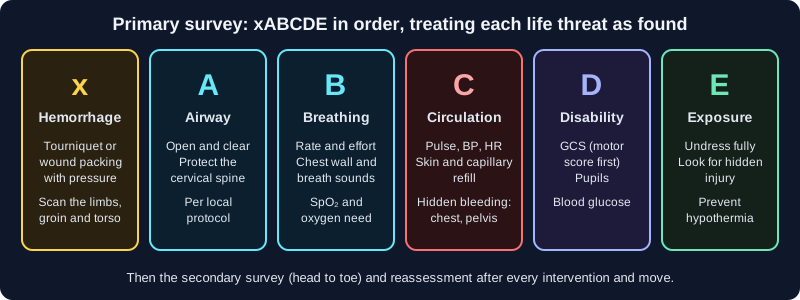
- Control exsanguinating bleeding (x): apply a tourniquet or wound packing with continuous pressure to active bleeding. Reassess and record the time.
- Assess the airway (A): open and clear it, protect the cervical spine per protocol, and treat an obstruction before going on.
- Assess breathing (B): count the respiratory rate and effort, inspect and palpate the chest, listen to both sides, then apply oxygen and read the SpO₂. Treat what you find: decompress a suspected tension pneumothorax (absent breath sounds, deviated trachea, distended neck veins or hypotension) by needle or finger decompression per scope and protocol; cover an open chest wound with a vented or occlusive dressing; support ventilation for flail chest or respiratory distress per protocol.
- Assess circulation (C): check pulse and blood pressure, skin color, temperature and capillary refill. Look for hidden bleeding in the chest, abdomen, pelvis and femurs. Treat what you find: apply a pelvic binder for a suspected unstable pelvic fracture; establish two large-bore IV or IO lines per protocol; start the blood-product or tranexamic acid pathway if your system carries one (CRASH-2 found TXA beneficial when given within 3 hours of injury). Permissive hypotension applies to hemorrhage without head injury and is avoided when TBI is present. See hemorrhage control.
- Assess disability (D): score the GCS (eye, verbal and motor), check the pupils and check blood glucose.
- Expose and protect (E): undress the patient fully, look for hidden injury, and prevent hypothermia.
Phase 3: Confirm & Secure (Secondary Survey and Triage)
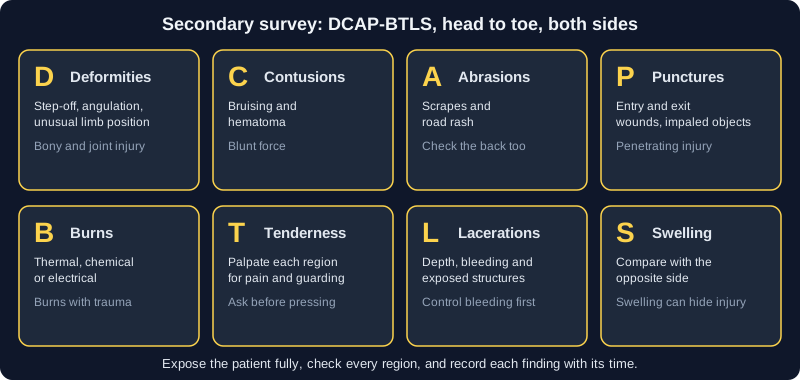
- Examine head to toe: check each region with DCAP-BTLS (deformities, contusions, abrasions, punctures or penetrations, burns, tenderness, lacerations, swelling). Examine both sides and log roll for the back.
- Repeat the vital signs: repeat blood pressure, pulse, respiratory rate, SpO₂, GCS and pupils. Compare with the first set; a worsening trend matters more than a single value.
- Apply the triage criteria: match the findings to the red and yellow criteria in Overview. Red criteria go to the highest-level trauma center available; yellow criteria go to a trauma center as available (need not be the highest level).
- Reassess after any change: repeat the primary survey after any move, change or intervention, and confirm hemorrhage control and airway status.
- Hand off: give a structured report with mechanism, injuries, interventions and response (see Post-Procedure Care & Transport).
Confirmation & Monitoring
Primary Confirmation
Your primary confirmation is a second set of vitals and GCS, read against the survey. Hold it next to the first set. A rising heart rate while systolic BP drops, a GCS that is sliding or an SpO₂ that is sliding all mean one thing: worse. That holds even when one value still sits in range.
Secondary Confirmation
- No active bleeding through the dressing or tourniquet, with tourniquet time recorded
- Airway open, with clear or equal breath sounds and no obstruction
- Waveform EtCO₂ present when the airway is advanced and ventilated
- Pupils and GCS unchanged or improving; motor GCS 6 (obeys commands)
| Finding | Success | Failure / Concern |
|---|---|---|
| Hemorrhage | No bleeding through the dressing after pressure or tourniquet | Bleeding continues; tourniquet not holding; new bleeding under clothing |
| Airway | Speaking, or clear breath sounds with no obstruction | Snoring, gurgling, stridor or a muffled voice |
| Breathing | No high-risk respiratory criterion met: rate 10–29/min and SpO₂ at or above 90% on room air (triage thresholds; normal rates differ in children) | Rate <10 or >29/min; SpO₂ <90%; respiratory distress or need for support; unequal chest movement |
| Circulation | Systolic BP at or above 90 mm Hg (age 10–64 y), 110 mm Hg (age 65 y and older), or 70 + 2 × age mm Hg (age 0–9 y); at age 10 y and older, heart rate at or below systolic BP | Systolic BP below the age threshold; at age 10 y and older, heart rate > systolic BP; pale, cool or mottled skin |
| Disability | Motor GCS 6 with pupils equal and reactive | Motor GCS <6; unequal or sluggish pupils; falling GCS |
Ongoing Monitoring
- Vital signs, GCS and pupils: after each intervention, each move and any change; the interval follows local protocol.
- SpO₂ and capnography: continuously when available.
- Bleeding and dressings: at every reassessment and before transport.
- Temperature: check it and keep the patient warm.
Troubleshooting
| Problem | Likely Cause | Fix |
|---|---|---|
| Low systolic BP with fast heart rate | Internal bleeding (chest, abdomen, pelvis, femur) or uncontrolled external bleeding | Find and control the bleeding; fluid and drug therapy per protocol (see the tranexamic acid page); transport to a trauma center |
| GCS falling | Hypoxia, hypoperfusion, hypoglycemia or intracranial bleeding | Oxygenate, restore perfusion, check glucose and watch the pupils; move early |
| SpO₂ below 90% on room air | Chest injury, aspiration, obstruction or head injury impairing breathing | Give oxygen; check breath sounds, chest wall and airway; decompress a suspected tension pneumothorax per scope and protocol |
| Noisy or obstructed airway | Blood, vomit, tongue or a foreign body | Clear and position the airway; suction; airway adjunct per protocol |
| Bleeding not visible | Hidden in the abdomen, pelvis, thigh or back | Log roll and examine the back; check pelvis, thighs and axillae; repeat the survey |
| Patient cold after exposure | Exposure during the survey | Cover quickly with blankets; keep the environment warm; recheck temperature |
| Agitated or combative patient | Hypoxia, hypoperfusion, hypoglycemia, intoxication or head injury | Treat the cause first: oxygen, glucose, perfusion; do not assume intoxication |
| Pain limits the exam | Pain and anxiety | Analgesia per protocol once bleeding and airway are addressed |
| Findings change after a move | Delayed bleeding or evolving injury | Restart from the primary survey at the new position |
If the Patient Is Still in Shock
- Control bleeding: reapply the tourniquet or packing per protocol.
- Protect oxygenation and the airway: keep SpO₂ monitored and airway support in place.
- Move: transport to the highest-level trauma center the triage criteria allow. In extremis, the closest hospital may come first for stabilization.
Complications
| Complication | Recognition | Prevention | Management |
|---|---|---|---|
| Immediate: missed exsanguinating hemorrhage | Shock signs; heart rate above systolic BP; blood under clothing | Bleeding first in the xABCDE order; full exposure | Pressure, tourniquet or packing per protocol; rapid transport |
| Immediate: missed airway obstruction | Noisy breathing, falling SpO₂ or agitation | Check the airway at every reassessment | Clear, position and suction; advanced airway per protocol |
| Delayed: missed spinal injury | New motor or sensory loss; neck or back pain; midline tenderness | Complete the secondary survey; spinal precautions per protocol | Immobilize per protocol; alert the receiving team |
| Delayed: hypothermia | Shivering, low temperature, slowed thinking | Remove wet clothing; blankets; warm environment | Insulate and warm per protocol; recheck temperature |
| Common pitfall: undertriage of older adults | Systolic BP <110 mm Hg at age 65 y or older; low-level fall with head impact | Apply the age-specific criteria, not appearance alone | Transport per triage; document the criteria met |
| Common pitfall: missed child abuse | Injury pattern that does not fit the history | Ask about the mechanism and examine the whole child | Document objectively; report per law and local protocol |
Special Populations
Pediatrics
- Hypotension is late: kids compensate with tachycardia and vasoconstriction. Watch perfusion, capillary refill and mental status first. The Pediatric Assessment Triangle gives that look a structure.
- Age-based systolic threshold: in a child aged 0–9 y, systolic BP below 70 mm Hg + (2 × age in years) is high-risk. At 10 y the adult 90 mm Hg threshold takes over. The age-based ranges sit on the pediatric vital signs page.
- Low-level falls: a child 5 y and younger who falls low with significant head impact is an EMS judgment criterion.
- Restraint: an unrestrained child 0–9 y, or one in an unsecured seat, is a moderate-risk mechanism.
- Destination: a child who meets red criteria goes preferentially to a pediatric-capable trauma center. Local system resources set the age that defines a child.
- Equipment: cuffs and other gear are sized to the child. See the equipment sizing page.
Older Adults
- Systolic BP below 110 mm Hg at 65 y or older is high-risk. It may already mean shock.
- A low-level fall with significant head impact in an adult 65 y or older is an EMS judgment criterion. Ground-level falls can still cause severe injury.
- Anticoagulants, antiplatelets included, are an EMS judgment criterion at every age. Weigh them against the mechanism and any head injury.
Pregnancy
- Pregnancy over 20 weeks is a moderate-risk criterion. EMS judgment decides it.
- The guideline favors trauma centers that have obstetric capability. Follow your local obstetric trauma protocol.
Head Injury
- Avoid hypoxia and hypotension: each one makes the secondary brain injury worse. Keep SpO₂ at or above 90% and treat hypotension early, per protocol.
- Ventilation: no routine hyperventilation. Ventilate to the protocol target EtCO₂. Go lower only for signs of herniation: unequal or dilated pupils, posturing or a falling GCS.
- Triage is not a head-injury target: SBP below 90 mm Hg, or the age-based thresholds, is a transport trigger. Protocol sets the head-injury blood pressure goals.
- Move early: a falling GCS, a new pupil change or posturing means transport now. Don't finish the survey on scene first.
| GCS Component | Responses (score) |
|---|---|
| Eye opening (E) | Spontaneous (4); to voice (3); to pain (2); none (1) |
| Verbal (V) | Oriented (5); confused (4); inappropriate words (3); incomprehensible sounds (2); none (1) |
| Motor (M) | Obeys commands (6); localizes pain (5); withdraws from pain (4); abnormal flexion (3); extension (2); none (1) |
Score each component, then record the total (3–15) along with its parts. For example, E3 V4 M6 = 13. If the patient is intubated, record V as T. Teasdale and Jennett described the scale in 1974. The head-injury points above follow the 2023 prehospital TBI guideline. Numeric blood pressure and EtCO₂ targets are left to local protocol.
Spinal and Burn Injury
- New motor or sensory loss with suspected spinal injury is a high-risk pattern.
- Selective spinal motion restriction: the 2018 joint position statement from NAEMSP, ACS-COT and ACEP favors limiting motion based on clinical findings. It moves away from routine long-board and collar use. The long board is for extrication or movement when other means can't be used, per protocol. Never hold up airway or hemorrhage control to finish it.
- Burns with trauma: a trauma center with burn care is preferred. If there isn't one, a trauma center takes precedence over a burn center.
Post-Procedure Care & Transport
Immediate Aftercare
Pick the position, then check what rides on it. Two things have to survive every position and every turn: the airway and your hemorrhage control. Turns are log rolls under spinal precautions, per protocol. Blankets on. Patient warm.
Ongoing Maintenance
- Recheck vital signs, GCS and pupils after every move. The interval follows local protocol.
- Look at tourniquets and dressings for bleeding. Record the tourniquet time.
- Keep SpO₂ and capnography on when available.
Transport Considerations
- Destination: red goes to the highest-level trauma center available within the regional system. Yellow goes to a trauma center as available, and it need not be the highest level. In extremis, the closest hospital may come first.
- Pediatric red patients: a child who is red goes preferentially to a pediatric-capable trauma center.
- Medical control: for a moderate-risk judgment call, the guideline says call online medical control.
- Noise and motion: a moving vehicle drowns out the pulse and breath sounds. Trust the monitor, and waveform capnography once the airway is advanced.
- Reassessment: repeat the full set after every move and on any change.
Handoff & Documentation
Document & Hand Off
- Time of injury, time of call and time of patient contact
- Mechanism and energy: speed, height, intrusion, ejection and extrication time
- Injuries found by the primary and secondary surveys, with DCAP-BTLS findings
- Hemorrhage control: method, location and tourniquet time
- First and repeat vital signs, GCS and pupils, with times
- Interventions, doses and response
- Triage criteria met (red or yellow) and the reason for the destination
Clinical Pearls & Pitfalls
Pearls
- Bleeding first: in xABCDE, x comes before A.
- Mechanism raises the index: ejection, a death in the same compartment, or a fall over 10 ft is moderate-risk, even with normal vitals.
- Trend, do not snapshot: Watch the line, not the dot. A falling GCS, rising heart rate or falling systolic BP across repeated sets matters more than any single value.
- Heart rate above systolic BP: the guideline uses this as a field stand-in for a shock index above 1.0, in adults and older adults.
- Look under the clothes: log roll to see the back, then check the pelvis, thighs and axillae.
Common Pitfalls
- Stopping at the first abnormal finding: finish the primary survey, then move on to the secondary.
- Trusting one normal set of vital signs: one normal set means little until you repeat it after each intervention and move.
- Calling a minor-looking scene stable: looks can fool you. Apply the mechanism criteria.
- Delaying bleeding control for spinal precautions: the bleeding gets controlled first. Immobilize per protocol after that.
- Assuming intoxication for altered mental status: check glucose, oxygenation and the head before anything else.
References
- Newgard CD, Fischer PE, Gestring M, et al. National guideline for the field triage of injured patients: recommendations of the National Expert Panel on Field Triage, 2021. J Trauma Acute Care Surg. 2022;93(2):e49-e60. https://doi.org/10.1097/TA.0000000000003627
- Teasdale G, Jennett B. Assessment of coma and impaired consciousness: a practical scale. Lancet. 1974;2(7872):81-84 (landmark scale derivation). https://doi.org/10.1016/S0140-6736(74)91639-0
- CRASH-2 Collaborators. Effects of tranexamic acid on death, vascular occlusive events, and blood transfusion in trauma patients with significant haemorrhage (CRASH-2): a randomised, placebo-controlled trial. Lancet. 2010;376:23-32. https://doi.org/10.1016/S0140-6736(10)60835-5
- Brain Trauma Foundation, National Association of EMS Physicians and American College of Surgeons Committee on Trauma. Prehospital Guidelines for the Management of Traumatic Brain Injury, 3rd edition. Prehosp Emerg Care. 2023. https://doi.org/10.1080/10903127.2023.2187905
- Spinal Motion Restriction in the Trauma Patient: A Joint Position Statement. American College of Surgeons Committee on Trauma, American College of Emergency Physicians and National Association of EMS Physicians. Prehosp Emerg Care. 2018;22:659-661. https://doi.org/10.1080/10903127.2018.1481476
- American College of Surgeons Committee on Trauma. Advanced Trauma Life Support (ATLS): Student Course Manual, 11th edition. Chicago, IL: American College of Surgeons; 2025. Program launch and xABCDE change announced 16 September 2025: https://www.facs.org/for-medical-professionals/news-publications/news-and-articles/acs-brief/september-16-2025-issue/trauma-care-gets-major-upgrade-with-launch-of-atls-11/
Medical Disclaimer
- For Educational Purposes Only: This content is intended for educational reference and should not be used for clinical decision-making.
- Not a Substitute for Professional Judgment: Always consult your local protocols, institutional guidelines, and supervising physicians.
- Verify Before Acting: Users are responsible for verifying information through authoritative sources before any clinical application.