

Bedside Snapshot
- Use It When
- Every child with pain or a pain-like complaint: at first contact, after each analgesic dose, and at handoff. Age picks the tool: observe under 4 years, self-report from 4. Score before and after every dose.
- Key Numbers
- < 4 years: observational scale
0–10 FLACC total (five items, 0–2 each)
1.5 mcg/kg IN fentanyl, age 12 months and older
5 min before re-dosing an opioid or ketamine; acetaminophen and NSAIDs are excluded - Formulas
- Dose = mcg/kg × measured kg
IN fentanyl volume = dose ÷ 50 mcg/mL (1.5 mcg/kg = 0.03 mL/kg)
Acetaminophen ceiling = 75 mg/kg per day, all routes (adult 4 g/day at 50 kg or more) - Action Thresholds
- FLACC 1–3: mild, non-drug measures
- FLACC 4–6: moderate, analgesia per protocol
- FLACC 7–10: severe, treat promptly
- Watch Out
- A quiet, still child is not automatically comfortable. Score the behavior, then check breathing after every opioid dose.
Overview & Pediatric Differences
A child's pain is scored from the child's own words when the child can give them. When the child cannot, you score what the child does. Pick the scale by age and ability. Record a baseline before treatment. Then repeat the score after every analgesic dose and at handoff.
Every child's analgesic dose is worked out from a measured weight. That is why each drug line here gives a per-kilogram dose and a maximum. The scales and doses come from the NASEMSO pain guideline and the Royal Children's Hospital intranasal fentanyl guideline. Product labels are used where they apply.
Why Kids Are Different
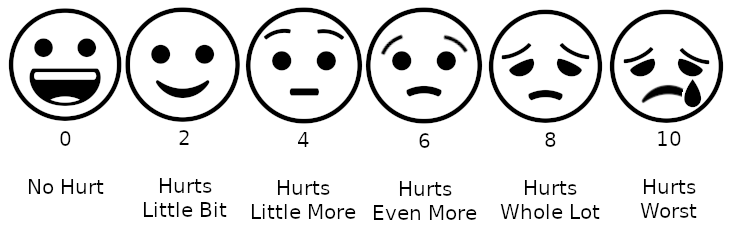
- Self-report depends on development: NASEMSO matches the tool to development. Observational scales (FLACC, CHEOPS) cover children under 4 years and any child who cannot self-report. Pictorial scales cover 4 to 12 years. Over 12 years, use the 0–10 numeric scale.
- No self-report scale is strongly recommended under 6 years: The 2019 systematic review of pediatric pain intensity measures recommends none for children younger than 6 years.
- Vital signs do not measure pain: Heart rate and blood pressure also move with fever, bleeding and fear. Use the pain tool for pain. Then go find the other cause.
- Doses are per kilogram: Use a measured weight. The per-kilogram math is in Weight-Based Dosing.
- Opioids need breathing checks: Capnography predicts hypoventilation earlier than pulse oximetry when opioids are given. NASEMSO says so.
How to Use
- Choose the scale by age and ability: FLACC under 4 years or when the child cannot self-report; a faces scale from 4 to 12 years (FPS-R is the strongly recommended faces tool; Wong-Baker is also allowed); a 0–10 numeric scale over 12 years (NASEMSO; 2019 systematic review).
- Score before treatment: observe an awake child for 1–2 minutes, or an asleep child for at least 2 minutes, with the legs and body uncovered (NASEMSO FLACC instructions).
- Choose the route: for a child without IV access, intranasal opioid is the preferred first route (NASEMSO; the 2023 prehospital pain guideline makes a strong recommendation).
- Repeat by the protocol rule: re-dose an opioid or ketamine 5 minutes after the last dose if pain persists and vital signs allow. Acetaminophen and NSAIDs follow their own interval and daily limit.
- Record the score: before and after each analgesic dose and at the destination (NASEMSO).
Pain Scales by Age and Ability
Pick the tool that fits the child's age and ability. The age bands are NASEMSO's. The evidence strength for each self-report scale comes from a 2019 systematic review.
| Scale | Age or Ability | How It Is Scored | Notes |
|---|---|---|---|
| FLACC | Under 4 years, or cannot self-report | Five observed items (face, legs, activity, cry, consolability), 0–2 each, total 0–10 | Original study enrolled postoperative children aged 2 months to 7 years |
| CHEOPS | Under 4 years (NASEMSO) | Observational behavioral scale | Named by NASEMSO for this age; use the unit's version |
| NIPS | Preterm and term neonates | Six component scores, rated over the procedure | Developed for neonatal procedural pain; use the unit's cut-off |
| Faces Pain Scale-Revised (FPS-R) | 4–12 years (NASEMSO) | Pictorial faces; the child points to the face that matches the pain | Strongly recommended for acute pain (2019 systematic review); the faces tool this page leads with |
| Wong-Baker FACES | 4–12 years (NASEMSO); reviewed in ages 3 to 18 (2019 systematic review) | Faces scored 0, 2, 4, 6, 8, 10, from no hurt to hurts worst | Allowed by NASEMSO but not among the strongly recommended measures (2019 systematic review); reliability varies across studies. Use it where the local protocol names it. |
| Numeric rating scale (0–10) | Over 12 years (NASEMSO) | 0 = no pain, 10 = worst pain | Strongly recommended for acute pain in the 2019 review; needs number understanding |
FLACC Scoring Criteria
Five items make up FLACC: Face, Legs, Activity, Cry and Consolability. NASEMSO calls the third one "Arms". Each category earns 0, 1 or 2. Add them up for a total from 0 to 10 (NASEMSO).
| Category | 0 points | 1 point | 2 points |
|---|---|---|---|
| Face | No particular expression or smile | Occasional grimace or frown, withdrawn, disinterested | Frequent to constant frown, clenched jaw, quivering chin |
| Legs | Normal position or relaxed | Uneasy, restless, tense | Kicking, or legs drawn up |
| Activity | Lying quietly, normal position, moves easily | Squirming, shifting back and forth, tense | Arched, rigid, or jerking |
| Cry | No cry (awake or asleep) | Moans or whimpers, occasional complaint | Crying steadily, screams or sobs, frequent complaints |
| Consolability | Content, relaxed | Reassured by occasional touching, hugging, or being talked to; distractible | Difficult to console or comfort |
Non-Drug Pain Measures
Use these measures alongside analgesia, never instead of it. The evidence for each one sits in the table. The sucrose evidence covers only the procedures it was studied for.
| Measure | Use | Evidence or Limit |
|---|---|---|
| Position of comfort | Let the child rest in the position that eases pain; transport the child in that position | NASEMSO pain guideline |
| Ice and splinting | Trauma-related pain; splinting and ice reduce the total analgesic needed | NASEMSO pain guideline |
| Verbal reassurance | Reduce anxiety and help the child tolerate exam and transport | NASEMSO pain guideline |
| Oral sucrose (neonates) | 24% sucrose before heel lance, venipuncture or intramuscular injection, with non-nutritive sucking in some trials; volume follows the neonatal protocol and gestational age | High-quality evidence for heel lance, venipuncture and intramuscular injection; not effective for circumcision pain. The review found no optimal dose (2016 Cochrane review). |
Interpretation & Action Thresholds
Let the score set the level of treatment, then reassess. The bands below are NASEMSO's FLACC categories.
| Finding or Threshold | Meaning | Action |
|---|---|---|
| FLACC 0 | Relaxed and comfortable | Re-score at the next change in care |
| FLACC 1–3 | Mild discomfort | Non-drug measures; an oral non-opioid if pain persists and the protocol allows |
| FLACC 4–6 | Moderate pain | Analgesia per protocol: opioid or ketamine, or acetaminophen or ibuprofen as adjunct |
| FLACC 7–10 | Severe discomfort or pain | Treat promptly per protocol, with breathing monitoring |
| No change 5 minutes after an opioid or ketamine dose | Relief is not yet adequate | Re-dose per protocol if vital signs allow; acetaminophen and NSAIDs do not follow the 5-minute rule |
| GCS below 15, hypotension, SpO₂ below 90% after oxygen, or hypoventilation | Higher risk with opioids | Give opioids with caution; watch breathing and use capnography (NASEMSO) |
Limitations & Alternatives
- Observer dependence: observational scores rest on who is watching and for how long. Use the same observation window every time.
- Thin validation: the original FLACC study enrolled 89 postoperative children. The evidence behind observational scales is small.
- Age gap: children under 6 years have no self-report measure with a strong recommendation.
- Vital signs are not a pain score: They tell you about illness and breathing. They do not tell you about comfort.
| Alternative | Method | Strengths | Weaknesses |
|---|---|---|---|
| Numeric rating scale | Child states a number from 0 to 10 | Strongly recommended for acute pain | Needs number understanding |
| Faces scales (FPS-R, Wong-Baker) | Child points to a face | Pictorial; FPS-R is strongly recommended for acute pain (2019 systematic review) | Wong-Baker is not strongly recommended; reliability varies across studies |
| FLACC or CHEOPS | Observer scores behavior | Used under 4 years and for children who cannot self-report | Observer-dependent; limited validation |
| NIPS | Observer scores neonatal behavior | Designed for neonatal procedures | Neonates only |
Medications & Dosing
Doses vary by protocol; follow local protocols and medical direction. Every dose runs off a measured weight. Pick the route by the access you have. No IV? Intranasal fentanyl. IV or IO once access is in place and the pain is severe. NASEMSO ties drug class and route to pain severity, and to the move from oral to parenteral routes. Acetaminophen and ibuprofen are for minor pain or as adjuncts.
Opioids and Ketamine
| Drug | Dose & Route | Max | Notes |
|---|---|---|---|
| Fentanyl High-alert |
Acute pain, IN: 1.5 mcg/kg by atomizer, split between nares = 0.03 mL/kg of 50 mcg/mL Draw up 0.1 mL extra to prime the atomizer (RCH) |
First dose 75 mcg usual maximum (1.5 mL); 100 mcg only at 300 mcg/mL. Repeat 0.75–1.5 mcg/kg (max 75–100 mcg) after 5–10 min per protocol |
Age 12 months and older (RCH); avoid under 12 months. Contraindicated: known fentanyl hypersensitivity, altered conscious state, bilateral occluded nasal passages, active epistaxis (RCH). Use ideal body weight if overweight (RCH). NASEMSO 2022 uses 1 mcg/kg IN (max 100 mcg); the RCH dose is protocol-dependent. |
| Fentanyl High-alert |
Acute pain, IV/IO: 1 mcg/kg, slow push over 1–2 min = 0.02 mL/kg of 50 mcg/mL |
100 mcg initial dose (NASEMSO); repeat per protocol |
Watch breathing after each dose (NASEMSO). Contraindicated with an MAOI taken in the previous 14 days (NASEMSO). Use caution with a medication allergy, GCS below 15, hypotension, SpO₂ below 90% after oxygen, or hypoventilation (NASEMSO). |
| Ketamine High-alert |
Analgesia, IV/IO: 0.25 mg/kg = 0.025 mL/kg of 10 mg/mL IM at the same dose and maximum (NASEMSO) |
25 mg initial dose; 100 mg cumulative (NASEMSO) |
Monitor the airway and breathing. Adverse effects on the label to watch for: emergence reactions (fewer with IM), laryngospasm, airway obstruction, and adverse psychiatric events. The 2023 prehospital guideline (not pediatric-specific) made a conditional recommendation against weight-based IV ketamine added to weight-based IV opioids. |
Non-Opioid Analgesics
| Drug | Dose & Route | Max | Notes |
|---|---|---|---|
| Acetaminophen, IV | Under 50 kg (ages 2–12 years and adolescents): 15 mg/kg IV every 6 hours, or 12.5 mg/kg every 4 hours; infuse over 15 minutes = 1.5 mL/kg of 10 mg/mL (15 mg/kg) 50 kg or more: 1,000 mg (100 mL) every 6 hours or 650 mg (65 mL) every 4 hours |
Under 50 kg: 15 mg/kg per dose, up to 750 mg; 75 mg/kg per day, up to 3,750 mg per day, all routes. 50 kg or more: 1,000 mg per dose, 4,000 mg per day. Minimum interval 4 hours |
Label sections 2.2 and 2.3. Use caution with hepatic impairment or active liver disease, alcoholism, chronic malnutrition, severe hypovolemia (dehydration or blood loss), or severe renal impairment (CrCl 30 mL/min or less). NASEMSO's 1 g limit is an upper bound, and the lower label cap applies. Label doses for infants (29 days to 2 years, max 60 mg/kg/day) and neonates (max 50 mg/kg/day) are for fever (section 2.4); confirm pain dosing against the neonatal or pediatric protocol. |
| Acetaminophen, oral | 15 mg/kg PO every 4 hours (NASEMSO dose; OTC label interval) Volume from the product's concentration |
1,000 mg per dose (NASEMSO); 75 mg/kg per day and 4,000 mg per 24 hours, whichever is lower; no more than 5 doses in 24 hours (OTC label) |
Dose in mL with the labeled oral syringe. Liquid strengths differ between products; do not stack products. Ask a doctor first if the child has liver disease (OTC label). |
| Ibuprofen, oral | Over 6 months (NASEMSO): 10 mg/kg PO every 6–8 hours (OTC label) = 0.5 mL/kg of 100 mg/5 mL suspension |
800 mg per dose (NASEMSO ceiling). Many pediatric protocols cap a single dose at 400 mg, as the IV label does. Up to 40 mg/kg per day, max 2,400 mg per day (IV label, ages 6 months to 17 years); no more than 4 doses in 24 hours (OTC label) |
Avoid with NSAID allergy, aspirin-sensitive asthma, renal insufficiency, pregnancy or peptic ulcer (NASEMSO). Ask first if the child is dehydrated or losing fluid, has bleeding problems, takes an anticoagulant, or has had a stomach ulcer (OTC label). The OTC children's suspension label says to ask a doctor under 2 years; the 6-month floor is NASEMSO's. |
High-alert: fentanyl and ketamine are both high-alert drugs. Check each dose in micrograms or milligrams, then again in mL, before you draw up.
Opioid Safety & Rescue
- Contraindications: an MAOI taken in the previous 14 days (NASEMSO). For intranasal fentanyl, also known fentanyl hypersensitivity, altered conscious state, bilateral occluded nasal passages or active epistaxis (RCH).
- Before each dose: the child should be awake or easily roused (UMSS 0–1). Record the sedation score, pain score, heart rate, respiratory rate and SpO₂ (RCH). Capnography sees hypoventilation before pulse oximetry does (NASEMSO).
- After the last dose: two more sets of observations at 5-minute intervals (RCH).
- Excessive sedation (UMSS 3): stop further opioid, support the airway, assist ventilation, and give naloxone 1–5 mcg/kg (max 100 mcg) IM or IV, repeated every 2–3 minutes if needed (RCH).
- Acute overdose (UMSS 4): naloxone 10 mcg/kg (max 400 mcg); if there is no response, 100 mcg/kg (max 2 mg) (RCH).
- Antiemetic: consider one for nausea (NASEMSO). Naloxone and the rescue steps follow local protocol.
Pitfalls & Safety Checks
| Pitfall | Consequence | Prevention |
|---|---|---|
| Self-report scale used under 4 years | Unreliable score; under-treatment follows | Use FLACC or CHEOPS; re-score after each dose |
| Intranasal fentanyl under 12 months | Outside the RCH guidance for intranasal fentanyl | Use another route per protocol; consult medical direction |
| Micrograms written as milligrams, or a whole vial drawn up | Overdose of up to 1,000-fold for a mg/mcg error | Write "micrograms" in full; calculate the volume before drawing up |
| Two acetaminophen products given | Total exceeds 75 mg/kg/day; liver injury | Add up every route and product before each dose |
| Opioid over-sedation or slowed breathing | Hypoventilation or apnea | Stop further opioid, support the airway, assist ventilation, give naloxone per protocol (RCH) |
| Opioid given without breathing monitoring | Hypoventilation is missed | Use capnography; reassess breathing and sedation after each dose (NASEMSO) |
| NSAID given to a child with an avoid condition | Renal injury, bronchospasm or GI bleeding | Check renal function, NSAID allergy, asthma history and ulcer history first (NASEMSO) |
| Pain score not recorded before and after dosing | No way to judge response or to hand off the trend | Score before, after and at arrival (NASEMSO) |
Special Populations
Neonates and Young Infants
- Scale: NIPS suits preterm and term neonates. An observer scores it across the procedure.
- Sucrose: At 24%, sucrose has high-quality evidence for heel lance, venipuncture and intramuscular injection in neonates. The 2016 Cochrane review found no optimal dose. Volume and concentration therefore follow the neonatal protocol and gestational age. Circumcision pain did not fall.
- Intranasal fentanyl: under 12 months, avoid it (RCH). For this age, other analgesia follows the neonatal or transport protocol.
Children Who Cannot Self-Report
- Scale: reach for FLACC or CHEOPS (NASEMSO). For children with cognitive impairment, the revised FLACC (r-FLACC) adds descriptors for that group. ICU and sedated-patient pain tools sit outside this EMS scope, so follow the unit protocol.
- Baseline: find out from the caregiver what usual crying, posture and comfort look like for this child. Also find out what has worked before.
Children with Overweight or Obesity
- Intranasal fentanyl: for an overweight child, dose on ideal body weight (RCH).
- Other drugs: a measured weight is still the preferred basis. Length-based and age-based weights are unreliable in obesity. The details are in Weight-Based Dosing.
Adolescents Over 12 Years
- Scale: the 0–10 numeric scale (NASEMSO).
- Dosing: at 50 kg or more, IV acetaminophen takes the adult label dose (1,000 mg per dose, 4,000 mg per day). Other drugs follow the protocol that fits the child's size and age.
Prehospital & Transport Considerations
| Level | Typical Role in This Topic |
|---|---|
| EMT | Pain score, non-drug measures and position of comfort; medication only where the protocol allows (commonly) |
| AEMT | Non-opioid or intranasal options per state or agency protocol (commonly) |
| Paramedic | Intranasal and IV/IO opioid, low-dose ketamine, acetaminophen or ibuprofen per protocol (commonly) |
| RN (ED/ICU) | IV analgesia and titration, scored reassessment, capnography (commonly) |
| Critical Care Transport | Analgesia and infusions during transport, per protocol and medical direction (commonly) |
- Equipment: a mucosal atomizer and the stocked opioid concentration, with the label checked on the drawn-up syringe.
- Preparation: a measured or caregiver-confirmed weight, and the dose written in mcg and mL before drawing up.
- Comfort: transport in a position of comfort, with splinting and ice for trauma (NASEMSO).
- Scope: the roles above are general, so confirm them against your state scope of practice. NASEMSO names other agents too (morphine, hydromorphone, ketorolac, nitrous oxide). Those depend on protocol, and this page does not cover them.
- Handoff: time and dose of every analgesic, the pain score before and after, the breathing trend, and any acetaminophen given in the past 24 hours.
Clinical Pearls
References
- Lindbeck G, Shah MI, Braithwaite S, et al. Evidence-based guidelines for prehospital pain management: recommendations. Prehosp Emerg Care. 2023;27(2):144–153. doi:10.1080/10903127.2021.2018073. https://doi.org/10.1080/10903127.2021.2018073
- National Association of State EMS Officials (NASEMSO). National Model EMS Clinical Guidelines, Version 3.0: Pain Management. Revised March 2022. https://ems.utah.gov/wp-content/uploads/sites/34/2024/05/National-Model-EMS-Clinical-Guidelines_2022.pdf
- Merkel SI, Voepel-Lewis T, Shayevitz JR, Malviya S. The FLACC: a behavioral scale for scoring postoperative pain in young children. Pediatr Nurs. 1997;23(3):293–297. https://pubmed.ncbi.nlm.nih.gov/9220806/
- Lawrence J, Alcock D, McGrath P, Kay J, MacMurray SB, Dulberg C. The development of a tool to assess neonatal pain. Neonatal Netw. 1993;12(6):59–66. https://pubmed.ncbi.nlm.nih.gov/8413140/
- Birnie KA, Hundert AS, Lalloo C, Nguyen C, Stinson JN. Recommendations for selection of self-report pain intensity measures in children and adolescents: a systematic review and quality assessment of measurement properties. Pain. 2019;160(1):5–18. doi:10.1097/j.pain.0000000000001377. https://doi.org/10.1097/j.pain.0000000000001377
- Stevens B, Yamada J, Ohlsson A, Haliburton S, Shorkey A. Sucrose for analgesia in newborn infants undergoing painful procedures. Cochrane Database Syst Rev. 2016;(7):CD001069. doi:10.1002/14651858.CD001069.pub5. https://doi.org/10.1002/14651858.CD001069.pub5
- Royal Children's Hospital Melbourne. Clinical Practice Guidelines: Intranasal fentanyl. Last updated October 2025. https://www.rch.org.au/clinicalguide/guideline_index/intranasal_fentanyl/
- Sandoz Inc. Acetaminophen injection, for intravenous use: full prescribing information. DailyMed, National Library of Medicine; label revised August 2021. https://dailymed.nlm.nih.gov/dailymed/drugInfo.cfm?setid=2884e523-5f12-48d6-98dc-3a80cde524f8
Medical Disclaimer
- For Educational Purposes Only: This content is intended for educational reference and should not be used for clinical decision-making.
- Not a Substitute for Professional Judgment: Always consult your local protocols, institutional guidelines, and supervising physicians.
- Verify Before Acting: Users are responsible for verifying information through authoritative sources before any clinical application.