

Bedside Snapshot
- Recognize
- Bleeding within 24 hours of birth: measured loss of 500 mL or more, or 300 mL or more with pulse over 100, shock index over 1, SBP under 100 or DBP under 60 per WHO 2025. Visual estimates under-count.
- Red Flags
- Soft boggy uterus; bleeding that continues after massage and oxytocin; shock index over 1; syncope; uterus visible or not palpable at the umbilicus; laceration or hematoma
- First Actions
- Call for help; measure blood loss; massage the uterus (not if inverted); oxytocin; TXA within 3 hours of birth; two large-bore IVs; isotonic crystalloid; genital tract exam
- Key Doses
- Oxytocin 10 units IM, or IV 10–40 units in 1,000 mL titrated to tone; TXA 1 g IV over 10 min, repeat 1 g if bleeding continues after 30 min or restarts within 24 h (max 2 g); misoprostol 800 mcg SL if oxytocin unavailable
- Don't Miss
- Uterine inversion (no massage or uterotonic until replaced); retained placenta or tissue; lacerations and hematoma; coagulopathy; sepsis mistaken for vasovagal shock; methylergonovine given to a hypertensive patient
- Escalate & Transport
- Escalate early for no response to uterotonics and TXA: balloon tamponade, bimanual or aortic compression, NASG, arterial embolization, surgery and blood products. Transport to an obstetric unit with blood bank and surgery
Definition & Pathophysiology
Postpartum hemorrhage (PPH) is excessive bleeding from the genital tract within 24 hours after birth. Here's the catch: a fixed number may not tell you the risk. WHO 2025 uses 500 mL as its conventional threshold, but tolerance to blood loss depends on circulating volume, baseline hemoglobin and general health. ACOG's US definition is cumulative blood loss of 1,000 mL or more, or blood loss with signs or symptoms of hypovolemia, within 24 hours after birth. This page starts first-response treatment at the earlier WHO triggers (see Recognition & Red Flags). Most cases happen in the first 1–2 hours after birth. PPH causes nearly one fifth of all maternal deaths worldwide.
Most of the bleeding comes from the placental bed, where the vessels are open. The myometrium squeezes them shut. When it does not contract, nothing compresses those vessels, and uterine tone is your main defense. Causes sort into four groups, the 4Ts: tone, trauma, tissue and thrombin. WHO 2025 section 3.5 lays out that framework.
- Tone (uterine atony): the most common cause, per WHO 2025 remarks to rec 23. Watch the risk factors: prolonged or obstructed labor, augmentation, tocolysis, chorioamnionitis, multiple pregnancy, polyhydramnios, macrosomia, grand multiparity, previous PPH and anemia
- Trauma: vaginal, cervical or third- or fourth-degree perineal lacerations, episiotomy, uterine rupture and uterine inversion
- Tissue: retained placenta or membranes, and placenta accreta or other placental abnormality
- Thrombin (coagulopathy): pre-existing clotting disorders, consumptive coagulopathy and low fibrinogen. Each one makes every other cause worse.
Left alone, the bleeding ends in hypovolemic shock, coagulopathy and death.
Recognition & Red Flags
Presentations
- Atony: continuous bleeding, with a soft, boggy uterus that won't firm up with massage
- Trauma or tissue: bleeding with a firm uterus. Look for a visible laceration or hematoma, or a retained placenta or tissue.
- Concealed bleeding: tachycardia or hypotension that doesn't match the blood you can see on pads or sheets
Red Flags
- Measured blood loss of 500 mL or more, or 300 mL or more with any abnormal sign: pulse over 100, shock index over 1, systolic BP under 100 mmHg, or diastolic BP under 60 mmHg, within 24 hours after birth per WHO 2025 recommendation 22
- Syncope, confusion, pallor, cool or mottled skin, or reduced urine output
- Soft or boggy uterus on palpation, or bleeding that continues after massage and oxytocin
Uterine Inversion
- Finding: the fundus turns inside out and pushes through the cervix or out the vulva. You can't feel the uterus at the umbilicus. Bleeding and shock can be out of step with the visible blood loss
- Action change: The rule flips. An inverted uterus is not massaged, and it gets no uterotonics until it is replaced (see ALS Management).
- Why it matters: in a 2025 case report, massive hemorrhage and cardiac arrest followed the inversion. Ischemic pancreatitis came later.

Assessment & Diagnostics
You diagnose this at the bedside, and the numbers drive it. Treat at the trigger. Don't wait on the lab.
| Check | Why | Act If |
|---|---|---|
| Measured blood loss | Visual estimates under-count | Weigh pads or use a calibrated drape. Treat at 500 mL, or at 300 mL with an abnormal sign per WHO 2025 rec 21–22 |
| Uterine tone and fundus | Atony is the most common cause (WHO 2025 remarks to rec 23) | Soft or boggy: massage and oxytocin now. Not palpable at the umbilicus, or a mass at the vulva: check for inversion before massage or uterotonics |
| Vital signs and shock index | Pulse divided by systolic BP shows shock before BP falls | Shock index over 1, SBP under 100 or pulse over 100: escalate and reassess at each intervention |
| Genital tract examination | Genital tract examination is part of the first-line bundle per WHO 2025 rec 29 | Visible laceration or hematoma: repair or escalate. Retained tissue: complicated delivery |
| Fibrinogen | Low fibrinogen can sustain bleeding | Send early. WHO 2025 goal is 2 g/L or more. Replace per the Fibrinogen page when low with ongoing bleeding |
| Hemoglobin, platelets, PT/INR | Anemia and coagulopathy from ongoing loss |
Differential & Mimics
- Sepsis (endometritis or chorioamnionitis): The tell is fever, tachycardia and hypotension with little blood loss. Give fluids and antibiotics per protocol
- Concealed hematoma: Bleeding that hides in the vulva, vagina or broad ligament, with a normal, firm uterus. Pain and swelling are the clues
- Vasovagal syncope: Pale and sweaty, but the shock index is normal, the measured loss is small and the uterus is firm
BLS Management
- Call for ALS and obstetric help early. Tell the receiving facility a delivery is under way or a postpartum hemorrhage is in progress.
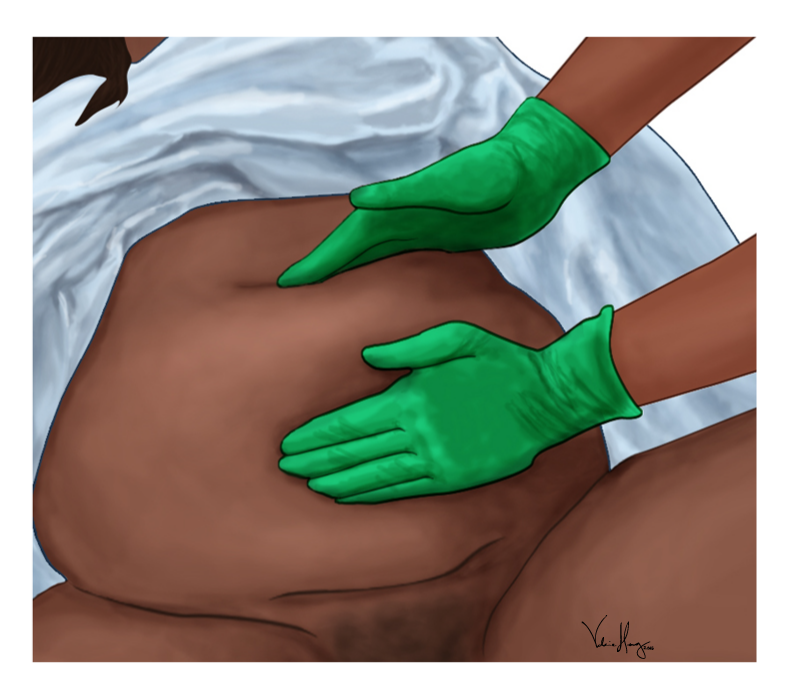
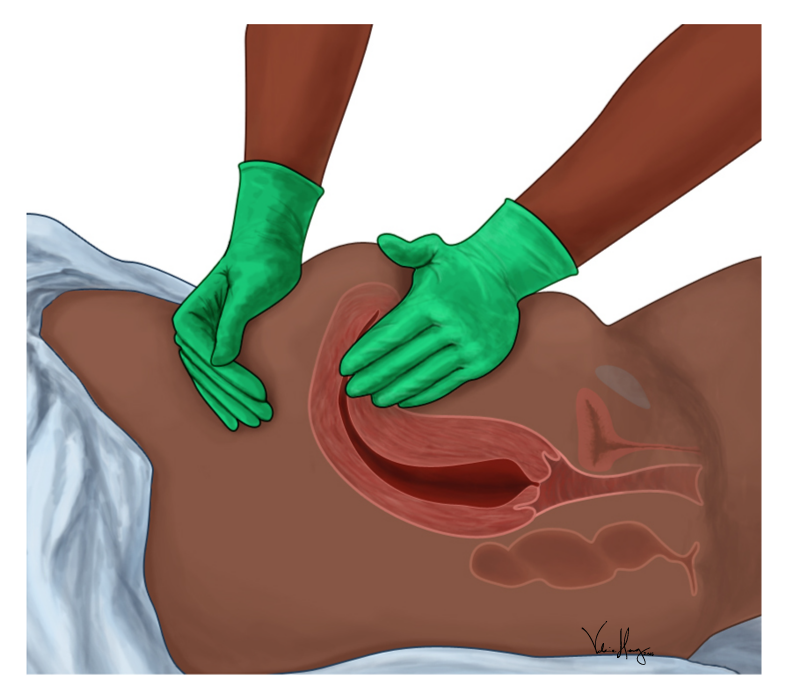
- Massage the uterus: massage the fundus through the lower abdomen until it is firm, then keep checking tone. Uterine massage is recommended for PPH treatment per WHO 2025 rec 26. Do not massage a fundus that protrudes through the cervix or vulva (inversion; see ALS Management).
- Measure blood loss: weigh pads and record the time and amount of each measurement. Use a calibrated drape if one is available.
- Oxygen: give oxygen to maintain SpO₂ and perfusion.
- Vital signs: check pulse, BP, mental status and skin perfusion at each intervention and frequently while bleeding.
- Do not delay transport for drugs or IV access that the crew cannot complete quickly. Continue massage in transit.
ALS Management
Doses vary by protocol; follow local protocols and medical direction. Tone and blood loss come first. Drugs and fluids run alongside, not after. Uterine inversion changes the order, so it's listed separately below.
- Oxytocin (Paramedic/RN/CCT): The first-line uterotonic, per WHO 2025 rec 24. IV: dilute the first dose and give it slowly over 1–2 minutes, or in crystalloid over 5–10 minutes, to avoid hypotension. Then the infusion: 10–40 units per 1,000 mL (label maximum 40 units per 1,000 mL), titrated to uterine tone. WHO 2025 describes a maintenance of 10–20 units over about 4 hours. Don't push it undiluted. IM: 10 units after delivery of the placenta when there is no IV access. The infusion dose is protocol-dependent. See Oxytocin
- Tranexamic acid (Paramedic/RN/CCT): 1 g IV over 10 minutes (IO per protocol), as soon as possible. The clock starts at birth, and ideally it goes in within 3 hours, because benefit falls with delay (WHO 2025 rec 27). Give a second 1 g if bleeding continues after 30 minutes or restarts within 24 hours of the first dose (max 2 g). See Tranexamic Acid
- Second-line uterotonics (Paramedic/RN/CCT, where protocol and medical direction allow): for bleeding that keeps going after oxytocin, WHO 2025 rec 25 lists IV ergometrine or a prostaglandin. US options: methylergonovine 0.2 mg IM, which may be repeated every 2–4 hours. Contraindicated in hypertension, toxemia (preeclampsia), pregnancy and hypersensitivity. It should not be given IV routinely, and it should not be co-administered with strong or moderate CYP3A4 inhibitors.
- Carboprost (Paramedic/RN/CCT, where protocol allows): carboprost (Hemabate) 250 mcg IM, repeated at 15–90 minute intervals to a maximum of 8 doses (2 mg), for atony that has not responded to conventional methods. Contraindicated with acute pelvic inflammatory disease and active cardiac, pulmonary, renal or hepatic disease. In asthma, the label says to use it cautiously. Carboprost can cause transient bronchoconstriction, so prefer another agent where one is available. Protocol-dependent.
- Misoprostol (Paramedic/RN/CCT, where protocol allows): 800 mcg sublingual if oxytocin is unavailable or the bleeding does not respond to it, per WHO 2025 rec 25. Know the label: US labeling is for NSAID-ulcer risk reduction. PPH use is off-label.
- Uterine massage and bimanual compression (Paramedic/RN/CCT): massage per WHO 2025 rec 26. When massage doesn't firm the uterus after vaginal birth, bimanual compression for atony buys time until definitive care, per WHO 2025 rec 33. Neither applies to an inverted uterus.
- Bladder and warmth: empty the bladder, catheterizing if needed. A full bladder can get in the way of uterine contraction. Keep the patient warm.
- IV access and fluids: Two large-bore IVs if you can get them. IO if IV fails (IO access). Isotonic crystalloid over colloid, per WHO 2025 rec 28. Volume and reassessment per protocol
- Blood products: The transfusion call rests on the underlying risk and on constant clinical and laboratory assessment, per WHO 2025 rec 41. WHO sets no product ratio. For massive hemorrhage, follow the local massive-hemorrhage protocol for balanced products. Where blood is carried or available, follow the blood transfusion protocol
- Uterine inversion, step 1 (Paramedic/RN/CCT): Suspect inversion when the fundus isn't palpable at the umbilicus with bleeding or shock, or when a mass sticks out of the vulva. Call early.
- Uterine inversion, step 2: Don't remove an attached placenta. Don't massage the protruding fundus. Hold oxytocin and other uterotonics until the uterus is replaced. Given before replacement, uterotonics can clamp the cervical ring down on the fundus and make replacement harder.
- Uterine inversion, step 3: Replace it immediately, ideally by the Johnson maneuver: the palm pushes the fundus up through the cervix toward the umbilicus, then the hand stays in place. Run IV access and volume or blood resuscitation in parallel.
- Uterine inversion, step 4: If replacement fails, give a uterine relaxant per protocol and OB direction: nitroglycerin (see Nitroglycerin) or terbutaline (see Terbutaline). The terbutaline label's boxed warning is against prolonged tocolysis. Single-dose use for inversion is per OB direction. Nitroglycerin can worsen hypotension in a volume-depleted patient, so give it only after volume resuscitation. Doses are protocol- and medical-direction dependent.
- Uterine inversion, step 5: Still not replaced? The obstetric team moves to general anesthesia and surgical repositioning (laparotomy, Huntington or Haultain technique).
- Uterine inversion, step 6: Once it's replaced, give oxytocin. Keep the hand in place until the uterus is firm.
- Monitoring: continuous ECG and SpO₂; BP and HR at each intervention; EtCO₂ if an advanced airway is placed
ED & ICU Management
- Bundle: The bundle is the standard. WHO 2025 recommends it for every PPH: uterine massage, an oxytocic, tranexamic acid, IV fluids, genital tract examination and escalation of care (rec 29)
- Refractory atony: Uterine atony is the leading underlying cause in 30–50% of refractory cases (WHO 2025 section 3.6). When it won't respond, bimanual or aortic compression and a non-pneumatic anti-shock garment buy time, per WHO 2025 rec 33–35. Uterine balloon tamponade (rec 36) is for refractory atony. It requires immediate access to surgery and blood products, exclusion of retained tissue or trauma, and trained staff. Gauze packing is not recommended (rec 37). For device choice, see the ACOG 2025 Clinical Practice Update on nonsurgical hemorrhage-control devices
- Massive hemorrhage: Activate the local massive-hemorrhage or obstetric hemorrhage protocol early. Keep the patient warm. Check fibrinogen, hemoglobin and platelets early. The WHO 2025 fibrinogen goal is 2 g/L or more, given as cryoprecipitate when low and where available
- Definitive measures: If other measures fail and resources are available, uterine artery embolization (rec 38). If bleeding does not stop, surgery (rec 39).
- Labs and replacement: repeat fibrinogen, hemoglobin, platelets and PT/INR per protocol. Fibrinogen replacement per the Fibrinogen page. Blood products per Blood Products
- Retained placenta: give a uterotonic only when PPH is present per WHO 2025 rec 30. Antibiotic prophylaxis for manual removal (rec 31)
- Rh-negative patient: give Rho(D) immune globulin per the Rho(D) Immune Globulin page
- Uterine inversion not replaced: Repositioning under general anesthesia with uterine relaxation, per the obstetric team (see ALS Management steps 4–5). Once repositioned, uterotonics and, if needed, intrauterine balloon tamponade, per the obstetric team.
- Consults: Call obstetrics, anesthesia and the blood bank early. Call interventional radiology if embolization is an option (rec 38).
Transport Considerations
- Destination: Go to the nearest facility with obstetric surgery, a blood bank and interventional radiology, once the patient is stable enough to travel. Uterine artery embolization and surgery depend on resources, per WHO 2025 rec 38–39.
- Continue in transit: uterine massage, the oxytocin infusion on a pump, IV fluids and monitoring. Keep tranexamic acid timing on the handoff
- Measured losses: carry the pads and record every measurement with the time
- Handoff essentials: time of birth, placenta delivered or not, measured blood loss and trend, each uterotonic and TXA dose with time, fluids given, vital-sign trend, and whether inversion was seen or replaced
- Equipment: pads or calibrated drape, IV and IO supplies, oxytocin, tranexamic acid, and misoprostol and NASG if protocol allows
Special Populations
- Pediatrics: Adolescent postpartum patients get adult PPH doses, per protocol. No pediatric weight-based adjustment applies to the mother on this page. The newborn is covered on the Neonatal Resuscitation page
- Pregnancy: A recently delivered patient who is bleeding within 24 hours is managed as PPH on this page. Oxytocin is the recommended uterotonic of choice for prevention in all births (WHO 2025 rec 10). Methylergonovine is contraindicated in pregnancy. Its label cites the uterotonic effect, so it is used only after delivery. WHO 2025 does not recommend ergometrine or methylergometrine for PPH prevention (rec 9.1)
- Hypertensive disorders: Preeclampsia and hypertension raise the risk of PPH, and the risk of harm from ergot alkaloids. Avoid methylergonovine. Use oxytocin, per the treatment order above.
- Patients on Anticoagulants: Anticoagulant exposure raises the bleeding risk. Reversal decisions follow the Anticoagulant Reversal reference and local protocol
Pitfalls & Safety Checks
- Error: Waiting for ACOG's 1,000 mL to start treatment is a mistake. WHO 2025 starts first-response treatment at 500 mL, or at 300 mL with an abnormal sign. Don't wait for 1,000 mL.
- Error: Giving drugs without massage. Uterine massage and oxytocin are first-line together. That's the bundle WHO recommends. The exception: an inverted uterus is not massaged
- Error: Mixing up oxytocin units and milliunits, or giving it undiluted as an IV push. The PPH dose is in units (10 units IM, or 10–40 units in 1,000 mL). The labor infusion runs in milliunits per minute. Dilute it and give it slowly
- Error: Giving methylergonovine to a hypertensive patient. It's contraindicated in hypertension and toxemia. Use oxytocin, and reach for carboprost or misoprostol only per protocol.
- Error: Giving tranexamic acid for prevention. WHO 2025 doesn't recommend TXA for prevention at vaginal or cesarean birth. It's for treating established PPH, as soon as possible and ideally within 3 hours of birth
- Error: Missing an inversion, or treating it as ordinary atony. If the fundus isn't palpable at the umbilicus with shock, check for inversion at once. Once you find one, don't massage, don't give uterotonics, and don't remove an attached placenta until the uterus is replaced
- Error: Packing the uterus with gauze. WHO 2025 doesn't recommend it for PPH (rec 37)
- Error: Stopping at first-line measures while bleeding continues. Escalate early under the bundle (rec 29)
Clinical Pearls
References
- World Health Organization, International Federation of Gynecology and Obstetrics, and International Confederation of Midwives. Consolidated guidelines for the prevention, diagnosis and treatment of postpartum haemorrhage. Geneva: World Health Organization; 2025. https://iris.who.int/handle/10665/382923
- American College of Obstetricians and Gynecologists. ACOG Clinical Practice Update: Use of nonsurgical hemorrhage-control devices for postpartum hemorrhage management. Obstet Gynecol. 2025;146:569–571. https://doi.org/10.1097/aog.0000000000006024
- American College of Obstetricians and Gynecologists. Practice Bulletin No. 183: Postpartum hemorrhage. Obstet Gynecol. 2017;130:e168–e186. https://doi.org/10.1097/AOG.0000000000002351
- WOMAN Trial Collaborators. Effect of early tranexamic acid administration on mortality, hysterectomy, and other morbidities in women with post-partum haemorrhage (WOMAN): an international, randomised, double-blind, placebo-controlled trial. Lancet. 2017;389:2105–2116. https://doi.org/10.1016/S0140-6736(17)30638-4 (landmark trial)
- Pitocin (oxytocin) injection, USP: prescribing information. PAR Health USA. DailyMed; label dated May 2026. https://dailymed.nlm.nih.gov/dailymed/drugInfo.cfm?setid=6e5a66fc-e507-497c-b5ce-44a8c95898ad
- Methylergonovine maleate injection, USP: prescribing information. Breckenridge Pharmaceutical. DailyMed; label dated September 2025. https://dailymed.nlm.nih.gov/dailymed/drugInfo.cfm?setid=8bccff44-2a39-400a-b8a4-2eb5249fdbc8
- Hemabate (carboprost tromethamine) injection: prescribing information. Pharmacia & Upjohn. DailyMed; label dated March 2026. https://dailymed.nlm.nih.gov/dailymed/drugInfo.cfm?setid=3d282998-ff0c-480a-bd80-155606ef0a65
- Pararajasingam SS, Tsen LC, Onwochei DN. Uterine inversion. BJA Education. 2024;24:109–112. https://doi.org/10.1016/j.bjae.2024.01.004
- Kodama A, Chigusa Y, Yamanishi Y, Korenaga A, Sakura Y, Mogami H, Mandai M, Yoshida T. Ischemic pancreatitis following uterine inversion and severe postpartum hemorrhage: a case report and review of the literature. Case Rep Womens Health. 2025. https://doi.org/10.1016/j.crwh.2025.e00741
- Gallos I, Devall A, Martin J, et al. Randomized trial of early detection and treatment of postpartum hemorrhage (E-MOTIVE). N Engl J Med. 2023;389:11–21. https://doi.org/10.1056/NEJMoa2303966
Medical Disclaimer
- For Educational Purposes Only: This content is intended for educational reference and should not be used for clinical decision-making.
- Not a Substitute for Professional Judgment: Always consult your local protocols, institutional guidelines, and supervising physicians.
- Verify Before Acting: Users are responsible for verifying information through authoritative sources before any clinical application.