

Bedside Snapshot
- Indications
- A drug ordered or protocol-directed IV as a push, piggyback or infusion
- A drug whose labeled route is IV and that needs a fast onset
- Titrated therapy that needs a pump and a continuous rate
- Contraindications / Abort
- Never push potassium chloride concentrate
- Stop: swelling, pain or coolness at the site (possible infiltration)
- Stop: unverified drug, concentration or dose, or an unclear order
- Stop: a Y-site partner not checked for compatibility
- Critical Steps
- Check the label, calculate the dose in mg and mL, and get a second check for high-alert drugs
- Flush, confirm free flow, then push at the labeled rate
- Flush after every push; connect piggybacks at the Y-site
- Program the pump and compare the screen with the order
- Confirm & Monitor
- Free flow, and no swelling, pain or blanching at the site
- Pump rate and volume match the order at every check
- Blood pressure, rhythm and SpO₂ as the drug requires
- Continuous sets: 96 h to 7 days; propofol 6–12 h (CDC)
Key Numbers
IV medication errors are fast and often silent. Check every drug, push at the labeled rate, and flush before and after each dose.
| Parameter | Value |
|---|---|
| Push rate | Per the drug label and protocol. Fosphenytoin: 150 mg PE/min maximum in adults (boxed warning). Lorazepam for status epilepticus: 2 mg/min |
| Flush | Saline before and after each push, unless the label names another solution. Volume per agency policy; the flush must clear the catheter and extension set. Adenosine: a rapid saline flush follows the bolus (label) |
| Potassium chloride concentrate | Never push. Dilute every potassium dose and give it by pump (ISMP alert, 2021) |
| Continuous administration set | Including secondary sets: no more often than every 96 hours, and at least every 7 days (CDC 2011, Category IA). CDC makes no recommendation for intermittently used sets; follow agency policy |
| Blood, blood products, fat emulsions | Replace tubing within 24 hours of starting the infusion, including fat emulsions infused alone or as a 3-in-1 admixture (CDC 2011, Category IB) |
| Propofol | Replace tubing every 6 or 12 hours, per manufacturer, when the vial is changed (CDC 2011, Category IA) |
| Needleless connector | Change at least as often as the administration set. No benefit to changing more often than every 72 hours (CDC 2011, Category II) |
| Access port | Scrub with chlorhexidine, povidone-iodine, an iodophor or 70% alcohol before each access. CDC 2011 guideline, Category IA |
| Extravasation: norepinephrine | Phentolamine 5–10 mg in 10 mL saline, injected into the area within 12 hours (label) |
| Pediatric doses | Weight-based: mg/kg with the adult maximum checked; second-person verification |
Overview & Principles
IV medication administration puts a drug into the bloodstream through a catheter that is already in place. Three forms are in common use. A push is a measured bolus by syringe. A piggyback is an intermittent bag on a secondary set. A continuous infusion is a bag or syringe run on a pump. Each form has its own rate, dilution and monitoring rules. The drug label and local protocol set them. Catheter placement is covered on the IV insertion page.
How It Works
- Push: one dose, delivered over seconds to minutes. Rate is the control here. It limits the peak effect and many adverse effects.
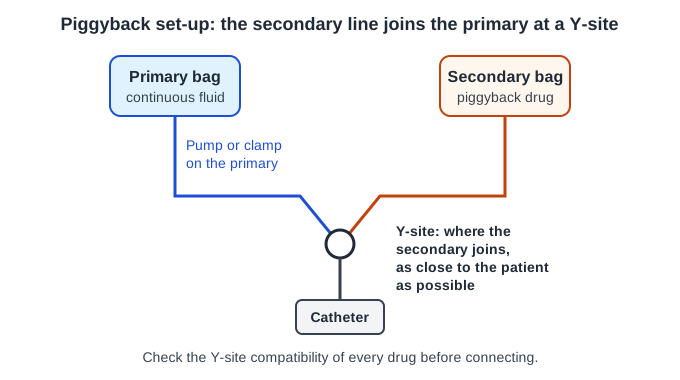
- Piggyback: a secondary bag joins the primary line at a Y-site, close to the catheter. It runs for a set time.
- Infusion: the pump holds a set rate in mL/hr. That is how you titrate vasoactive, sedative and antiarrhythmic agents.
- Volume and concentration: dilution sets the rate and the amount per mL. Get the concentration wrong and you have made a dose error.
Where It Fits
Confirm the line is patent and the site is clear first. Then give the drug, and not before. If IV access fails and the patient needs drugs now, the protocol may call for intraosseous access (see Intraosseous Access). Drip-rate arithmetic for gravity sets is in the infusion calculations reference.
Indications & Contraindications
Indications
- A drug ordered or protocol-directed by the IV route, as a push, a piggyback or a continuous infusion
- A drug whose labeled route is IV and that needs fast onset
- Titrated therapy that needs a pump and a continuous rate
Absolute Contraindications
- A product not labeled for IV use, or a drug whose label restricts it to another route (check the label)
- Undiluted potassium chloride concentrate, or any potassium product given as a push
- An unverified drug, concentration or dose: stop and clarify the order before giving anything
Relative Contraindications & Cautions
- A site with infiltration, phlebitis, burn or infection: choose another site or route
- A vesicant or osmotic drug through a peripheral line: confirm the site and the protocol before starting
- Hypotension, bradycardia, arrhythmia or sedation: slow the rate and reassess before the next dose
- An arm with an AV fistula or graft: do not use it (see the IV insertion page)
Consider an Alternative
- Intraosseous access when IV access fails or is impractical (Intraosseous Access)
- A different route when the label allows it and the clinical need is not immediate; confirm with the order
Scope & Team Roles
| Provider Level | Typical Role | Notes |
|---|---|---|
| EMT | Not in scope | Monitors and reports; does not give IV medications. State rules govern |
| AEMT | Performs (protocol/credentialing required) | A limited IV drug list by state and protocol; pump use per agency policy |
| Paramedic | Performs | Drug list and rates per protocol; push, piggyback and infusions |
| RN (ED/ICU) | Performs | Per hospital policy; second-person check for high-alert drugs |
| Critical Care Transport (CFRN / CCP-C / FP-C) | Performs | Infusion management during transport per program policy |
| Physician / APP | Performs | Selects the drug and rate; gives or supervises per setting |
Team Roles During the Procedure
- Medication clinician: draws up, labels and gives the drug
- Checker: verifies drug, concentration, dose, rate and patient independently
- Monitor: watches rhythm, blood pressure, SpO₂ and the site during and after the dose
- Recorder: documents drug, dose, route, rate, time and response
Pre-Procedure Assessment
Medication Checks
- Identity and order: patient identifiers, drug name on the label, and the order or protocol step
- Dose and concentration: dose in mg and mL, the concentration, and the weight used for weight-based doses
- Route and rate: IV route on the label, the labeled push time or the pump rate
- Compatibility and timing: compatible diluent, any Y-site partner, and the time of the last dose of the same drug
Read the label at the bedside. Not from memory. Where a drug comes in more than one strength, say the strength out loud before you draw up.
Physiologic Risk
Get a baseline before any sedative, opioid, antiarrhythmic or vasoactive drug: blood pressure, heart rate, rhythm, SpO₂ and level of consciousness. Hypotension, bradycardia and respiratory depression change how fast a push can safely go. Hold or slow the drug, then reassess per protocol.
Site / Device Check
- Flush the line: free flow with no resistance
- Look at the site: no swelling, pain, coolness or blanching
- Check the catheter and set dates, and the dressing
Equipment & Preparation
Equipment
| Item | Size / Spec | Notes |
|---|---|---|
| Syringes | Luer-lock, sized to the dose volume | Use the smallest syringe that holds the full dose; label every syringe |
| Saline flush | 0.9% sodium chloride, prefilled or drawn up | Flush before and after each push, unless the label names another solution |
| Primary IV set | Continuous set with drip chamber | Change per policy: CDC continuous-set interval, 96 hours to 7 days |
| Secondary (piggyback) set | Matched to the secondary bag and to the Y-site or piggyback port | Continuous sets: 96 hours to 7 days (CDC). Intermittent sets: no CDC interval; follow agency policy |
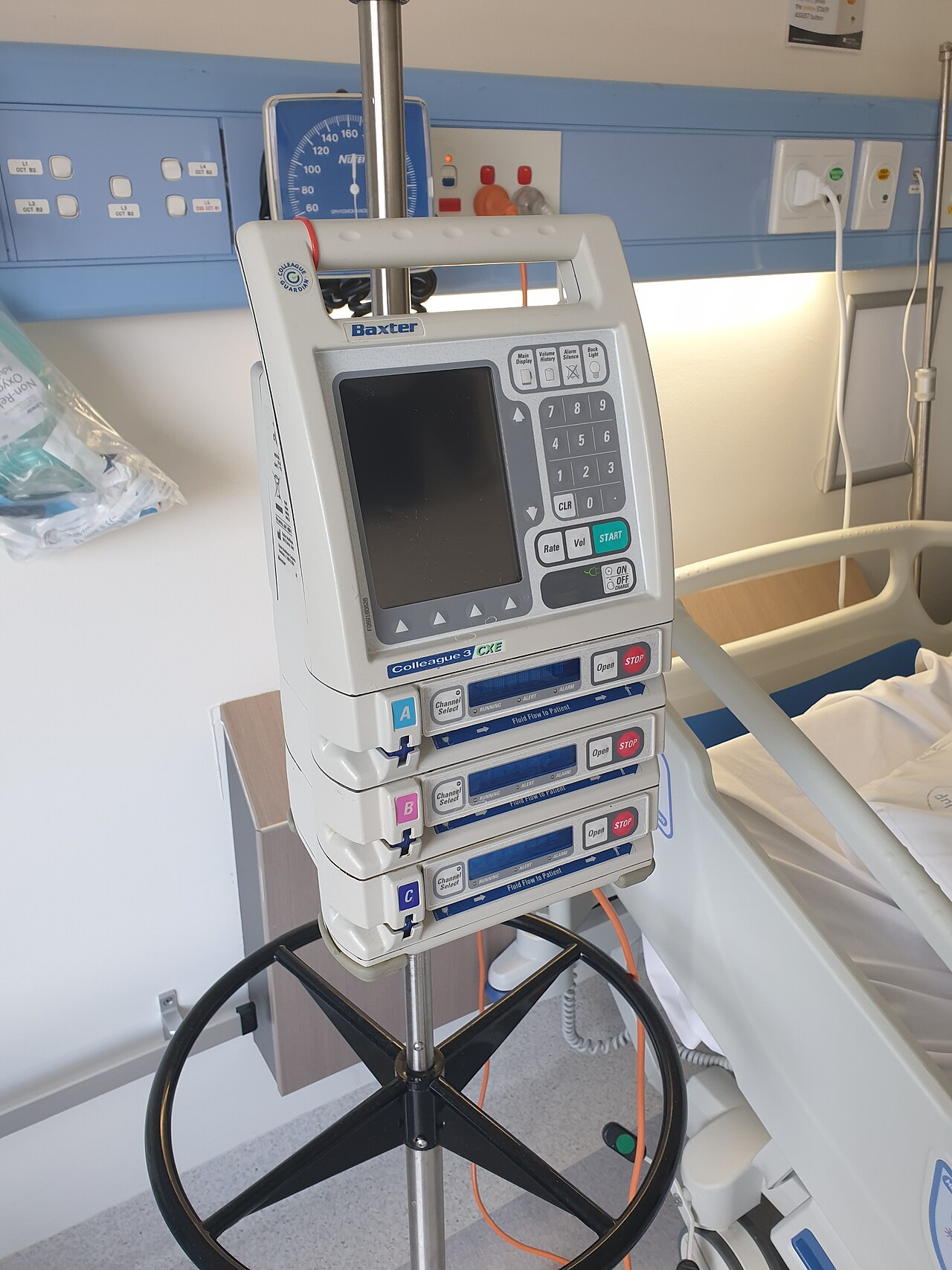
| Infusion pump | Volumetric pump, with a drug library if the agency has one | Check battery, power and alarms before the patient moves |
| Needleless connectors | Per agency standard | Change at least as often as the administration set; no benefit to changing more often than every 72 hours (CDC) |
| Antiseptic | Chlorhexidine, povidone-iodine, an iodophor or 70% alcohol | Scrub the access port before each access |
| Label-specific supplies | In-line filter or diluent, where the label requires one | Check the label before you connect |
Sizing
Find the weight in kilograms on the order before you touch the calculator. Weight-based drugs cannot be dosed without that number. Pediatric equipment sizes are on the equipment sizing page. Weight-based dosing is on the weight-based dosing page.
Pre-Medication Checklist
- Confirm the order, the patient's identity and the allergies
- Check the drug, strength, dose and IV route against the label
- Calculate the dose in mg and mL. Write down the weight you used
- Check potassium products for concentration and dilution before you draw up
- Confirm the line is patent and the site is clear
- Program the pump and check it against the order. Use a second person for high-alert drugs
- Check any Y-site partner for compatibility before you connect
Medications & Settings
These doses are typical adult and pediatric references. Check them against local protocol and the current drug label. Doses vary by protocol; follow local protocols and medical direction.
| Drug | Adult | Pediatric | Notes |
|---|---|---|---|
| Adenosine (SVT) | 6 mg rapid IV bolus over 1–2 seconds. If the rhythm does not convert in 1–2 minutes, 12 mg, which may be repeated a second time (label). Central venous use is not systematically studied (label). See the adenosine page | Under 50 kg: 0.05–0.1 mg/kg rapid IV bolus, central or peripheral, then a saline flush. If no conversion in 1–2 minutes, increase by 0.05–0.1 mg/kg per attempt; maximum single dose 0.3 mg/kg. 50 kg or more: adult dose (label) | Give as close to the patient as possible. Flush after every bolus. No dose above 12 mg for any patient (label) |
| Fosphenytoin | Rate: 150 mg PE/min maximum | 2 mg PE/kg/min or 150 mg PE/min, whichever is slower | Boxed warning: cardiovascular risk with rapid infusion (hypotension and arrhythmias). Watch BP and rhythm during the infusion |
| Norepinephrine (extravasation) | Phentolamine 5–10 mg in 10 mL saline, injected into the area of extravasation within 12 hours (label). See the norepinephrine page | No pediatric extravasation dose on the label; use pharmacy and medical direction | High-alert Prevention: 10 mg phentolamine added to each liter of norepinephrine (label). Phentolamine is contraindicated with myocardial infarction, coronary insufficiency or angina (label) |
| Potassium chloride (concentrate) | Never pushed; dilute and give by pump only. See the potassium chloride page | Never pushed; weight-based dose per protocol, diluted | High-alert Concentrate must be diluted before use |
Push rates for other common IV drugs live on their medication pages. That includes lorazepam, ondansetron, diazepam, midazolam and amiodarone. Check the label on each page before you give the drug.
Piggyback (Secondary) Infusions
- Y-site compatibility: check each drug pair with a current institutional compatibility reference before connecting
- Order and timing: follow the order or protocol on whether the primary is paused, stopped or kept running during the piggyback
- Set changes: continuous secondary sets change no more often than every 96 hours and at least every 7 days (CDC 2011 guideline, Category IA). Intermittent sets: CDC gives no interval; follow agency policy. Blood, blood products and fat emulsions: within 24 hours. Propofol tubing: every 6 or 12 hours
- Flush: flush the secondary line before and after the drug, per agency policy
Continuous Infusions and Pump Programming
- Calculate first: convert the order into the pump rate in mL/hr. Say whether the rate is weight-based (mcg/kg/min, for example)
- Program and check: enter the drug, concentration, rate and volume, then compare the screen with the order before you start
- Use the drug library and limits: where the pump has a drug library, select the drug. Its dose limits then flag out-of-range entries.
- Gravity sets: drops per minute = mL per hour × drop factor ÷ 60. Use the drop factor printed on the set package
- Verify every rate change: a second person checks the new rate, and the change is recorded
Step-by-Step Procedure
Phase 1: Prepare
- Confirm the order and the patient: identity, drug, dose, route, rate and indication match the order or protocol.
- Read the label: confirm the strength, the diluent, the IV route, any rate limit and any boxed warning.
- Calculate and draw up: state the dose in mg and mL and the weight used. Label the syringe or bag at the bedside.
- Get the second check: for high-alert drugs, a second clinician verifies drug, dose, concentration and rate.
Phase 2: Perform
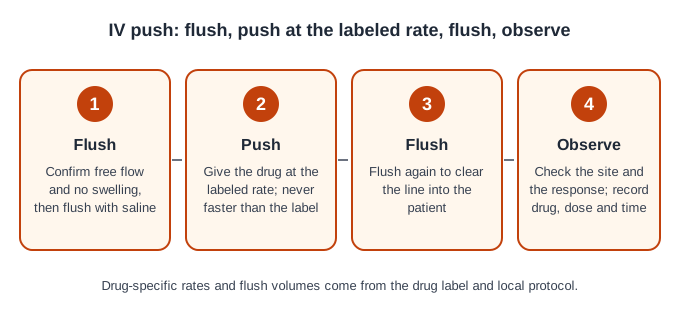
- Check the line and site: free flow, and no swelling, pain or coolness.
- Flush the line: a saline flush confirms patency before the drug.
- Give the push at the labeled rate: push over the labeled time. Watch the site and the patient during the push; stop for pain, swelling, flushing, hypotension or a new arrhythmia.
- Flush after the drug: give the saline flush the label or protocol requires, unless the label names another solution. Adenosine is followed by a rapid saline flush (label).
- Start the piggyback or pump: connect the secondary at the Y-site after the compatibility check. Start the pump and confirm the screen matches the order.
Phase 3: Confirm & Monitor
- Watch the site and the patient: check the site and vital signs at the times the drug and protocol require.
- Document: drug, strength, dose, route, rate, start and stop times, pump settings, site, flushes and response.
- Reassess at every move and handoff: confirm the pump, the rate, the site and the set dates.
Confirmation & Monitoring
Primary Confirmation
Before the drug, a saline flush runs freely and the site is clear. Through the push and the infusion, the site stays free of swelling, pain, coolness and blanching. The pump shows the programmed rate the whole time.
Secondary Confirmation
- Pump screen matches the order: drug, concentration, rate and volume remaining
- Patient response matches the expected effect of the drug, such as the rhythm after an antiarrhythmic
- The flush runs without resistance after each dose
| Finding | Success | Failure / Malposition |
|---|---|---|
| Flush | Free flow, no resistance | Resistance, pain or swelling: stop; possible malposition or occlusion |
| Site | No swelling, pain, coolness or blanching | Swelling, pain, coolness or blanching: possible extravasation |
| Pump | Rate and volume match the order | Mismatch: stop, verify the order and reprogram |
| Patient | Expected effect; no new arrhythmia or hypotension | Adverse effect: stop the drug and treat per protocol |
Ongoing Monitoring
- During a push: site and patient continuously, with blood pressure and rhythm as the drug requires
- Continuous infusions: site, rate and volume at the interval your protocol sets, and at every move
- Set changes: record the date and time of each change; use the CDC schedule
- Sedatives and opioids: sedation score and respiratory rate per protocol
Troubleshooting
| Problem | Likely Cause | Fix |
|---|---|---|
| Resistance on flush | Clot, kink, closed clamp, or catheter against the vein wall | Stop. Check clamps and kinks, reposition the arm, and do not force the flush. Replace the catheter per policy if still blocked |
| Swelling or pain during push | Infiltration or extravasation | Stop the push. Leave the catheter in place, aspirate residual drug, and do not flush. Start the extravasation steps in Complications |
| Pump occlusion alarm | Kink, closed clamp or blocked catheter | Find and clear the cause, then check the site. Do not silence and ignore the alarm |
| Pump air-in-line alarm | Air in the set, or an empty bag | Clear per the pump manual; prime or replace the set per policy |
| Pump rate or volume does not match the order | Programming error, wrong concentration or a drop-factor error | Stop the infusion, verify the order and the concentration, reprogram, and have a second person check |
| Flushing, hypotension or new arrhythmia during a push | Rate too fast, or a known drug effect | Stop the push, monitor, treat per protocol, and document the time and dose |
| Cloudiness, particles or precipitate | Incompatibility or contamination | Do not give. Discard the drug and the line, and check the compatibility reference |
Complications
| Complication | Recognition | Prevention | Management |
|---|---|---|---|
| Immediate: extravasation | Swelling, pain, blanching or coolness at the site | Check the site before and during the infusion. Know whether the drug is a vesicant or an osmotic agent | Stop the infusion. Aspirate residual drug through the catheter, leave it in place, and do not flush. Start the extravasation steps below. For norepinephrine, phentolamine into the area within 12 hours (label) |
| Immediate: rapid-push effects | Arrhythmia, hypotension, flushing or chest pain | Push at the labeled rate; stop if symptoms start | Stop the push, monitor the rhythm and BP, and treat per protocol |
| Immediate: air embolism | Sudden dyspnea, chest pain, hypotension or arrhythmia during the infusion | Purge air from every set before connecting; check pump and gravity sets for air | Stop the infusion, call for help, give high-flow oxygen, and treat per protocol |
| Immediate: allergy or anaphylaxis | Rash, wheeze, angioedema or hypotension | Confirm allergies before the first dose; observe closely after it | Stop the infusion and treat per anaphylaxis protocol |
| Delayed: phlebitis | Redness, warmth, pain, or a palpable cord along the vein | Use the catheter and set-change schedule; dilute as the label says | Stop the line, remove the catheter, and re-site per protocol |
| Delayed: line infection | Fever, purulence or redness at the site; signs of bloodstream infection | Scrub each access port with an antiseptic; change sets and connectors on schedule | Remove the catheter per protocol and obtain cultures per protocol |
| Rare: drug-line incompatibility | Cloudiness, precipitate or unexpected loss of effect | Check each Y-site pair before connecting | Stop, discard the drug and line, and document the event |
Extravasation: First Response
- Stop: stop the infusion or push at once. Do not flush the line.
- Aspirate: leave the catheter in place and aspirate residual drug through it before removal.
- Remove and elevate: remove the catheter and elevate the limb.
- Compress: apply warm or cold compresses according to the agent, per protocol.
- Mark and document: mark the borders of the swelling, photograph it if policy allows, and record the agent, volume, time and steps taken.
- Escalate early: notify the provider and pharmacy at once, especially for vasopressors, vesicants and large volumes.
Antidotes by agent group
- Vasopressors (norepinephrine): phentolamine into the area within 12 hours (label). Contraindicated with myocardial infarction, coronary insufficiency or angina (label). Terbutaline is an alternative when phentolamine is in short supply
- Hyperosmolar or pH-related agents, such as hypertonic saline: hyaluronidase to aid absorption and dispersion, per the 2023 Stefanos review
- Other agents: no specific antidote is named in the 2023 review; supportive care and early protocolized referral, including surgical referral when needed
Concentrated potassium pushed by mistake
- Stop: stop the push. Do not flush the concentrate into the patient. The catheter still holds concentrate, so use a second access for treatment if one can be placed quickly.
- Alert: call for help, and call poison control and pharmacy.
- Monitor and test: continuous rhythm monitoring with a defibrillator ready. Obtain a 12-lead ECG and a stat serum potassium.
- Treat hyperkalemia: for ECG changes, arrhythmia or arrest, give IV calcium (calcium chloride or gluconate) per protocol. Calcium stabilizes the cardiac membrane but does not lower potassium. Then, per protocol, consider insulin with dextrose, nebulized albuterol, or sodium bicarbonate as adjuncts, per protocol. Links: calcium chloride, calcium gluconate, insulin, albuterol, sodium bicarbonate.
- Arrest: follow ACLS or PALS (2025 AHA, Part 9) for the arrest, and give calcium as above.
- Document: the drug, the amount, the concentration, the time, the rhythm, and each treatment given.
Special Populations
Pediatrics
- Weight-based: calculate every dose in mg/kg, check the adult maximum on the label, and have a second person verify
- Rates: pediatric labels often cap the rate in mg/kg/min or mg/min. The slower limit wins
- Concentration: pediatric volumes are small. One dilution error turns straight into a dose error. Write the concentration on the syringe
- Related pages: Weight-Based Dosing, Equipment Sizing, Vascular Access in Children
Pregnancy
- Check the label's pregnancy section for each drug before giving it. Adenosine label: use during pregnancy only if clearly needed
- Fosphenytoin: pregnancy lowers phenytoin levels. The label advises periodic serum concentration checks
Neonates
- The adenosine label dosed neonates by weight, the same as children. Calculate every dose in mg/kg and verify the concentration
Older Adults
- Start sedatives and antihypertensives at the low end of the label or protocol range, and check age-based dosing on the label
- Fragile veins and thin skin make infiltration more likely. Check the site more often
Renal and Hepatic Impairment
- Check the label for dose changes in renal or hepatic impairment before the dose
- Reduced clearance raises the risk of accumulation and of rate-related effects. Slow the rate and reassess
Dialysis Patients
- Do not give IV medications through, or place lines in, an arm with an AV fistula or graft (see the IV insertion page)
Physiologically Difficult
- Shock and low-flow states: slow the push, use the smallest effective volume, and check blood pressure before each dose
- Obesity: follow the label for the weight basis (total, ideal or lean) and the protocol for dosing
Post-Procedure Care & Transport
Immediate Aftercare
- Recheck the site, the flush and the pump settings after the dose
- Document the response and any change to the plan
Ongoing Maintenance
- Continuous administration sets, including secondary sets: no more often than every 96 hours and at least every 7 days, per the CDC 2011 guideline. Intermittent sets: follow agency policy, as CDC gives no interval
- Blood, blood products and fat emulsions: within 24 hours. Propofol tubing: every 6 or 12 hours, per the CDC 2011 guideline
- Needleless connectors: at least as often as the administration set; no benefit to changing more often than every 72 hours, per the CDC 2011 guideline
- Scrub each access port with an antiseptic before access
Transport Considerations
- Secure pumps and lines. Check for kinks and disconnections after every move
- Confirm pump power and battery before you leave
- Reassess the site and the rate after every move and handoff
Document & Hand Off
- Drug, strength, dose, route and time given
- Pump program: rate, volume and volume infused
- Site, flushes and set dates
- Response, adverse effects and any extravasation
- Next due dose or next check
Clinical Pearls & Pitfalls
Pearls
- Read the label each time: rates and maximums are drug-specific. They change from one label to the next
- Flush before and after: the flush confirms the line is open and clears the drug out of the catheter
- Rate is a safety control: many adverse effects come from giving the drug too fast. The fosphenytoin boxed warning shows exactly that
- Peripheral vasopressors: recent reviews report low risk of harm when vasopressors start peripherally. The site still needs close watch
- Vesicant patterns: acidic agents such as promethazine, amiodarone and vancomycin can cause edema, sloughing and necrosis. So can basic agents such as phenytoin and acyclovir
Common Pitfalls
- Pushing fast because the patient is crashing → push at the labeled rate. The drug's own limit wins
- A concentrate pushed as if it were diluted → read the concentration aloud and dilute every potassium dose
- A gravity set with the wrong drop factor → use the factor printed on that package
- A free flush taken as proof the drug is in the vein → check the site throughout
- An unchecked Y-site partner → check each pair before connecting
Education & Skill Maintenance
Skill Maintenance
- Practice IV pushes, piggyback set-up and pump programming in simulation, using a checklist
- Drill label reading and weight-based calculations at the frequency your agency requires
- Debrief medication errors and near misses with the same checklist
- Practice recognizing extravasation signs on a simulation arm or model
References
- ECRI and Institute for Safe Medication Practices (ISMP). ISMP List of High-Alert Medications in Acute Care Settings. ECRI; 2024. https://home.ecri.org/blogs/guidance-insights-tools/high-alert-medications-in-acute-care-settings
- Institute for Safe Medication Practices. Administration of concentrated potassium chloride for injection during a code: still deadly! ISMP Medication Safety Alert! Acute Care. June 3, 2021;26(11). Summary and link via AHRQ PSNet. https://psnet.ahrq.gov/issue/administration-concentrated-potassium-chloride-injection-during-code-still-deadly
- O'Grady NP, Alexander M, Burns LA, et al. Guidelines for the Prevention of Intravascular Catheter-Related Infections, 2011. Centers for Disease Control and Prevention; last updated October 2017. https://www.cdc.gov/infection-control/media/pdfs/Guideline-BSI-H.pdf
- Stefanos SS, Kiser TH, MacLaren R, Mueller SW, Reynolds PM. Management of noncytotoxic extravasation injuries: a focused update on medications, treatment strategies, and peripheral administration of vasopressors and hypertonic saline. Pharmacotherapy. 2023;43(4):321–337. https://doi.org/10.1002/phar.2794
- Hikma Pharmaceuticals USA Inc. Phentolamine Mesylate for Injection, USP: prescribing information. DailyMed; label effective March 13, 2024. https://dailymed.nlm.nih.gov/dailymed/drugInfo.cfm?setid=ed6c506c-5535-4b7c-ae1a-d63f09d796c9
- Pfizer Laboratories Div Pfizer Inc. Cerebyx (fosphenytoin sodium) injection: prescribing information. DailyMed; label effective August 28, 2025. https://dailymed.nlm.nih.gov/dailymed/drugInfo.cfm?setid=d4c36fad-0ba2-4cd4-9c5e-dcf843f38a5a
- Sagent Pharmaceuticals. Adenosine Injection, USP for rapid bolus intravenous use: prescribing information. DailyMed; label effective July 27, 2026. https://dailymed.nlm.nih.gov/dailymed/drugInfo.cfm?setid=546642f2-662f-46cf-9d82-5bb3bdcc7677
- American Heart Association. Part 9: Adult Advanced Life Support: 2025 American Heart Association Guidelines for Cardiopulmonary Resuscitation and Emergency Cardiovascular Care. Circulation. 2025;152:S538–S577. https://doi.org/10.1161/cir.0000000000001376
Medical Disclaimer
- For Educational Purposes Only: This content is intended for educational reference and should not be used for clinical decision-making.
- Not a Substitute for Professional Judgment: Always consult your local protocols, institutional guidelines, and supervising physicians.
- Verify Before Acting: Users are responsible for verifying information through authoritative sources before any clinical application.