

Bedside Snapshot
- Recognize
- Rapid rhythm with a pulse. Sort by QRS width (narrow <0.12 s, wide ≥0.12 s) and by regularity (regular or irregular).
- Red Flags
- Hypotension, altered mental status, ischemic chest pain, acute heart failure or shock: unstable, cardiovert now. Wide QRS: treat as VT until proven otherwise.
- First Actions
- Monitor, 12-lead ECG, IV/IO access, oxygen if hypoxic; unstable: synchronized cardioversion; stable: vagal maneuver, then drug by rhythm (see ALS).
- Key Doses
- Adenosine 6 mg IV push, then 12 mg (max 12 mg/dose); diltiazem 0.25 mg/kg IV over 2 min; amiodarone 150 mg IV over 10 min (stable wide-QRS VT).
- Don't Miss
- No pulse means cardiac arrest, not tachycardia. Pre-excited AF (WPW): AV-nodal blockers, including adenosine and amiodarone, can cause a life-threatening fast rate with hypotension.
- Escalate & Transport
- Unstable or refractory: synchronized cardioversion, then antiarrhythmic and expert consult. Transport to a monitored ED or cardiology-capable center; ICU for infusions or shock.
Definition & Pathophysiology
Tachycardia with a pulse is a rapid rhythm, and the pulse check tells you it is perfusing the patient. Sort it by QRS width first and regularity second. The width sets the pathway: wide is treated as ventricular until proven otherwise.
- Narrow-complex tachycardia (QRS <0.12 s): The impulse starts above the ventricles. Examples are AV-nodal re-entrant tachycardia (AVNRT), AV re-entrant tachycardia through an accessory pathway (AVRT, including Wolff-Parkinson-White [WPW] syndrome), atrial flutter, atrial fibrillation (AF), and sinus or atrial tachycardia.
- Wide-complex tachycardia (QRS ≥0.12 s): Usually ventricular tachycardia (VT). It can also be supraventricular conduction with aberrancy, or AF in a patient with a pre-excitation pathway.
- Mechanism: AVNRT and AVRT are re-entry circuits. A drug that slows the AV node or a pathway can break them. AF is chaotic atrial activation. The ventricular rate depends on how much of it the AV node conducts.
- Course: Many episodes stop on their own or respond to vagal maneuvers. Unstable tachycardia, pre-excited AF and sustained wide-complex rhythms can get worse fast, into shock or ventricular fibrillation.
This page is about the rhythm. The triggers are sepsis, pain, bleeding, hypoxia, electrolytes and ischemia. Treat the cause alongside the rhythm.
Recognition & Red Flags
Presentations
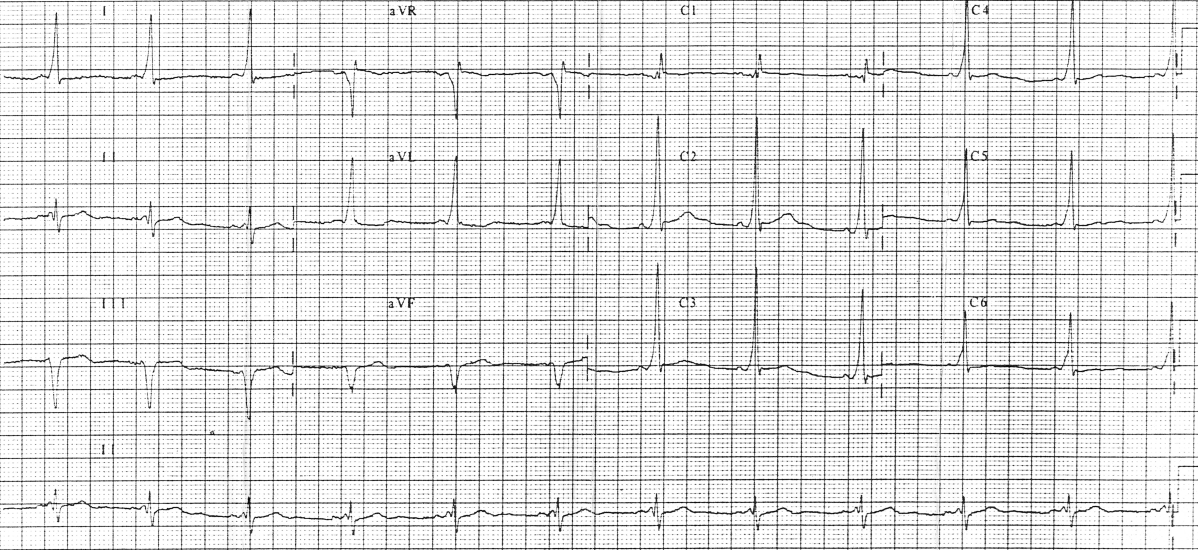
- Narrow and regular: Sudden start, sudden stop, often with palpitations, dizziness or chest discomfort. Usually AVNRT or AVRT. Atrial flutter can also look regular.
- Narrow and irregular: AF with rapid ventricular response (RVR). Look for pre-excitation, and find out how long the AF has been going.
- Wide and regular: Monomorphic VT until proven otherwise. The main alternative is SVT with aberrancy.
- Wide and irregular: Polymorphic VT, or AF with pre-excitation. The second one is a dangerous mimic of VT.
Red Flags
- Hypotension or systolic pressure falling with the rate
- Altered mental status, syncope or near-syncope
- Ischemic-type chest pain or dyspnea with pulmonary edema
- Signs of shock: cool, mottled skin, weak pulse, poor capillary refill
- QRS ≥0.12 s, or an irregular wide-complex rhythm (pre-excited AF until proven otherwise)
Assessment & Diagnostics
The first minute decides the pathway. Stable or unstable comes first, then QRS width and regularity. Each row below tells you what to do.
| Check | Why | Act If |
|---|---|---|
| Pulse, BP, mentation, chest pain | Stability sets the pathway | Hypotension, altered mentation, ischemic chest pain, shock or acute heart failure: unstable pathway, synchronized cardioversion |
| 12-lead ECG | QRS width, regularity, PR interval, delta waves | QRS ≥0.12 s: wide-complex pathway. Irregular with delta waves: pre-excited AF. See SVT ECG patterns and wide-complex tachycardia. |
| Ejection fraction or heart failure history | Calcium channel blockers are unsafe with reduced function | EF ≤40% or decompensated heart failure: no IV diltiazem or verapamil |
| SpO₂, lung sounds | Hypoxia and pulmonary edema change the rate-control choice | Hypoxia or pulmonary edema: oxygen and treat the cause before choosing a rate-control drug |
| Potassium, magnesium | Low electrolytes sustain ectopy and AF | |
| AF onset and anticoagulation | Cardioversion carries an embolic risk | AF of 48 hours or longer, or of unknown duration: elective cardioversion needs 3 weeks of anticoagulation or imaging, then at least 4 weeks after. Unstable patients are not delayed. |
| Repeat 12-lead after treatment | Confirms conversion or rate change | Recurrent or new wide QRS: reassess for VT |
Differential & Mimics
- Sinus tachycardia: A P wave before every QRS, with a gradual onset and offset. Treat the cause (pain, sepsis, bleeding, hypovolemia), not the rhythm.
- Atrial flutter with fixed AV block: A regular narrow rhythm that can pass for SVT. Adenosine won't convert flutter. It only slows the ventricular response for a moment, and that can expose the flutter waves.
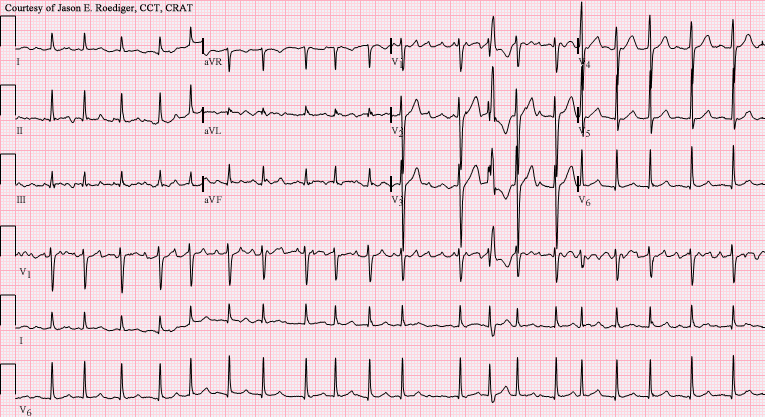
- Aberrant conduction in AF (Ashman phenomenon): Some beats come out wide, with a bundle-branch pattern (Figure 2). Irregular wide beats at a fast rate get managed as wide-complex until the ECG proves otherwise.
- Pre-excited AF (WPW): Irregular, very fast and wide. It looks like VT. AV-nodal blockers can make it worse.
BLS Management
- Check responsiveness, breathing and pulse. No pulse means cardiac arrest: start CPR and follow Adult Cardiac Arrest.
- Position the patient supine if hypotensive or confused; allow sitting up if breathing is easier. Oxygen if hypoxic.
- Attach the monitor and pads early for any unstable patient, and call for ALS at once.
- Vagal maneuver (only if stable): a 15-second strain at 40 mm Hg, then lie supine and passively raise the legs immediately after the strain (the modified Valsalva used in the REVERT trial).
- Do not delay transport for drugs or cardioversion. Hand off the rhythm strip, time of onset and any response to the vagal maneuver.
ALS Management
Doses below follow the 2025 AHA Part 9 algorithm sidebars and the FDA labels. When this page parts ways with the label, that line carries "Differs from FDA label:".
Step 1: Stable or unstable
Call it unstable if you see hypotension, altered mentation, ischemic chest pain, signs of shock or acute heart failure (2025 AHA Part 9, Adult Tachyarrhythmia With a Pulse algorithm, Box 3). Unstable gets cardioversion now, with no waiting. Stable patients go to the pathway for their rhythm, below.
Unstable: synchronized cardioversion (Paramedic/RN/CCT)
- Initial energy (2025 AHA Part 9): narrow-complex tachycardia 100 J and monomorphic VT with a pulse 100 J (Electrical Cardioversion algorithm); AF at least 200 J biphasic (COR 2a, B-R); atrial flutter 200 J may be reasonable (COR 2b, C-LD). If you know the device's recommended energy, use it. If you don't, use the maximum energy setting (2025 AHA Part 9 Tachyarrhythmia algorithm sidebar). If the first shock fails, raise the energy per the device.
- Polymorphic VT: Unsynchronized defibrillation at the defibrillation dose. Not cardioversion.
- Synchronize first: Confirm a marker on every R wave before you shock. Give sedation only if it won't delay the shock.
- See Cardioversion for technique and Defibrillation for unsynchronized shocks.
Stable narrow-complex regular (SVT)
- Vagal maneuver first (2025 AHA Part 9, COR 1, B-R): Use the modified Valsalva from BLS.
- Adenosine (Paramedic/RN/CCT; 2025 AHA Part 9, COR 1, B-R): 6 mg rapid IV push with a rapid saline flush, given as close to the patient as possible. No response in 1–2 min? Give 12 mg. You may repeat once (max 12 mg per dose). Expect a brief asystole or pause, so have pads on. Don't give it with second- or third-degree AV block or sick sinus syndrome unless a pacemaker is in place. Contraindicated in asthma or active bronchospasm (2025 AHA Part 9: adenosine can cause severe bronchospasm in patients with asthma). With dipyridamole, a smaller dose may be effective. With carbamazepine, heart block can be greater. Central venous dosing has not been systematically studied, and the label gives no separate dose for it. Part 9 supportive text says adenosine may have profound effects in patients with central lines or post–heart transplant patients, and that 1 mg IV may be adequate. Use a reduced dose only per medical direction. SeeAdenosine.
- If adenosine fails (2025 AHA Part 9, COR 2a, B-R): Diltiazem 0.25 mg/kg actual body weight IV over 2 min (about 20 mg for an 80 kg adult). If needed, give 0.35 mg/kg (about 28 mg at 80 kg) over 2 min after 15 min. Use it only with EF above 40% and no pre-excitation. Stay away from severe hypotension, cardiogenic shock, sick sinus syndrome, second- or third-degree AV block without a pacemaker, or within a few hours of an IV beta blocker. See Diltiazem.
Stable narrow-complex irregular (AF or flutter with RVR)
- Rate control first (Paramedic/RN/CCT): Diltiazem as above, or metoprolol 2.5–5 mg IV over 2 min, up to 3 doses (max 15 mg). The metoprolol label gives IV dosing only for acute MI. This dose comes from the 2025 AHA Part 9 AF/flutter drug table (2.5–5 mg over 2 min, up to 3 doses). Don't give metoprolol when heart rate is below 45/min, when there is second- or third-degree block or a PR interval of 0.24 s or more, when systolic BP is below 100 mm Hg, or when there is sick sinus syndrome without a pacemaker. Don't give it with decompensated heart failure or cardiogenic shock. Avoid it in asthma or active bronchospasm. See Metoprolol.
- Diltiazem infusion (RN/CCT): Start at 10 mg/hr. Some patients stay at 5 mg/hr. Step up in increments of 5 mg/hr to a maximum of 15 mg/hr, for up to 24 hours.
- Esmolol (RN/CCT): Optional 500 mcg/kg IV over 1 min, then 50 mcg/kg/min. Titrate no faster than every 4 min, to a maximum of 200 mcg/kg/min (label). The Part 9 AF/flutter table lists 50–300 mcg/kg/min. This page uses the label cap. Don't give it with severe sinus bradycardia, heart block greater than first degree, sick sinus syndrome, decompensated heart failure or cardiogenic shock. Stop the infusion for bronchospasm. See Esmolol.
- Refractory: Digoxin may be considered, and IV magnesium sulfate may be added. Amiodarone may be considered in critically ill patients or in decompensated heart failure, when beta blockers and calcium channel blockers have failed or are contraindicated. Not in pre-excited AF.
Stable wide-complex (QRS ≥0.12 s), regular and monomorphic
- Treat as VT until proven otherwise.
- Amiodarone (RN/CCT): 150 mg IV over 10 min, repeated if VT recurs (2025 AHA Part 9 algorithm sidebar), then 1 mg/min for 6 hr, then 0.5 mg/min (label). Keep a defibrillator immediately available (2025 AHA Part 9, wide-complex tachycardia supportive text). The FDA label covers IV amiodarone for VF and hemodynamically unstable VT, so stable VT is off-label use. See Amiodarone.
- Procainamide (Paramedic/RN/CCT): Give 20–50 mg/min IV until the arrhythmia is suppressed, hypotension develops, QRS widens more than 50%, or the total reaches 17 mg/kg (2025 AHA Part 9 Tachyarrhythmia algorithm sidebar). Differs from FDA label: label limits rate to 50 mg/min and total to 1 g. See Procainamide. Keep a defibrillator immediately available (2025 AHA Part 9, wide-complex tachycardia supportive text). Avoid it with a prolonged QT interval, heart failure (2025 AHA Part 9 algorithm sidebar) or torsades, or with complete heart block or second-degree AV block. Use caution in acute ischemia and renal impairment. Contraindicated with an established diagnosis of systemic lupus erythematosus.
- Adenosine: Only in a hemodynamically stable patient with a regular, monomorphic wide-complex rhythm, when the cause of the rhythm can't be determined, to treat or aid diagnosis (2025 AHA Part 9, COR 2b, B-NR). It does not convert VT. It should not be given (COR 3: Harm, C-LD) for unstable, irregularly irregular or polymorphic wide-complex tachycardia.
- Never IV diltiazem or verapamil for wide-complex tachycardia. In this setting, calcium channel blockers have caused hemodynamic deterioration and ventricular fibrillation (2025 AHA Part 9, wide-complex tachycardia, COR 3: Harm, B-NR).
- Torsades (polymorphic VT with long QT): Procainamide is contraindicated here. Magnesium sulfate 1–2 g IV over 10 min for recurrent torsades with long QT in a patient with a pulse (2025 AHA Part 9, COR 2b, C-LD; dose and rate per NASEMSO Tachycardia with a Pulse, p. 43; see Magnesium Sulfate). The 2 g over 1–2 min push is the pulseless-torsades rate, and it is not used here. Not for polymorphic VT with a normal QT (2025 AHA Part 9, COR 3: No Benefit, C-LD). An unstable patient gets unsynchronized defibrillation.
Pre-excited AF (WPW): irregular, wide and fast
- No AV-nodal blockers: Avoid diltiazem, verapamil, beta blockers, digoxin, adenosine and IV amiodarone. Part 9 rates digoxin, nondihydropyridine calcium channel blockers, beta-blockers and IV amiodarone COR 3: Harm (C-LD) in pre-excited AF/flutter. They may increase the ventricular response and cause VF (2025 AHA Part 9, AF/flutter rec 3).
- Unstable: Synchronized cardioversion at 200 J biphasic for AF.
- Stable: IV procainamide, or IV ibutilide when LVEF is 40% or higher. The 2023 AF guideline recommends either drug as an alternative to electrical cardioversion, and electrical cardioversion is the other option.
ED & ICU Management
- Confirm the rhythm and QRS on a 12-lead. Repeat it after each rate or rhythm intervention.
- Electrolytes and ischemia: Check potassium and magnesium. Check troponin when ischemia is possible. See Troponin.
- Rate target in AF: The usual goal is a resting heart rate below about 100 to 110/min (AF guideline).
- Infusions: Diltiazem can run for up to 24 hours, at no more than 15 mg/hr. Esmolol is titrated in 4-minute steps. When you need infusions, escalate to the ICU.
- Rhythm control (AF, stable): Electrical cardioversion is the preferred option when the patient is unstable. Per the AF guideline, the drug options are IV amiodarone (reasonable; not in pre-excited AF), ibutilide (LVEF 40% or higher), flecainide or propafenone with an AV-nodal blocker if previously tested in a monitored setting, and IV procainamide (may be considered).
- Anticoagulation: For AF of 48 hours or longer, get at least 3 weeks of therapeutic anticoagulation before elective cardioversion, or imaging to rule out thrombus. Keep anticoagulating for at least 4 weeks after cardioversion. Go longer when stroke risk (CHA2DS2-VASc) calls for it. For AF under 48 hours, imaging may be considered when CHA2DS2-VASc is 2 or higher. None of this delays unstable cardioversion.
- Consultation and disposition: Call cardiology or electrophysiology for wide-complex tachycardia of uncertain cause, for pre-excitation, or for recurrent episodes. Admit or observe after an unstable episode, infusions or new AF.
Transport Considerations
- Destination: A monitored ED or a cardiology-capable center. Unstable patients and wide-complex rhythms go to the center that can cardiovert, pace and consult cardiology right away.
- In transit: Run continuous ECG and BP. Pads on for any unstable patient. Reassess mentation, BP and rate after each dose.
- Infusions: Run diltiazem and esmolol on pumps, with BP monitoring. Don't give an IV beta blocker within a few hours of IV diltiazem.
- Handoff: rhythm strips and 12-lead; each drug with dose and time; number and energy of shocks; response; sedation given.
- Air transport: Altitude and vibration can throw off monitoring and infusions. See Flight Transport Physiology.
Special Populations
- Pediatrics: Adenosine is weight-based. Use the PALS dose as the EMS standard (2025 AHA Part 8, Pediatric Tachyarrhythmia With a Pulse algorithm): 0.1 mg/kg IV/IO (max 6 mg), then 0.2 mg/kg (max 12 mg). Differs from FDA label: the adenosine label gives 0.05–0.1 mg/kg initial, up to 0.3 mg/kg per dose (max 12 mg). SeeAdenosine. Pediatric synchronized cardioversion is 0.5–1 J/kg, raised to 2 J/kg if the first attempt fails (2025 AHA Part 8: COR 2a, C-LD for SVT with cardiopulmonary compromise; COR 2a, C-EO for wide-complex tachycardia); see weight-based dosing and Pediatric Shock. Safety and effectiveness of amiodarone in children are not established, and the label does not recommend it.
- Pregnancy: Synchronized cardioversion is safe for both the patient and the fetus. Do it the same way as in non-pregnant adults (2023 AF guideline). For stable AF with a structurally normal heart, IV procainamide may be considered for drug cardioversion. Beta blockers (metoprolol or propranolol) and digoxin are the first-line rate-control agents, with a record of safety. For stable SVT, vagal maneuvers come first. Adenosine may be used if clearly needed, since the label reports no adequate studies in pregnant women. Amiodarone can cause neonatal hypothyroidism and bradycardia, so avoid it when alternatives exist. Bring in fetal monitoring and obstetrics as indicated.
- Older Adults: After AV-nodal blockers, they are more prone to hypotension and conduction disease. Give each dose, then reassess before the next.
- Renal Impairment: At conventional doses, procainamide builds up in renal insufficiency. Watch for a prolonged QRS and hypotension.
- Obesity: Dose diltiazem on actual body weight, per the label.
- Reduced Ejection Fraction: No IV diltiazem or verapamil with moderate or severe LV dysfunction, with or without decompensated heart failure. Metoprolol and esmolol are contraindicated too, with decompensated heart failure or cardiogenic shock. Procainamide is contraindicated with an established diagnosis of systemic lupus erythematosus, and it should be avoided in heart failure (2025 AHA Part 9 algorithm sidebar).
- Patients on Anticoagulants: Know the anticoagulation status before elective cardioversion of AF of 48 hours or longer. Unstable cardioversion is not delayed for it.
- Patients on Beta Blockers: Don't give IV diltiazem with an IV beta blocker, or within a few hours of one.
Pitfalls & Safety Checks
- Error: AV-nodal blocker in pre-excited AF. Diltiazem, verapamil, beta blockers, digoxin, adenosine or IV amiodarone can cause a life-threatening fast rate and hypotension in AF with an accessory pathway. Pick synchronized cardioversion if unstable. If stable, pick procainamide, or ibutilide when LVEF is 40% or higher.
- Error: Adenosine for AF or flutter. Adenosine doesn't convert AF, flutter or VT. Reach for rate control or cardioversion.
- Error: Adenosine without safety checks. Before the dose, check for second- or third-degree AV block, sick sinus syndrome, asthma or bronchospasm, and dipyridamole or carbamazepine. Warn that asystole can occur, and have pads on.
- Error: Adenosine into a distal line. Give it as close to the patient as possible, then flush fast with saline. A poorly delivered dose fails. Central venous dosing has not been studied systematically, and the label gives no separate dose for it. Part 9 notes that 1 mg IV may be adequate in central-line and post–heart transplant patients. Use a reduced dose only per medical direction.
- Error: Calcium channel blocker with a beta blocker. IV diltiazem and IV beta blockers don't mix. Don't give them together, or within a few hours of each other.
- Error: Rate-slowing drug with reduced EF or shock. Diltiazem or verapamil with EF of 40% or lower, or with decompensated heart failure. Metoprolol or esmolol with decompensated heart failure, cardiogenic shock, hypotension or bradycardia. An unstable patient needs cardioversion, not a rate-slowing drug.
- Error: Unchecked synchronization. Confirm a marker on every R wave before a synchronized shock. Shocks synced at the wrong point have caused VF, including in pre-excited AF.
- Error: Treating the rate without the cause. A rate-control drug won't fix sinus tachycardia from sepsis, bleeding or hypoxia.
Clinical Pearls
References
- Wigginton JG, Agarwal S, Bartos JA, et al. (2025). Part 9: Adult Advanced Life Support: 2025 American Heart Association Guidelines for Cardiopulmonary Resuscitation and Emergency Cardiovascular Care. Circulation, 152(16 suppl 2), S538–S577. https://doi.org/10.1161/CIR.0000000000001376
- Lasa JJ, Dhillon GS, Duff JP, et al. (2025). Part 8: Pediatric Advanced Life Support: 2025 American Heart Association and American Academy of Pediatrics Guidelines for Cardiopulmonary Resuscitation and Emergency Cardiovascular Care. Circulation, 152(suppl 2), S479–S537. https://cpr.heart.org/en/resuscitation-science/cpr-and-ecc-guidelines/pediatric-advanced-life-support
- Joglar JA, Chung MK, Armbruster AL, et al. (2024). 2023 ACC/AHA/ACCP/HRS Guideline for the Diagnosis and Management of Atrial Fibrillation. Circulation, 149(1), e1–e156. https://doi.org/10.1161/CIR.0000000000001193
- Appelboam A, Reuben A, Mann C, et al. (2015). Postural modification to the standard Valsalva manoeuvre for emergency treatment of supraventricular tachycardias (REVERT): a randomised controlled trial (landmark trial). Lancet, 386(10005), 1747–1753. https://doi.org/10.1016/S0140-6736(15)61485-4
- Adenosine injection, USP, prescribing information (repackaged label, DailyMed; intravenous dosing and pediatric dosing sections). Revised 2024. https://dailymed.nlm.nih.gov/dailymed/drugInfo.cfm?setid=1809fc7e-f5d8-18d8-e063-6394a90a7713
- Diltiazem hydrochloride injection, prescribing information (DailyMed; indications, contraindications, dosage and administration). Revised 2025. https://dailymed.nlm.nih.gov/dailymed/drugInfo.cfm?setid=3f2942d7-f4d0-2d77-e063-6294a90a74ad
- Amiodarone hydrochloride injection, prescribing information (DailyMed; indications, dosage and administration, pregnancy and pediatric use). Revised 2026. https://dailymed.nlm.nih.gov/dailymed/drugInfo.cfm?setid=0a28ae25-7cc4-4ac0-a2ba-7820fb93e25c
- Procainamide hydrochloride injection, prescribing information (repackaged label, DailyMed; contraindications and dosage). Revised 2023. https://dailymed.nlm.nih.gov/dailymed/drugInfo.cfm?setid=0aac32fa-37b7-5520-e063-6394a90a1fe4
- Brevibloc (esmolol hydrochloride) injection, prescribing information. Baxter Healthcare (DailyMed; indications and dosage). Revised 2025. https://dailymed.nlm.nih.gov/dailymed/drugInfo.cfm?setid=220a07b8-5c68-41a3-8705-fd91f14c50b4
- Metoprolol tartrate injection, USP, prescribing information (DailyMed; indications, dosage and contraindications). Revised 2026. https://dailymed.nlm.nih.gov/dailymed/drugInfo.cfm?setid=05946833-9d66-4832-a0d8-b91b1ff01b8b
- National Association of State EMS Officials (2022). NASEMSO National Model EMS Clinical Guidelines, Version 3.0 (March 2022), Tachycardia with a Pulse, p. 43, Irregular Wide Complex Tachycardia – Stable, item 2 (magnesium for torsades, with a pulse). The pulseless-torsades rate is in Cardiac Arrest, p. 119. https://hhs.iowa.gov/media/198/download
Medical Disclaimer
- For Educational Purposes Only: This content is intended for educational reference and should not be used for clinical decision-making.
- Not a Substitute for Professional Judgment: Always consult your local protocols, institutional guidelines, and supervising physicians.
- Verify Before Acting: Users are responsible for verifying information through authoritative sources before any clinical application.