

Bedside Snapshot
- Normal (Adult)
- Device-specific. No universal viscoelastic range. Use the printed reference for your TEG or ROTEM device and cartridge
- Critical Values
- Fibrinogen ≤1.5 g/L (≤150 mg/dL) or a functional fibrinogen deficit; LY30 ≥3% (hyperfibrinolysis). No universal numeric critical value
- High Suggests
- Prolonged R or CT: factor deficiency or anticoagulant (LMWH, DOAC)
- LY30 ≥3%: hyperfibrinolysis
- Low Suggests
- Low MA, MCF or FIBTEM: fibrinogen or platelet deficit. Low LY30 (≤0.8%) is shutdown and is not reassuring
- Act Now If
- Major bleeding: tranexamic acid 1 g IV over 10 min, then 1 g over 8 h, within 3 h of injury, without waiting for the test; give calcium; send viscoelastic and fibrinogen testing
- Watch Out For
- Citrated blood and low calcium make tracings look falsely hypercoagulable. Treat by the trend and repeat hourly, not by one tracing
Reference & Critical Ranges
Test parameters and units
| Measure | TEG name | ROTEM name | Units and what it reflects |
|---|---|---|---|
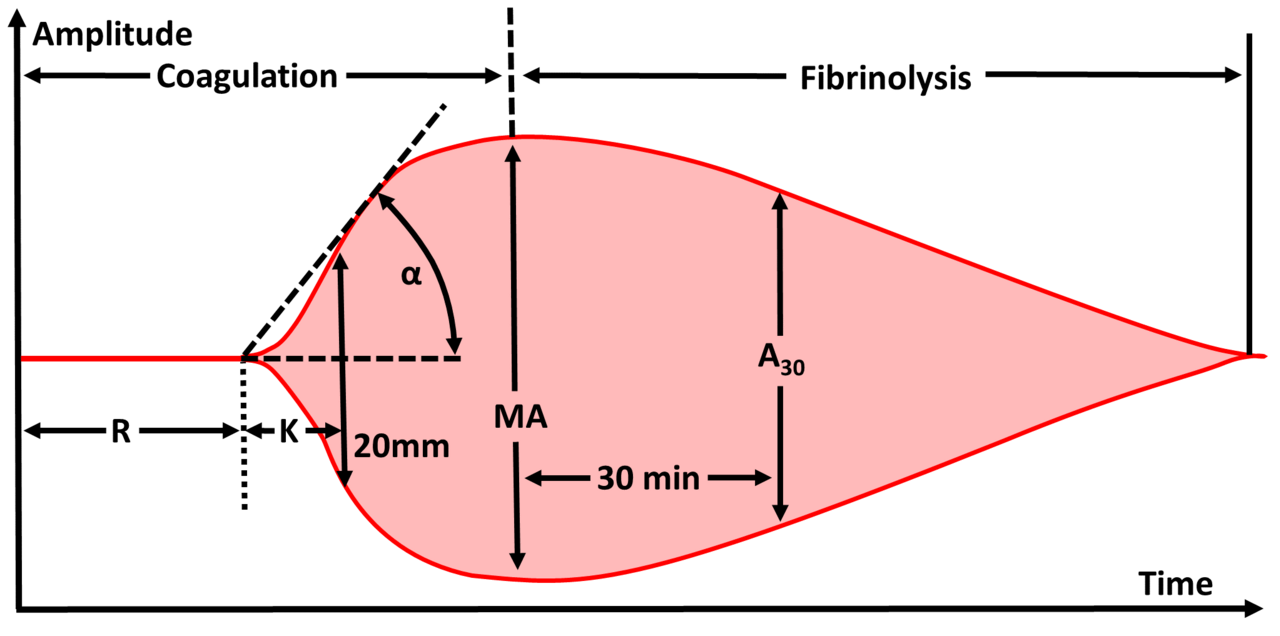
| Clot start | R (reaction time) | CT (clotting time) | min; time to first clot formation. Prolonged in factor deficiency or anticoagulation |
| Clot build speed | K and α angle | CFT (clot formation time) and α | min and degrees; how fast the clot strengthens |
| Maximum strength | MA (maximum amplitude) | MCF (maximum clot firmness) | mm; overall clot strength, driven by fibrinogen and platelets |
| Fibrinogen contribution | Device fibrinogen assay | FIBTEM A5 (amplitude at 5 min) | mm; fibrin-based clot strength used in fibrinogen decisions |
| Fibrinolysis | LY30 (% lysis 30 min after MA) | CL30 (clot lysis at 30 min) | %; the share of clot lost 30 min after peak strength |
Severity and action thresholds
| Level | Threshold | Source | What it means |
|---|---|---|---|
| Critical | Fibrinogen ≤1.5 g/L (≤150 mg/dL) or a viscoelastic functional fibrinogen deficit | 2023 European trauma guideline | Major bleeding with hypofibrinogenemia: give fibrinogen concentrate or cryoprecipitate |
| Critical | LY30 ≥3% (hyperfibrinolysis) | Adult and pediatric admission cohorts (rapid TEG) | Lysis at the level linked with a doubling of mortality; treat as active fibrinolysis in bleeding. The cut-off was derived on rapid TEG; no validated ROTEM CL30 equivalent is given here |
| Physiologic lysis | LY30 0.9–2.9% | Adult admission cohort | Lysis within the range seen in the adult admission cohort |
| Fibrinolysis shutdown | LY30 ≤0.8% (2016 cohort); <0.9% (2023 guideline) | Adult admission cohort; guideline | Little lysis; linked with higher mortality, not with safety |
| Factor and plasma trigger | PT or aPTT >1.5 times normal, or viscoelastic clot-time prolongation | 2023 European trauma guideline | Plasma or factor concentrate guidance in the guideline's plasma-based pathway |
| Algorithm trigger | PTr >1.2; fibrinogen <2 g/L; platelets <100 ×10⁹/L | Pragmatic algorithm cited in the 2023 guideline | Thresholds from a six-centre algorithm study; use only inside an approved local algorithm |
| Platelet guidance (bleeding trauma) | Keep platelets above 50 ×10⁹/L with ongoing bleeding; above 100 ×10⁹/L with TBI | 2023 European trauma guideline, recommendation 30 (Grade 2C) | A suggested transfusion target in the guideline, not a diagnostic cut-off; the 100 ×10⁹/L algorithm trigger above is a local-protocol value |
Conversion: Fibrinogen: 1 g/L is 100 mg/dL, so 1.5 g/L is 150 mg/dL. Platelets ×10⁹/L is the same as ×10³/µL.
Causes of Abnormal Results
Prolonged clot start (high R or CT)
| Mechanism | Common causes | Bedside clue |
|---|---|---|
| Coagulation factor deficiency | Factor loss in major bleeding; the 2023 guideline ties a prolonged EXTEM clotting time to factor deficiency | EXTEM CT still prolonged after fibrinogen is above 1.5 g/L |
| Anticoagulant effect | Low-molecular-weight heparin, vitamin K antagonists, direct oral anticoagulants (DOAC) | Known anticoagulant exposure; viscoelastic tests detect LMWH and NOAC effect better than lab tests |
Low clot strength (low MA, MCF or FIBTEM A5)
| Mechanism | Common causes | Bedside clue |
|---|---|---|
| Functional fibrinogen deficit | Low fibrinogen is the expected early pattern in traumatic coagulopathy | Low FIBTEM amplitude or MCF; fibrinogen at or below 1.5 g/L |
| Platelet deficit or dysfunction | Low platelet count (local algorithm trigger 100 ×10⁹/L; guideline bleeding target 50 ×10⁹/L, or 100 with TBI); antiplatelet drugs | Low MA with a normal fibrinogen contribution; point-of-care platelet tests are not interchangeable |
High lysis: hyperfibrinolysis (LY30 ≥3%)
| Mechanism | Common causes | Bedside clue |
|---|---|---|
| Fibrinolytic activation after injury | Severe trauma with shock; the phenotype is the most lethal one in trauma, and viscoelastic testing is highly specific for it | Tracing narrows steeply after maximum strength; bleeding out of proportion to the clot |
| Shock and dilution | Higher admission base deficit and more prehospital crystalloid (1.5 vs 0.5 L in one 2012 cohort) | Admission hyperfibrinolysis tracks with prehospital crystalloid volume |

Shutdown: low lysis (LY30 ≤0.8% or <0.9%)
Shutdown was the most common admission pattern in the adult cohort, at 46%. It also carried higher mortality than physiologic lysis (adjusted odds ratio 1.6). Don't read a low LY30 as good news. It is a warning sign. Treatment decisions do not rest on that number alone (see Interpretation).
Interpretation & Bedside Approach
Step-by-step approach
- Is it real? Check the sample: citrated whole blood, run as the device requires. Transfused plasma and platelets carry citrate too, and that can make a tracing look falsely hypercoagulable unless calcium is replaced.
- How sick is the patient? Shock, ongoing bleeding and surgical source control set the urgency. Viscoelastic testing guides the coagulation part of resuscitation. It does not replace control of the bleeding.
- Which part of the tracing is abnormal? Read clot start (R or CT), clot strength (MA or MCF), the fibrinogen contribution (FIBTEM A5), and lysis (LY30) separately. Each points to a different product.
- Trend beats a single value. While bleeding is active, repeat viscoelastic testing at least hourly and after each major intervention.
- Match the defect to the product. Low fibrinogen: fibrinogen concentrate or cryoprecipitate. Prolonged CT after fibrinogen is above 1.5 g/L: prothrombin complex concentrate. High lysis: tranexamic acid (already given per protocol). Low platelets: platelets per algorithm.
- Reassess and escalate. Re-test after each product. If the bleeding continues, escalate to surgery, interventional radiology or the massive transfusion pathway.
Decision patterns
| Pattern | Suggests | Response in the cited guidance |
|---|---|---|
| Low FIBTEM or MCF | Functional fibrinogen deficit | Fibrinogen 3–4 g, or 15–20 single-donor cryoprecipitate units; repeat by viscoelastic and fibrinogen level |
| EXTEM CT prolonged after fibrinogen >1.5 g/L | Factor deficiency | Prothrombin complex concentrate; avoid overly liberal use because of delayed thrombotic risk |
| LY30 ≥3% | Hyperfibrinolysis | Tranexamic acid; it should not wait for the viscoelastic result |
| LY30 low (shutdown) | Low lysis | Do not withhold tranexamic acid on this result alone |
| Prolonged R or CT, DOAC exposure | Anticoagulant effect, possibly mixed with trauma coagulopathy | Confirm with anti-Xa or PT; viscoelastic cannot separate the two when CT is prolonged |
Management Priorities
Emergency: Major bleeding with suspected coagulopathy
- Tranexamic acid: Don't wait on the viscoelastic result. Give 1 g IV/IO over 10 min, then 1 g over 8 h, starting within 3 h of injury.
- Calcium: Calcium chloride is the preferred agent. Start early, and keep replacing it through massive transfusion.
- Balanced products: Aim for a 1:1:1 ratio of whole blood or components, per the 2026 TSACO review and PROPPR. ESA 2023 recommends a fibrinogen-based strategy, or a plasma:RBC ratio of at least 1:2 (Grade 1C). Follow the local massive transfusion protocol.
- Viscoelastic-directed: Fibrinogen comes first. Use prothrombin complex concentrate only if EXTEM CT stays prolonged once fibrinogen is above 1.5 g/L.
- Monitor and repeat: Test again at least hourly while bleeding is active, and after each major product.
Medications
| Drug | Adult dose | Pediatric dose (max) | Onset / key notes |
|---|---|---|---|
| Tranexamic acid | 1 g IV/IO over 10 min, then 1 g IV over 8 h (2 g total) Start within 3 h of injury | Off-label; per protocol: 15 mg/kg IV/IO over 10–20 min (max 1 g), then 2 mg/kg/hr (max 1 g over 8 h) | Immediate. Do not wait for viscoelastic results; give as soon as possible. Pediatric dose matches the E3 TXA page; not in the 2023 guideline |
| Fibrinogen concentrate or cryoprecipitate | 3–4 g IV initial (equal to 15–20 single-donor cryoprecipitate units); repeat by viscoelastic and fibrinogen level | Weight-based; see the fibrinogen page | Start for Clauss fibrinogen ≤1.5 g/L or a viscoelastic functional deficit. Do not treat empirically above that level |
| 4-factor PCC, vitamin K antagonist reversal | 25 units/kg if INR 2 to under 4 (max 2,500 units); 35 units/kg if INR 4–6 (max 3,500); 50 units/kg if INR above 6 (max 5,000). Give with vitamin K Label dose caps (Kcentra); dosing by actual weight up to 100 kg | Not established in children: specialist or medical-control use only | Boxed warning: arterial and venous thromboembolic complications. Use for life-threatening bleeding; monitor for thrombosis during recovery; consider thromboprophylaxis once bleeding is controlled |
| 4-factor PCC, trauma coagulopathy without a vitamin K antagonist (off-label) | Off-label; dose per local protocol. ESA 2023 recommendation 34 suggests 25–50 units/kg for factor Xa inhibitor effect when andexanet is unavailable (Grade 2C), with an initial dose of 25 units/kg Only after fibrinogen is above 1.5 g/L and EXTEM CT stays prolonged (viscoelastic-directed) | Not established in children: specialist or medical-control use only | Same boxed thromboembolic warning. Avoid overly liberal use; ESA 2023 notes delayed thrombotic risk |
| Vitamin K1 (phytonadione) | 5–10 mg IV, given with PCC for vitamin K antagonist reversal in bleeding Slow infusion, not faster than 1 mg/min | Per pediatric protocol | Given with PCC for vitamin K antagonist reversal (2023 guideline, Grade 1A). Boxed warning: severe and fatal hypersensitivity or anaphylaxis with IV or IM use; the label prefers subcutaneous use when IV is not essential |
| Plasma | Typical local-protocol volume about 15 mL/kg (not a guideline dose). ESA 2023 gives no mL/kg figure; guide by PT or aPTT above 1.5 times normal or viscoelastic clot-time prolongation (recommendation 27) | Typical local-protocol range 10–15 mL/kg (actual weight); not a guideline dose | Further plasma by lab or viscoelastic evidence of factor deficiency, not by fixed ratio alone |
| Platelets | Initial dose 4–8 single units or 1 apheresis pack (ESA 2023, Grade 2B). ESA trigger: keep count above 50 ×10⁹/L with ongoing bleeding and above 100 ×10⁹/L with TBI (Grade 2C). A local algorithm may use 100 ×10⁹/L | 5–10 mL/kg or 1 unit per 10 kg | ESA 2023 (Grade 1C): avoid routine platelet transfusion in bleeding patients on antiplatelet drugs. Point-of-care platelet function tests are not interchangeable |
| Calcium chloride | 1 g IV (10 mL of 10%) given slowly over about 10 min, repeat per ionized calcium | Weight-based per protocol; not set here | Vesicant: extravasation can cause tissue necrosis. Give into a central or deep vein, not as a bolus (label maximum 1 mL/min). Do not run in the same line as citrated blood products. 10 mL of 10% gives 270 mg elemental calcium; 10 mL of 10% calcium gluconate gives 90 mg |
Definitive care & disposition
- Dabigatran bleeding: Give idarucizumab 5 g IV for life-threatening bleeding. Repeat coagulation tests, viscoelastic included, within 5–10 min.
- Surgery and intervention: Viscoelastic results steer coagulation therapy. Source control (surgery, interventional radiology) decides the bleed.
- ICU: Patients who are still bleeding need repeat viscoelastic testing for as long as the bleeding goes on.
- ECMO: Anticoagulation and bleeding on ECMO follow the ECMO page and the local protocol. This page sets no ECMO targets.
Doses are typical references. Follow local protocols, medical direction and institutional policy.
Field & Transport Considerations
Point-of-care testing
Point-of-care viscoelastic testing now comes in cartridge-based machines: the TEG 6s (FDA approved in 2019) and the ROTEM sigma (FDA approved in 2022). The screen can update live in the trauma bay, the OR or the ICU. A few prehospital systems feed viscoelastic data into in-field decisions. But a TEG result and a ROTEM result are not interchangeable.
Before and during interfacility transport
- Tranexamic acid first: Give it as early as possible, en route if feasible and within 3 h of injury. Don't hold it for a viscoelastic result.
- Calcium: Start early and keep it going through transfusion. Citrated products drop ionized calcium.
- Repeat the test: If the receiving site has a device, repeat viscoelastic testing at least hourly while bleeding continues.
| Setting | Consideration |
|---|---|
| Prehospital (EMS) | Tranexamic acid and early calcium per protocol; viscoelastic data only where the system provides it |
| Interfacility transport (CCT) | Carry the last viscoelastic result, the time of each product, and the calcium dose |
| Receiving ICU or OR | Repeat viscoelastic testing; fibrinogen and PCC per the tracing; plasma and platelets per algorithm |
Timing & Kinetics
| Parameter | Value | Clinical implication |
|---|---|---|
| Tranexamic acid window | Within 3 h of injury | The guideline's Grade 1A window; earlier is better, and the drug is not delayed for testing |
| Tranexamic acid infusion | 1 g over 10 min, then 1 g over 8 h | The 8-hour infusion continues after handover; record the start time |
| LY30 timing | Amplitude loss measured 30 min after maximum amplitude | A result needs the full test run; it describes lysis after peak clot strength, not before it |
| Repeat viscoelastic testing | At least hourly during active bleeding | Track the trend; one tracing is not a transfusion order |
| Prehospital tranexamic acid | Not reliably detected by admission viscoelastic testing | An admission tracing cannot confirm TXA given before arrival; check the prehospital record |
Special Populations
| Population | What changes | Clinical implication |
|---|---|---|
| Children & adolescents | Admission hyperfibrinolysis (LY30 ≥3%) was present in 24% of severely injured children aged 17 or younger in the 2015 cohort; earlier adult studies cited about 9% | Hyperfibrinolysis carried a mortality rise from 6% to 14%. Pediatric TXA dosing is off-label; follow the pediatric protocol and medical direction |
| Pregnancy (postpartum hemorrhage) | Fibrinogen rises at term; OBS2 (55 women randomized, underpowered) treated FIBTEM A5 ≤15 mm, and subgroup data suggest replacement may not be needed above 12 mm or a Clauss level above 2 g/L | In the randomized trial, fibrinogen concentrate did not significantly reduce units transfused (the primary outcome). The trial was small, and benefit below 12 mm or 2 g/L was not excluded. Follow the obstetric hemorrhage protocol; do not withhold fibrinogen for a low level during ongoing bleeding |
| Older adults | No age-specific viscoelastic thresholds in the sources checked | Use the same device algorithm and clinical context; this is not an age-based adjustment |
| Cardiac surgery | Viscoelastic-guided algorithms lowered plasma and platelet transfusion in pooled trials | The 2026 Cochrane review: TEG/ROTEM-guided algorithms may reduce mortality (RR 0.76, 95% CI 0.63–0.92), with very low certainty and very uncertain evidence; plasma RR 0.52, platelets RR 0.69. Evidence is mostly from elective cardiac surgery |
| Anticoagulated patients | DOAC and LMWH prolong clotting; apixaban has little effect on CT even at high levels | A prolonged CT cannot separate a DOAC from trauma coagulopathy; check anti-Xa or PT as well |
Interfering Factors & Pitfalls
Collection & handling
| Factor | Effect | Why | Avoid / fix |
|---|---|---|---|
| Citrated blood or citrated products | False hypercoagulable tracing | Citrate removes calcium; artifact compounds with repeated transfusion | Replace calcium early and during massive transfusion; repeat on the trend, not one tracing |
| Prehospital crystalloid | Associated with admission hyperfibrinolysis | Hemodilution and shock; each extra litre was linked with about 15% higher odds in one cohort | Follow a restrictive crystalloid strategy per protocol |
Medications & supplements
| Factor | Effect | Why | Avoid / fix |
|---|---|---|---|
| DOAC (apixaban, rivaroxaban) | ↑ CT, variable | Mixes with trauma coagulopathy; apixaban has little effect on CT at high levels | Anti-Xa or PT alongside the test; ROTEM is less affected by low DOAC levels |
| Dabigatran | Reversal needed | Thrombin inhibition | Idarucizumab 5 g IV; repeat testing within 5–10 min |
| Antiplatelet drugs | Platelet dysfunction | Point-of-care platelet tests do not agree; aspirin detection is better than ADP detection | Avoid routine point-of-care platelet function testing in trauma |
| Heparin (including line flushes) | ↑ R or CT | Heparin prolongs clot start on standard activators; common in cardiac surgery and from heparinised lines or sample contamination | Use a heparinase-containing assay (for example, ROTEM HEPTEM) to separate heparin effect from factor deficiency |
Assay & device-specific
- Devices: TEG and ROTEM values don't translate directly. Use the reference and cut-offs for the device in front of you.
- Phenotype definitions: Fibrinolysis cut-offs vary between systems and studies. A 7.5% LY30 cut-off came from a 2012 rapid TEG cohort, while later cohorts used 3%. The 3% threshold came from rapid TEG. This page gives no validated ROTEM CL30 equivalent.
- Prehospital TXA: Admission viscoelastic testing lacks the sensitivity to show TXA given before arrival.
Common misinterpretations
- "Low LY30 means safe." It doesn't. Shutdown was linked with higher mortality than physiologic lysis.
- "Wait for the test before TXA." The guideline says to give TXA without waiting.
- "Low FIBTEM always needs fibrinogen." In obstetric hemorrhage, the evidence is one small, underpowered trial (OBS2, 55 women randomized). It found no benefit at a 15 mm trigger. A low level during ongoing bleeding is still managed per protocol.
Physiology & Test Basics
What it measures
One small sample of whole citrated blood gives you clot formation and breakdown as a single continuous tracing. Fibrin, platelets and fibrinolysis show up together. PT/INR, aPTT and fibrinogen each measure one piece of plasma clotting. This page covers the point-of-care TEG and ROTEM tests used to guide bleeding treatment. For the individual lab tests, see the coagulation panel pages.
Physiology & regulation
- Clotting starts with thrombin generation. Fibrin strength depends on fibrinogen and platelets.
- Fibrinolysis breaks fibrin down. Hyperfibrinolysis is too much breakdown after injury. Shutdown means very little breakdown.
- Traumatic coagulopathy is typically low fibrinogen with variable fibrinolysis. Thrombin generation holds up early on.
How it is measured
Each test uses about 300 µL of citrated whole blood, run at the bedside or in the lab. What starts the clot matters. TEG uses kaolin. ROTEM's INTEM assay uses ellagic acid, and its EXTEM assay uses tissue factor. Each activator changes how sensitive the test is to anticoagulants and antiplatelet drugs. Follow the collection tube and fill instructions in the device manual.
Why it matters
Conventional tests cover only part of the process, and they are often slow (2026 review). That is why viscoelastic testing can guide fibrinogen, plasma, platelet and PCC decisions in near real time. The trauma evidence is mixed. The randomized ITACTIC trial found no overall difference in outcome. A 2026 Cochrane review finds that TEG/ROTEM-guided transfusion may reduce mortality, but with very low certainty. Most of that evidence comes from elective cardiac surgery.
Clinical Pearls
References
- Rossaint R, Afshari A, Bouillon B, et al. The European guideline on management of major bleeding and coagulopathy following trauma: sixth edition. Crit Care. 2023;27(1):80. https://doi.org/10.1186/s13054-023-04327-7
- Brito AM, Schreiber MA. Precision hemostasis: how viscoelastic testing guides real-time decision-making in trauma. Trauma Surg Acute Care Open. 2026;11(Suppl 1):e002241. https://pmc.ncbi.nlm.nih.gov/articles/PMC13141058/ (doi:10.1136/tsaco-2026-002241)
- Kvisselgaard AD, Wolthers SA, Wikkelsø AJ, et al. Thromboelastography (TEG) or thromboelastometry (ROTEM) to monitor haemostatic treatment versus usual care in adults or children with bleeding. Cochrane Database Syst Rev. 2026;(5):CD007871. https://pubmed.ncbi.nlm.nih.gov/42145275/ (doi:10.1002/14651858.CD007871.pub4)
- Baksaas-Aasen K, Gall LS, Stensballe J, et al. Viscoelastic haemostatic assay augmented protocols for major trauma haemorrhage (ITACTIC): a randomized, controlled trial. Intensive Care Med. 2021;47(1):49–59. https://doi.org/10.1007/s00134-020-06266-1
- Collins PW, Cannings-John R, Bruynseels D, et al. Viscoelastometric-guided early fibrinogen concentrate replacement during postpartum haemorrhage: OBS2, a double-blind randomized controlled trial. Br J Anaesth. 2017;119(3):411–421. https://doi.org/10.1093/bja/aex181
- Moore HB, Moore EE, Liras IN, Gonzalez E, et al. Acute fibrinolysis shutdown after injury occurs frequently and increases mortality: a multicenter evaluation of 2,540 severely injured patients. J Am Coll Surg. 2016;222(4):347–355. https://doi.org/10.1016/j.jamcollsurg.2016.01.006
- Liras IN, Cotton BA, Cardenas JC, Harting MT. Prevalence and impact of admission hyperfibrinolysis in severely injured pediatric trauma patients. Surgery. 2015;158(3):812–818. https://doi.org/10.1016/j.surg.2015.05.004
- Cotton BA, Harvin JA, Kostousouv V, Minei KM, et al. Hyperfibrinolysis at admission is an uncommon but highly lethal event associated with shock and prehospital fluid administration. J Trauma Acute Care Surg. 2012;73(2):365–370. https://doi.org/10.1097/TA.0b013e31825c1234
Medical Disclaimer
- For Educational Purposes Only: This content is intended for educational reference and should not be used for clinical decision-making.
- Not a Substitute for Professional Judgment: Always consult your local protocols, institutional guidelines, and supervising physicians.
- Verify Before Acting: Users are responsible for verifying information through authoritative sources before any clinical application.