

Bedside Snapshot
- Use It For
- Atrial fibrillation (AF) stroke prevention; deep vein thrombosis (DVT) or pulmonary embolism (PE) treatment and recurrence prevention; hip and knee replacement prophylaxis
- Adult Dose
- AF: apixaban 5 mg twice daily; rivaroxaban 20 mg daily; edoxaban 60 mg daily; dabigatran 150 mg twice daily
- VTE: apixaban 10 mg twice daily ×7 days, then 5 mg; rivaroxaban 15 mg twice daily ×21 days, then 20 mg daily
- Pediatric Dose
- Weight-based VTE dosing: apixaban and rivaroxaban from birth to under 18 yr; dabigatran capsules 8 to under 18 yr, pellets 3 months to under 12 yr; edoxaban not established
- Onset / Duration
- PO: peak 1–4 hr; apixaban effect persists at least 24 hr after the last dose (edoxaban about 24 hr; label)
- Do Not Give / Hold If
- Active pathological bleeding; severe hypersensitivity; mechanical valve (dabigatran; others not recommended); CrCl <15 mL/min (edoxaban; rivaroxaban for VTE); edoxaban for AF above 95 mL/min
- Watch For
- Bleeding (GI, intracranial, retroperitoneal); spinal or epidural hematoma after neuraxial procedures; stroke or thrombosis after an unplanned stop
- Reversal / Rescue
- Dabigatran: idarucizumab 5 g IV. Apixaban or rivaroxaban: andexanet is no longer sold in the US; 4F-PCC per protocol. Edoxaban: no specific agent; PCC may be considered
- Must Remember
- Name the drug and the last-dose time: four drugs, four reversal plans. A normal PT/INR or aPTT does not exclude a clinically important DOAC effect
Indications
Emergency & Prehospital
- Home medication history: These drugs often explain bleeding nobody expected after a fall or trauma. Get the drug name, strength, last dose time and dose-reduction criteria from the bottle, the pharmacy or the family.
- Interfacility transfer: Two facts drive the plan on arrival: the drug and the last dose. They decide whether a procedure, a neuraxial block or a reversal agent is needed.
ED / ICU / Transport
- Nonvalvular atrial fibrillation (AF): All four are labeled to prevent stroke and systemic embolism. DOACs are not used with a mechanical valve or in moderate-to-severe mitral stenosis (see Precautions)
- Acute deep vein thrombosis (DVT) or pulmonary embolism (PE): apixaban and rivaroxaban start with no parenteral lead-in. Dabigatran and edoxaban come after 5–10 days of parenteral anticoagulation
- Recurrence prevention after DVT or PE: labeled with apixaban, rivaroxaban and dabigatran. Apixaban and rivaroxaban start after at least 6 months of treatment. Dabigatran starts after previous treatment
Other Uses
- Hip or knee replacement prophylaxis: Apixaban and rivaroxaban cover hip and knee. Dabigatran covers hip only. Edoxaban has no labeled prophylaxis indication
- Rivaroxaban only: 2.5 mg twice daily with aspirin for chronic coronary or peripheral artery disease, and prophylaxis in acutely ill medical patients
- Pediatric VTE: apixaban and rivaroxaban (birth to under 18 yr); dabigatran capsules (8 to under 18 yr) and pellets (3 months to under 12 yr); edoxaban not established in children
- Pediatric Fontan thromboprophylaxis (rivaroxaban only): Given to children aged 2 years and older with congenital heart disease after the Fontan procedure (label section 1.10). Dosing is weight-based, per label Table 3
Dosing & Administration
Doses vary by protocol; follow local protocols and medical direction.
Available Forms
- Apixaban (Eliquis): 2.5 mg and 5 mg tablets; 0.5 mg tablet in a packet for oral suspension and 0.15 mg sprinkle capsule for young children
- Rivaroxaban (Xarelto): 2.5 mg, 10 mg, 15 mg and 20 mg tablets; 1 mg/mL oral suspension for children
- Edoxaban (Savaysa): 15 mg, 30 mg and 60 mg tablets
- Dabigatran etexilate (Pradaxa): 75 mg, 110 mg and 150 mg capsules; oral pellets for children 3 months to under 12 yr (dose per the Pradaxa Oral Pellets label)
High-Alert Medication: Four drugs, four different rules. They are not interchangeable mg for mg, and frequency differs. Apixaban and dabigatran are twice daily. Rivaroxaban and edoxaban are once daily after any lead-in. Get an independent double-check of drug, strength, frequency, renal function and dose-reduction criteria before each order, transfer or dose.
Not Interchangeable: Never swap the drugs or forms mg for mg. Each drug has its own renal, age, weight and interaction rules.
Adult Dosing
| Indication | Dose & Route | Repeat / Max | Notes |
|---|---|---|---|
| AF: apixaban | 5 mg PO twice daily; 2.5 mg twice daily if 2 of: age ≥80 yr, weight ≤60 kg, SCr ≥1.5 mg/dL | Fixed schedule; no single-dose maximum | High-alert High-alert Dose by these criteria, not CrCl alone |
| AF: rivaroxaban | 20 mg PO once daily with the evening meal; 15 mg once daily with the evening meal if CrCl ≤50 mL/min | Fixed schedule; one dose per day | High-alert High-alert CrCl <30 mL/min not studied (label expects exposure like CrCl 30–50). ESRD on intermittent hemodialysis: 15 mg once daily (label section 8.6) |
| AF: edoxaban | 60 mg PO once daily; 30 mg once daily if CrCl 15–50 mL/min | Fixed schedule; one dose per day | High-alert High-alert Do not use if CrCl >95 mL/min (boxed warning) |
| AF: dabigatran | 150 mg PO twice daily; 75 mg twice daily if CrCl 15–30 mL/min | Fixed schedule; no dosing advice if CrCl <15 mL/min or on dialysis | High-alert High-alert CrCl 30–50 mL/min with dronedarone or ketoconazole: 75 mg twice daily |
| DVT or PE: apixaban | 10 mg PO twice daily for 7 days, then 5 mg twice daily | Lead-in 10 mg twice daily for 7 days only | High-alert High-alert No parenteral lead-in required (label) |
| DVT or PE: rivaroxaban | 15 mg PO twice daily with food for 21 days, then 20 mg once daily with food | Lead-in 15 mg twice daily for 21 days only | High-alert High-alert Avoid if CrCl <15 mL/min |
| DVT or PE: edoxaban | 60 mg PO once daily after 5–10 days of parenteral anticoagulation | Fixed schedule; one dose per day | High-alert High-alert 30 mg once daily if CrCl 15–50 mL/min, weight ≤60 kg, or certain P-gp inhibitors (label section 2.2) |
| DVT or PE: dabigatran | 150 mg PO twice daily after 5–10 days of parenteral anticoagulation | Fixed schedule; no dosing advice if CrCl ≤30 mL/min | High-alert High-alert Avoid P-gp inhibitors if CrCl <50 mL/min (VTE labels) |
| Recurrence after 6 months: apixaban or rivaroxaban | Apixaban 2.5 mg PO twice daily; rivaroxaban 10 mg PO once daily | Fixed schedule; extended therapy after at least 6 months | High-alert High-alert Individualize duration to bleeding risk |
| Hip or knee prophylaxis: apixaban | 2.5 mg PO twice daily, first dose 12–24 hr after surgery | Fixed; 35 days (hip) or 12 days (knee) | High-alert High-alert Start once hemostasis is established |
| Hip or knee prophylaxis: rivaroxaban | 10 mg PO once daily, 6–10 hr after surgery | Fixed; 35 days (hip) or 12 days (knee) | High-alert High-alert Start once hemostasis is established |
| Hip prophylaxis: dabigatran | 110 mg PO 1–4 hr after surgery, then 220 mg once daily | Fixed; 28–35 days | High-alert High-alert Hip only; avoid P-gp inhibitors if CrCl <50 mL/min |
| CAD or PAD: rivaroxaban | 2.5 mg PO twice daily plus aspirin 75–100 mg once daily | Fixed schedule | High-alert High-alert Rivaroxaban only; start once hemostasis is established after revascularization |
| Acutely ill medical patients: rivaroxaban (VTE prophylaxis) | 10 mg PO once daily, in hospital and after discharge | Fixed; 31 to 39 days total | High-alert High-alert Avoid if CrCl <15 mL/min (label section 2.1, Table 1) |
Pediatric Dosing
| Indication | Dose by Weight & Route | Max Single / Max Total | Notes |
|---|---|---|---|
| VTE: apixaban (birth to <18 yr) | Twice daily; first dose days 1–7, second from day 8: ≥35 kg 10 mg then 5 mg; 25 to <35 kg 8 mg then 4 mg; 18 to <25 kg 6 mg then 3 mg; 12 to <18 kg 4 mg then 2 mg; 9 to <12 kg 3 mg then 1.5 mg; 6 to <9 kg 2 mg then 1 mg; 4 to <6 kg 1 mg then 0.5 mg; 2.6 to <4 kg 0.3 mg then 0.15 mg (label Table 1, all weight tiers) | Fixed by weight tier; no cap beyond adult tier | High-alert High-alert Start after at least 5 days of parenteral anticoagulation; re-weigh and change tiers as the child grows. Forms: 0.15 mg powder in capsule (2.6 to <4 kg); 0.5 mg tablet (4 to <35 kg); 2.5 mg or 5 mg tablet (≥35 kg) |
| VTE: rivaroxaban (birth to <18 yr) | ≥50 kg: 20 mg once daily; 30 to 49.9 kg: 15 mg once daily; under 30 kg: weight-based oral suspension (label Table 2) | Fixed by weight band; adult dose at ≥50 kg | High-alert High-alert Start after at least 5 days of parenteral anticoagulation; give with feeding or food |
| Fontan thromboprophylaxis: rivaroxaban (age 2 years and older, congenital heart disease) | Weight-based oral suspension by weight band (label Table 3); 10 mg once daily at 50 kg or more | Fixed by weight band | High-alert Take with or without food (label); dose by current weight |
| VTE: dabigatran (8 to <18 yr, capsules) | 11 to <16 kg: 75 mg twice daily; 16 to <26 kg: 110 mg; 26 to <41 kg: 150 mg; 41 to <61 kg: 185 mg; 61 to <81 kg: 220 mg; ≥81 kg: 260 mg (all twice daily) | Fixed by weight band; adult dose at ≥81 kg (260 mg) | High-alert High-alert Start after at least 5 days of parenteral anticoagulation; avoid if eGFR <50 mL/min/1.73 m²; pellets (3 months to under 12 yr) dosed per the Pradaxa Oral Pellets label |
Edoxaban in Children: safety and effectiveness in children with VTE are not established.
Infants: The label does not recommend rivaroxaban in children under 6 months born before 37 weeks, with under 10 days of oral feeding, or weighing under 2.6 kg.
Procedure and Neuraxial Timing (Label)
| Drug | Elective Procedure (non-neuraxial): Stop Before | Neuraxial Catheter or Puncture |
|---|---|---|
| Apixaban | 48 hr before moderate- or high-bleed-risk procedures; 24 hr before low-risk procedures | Remove catheter no sooner than 24 hr after the last dose; next dose no sooner than 5 hr after removal; traumatic puncture: delay 48 hr |
| Rivaroxaban | 24 hr before | Remove catheter after at least 2 half-lives (18 hr if age 20–45; 26 hr if age 60–76); next dose no sooner than 6 hr after removal |
| Edoxaban | 24 hr before | Remove catheter no sooner than 12 hr after the last dose; next dose no sooner than 2 hr after removal |
| Dabigatran | CrCl ≥50 mL/min: 1–2 days; CrCl <50 mL/min: 3–5 days; longer for major surgery or neuraxial work | Timing not defined; place or remove when effect is low. Before a parenteral anticoagulant: wait 12 hr (CrCl ≥30) or 24 hr (CrCl <30) |
Neuraxial puncture or catheter removal: the general-procedure holds above do not clear a neuraxial procedure. Work from the ASRA regional anesthesia guideline (4th edition, 2018, reference below) and institutional protocol. Both set longer holds for these drugs, and those holds depend on renal function. Check the interval in the guideline before you schedule.
Preparation & Administration
- Food: Take rivaroxaban 15 mg and 20 mg with food (label). Edoxaban and dabigatran can go with or without food. Apixaban can go with or without food, since food does not change apixaban exposure
- Swallowing: Dabigatran capsules go down whole with a full glass of water. Do not open, chew or crush them. Apixaban tablets may be crushed into water, D5W, apple juice or applesauce and given promptly. Crushed apixaban stays stable for up to 4 hr
- Nasogastric tube: Crushed apixaban (60 mL water or D5W, 12 French tube, flush with 20 mL) and crushed edoxaban (applesauce or water) are labeled routes. For rivaroxaban, follow the label's Administration Options section
- Missed dose: Take it as soon as it is remembered on the same day. Do not double the next dose. Dabigatran: skip the dose if it cannot be taken at least 6 hr before the next scheduled dose
- From warfarin: start when INR is below 2.0 (apixaban, dabigatran), below 3.0 (rivaroxaban, adults) or at or below 2.5 (edoxaban)
- From a parenteral anticoagulant: start at the time the next parenteral dose was due. Dabigatran: start 0–2 hr before the next parenteral dose was due, or at the time a continuous infusion (e.g., IV UFH) is stopped (label section 2.7). Edoxaban: start 4 hr after a continuous UFH infusion stops (label). Apixaban: at the usual next-dose time (label)
- To warfarin: DOACs raise the INR, so early INR values during overlap cannot guide the warfarin dose. Factor Xa inhibitors: where continuous anticoagulation is needed, the apixaban label (section 2.5) directs stopping the DOAC and starting both a parenteral anticoagulant and warfarin. Stop the parenteral agent once the INR is in range. Check the rivaroxaban and edoxaban labels for their switching text. Dabigatran: start warfarin 3 days (CrCl ≥50), 2 days (30–50) or 1 day (15–30) before stopping dabigatran. There is no recommendation if CrCl <15 mL/min (label section 2.6)
Dosing Notes: Calculate creatinine clearance (CrCl) by Cockcroft-Gault. The rivaroxaban label uses actual body weight. Recheck renal function before each dose change. Doses vary by protocol; follow local protocols and medical direction.
Contraindications & Precautions
Contraindications
- Active pathological bleeding (all four drugs)
- Severe hypersensitivity reaction (apixaban, rivaroxaban, dabigatran; edoxaban has active bleeding as its only labeled contraindication)
- Mechanical prosthetic heart valve (dabigatran only; see Precautions for the others)
Precautions
- Mechanical valves and mitral stenosis: Rivaroxaban is not recommended with prosthetic valves. Apixaban and edoxaban have not been studied in mechanical valves, and edoxaban has not been studied in moderate-to-severe mitral stenosis. Specialist decision
- Renal function: Exposure rises as CrCl falls. Each drug has its own threshold (Adult Dosing table). Calculate CrCl by Cockcroft-Gault
- Triple-positive antiphospholipid syndrome: The apixaban label warns of increased thrombosis risk. DOACs are generally avoided (specialist decision)
- Low body weight: weight of 60 kg or less is a dose-reduction criterion for apixaban (AF) and edoxaban (VTE)
- Hepatic impairment: apixaban needs no change in Child-Pugh A, dosing advice is not provided in Child-Pugh B and it is not recommended in Child-Pugh C. Edoxaban is not recommended in Child-Pugh B or C. Rivaroxaban should be avoided in Child-Pugh B and C. Dabigatran: no consistent exposure change in moderate impairment (label)
- Dialysis: Apixaban uses the label's usual dose (5 mg twice daily for AF, or 2.5 mg twice daily when two of age 80 or older, weight 60 kg or less, creatinine 1.5 mg/dL or higher). Dialysis patients were not in the efficacy trials. Dabigatran has no dosing advice. Rivaroxaban is not dialyzable because it is highly protein bound
Hold / Reassess If
- Major bleeding (falling hemoglobin or blood pressure, GI, intracranial or retroperitoneal bleeding): hold and treat per the Overdose & Toxicity section
- Acute kidney injury: reassess the drug and dose. The dabigatran label says to stop and consider an alternative. The rivaroxaban label says to consider a dose change or stopping
- CrCl falls below the drug threshold (rivaroxaban below 15 mL/min for VTE and prophylaxis indications; for AF, see the label, which gives 15 mg once daily for ESRD on intermittent hemodialysis; dabigatran at or below 30 mL/min; edoxaban below 15 mL/min is not recommended): change the drug or dose
- Planned procedure or neuraxial block: follow the timing table; document the last dose time before the procedure
FDA Boxed Warning: (A) Stopping any of these drugs early raises the risk of thrombotic events. If the stop is for a reason other than bleeding or course completion, consider another anticoagulant. (B) A spinal or epidural hematoma after neuraxial anesthesia or spinal puncture can cause long-term or permanent paralysis. Edoxaban also carries a warning: do not use it for AF with CrCl above 95 mL/min, where the ischemic stroke rate is higher than with warfarin.
Adverse Effects & Toxicity
Common
- Bleeding is the main adverse reaction. The rivaroxaban label names bleeding complications as the most common
- Dabigatran: the most common non-bleeding effects are dyspepsia, nausea, upper abdominal pain and gastrointestinal upset
- Antiplatelets, NSAIDs and SSRIs or SNRIs taken alongside add bleeding risk (apixaban label, section 5.2)
Serious / Life-Threatening
| Effect | Recognition | Management |
|---|---|---|
| Major bleeding | Falling hemoglobin or blood pressure; melena or hematemesis; severe headache or neuro change; flank or back pain (retroperitoneal) | Hold the drug; reversal per the Overdose section; source control and transfusion per protocol |
| Spinal or epidural hematoma | Midline back pain, leg numbness or weakness, bowel or bladder change after neuraxial block or spinal puncture | Urgent imaging and neurosurgical evaluation; hold the next dose |
| Thrombosis after premature stop | Stroke symptoms, new DVT or PE after a missed or stopped course | Restart or cover with another anticoagulant as soon as bleeding allows (boxed warning) |
| Hypersensitivity | Urticaria, angioedema, dyspnea, hypotension | Stop the drug and treat anaphylaxis per protocol |
Overdose & Toxicity Management
- Signs: Look for bleeding. Risk is higher with renal failure, interacting drugs, a double dose or a recent dose
- Recent ingestion: Activated charcoal cut apixaban exposure by 50% when given 2 hr after a 20 mg dose, and by 27% at 6 hr (label). Call Poison Help at 1-800-222-1222 or a medical toxicologist
- Dabigatran: Idarucizumab 5 g IV reverses it. It is given as two 2.5 g/50 mL vials, as two consecutive infusions or as one bolus of both vials back to back by syringe (label section 2.3). Data supporting a second 5 g dose are limited, per the label. Hemodialysis can remove dabigatran, but bleeding experience with it is limited. See the anticoagulant reversal reference
- Apixaban or rivaroxaban: Andexanet alfa (Andexxa) left the US market: it is no longer manufactured or sold there after December 22, 2025 (FDA). Use 4-factor prothrombin complex concentrate (PCC) per local protocol. This is off-label for factor Xa inhibitors. The 2020 ACC expert consensus pathway (reference below) lays out published PCC approaches, and it depends on protocol. PT/INR, aPTT or anti-Xa monitoring is not useful during PCC use (label)
- Edoxaban: No specific reversal agent exists. PCC, activated PCC or recombinant factor VIIa may be considered, but they are not evaluated for this use. Dialysis does not significantly clear it
- Not reversing: protamine and vitamin K do not reverse these drugs (labels). Antifibrinolytics are untested with apixaban (label)
- Intracranial hemorrhage on any DOAC: Manage per the 2022 AHA/ASA spontaneous ICH guideline (reference below), including its guidance on anticoagulant reversal. Pair that with neurosurgical consultation.
- Effect duration: The apixaban label says the effect lasts at least 24 hr after the last dose. Plan monitoring and observation to match
Monitoring
| Parameter | When / How Often | Target / Act If |
|---|---|---|
| Clinical: bleeding | Every assessment; sites of puncture, sheath, wound and stool or urine | New bleeding, falling hemoglobin or blood pressure: hold, notify, CBC, find the source |
| Clinical: neuro checks after neuraxial work | Frequently while a catheter is in place and after removal | Back pain, leg weakness or numbness, bowel or bladder change: urgent imaging |
| Renal: CrCl (Cockcroft-Gault) | Baseline, periodically, and whenever renal function may fall (creatinine) | Apply the drug thresholds in the Adult Dosing table (rivaroxaban 15 mL/min for VTE and prophylaxis; dabigatran 30 mL/min; edoxaban 15 and 50 mL/min) |
| Laboratory: CBC with hemoglobin | Baseline and periodically during therapy (CBC) | Falling hemoglobin or platelets: evaluate for bleeding |
| Laboratory: PT/INR and aPTT | Not used to dose apixaban, rivaroxaban or edoxaban | |
| Laboratory: dabigatran effect | Only when needed; the label allows aPTT or ecarin clotting time (ECT), not INR | Use for a specialist decision on bleeding or timing; not a dose tool |
| Laboratory: drug-specific anti-Xa level | Specialty test, not routine | Interpret with the lab's calibrator (see anti-Xa level) |
| Weight | At each visit and admission | Weight at or below 60 kg: re-check the apixaban (AF) and edoxaban (VTE) dose criteria |
- Observation after a reversal or a stop: The apixaban label says the effect lasts at least 24 hr after the last dose. The edoxaban label says about 24 hr. Build observation and re-dosing around that window
Interactions & Compatibility
Clinically Significant Interactions
| Drug / Class | Effect | What To Do |
|---|---|---|
| Combined P-gp and strong CYP3A4 inhibitors (ketoconazole, itraconazole, ritonavir) | Raises apixaban and rivaroxaban exposure; more bleeding | Apixaban 5 or 10 mg twice daily: reduce by 50%; apixaban 2.5 mg twice daily: avoid. Rivaroxaban: avoid. Clarithromycin needs no apixaban change (label) |
| Combined P-gp and strong CYP3A4 inducers (rifampin, carbamazepine, phenytoin, St. John's wort) | Lowers apixaban exposure and raises thrombotic risk | Avoid with apixaban and rivaroxaban. Edoxaban and dabigatran: avoid rifampin (label) |
| Dronedarone or systemic ketoconazole (dabigatran) | Raises dabigatran exposure (P-gp) | CrCl 30–50 mL/min: 75 mg twice daily. CrCl below 30 mL/min: avoid (AF labels) |
| Antiplatelets (aspirin, clopidogrel, P2Y12 inhibitors), NSAIDs, SSRIs or SNRIs | Additive bleeding; in APPRAISE-2 (apixaban), bleeding rose with antiplatelets | Use the combination only when the indication requires it, for the shortest time; stop non-essential NSAIDs and antiplatelets |
| Heparins, enoxaparin, fibrinolytics | Additive bleeding | Overlap only for a planned transition (Dosing section); a DOAC within 48 hr is a common exclusion for stroke fibrinolysis |
| Warfarin | Overlapping anticoagulation during transition | Switch per the label INR thresholds (Dosing section) |
IV Compatibility
No IV form of these drugs is sold in the US, so compatibility does not apply. Crushing and nasogastric use are covered under Preparation & Administration. Check an institutional compatibility resource.
Special Populations
- Pediatrics: Apixaban and rivaroxaban are labeled for VTE from birth to under 18 yr. Dabigatran is labeled for VTE too: capsules from age 8 to under 18 yr, and pellets from 3 months to under 12 yr. Rivaroxaban also carries a label for thromboprophylaxis after the Fontan procedure, in children aged 2 years and older. Edoxaban is not established. Use the Pediatric Dosing table, and re-weigh children as they grow.
- Neonates: Rivaroxaban is not recommended for a child under 6 months born before 37 weeks, with under 10 days of oral feeding, or under 2.6 kg. Apixaban is not recommended under 2.6 kg.
- Pregnancy: The labels give no adequate data. The apixaban label notes possible bleeding risk during pregnancy and delivery. For VTE in pregnancy, guideline practice favors low-molecular-weight heparin (see enoxaparin). Specialist decision.
- Lactation: Dabigatran: breastfeeding is not recommended during treatment (label), and data on dabigatran in human milk are insufficient. Rivaroxaban has been detected in human milk, and data on its effects on the breastfed child are insufficient. The label says to consider the developmental and health benefits of breastfeeding, along with the mother's clinical need for rivaroxaban and any potential adverse effects on the infant. Apixaban: breastfeeding is not recommended during treatment (label). Edoxaban: the label reports no human milk data.
- Older Adults: Bleeding risk rises with age. The apixaban AF dose reduction (2.5 mg twice daily) needs two of three criteria (age 80 or older, weight 60 kg or less, creatinine 1.5 mg/dL or higher). Age alone does not trigger it.
- Renal Impairment: rivaroxaban 15 mg once daily for AF at CrCl ≤50 mL/min (the label also gives 15 mg once daily for AF in ESRD on intermittent hemodialysis) and avoid below 15 mL/min for VTE and prophylaxis indications; edoxaban 30 mg at CrCl 15–50 mL/min and avoid for AF above 95 mL/min; dabigatran 75 mg twice daily for AF at CrCl 15–30 mL/min, with no dosing advice below 15 mL/min or on dialysis. Acute kidney injury: reassess (Hold / Reassess section).
- Hepatic Impairment: Child-Pugh limits for apixaban, edoxaban and rivaroxaban are in the Precautions section. Dabigatran shows no consistent exposure change in moderate impairment (label).
- Obesity / Dosing Weight: Labeled doses are fixed. Rivaroxaban renal calculations use actual body weight. A weight at or below 60 kg changes apixaban (AF) and edoxaban (VTE) dosing.
- Low Body Weight: weight of 60 kg or less is a dose-reduction criterion for apixaban (AF) and edoxaban (VTE). Re-check at each visit.
Field & Transport Considerations
- Scope: These are oral medications used at home or in hospital. EMS usually takes the history rather than giving doses. RN and critical-care transport teams manage them. Scope varies by state and agency protocol.
- Storage & Stability: Store it as dispensed and do not repackage it. Keep the original container, with the drug name and strength visible, for handoff.
- Carried Concentration: Not applicable, since these are oral tablets and capsules only. Check the patient's own supply (name, strength and count) instead of relying on memory.
- Infusions in Transport: There are none. Do not mix up the oral agents with heparin or enoxaparin infusions or injections.
- Altitude / Environment: No specific effect. In vibration or poor light, recheck sites and neuro status, because bleeding is easy to miss there.
- Handoff Essentials: drug and strength; last dose time and size; creatinine clearance or serum creatinine; indication; neuraxial catheter status; bleeding; any reversal agent given, with dose and time.
Clinical Pearls
Name the Drug, Not Just the Class: Four drugs, four plans. Dabigatran has its own reversal agent: idarucizumab. Apixaban and rivaroxaban rely on PCC per protocol, because andexanet is no longer sold in the US. Edoxaban has no specific agent.
Routine Clotting Tests Miss the Drug: Don't let a normal PT/INR or aPTT talk you out of a clinically important apixaban or edoxaban effect. Dabigatran is the exception: aPTT or ECT is used there. Make the call on the last-dose time, not the lab value.
Exam Discriminator, Dabigatran vs Factor Xa Inhibitors:
- Dabigatran: direct thrombin inhibitor, about 80% renal clearance, dialyzable, idarucizumab reverses it
- Apixaban, rivaroxaban, edoxaban: factor Xa inhibitors, no approved reversal for edoxaban, andexanet withdrawn from US sale
- Warfarin switch thresholds differ: INR below 2.0, below 3.0 or 2.5 or less
Anticoagulated Head Injury: A normal INR does not clear a DOAC. Before the trip, confirm the drug, last dose time and renal function, and tell the receiving team the last dose time.
Count Hours Since the Last Dose: For a procedure or neuraxial catheter removal, hours since the last dose set the timing. The number of doses taken does not. Dabigatran waits run longer when renal function is reduced.
Edoxaban Has an Upper Renal Limit in AF: Edoxaban for AF is off the table when CrCl is above 95 mL/min. The boxed warning reports more ischemic stroke than warfarin in that group.
Pharmacology
Mechanism of Action
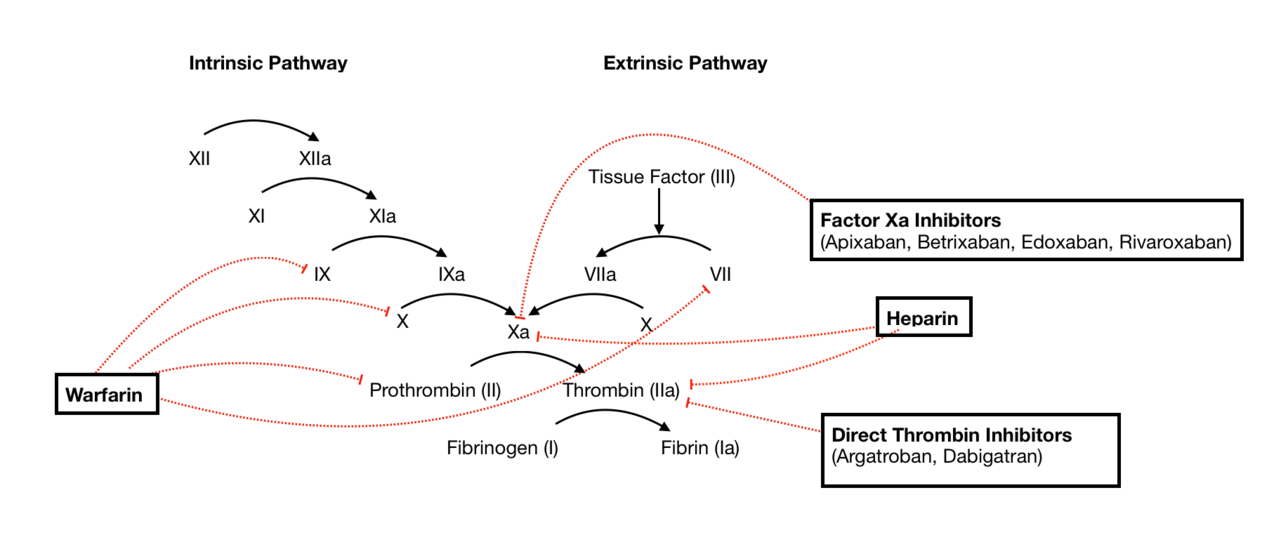
- Apixaban, rivaroxaban and edoxaban block factor Xa directly and reversibly. That means less thrombin generation and less fibrin formation
- Dabigatran etexilate is a prodrug. Dabigatran inhibits thrombin (IIa) directly, including clot-bound thrombin
- Doses are fixed, with no routine monitoring. Onset is rapid. Offset takes about 1–2 half-lives after the last dose
Pharmacokinetics
| Route | Onset | Peak | Duration |
|---|---|---|---|
| PO (all four) | Rapid; drug-specific | Apixaban 3–4 hr; rivaroxaban 2–4 hr; edoxaban 1–2 hr; dabigatran about 1 hr fasted | About 1–2 half-lives after the last dose; apixaban effect at least 24 hr |
- Half-life: apixaban about 12 hr; rivaroxaban 5–9 hr (age 20–45) and 11–13 hr (age 60–76); edoxaban 10–14 hr; dabigatran 12–17 hr in healthy adults, longer with renal impairment
- Bioavailability: apixaban about 50%; rivaroxaban 80–100% at 2.5 or 10 mg and about 66% at 20 mg fasted; edoxaban 62%; dabigatran etexilate 3–7%
- Metabolism: apixaban and edoxaban are CYP3A4 and P-gp substrates (edoxaban does not inhibit major CYP enzymes in vitro); rivaroxaban is a CYP3A4 and P-gp substrate; dabigatran etexilate is converted to dabigatran
- Elimination: apixaban about 27% renal; dabigatran about 80% renal; rivaroxaban is highly protein bound and not dialyzable
- Food: rivaroxaban 15 and 20 mg doses are taken with food (label); 20 mg fasted bioavailability is about 66%. A high-fat meal delays the dabigatran peak by about 2 hr with no change in exposure
Names & Classification
- Generic Name
- Apixaban; rivaroxaban; edoxaban tosylate; dabigatran etexilate mesylate
- Brand Names
- Eliquis (apixaban); Xarelto (rivaroxaban); Savaysa (edoxaban); Pradaxa (dabigatran etexilate)
- Pharmacologic Class
- Direct factor Xa inhibitors (apixaban, rivaroxaban, edoxaban); direct thrombin inhibitor (dabigatran, a prodrug)
- Therapeutic Class
- Oral anticoagulant
- Controlled Substance
- Not controlled
- ISMP High-Alert
- Yes: ISMP high-alert class (anticoagulants, including direct oral anticoagulants and factor Xa inhibitors; dabigatran is also a direct thrombin inhibitor). ISMP acute-care list, 2018
- Look-Alike / Sound-Alike
- Pradaxa (dabigatran) vs Plavix (clopidogrel)
- Error-Prone Abbreviations to Avoid
- “QD” and “QOD” (write “once daily”)
References
- E.R. Squibb & Sons, L.L.C. (2025). ELIQUIS (apixaban) prescribing information, DailyMed label (30-day starter pack set; label effective April 17, 2025). U.S. National Library of Medicine. https://dailymed.nlm.nih.gov/dailymed/drugInfo.cfm?setid=e9481622-7cc6-418a-acb6-c5450daae9b0
- Janssen Pharmaceuticals, Inc. (2026). XARELTO (rivaroxaban) prescribing information, DailyMed label effective September 10, 2026. U.S. National Library of Medicine. https://dailymed.nlm.nih.gov/dailymed/drugInfo.cfm?setid=10db92f9-2300-4a80-836b-673e1ae91610
- Daiichi Sankyo Inc. (2025). SAVAYSA (edoxaban tosylate) prescribing information, DailyMed label effective July 10, 2025. U.S. National Library of Medicine. https://dailymed.nlm.nih.gov/dailymed/drugInfo.cfm?setid=e77d3400-56ad-11e3-949a-0800200c9a66
- Boehringer Ingelheim Pharmaceuticals, Inc. (2025). PRADAXA (dabigatran etexilate) capsules and PRADAXA Oral Pellets prescribing information, DailyMed labels (capsules effective June 25, 2025; pellets for pediatric VTE, 3 months to under 12 years). U.S. National Library of Medicine. capsules; pellets
- Boehringer Ingelheim Pharmaceuticals, Inc. (2024). PRAXBIND (idarucizumab) injection prescribing information, DailyMed label effective January 23, 2024. U.S. National Library of Medicine. https://dailymed.nlm.nih.gov/dailymed/drugInfo.cfm?setid=c7400f8a-dcf4-a6df-6d07-983081b1bf34
- Tomaselli, G. F., Mahaffey, K. W., Cuker, A., et al. (2020). 2020 ACC Expert Consensus Decision Pathway on management of bleeding in patients on oral anticoagulants. Journal of the American College of Cardiology, 76(5), 594–622. https://doi.org/10.1016/j.jacc.2020.04.053
- Greenberg, S. M., Ziai, W. C., Cordonnier, C., et al. (2022). 2022 guideline for the management of patients with spontaneous intracerebral hemorrhage. Stroke, 53, e282–e361. https://doi.org/10.1161/STR.0000000000000407
- Horlocker, T. T., et al. (2018). Regional anesthesia in the patient receiving antithrombotic or thrombolytic therapy: American Society of Regional Anesthesia and Pain Medicine evidence-based guidelines (fourth edition). Regional Anesthesia and Pain Medicine, 43(3), 263–309. https://pubmed.ncbi.nlm.nih.gov/29561531/
Medical Disclaimer
- For Educational Purposes Only: This content is intended for educational reference and should not be used for clinical decision-making.
- Not a Substitute for Professional Judgment: Always consult your local protocols, institutional guidelines, and supervising physicians.
- Verify Before Acting: Users are responsible for verifying information through authoritative sources before any clinical application.
AI Assistance Notice
AI was used to assist in organizing, paraphrasing, and formatting this information.