

Bedside Snapshot
- Indications
- Vasopressor still needed after the short peripheral phase per SSC 2021
- Need documented per protocol; ASA 2020 sets no indications
- Not for CVP alone to guide fluids per SSC 2021
- Contraindications / Abort
- Burned or infected skin at the site per ASA 2020
- Arterial pattern: leave dilator or catheter in place, consult (ASA)
- Sterility breach: stop and restart per SHEA 2022
- Wire will not advance or come out: do not force it
- Critical Steps
- Static ultrasound before prep; real-time for the IJ puncture (ASA)
- Alcoholic chlorhexidine at least 2%; dry before puncture
- Confirm venous access by manometry or waveform, not color
- Count the wire out of the field before leaving
- Confirm & Monitor
- Tip at the lower SVC or cavoatrial junction; check on chest radiograph or ECG
- Transparent dressing every 7 days; gauze every 2 days (SHEA)
- Disinfect hubs before every access per SHEA 2022
- Daily chlorhexidine bath (ICU, over 2 months) per SHEA 2022; ask daily if still needed
Key Numbers
A CVC places its tip in a great vein. Confirm venous access and tip position, and keep the site clean.
| Parameter | Value |
|---|---|
| Ultrasound guidance | Real-time for the internal jugular per ASA 2020; SHEA 2022 essential practice: use ultrasound guidance for insertion, with an aseptic-technique caution |
| Adult site, infection risk | Subclavian preferred in the ICU per SHEA 2022; avoid it when hemodialysis is or may be needed (stenosis); upper-body site when possible per ASA 2020 |
| Skin antisepsis | Alcoholic chlorhexidine at least 2% gluconate; let it dry before the puncture per SHEA 2022 If chlorhexidine is contraindicated: povidone-iodine or alcohol per ASA 2020 |
| Transparent dressing | Change at least every 7 days, or at once if soiled, loose or damp per SHEA 2022 Gauze: every 2 days per SHEA 2022 |
| Administration sets | Replace up to every 7 days; not for blood, blood products or lipid formulations per SHEA 2022 |
| Lidocaine (local, no epinephrine) | Adult: max 4.5 mg/kg per dose, and generally not more than 300 mg total; the lower limit applies (DailyMed label). 0.5% = 5 mg/mL, so 60 mL = 300 mg; 1% = 10 mg/mL, so 30 mL = 300 mg Pediatric: max set by age and weight (label example: about 3.3–4.4 mg/kg in a 5-year-old, 23 kg) |
| Venous access check | Manometry or pressure waveform; blood color and absent pulsation do not prove a vein per ASA 2020 |
| Tip check | Confirm as soon as clinically appropriate: chest radiograph, or continuous ECG during placement per ASA 2020 Target: lower SVC or cavoatrial junction (general practice; see Confirmation) |
| Peripheral vasopressor | Short period only, in a vein in or proximal to the antecubital fossa; move to central access if still needed per SSC 2021 |
Overview & Principles
A central venous catheter (CVC) goes into a venous great vessel. ASA 2020 names these: the superior or inferior vena cava, brachiocephalic vein, internal jugular vein, subclavian vein, iliac vein or common femoral vein. This page covers non-tunneled CVCs. Tunneled and dialysis catheters, pulmonary artery catheters and PICCs are outside the ASA 2020 guideline, so they are not covered here.
How It Works
- Venous access: The needle gets into the vein. The guidewire goes in next. The dilator and catheter follow the wire.
- Tip position: Confirm the tip before use. Chest radiography is what ASA 2020 uses for OR placement. Ultrasound, fluoroscopy, continuous ECG and transesophageal echocardiography are also listed as verification methods.
Where It Fits
Start with peripheral access when it works (see IV Insertion). SSC 2021 suggests starting vasopressors peripherally instead of delaying them for central access. If the drug is still needed, move it to central infusion. Intraosseous access is on the IO Access page.
Indications & Contraindications
Indications
- Vasopressor still needed after the short peripheral phase: SSC 2021 suggests central infusion as soon as it is practical, if resources are available. The point is fewer complications.
- Protocol-defined need: ASA 2020 does not define indications. Use clinical judgment and local protocol. Document the specific need.
Absolute Contraindications
Do not use a site with burned or infected skin.
Relative Contraindications & Cautions
- Femoral site in adults: Pick an upper-body site when you can. ASA 2020 links the femoral site to a higher risk of thrombotic complications.
- Potentially contaminated sites: Avoid the inguinal area, a site next to a tracheostomy, or a site beside an open surgical wound when an alternative exists. ASA 2020 advises avoiding potentially contaminated sites when possible.
- Chlorhexidine allergy: Use povidone-iodine or alcohol for skin preparation per ASA 2020.
- Coagulopathy: ASA 2020 does not address coagulopathy at insertion, so set correction targets by local protocol. Note anticoagulation or coagulopathy before the puncture. Expert practice generally leans toward a compressible site, the internal jugular or femoral, with real-time ultrasound and the fewest passes. Bleeding from the subclavian cannot be compressed. That is general consensus, not ASA.
- Infants and children: See Special Populations for site and confirmation differences.
Consider an Alternative
- Peripheral IV: Short-term vasopressor infusion through a peripheral vein per SSC 2021; see IV Insertion.
- Intraosseous access: When IV access fails in shock or arrest, follow IO Access and local protocol.
Abort / Stop Criteria
- Sterility breach: Aseptic technique breaks? Any team member should be able to stop the procedure, per SHEA 2022.
- Wire will not advance or will not come out: Do not force it. Consult per local protocol. ASA 2020 lists interventional radiology or surgical consultation for a wire knot or a catheter that will not come out.
- Arterial cannulation: Stop advancing, leave the dilator or catheter in place and consult per ASA 2020.
Scope & Team Roles
| Provider Level | Typical Role | Notes |
|---|---|---|
| EMT | Not in scope | Varies by state and agency; follow local protocol |
| AEMT | Not in scope | Varies by state and agency; follow local protocol |
| Paramedic | Not in scope | Varies by state and agency; follow local protocol |
| RN (ED/ICU) | Monitors & maintains | Assists at insertion; dressings, hubs, flushes and site checks per policy |
| Critical Care Transport (CFRN / CTRN / FP-C / CCP-C) | Monitors & maintains | Maintains the line in transport; insertion only if the program credentials it |
| Physician / APP | Performs | Operator; a checklist and an assistant are expected per ASA 2020 |
Team Roles During the Procedure
- Operator: Selects the site, performs the puncture and places the catheter.
- Sterile assistant: Helps during placement and keeps the sterile field organized (ASA 2020 recommends an assistant).
- Ultrasound and monitor: Runs the ultrasound, watches the ECG and the patient, and reports changes.
- Recorder and checker: Runs the checklist, records the attempts, confirmation method and the wire count.
Anatomy & Landmarks
Pick the site by clinical need, infection risk and mechanical risk. ASA 2020 frames it that way.
| Site | Best For | Landmark | Risk Profile (sourced) | Avoid If |
|---|---|---|---|---|
| Internal jugular | Ultrasound-guided neck access | Real-time ultrasound of the vein | Real-time ultrasound lowers mechanical complications and attempts per ASA 2020 | Burned or infected skin; adjacent to a tracheostomy |
| Subclavian | Adult ICU patients; preferred for infection risk per SHEA 2022 | Infraclavicular; real-time ultrasound when feasible | Lower infection risk in the ICU per SHEA 2022; avoided when hemodialysis is or may be needed because of stenosis risk per SHEA 2022 | Burned or infected skin; open surgical wound when an alternative exists |
| Femoral | Infants and children when upper-body sites are contraindicated | Groin; real-time ultrasound when feasible | Higher thrombotic risk in adults per ASA 2020 | Inguinal area is potentially contaminated; adults with an upper-body option |
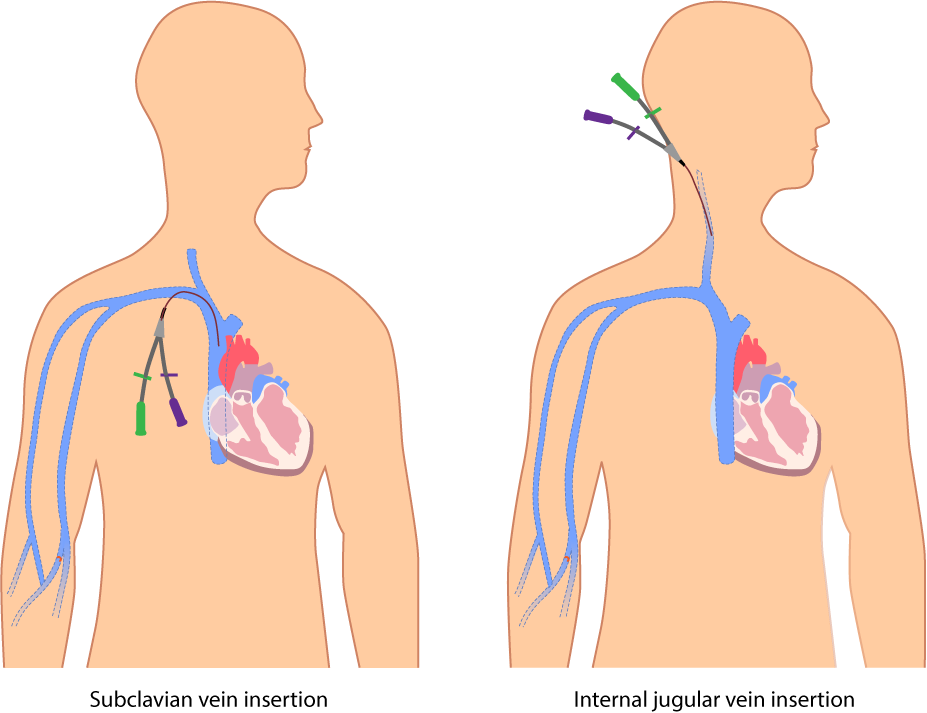
Internal Jugular
- Scan first: Use static ultrasound before prep to identify the vein and check patency per ASA 2020.
- Position: Use Trendelenburg when clinically appropriate and feasible per ASA 2020. The evidence is too thin to show it improves success.
- Puncture under real-time ultrasound: Real-time ultrasound is what ASA 2020 recommends for the puncture when you choose the internal jugular.
- Confirm venous access: Use manometry or pressure waveform before the wire or dilator.
Pediatric
Kids' right internal jugular runs wider in Trendelenburg than supine. Observational pediatric studies say so, per ASA 2020. Get sizes from the equipment sizing page.
Subclavian
- Choose the site: In the ICU, SHEA 2022 prefers the subclavian site to reduce infectious complications. Avoid it in patients who are or may need hemodialysis, because of stenosis risk. Choose with nephrology when dialysis is possible. In an emergency, the fastest safe route may take priority.
- Position: Use Trendelenburg when clinically appropriate and feasible per ASA 2020.
- Use ultrasound when feasible: Real-time ultrasound may be used for the subclavian vein, per ASA 2020. SHEA 2022 calls ultrasound guidance essential for insertion. It also notes that ultrasound use can risk a breach in aseptic technique.
- Select the technique: ASA 2020 picks a thin-wall (Seldinger) needle for the subclavian approach.
Pediatric
Technique is the same as for adults. In neonates, infants and children, venous confirmation may come after the wire is threaded, per ASA 2020.
Femoral
- Check for an upper-body option: In adults, use an upper-body site when possible per ASA 2020.
- Check the groin: ASA 2020 counts the inguinal area as potentially contaminated.
- Use ultrasound when feasible: Real-time ultrasound may be used for the femoral vein per ASA 2020.
- Consider the thrombotic risk: RCTs show no clear difference in mechanical complications between femoral and subclavian, per ASA 2020. In adults, though, the femoral site carries the higher thrombotic risk.
Pediatric
SHEA 2022 says a femoral catheter may be considered in children and infants when upper-body sites are contraindicated. A tunneled femoral catheter with the exit site in the mid-thigh, outside the diaper area, may be safer.
Equipment & Preparation
Equipment
| Item | Size / Spec | Notes |
|---|---|---|
| All-inclusive CVC kit | Standardized set | Available where CVCs are inserted per SHEA 2022; ASA 2020 asks for a standardized equipment set |
| Catheter | Smallest size appropriate for the situation | Choose type by need; antimicrobial-coated catheters for selected patients only per ASA 2020 |
| Needle, guidewire and dilator | Thin-wall or catheter-over-needle set | Technique and confirmation method must match per ASA 2020 |
| Ultrasound | Real-time | Static scan before prep; real-time for the puncture per ASA 2020 |
| Manometry or pressure transducer | — | Venous and arterial pattern check per ASA 2020 |
| Continuous ECG | — | Tip check during placement per ASA 2020 |
| Sterile barrier | Mask, cap, sterile gown, sterile gloves, full-body drape | Worn by everyone involved per SHEA 2022 |
| Skin antiseptic | Alcoholic chlorhexidine, at least 2% gluconate | Povidone-iodine or alcohol if chlorhexidine is contraindicated per ASA 2020 |
| Dressing | Transparent, bioocclusive | Chlorhexidine-containing dressings allowed per ASA 2020; CHG dressings for patients over 2 months per SHEA 2022 |
| Hub caps | Antiseptic-containing | Cover connectors per SHEA 2022 |
Sizing
Use the smallest outside diameter appropriate for the clinical situation per ASA 2020. Pediatric sizing by weight is on Equipment Sizing and Pediatric Vascular Access.
Patient Positioning & Preparation
- Positioning: Trendelenburg for neck or chest access when clinically appropriate and feasible per ASA 2020.
- Hand hygiene: Use alcohol-based hand rub or soap and water before insertion. Gloves do not replace hand hygiene per SHEA 2022.
- Assistant: Use an assistant during placement per ASA 2020.
Pre-Procedure Checklist
- Need for the line documented (the ASA 2020 principle: site chosen by clinical need)
- Checklist or protocol in use; assistant present per ASA 2020
- Hand hygiene done per SHEA 2022
- Site free of burned, infected or contaminated skin per ASA 2020
- Vessel located and patent on static ultrasound before prep per ASA 2020
- Chlorhexidine allergy checked; alternative antiseptic ready if needed per ASA 2020
- Alcoholic chlorhexidine applied and allowed to dry per SHEA 2022
- Full sterile barrier and full-body drape in place per SHEA 2022
- Lidocaine dose calculated within label limits (see Medications & Settings)
- ECG, manometry and chest radiograph access confirmed before the puncture per ASA 2020
Medications & Settings
These are typical adult and pediatric references. Check them against local protocol and current drug labeling. Doses vary by protocol; follow local protocols and medical direction.
| Drug | Adult Dose | Pediatric Dose | Onset / Duration | Notes |
|---|---|---|---|---|
| Lidocaine 0.5–1% (local infiltration, no epinephrine) | Small volumes per protocol (for example 1–5 mL of 1%, which is 10–50 mg); max 4.5 mg/kg per dose, and generally not more than 300 mg total; the lower limit applies. Worked: 0.5% = 5 mg/mL (60 mL = 300 mg); 1% = 10 mg/mL (30 mL = 300 mg) |
Max set by age and weight per label; label example: about 3.3–4.4 mg/kg in a 5-year-old, 23 kg |
— |
Contraindicated with known hypersensitivity to amide-type local anesthetics. The label gives these limits for products without epinephrine. 1 mL of 1% = 10 mg. Aspirate before injecting; a negative aspirate does not exclude intravascular injection (DailyMed warnings). Recognize systemic toxicity (perioral numbness, tinnitus, seizures, arrhythmia) and treat per protocol, including lipid emulsion where your protocol uses it. |
| Alcoholic chlorhexidine skin prep | At least 2% chlorhexidine gluconate, applied to the site |
Per protocol; neonates per institutional protocol per ASA 2020 |
Allow to dry before the puncture |
If chlorhexidine is contraindicated, use povidone-iodine or alcohol per ASA 2020. |
| Systemic antibiotic prophylaxis | Not routine |
Not routine |
— |
SHEA 2022 and ASA 2020 do not support routine antimicrobial prophylaxis at insertion. |
| Norepinephrine (vasopressor, peripheral start) | See the norepinephrine page |
See the norepinephrine page and weight-based dosing |
See the norepinephrine page |
High-alert Short peripheral use only, in a vein in or proximal to the antecubital fossa; move to central access if still needed per SSC 2021. |
Step-by-Step Procedure
Phase 1: Prepare
- Confirm the need and the site: Document the indication. Choose a site that is not contaminated; in adults use an upper-body site when possible per ASA 2020.
- Run the checklist: Use a checklist or protocol and assign an assistant per ASA 2020. SHEA 2022 asks each facility to have such a process in place.
- Scan before prep: Use static ultrasound to find the vein and check patency before draping per ASA 2020.
- Hand hygiene and barrier: Perform hand hygiene. Everyone wears a mask, cap, sterile gown and sterile gloves, and the patient gets a full-body drape per SHEA 2022.
- Apply antiseptic: Apply alcoholic chlorhexidine of at least 2% gluconate and let it dry before the puncture per SHEA 2022.
Phase 2: Perform
- Position the patient: Use Trendelenburg for neck or chest access when clinically appropriate and feasible per ASA 2020.
- Anesthetize within limits: Infiltrate lidocaine within the label limits (see Medications & Settings).
- Puncture under real-time ultrasound: Use real-time ultrasound for venipuncture when the internal jugular is chosen; use it for the subclavian or femoral vein when feasible per ASA 2020.
- Confirm venous access: Use manometry or pressure waveform. Do not rely on blood color or absent pulsatile flow per ASA 2020.
- Thread the wire and confirm it: With the thin-wall technique, confirm the wire is in the vein after it is threaded per ASA 2020.
- Dilate and place the catheter: Advance the dilator and the smallest appropriate catheter over the wire per ASA 2020.
- Remove the wire and count it: Confirm the complete guidewire is out of the field. If it is not found, order a chest radiograph per ASA 2020.
Phase 3: Confirm & Secure
- Confirm the tip: Use continuous ECG during placement, a chest radiograph, or ultrasound, as local protocol allows per ASA 2020. See Confirmation & Monitoring.
- Secure and dress: Fix the catheter by local practice, with as few skin punctures as possible. Apply a transparent bioocclusive dressing; a chlorhexidine-containing dressing is allowed per ASA 2020.
- Cap the hubs: Use antiseptic-containing caps on every connector per SHEA 2022.
Alternative Technique: Catheter-over-the-Needle
- Advance with manometry: Advance the catheter over the needle and use manometry or pressure waveform to confirm venous entry per ASA 2020.
- Check the wire when unsure: If there is any uncertainty, confirm the wire is in the vein after threading, before the dilator per ASA 2020.
- Choose by site: For the subclavian approach, ASA 2020 picks a thin-wall technique. For the jugular or femoral approach, the choice depends on skill and the situation.
Confirmation & Monitoring
Primary Confirmation
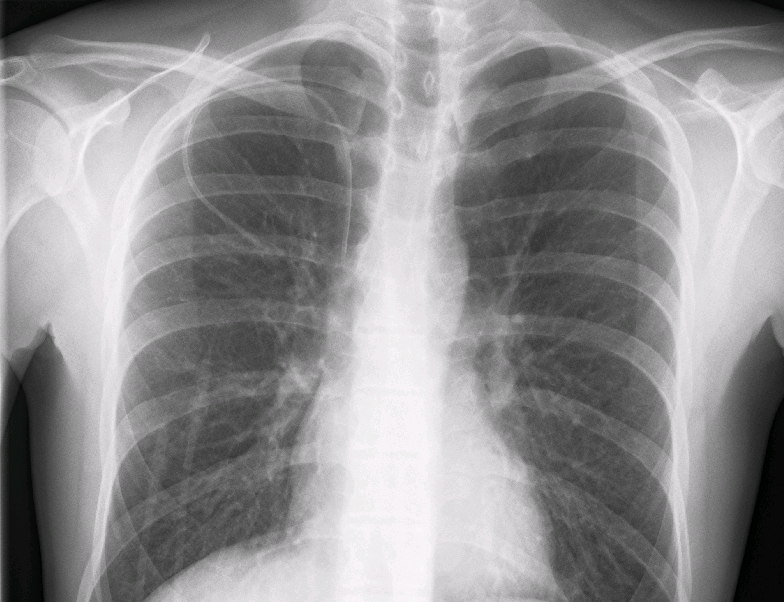
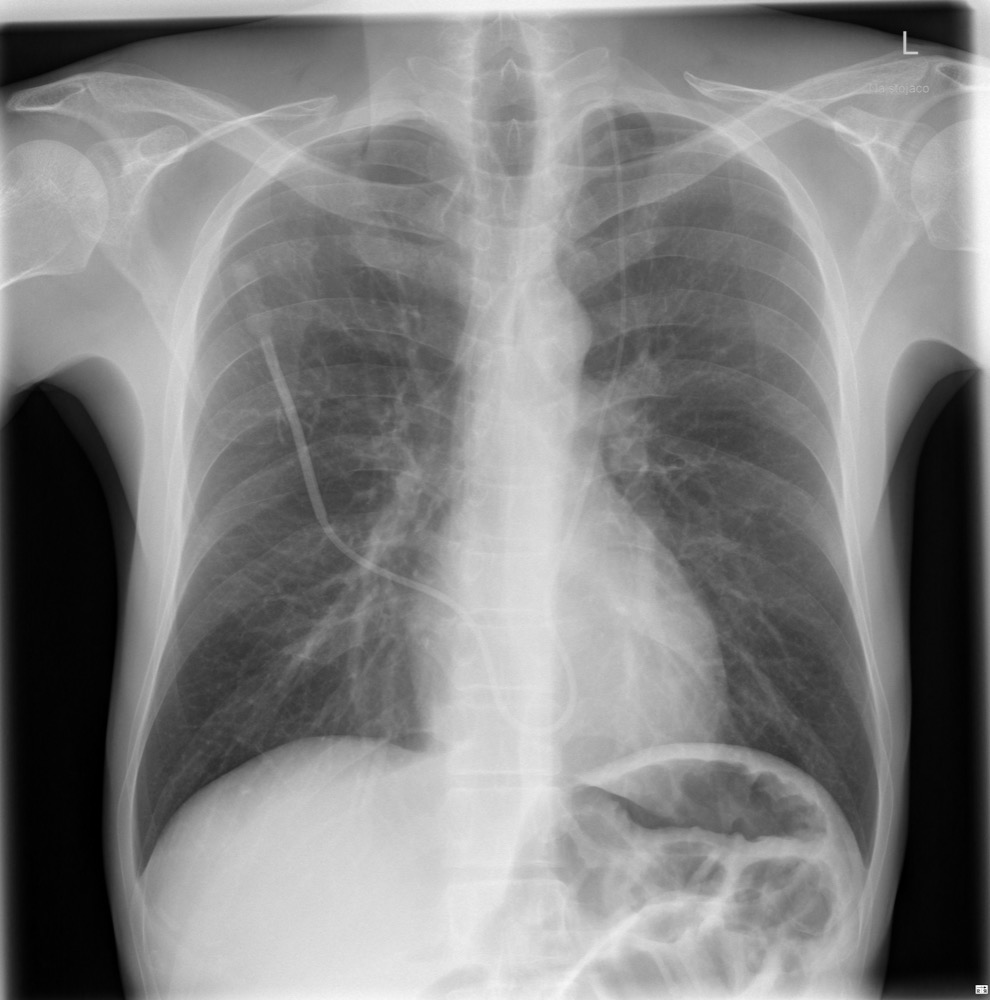
Confirm the tip as soon as it is clinically appropriate. Use a chest radiograph, continuous ECG during placement or ultrasound, per protocol, per ASA 2020. In RCTs, continuous ECG during placement identifies tip position better than no ECG, per ASA 2020.
Target Tip Position
In an adult upper-body CVC, the usual target sits in the lower third of the superior vena cava or the cavoatrial junction, with the tip parallel to the vessel wall. Keep it out of the right atrium and ventricle, and off the vessel wall. This target is general practice, not ASA 2020 wording. Confirm it against local protocol.
- Chest radiograph: Read the tip against the carina. Your target, the lower SVC or cavoatrial junction, sits at or just above it.
- Common malpositions: Contralateral brachiocephalic vein; ipsilateral internal jugular or azygos vein; too deep in the right atrium or ventricle (arrhythmia risk).
- ECG (general practice): Watch the P wave. It peaks near the cavoatrial junction. Biphasic or negative P waves suggest the tip has entered the right atrium.
Secondary Confirmation
- Venous pattern: Manometry or pressure waveform shows a venous pattern before the dilator.
- Wire accounted for: The complete guidewire is in the procedural field after removal per ASA 2020.
- Pneumothorax excluded: A chest radiograph or transthoracic ultrasound, per protocol; ASA 2020 cites high specificity for transthoracic ultrasound.
- Dressing intact: Transparent dressing secure and dry per SHEA 2022.
| Finding | Success | Failure / Malposition |
|---|---|---|
| Venous access | Venous pattern on manometry or pressure waveform | Arterial pattern: leave in place and consult per ASA 2020 |
| Guidewire | Complete wire found in the field | Wire missing: chest radiograph to look for a retained wire per ASA 2020 |
| Tip position | Lower SVC or cavoatrial junction on radiograph or ECG (general practice) | Brachiocephalic, IJ or azygos malposition, or right atrium or ventricle: reposition or replace per protocol |
| Pneumothorax | Excluded on imaging per protocol | Pneumothorax: manage per protocol and medical direction |
| Dressing | Intact, dry, secure | Soiled, loose or damp: change now per SHEA 2022 |
Ongoing Monitoring
- Each shift: Inspect the site for signs of infection and check the dressing per ASA 2020 and SHEA 2022.
- Daily: Assess whether the line is still needed and remove it promptly when it is not per ASA 2020.
- Before each access: Disinfect the hub, needleless connector and injection port per SHEA 2022.
Troubleshooting
| Problem | Likely Cause | Fix |
|---|---|---|
| Dark blood, no pulsation | Artery or misplaced needle mistaken for a vein | Check with manometry or pressure waveform before the wire per ASA 2020 |
| Wire will not advance | Resistance in the tract or wire in the wrong position | Do not force it; re-check on ultrasound and consult per protocol |
| Wire will not come out | Knot, or wire or catheter entrapped | Consult interventional radiology or surgery per ASA 2020 |
| Wire missing from the field | Possible retained guidewire | Chest radiograph; remove per consultation per ASA 2020 |
| Tip position uncertain | Confirmation not yet done or unclear | Confirm with ECG, radiograph or ultrasound per protocol per ASA 2020 |
| Dressing soiled, loose or damp | Dressing failure | Change immediately per SHEA 2022 |
| Site redness or drainage | Possible site infection | Culture and treat per protocol; change or remove the catheter when infection is suspected per ASA 2020 |
| Suspected catheter-related bloodstream infection | Fever or positive culture | Paired blood cultures, one drawn through the catheter and one peripheral, before antibiotics, per the IDSA 2009 guideline |
| Hub contaminated before use | Hub not disinfected | Disinfect the hub before each access per SHEA 2022 |
| Sterility breach during insertion | Break in aseptic technique | Stop and restart the sterile steps; any team member may stop per SHEA 2022 |
If It Still Fails
- Arterial cannulation: Leave the dilator or catheter in place and consult a surgeon, vascular surgeon or interventional radiologist per ASA 2020.
- Unable to place: Use the alternative access route in local protocol, such as IO Access in an emergency.
Complications
| Complication | Recognition | Prevention | Management |
|---|---|---|---|
| Immediate: arterial puncture | Arterial pattern on manometry or pressure waveform; ASA 2020 notes that color and flow can miss it | Check venous access before dilating per ASA 2020 | Leave the dilator or catheter in place; consult per ASA 2020 |
| Immediate: pneumothorax | Chest radiograph or transthoracic ultrasound per ASA 2020 | Real-time ultrasound for internal jugular access per ASA 2020 | Tension or large: decompress per protocol (see Needle Decompression and Chest Tubes); ASA 2020 does not address management |
| Immediate: air embolism | Sudden hemodynamic or respiratory change; recognition signs per protocol | At removal: Trendelenburg, Valsalva, direct pressure, air-occlusive dressing per ASA 2020 | Occlude the site; left lateral decubitus and Trendelenburg; 100% oxygen; call for help; aspiration through the catheter if protocol allows (general practice) |
| Immediate: retained guidewire | Wire not complete in the field after removal | Count the wire before leaving the field per ASA 2020 | Chest radiograph; retrieve per consultation per ASA 2020 |
| Delayed: bloodstream infection | Fever or positive cultures per protocol | Full insertion bundle, CHG dressing and hub disinfection per SHEA 2022 | Culture; change or remove the catheter when infection is suspected per ASA 2020 |
| Delayed: thrombosis | Swelling of the limb or neck per clinical assessment | Upper-body site in adults when possible per ASA 2020 | Per local protocol |
Special Populations
Pediatrics
- Femoral site: In infants and children, a femoral catheter may be considered when upper-body sites are contraindicated, per SHEA 2022.
- Venous confirmation: In neonates, infants and children, you may confirm venous placement after the wire is threaded, per ASA 2020.
- Dressing: For CVCs in patients over 2 months of age, use a CHG-containing dressing, per SHEA 2022. Neonatal skin prep follows institutional protocol, per ASA 2020.
- Sizes and doses: See Equipment Sizing, Pediatric Vascular Access, and Weight-Based Dosing.
Dialysis Patients
- Scope: Tunneled lines, dialysis catheters included, sit outside the ASA 2020 guideline. Follow the hemodialysis page and nephrology protocol.
- Site care: For hemodialysis catheters, SHEA 2022 recommends an antimicrobial ointment at the insertion site.
- Subclavian for CVCs: SHEA 2022 says the subclavian site is avoided in patients receiving or likely to need hemodialysis, because of stenosis risk. Choose the site with nephrology and protect the AV-fistula arm. In an emergency, the fastest safe route may take priority.
Pregnancy
- Positioning: Use left lateral tilt when feasible (general practice, protocol-dependent).
- Site: Prefer an upper-body site with ultrasound guidance, such as the internal jugular (general practice, protocol-dependent).
Physiologically Difficult
- Shock: SSC 2021 suggests starting vasopressors peripherally, rather than waiting until central access is secured.
- Fluid decisions: SSC 2021 says heart rate, CVP and systolic blood pressure alone are poor indicators of fluid status. Reach for dynamic measures instead.
Post-Procedure Care & Transport
Immediate Aftercare
- Tip confirmation: Confirm the final tip position as soon as clinically appropriate per ASA 2020.
- Site check: Inspect the site and dressing; the dressing must be intact and dry per SHEA 2022.
Ongoing Maintenance
- Dressing: Transparent every 7 days or at once if soiled, loose or damp; gauze every 2 days per SHEA 2022.
- Hubs: Disinfect hubs and connectors before each access; keep caps on per SHEA 2022 and ASA 2020.
- Administration sets: Replace at intervals up to every 7 days, except for blood, blood products or lipid formulations per SHEA 2022.
- Daily bathing: Bathe ICU patients older than 2 months with a chlorhexidine preparation every day per SHEA 2022.
- Need: Assess daily and remove the catheter promptly when it is not needed per ASA 2020.
- Removal: At removal, use Trendelenburg, Valsalva, direct pressure and an air-occlusive dressing, and monitor for a period after removal per ASA 2020.
Transport Considerations
- Site check after each move: Check the dressing and site; change the dressing if soiled, loose or damp per SHEA 2022.
- Existing line (general practice): Verify blood return and a free flush before use, scrub the hub before each access, keep air out of the line, and secure the line and tubing for transfer. Do not infuse through a line you cannot verify.
Handoff & Documentation
Document & Hand Off
- Time, operator and assistant
- Site, catheter type and size
- Technique and ultrasound use
- Venous confirmation method and tip confirmation method and result
- Attempts and complications
- Dressing date and the next change due
- Medications and fluids given through the line
Clinical Pearls & Pitfalls
Pearls
- Ultrasound first: The meta-analyses ASA 2020 cites favor real-time ultrasound at the internal jugular. First-attempt and overall success both go up, compared with the landmark approach.
- ECG for the tip: In RCTs, continuous ECG finds proper tip placement better than no ECG, per ASA 2020.
- Chlorhexidine for skin and dressing: Alcoholic chlorhexidine goes on the skin. CHG dressings are for patients over 2 months, per SHEA 2022.
- Ask every day: Is the line still needed? If not, take it out, per ASA 2020.
Common Pitfalls
- Dark blood taken as proof → confirm with manometry or pressure waveform per ASA 2020.
- Dilating before venous confirmation → confirm first, then dilate per ASA 2020.
- Losing track of the wire → count it; chest radiograph if it is missing per ASA 2020.
- Routine replacement to prevent infection → do not routinely replace CVCs per SHEA 2022.
- Femoral site in adults → use an upper-body site when possible per ASA 2020.
- CVP alone for fluids → use dynamic measures per SSC 2021.
Education & Skill Maintenance
Skill Maintenance
- Sequence rehearsal: Rehearse the ASA 2020 sequence: static scan, real-time puncture, venous confirmation, wire count.
- Checklist: Use the checklist or protocol at every practice run per ASA 2020.
- Competency: SHEA 2022 recommends education and competency assessment. It covers everyone who inserts, cares for or maintains CVCs.
References
- Buetti N, Marschall J, Drees M, et al. Strategies to prevent central line-associated bloodstream infections in acute-care hospitals: 2022 Update. Infect Control Hosp Epidemiol. 2022;43(5):553–569. https://doi.org/10.1017/ice.2022.87
- American Society of Anesthesiologists Task Force on Central Venous Access. Practice guidelines for central venous access 2020: an updated report by the American Society of Anesthesiologists Task Force on Central Venous Access. Anesthesiology. 2020;132(1):8–43. https://doi.org/10.1097/ALN.0000000000002864
- Evans L, Rhodes A, Alhazzani W, et al. Surviving Sepsis Campaign: international guidelines for management of sepsis and septic shock 2021. Crit Care Med. 2021;49(11):e1063–e1143. https://doi.org/10.1097/CCM.0000000000005337
- Hospira, Inc. Lidocaine hydrochloride injection (aqueous solutions for infiltration and nerve block): prescribing information. DailyMed set ID 3b2dd84e-cee8-4e58-d494-395a65a353a0; label effective August 5, 2026. https://dailymed.nlm.nih.gov/dailymed/drugInfo.cfm?setid=3b2dd84e-cee8-4e58-d494-395a65a353a0
- Mermel LA, Allon M, Bouza E, et al. Clinical practice guidelines for the diagnosis and management of intravascular catheter-related infection: 2009 update by the Infectious Diseases Society of America. Clin Infect Dis. 2009;49(1):1–45. https://doi.org/10.1086/599376
Medical Disclaimer
- For Educational Purposes Only: This content is intended for educational reference and should not be used for clinical decision-making.
- Not a Substitute for Professional Judgment: Always consult your local protocols, institutional guidelines, and supervising physicians.
- Verify Before Acting: Users are responsible for verifying information through authoritative sources before any clinical application.