

Bedside Snapshot
- Recognize
- Hypoperfusion from a failing circulation: low MAP (below 65 mmHg) or signs of hypoperfusion (lactate above 2 mmol/L, cool or mottled skin, altered mentation, low urine output). Normal BP does not exclude it. Name the type first.
- Red Flags
- MAP below 65 mmHg after a fluid bolus
- Lactate 4 mmol/L or higher
- New confusion, falling SpO₂ or cool, mottled limbs
- Absent breath sounds, tracheal shift, or muffled heart sounds with neck vein distension
- First Actions
- Oxygen, monitor, two IV or IO lines, 12-lead ECG. Then by type: fluids and norepinephrine for distributive shock; stop bleeding and give blood for hemorrhage; decompress or drain obstruction; pressor plus inotrope for cardiogenic.
- Key Doses
- Norepinephrine 8–12 mcg/min IV initial, then titrate; BP every 2 min to target (label)
- Vasopressin 0.01 units/min, up 0.005 units/min every 10–15 min
- Dobutamine 2–20 mcg/kg/min with cardiac dysfunction
- Don't Miss
- Obstructive shock that fluids and pressors cannot fix (tension pneumothorax, tamponade, massive PE); bleeding that looks like sepsis; a pressor given instead of volume or blood.
- Escalate & Transport
- Escalate early for MAP below 65 mmHg after fluids, a rising lactate or a second pressor. STEMI-related cardiogenic shock goes to a PCI-capable center; hemorrhage to a trauma center; obstruction to the procedure team.
Definition & Pathophysiology
Shock is circulatory failure. The tissues stop getting enough oxygen delivery. Sepsis-3 defines septic shock in operational terms: a vasopressor is needed to hold mean arterial pressure (MAP) at 65 mmHg or higher, and lactate sits above 2 mmol/L with no hypovolemia present. That combination is linked to hospital mortality above 40%.
MAP is estimated as (systolic + 2 × diastolic) ÷ 3. A low MAP on its own does not mean shock. Shock needs low pressure or low flow, and the tissues have to show it: lactate above 2 mmol/L, altered mentation, cool or mottled skin, or low urine output. The four types differ in what fails:
- Distributive: Vessels dilate or leak, from sepsis, anaphylaxis or spinal cord injury. Output may be normal or high early.
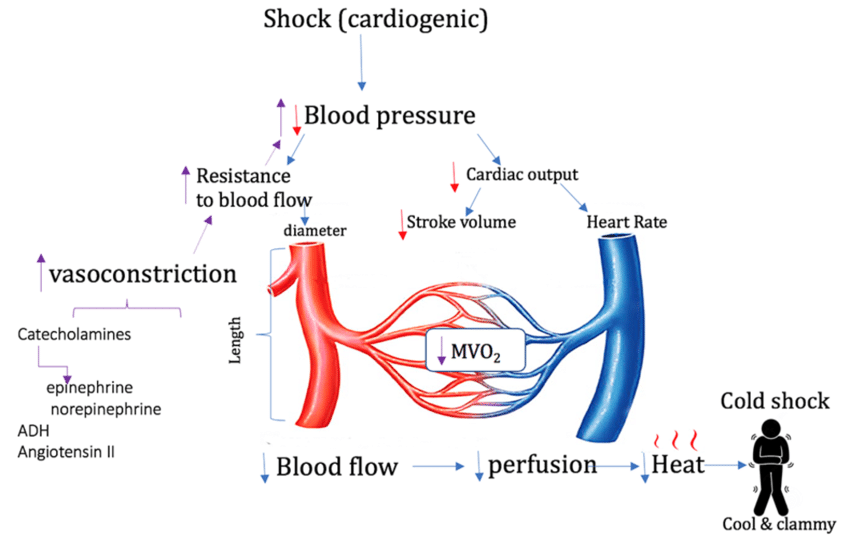
- Cardiogenic: The pump fails. Output drops, and the body answers with catecholamine vasoconstriction (Figure 1). Filling pressures climb.
- Hypovolemic: Circulating volume drops from hemorrhage, severe GI losses, burns or plasma loss. Preload falls, and output falls with it.
- Obstructive: Flow is blocked outside the heart muscle: tension pneumothorax, cardiac tamponade or massive pulmonary embolism (PE).
Recognition & Red Flags
Hemodynamic Profile by Type
| Type | Skin and Perfusion | Pressure and Rate | Separating Clue |
|---|---|---|---|
| Distributive | Warm and flushed early in sepsis, cool late. Urticaria in anaphylaxis | Low MAP; heart rate high in sepsis or anaphylaxis, low after spinal cord injury | Warm, well-filled patient with a low MAP points to vasodilation |
| Cardiogenic | Cool, clammy or mottled; capillary refill slow | Low MAP; heart rate high; high filling pressures | Crackles, neck vein distension, S3, ischemic or arrhythmic ECG |
| Hypovolemic | Pale, cool and clammy; dry mucosa in GI or burn loss | Low MAP; heart rate high; falls as loss continues | Visible or concealed bleeding; flat neck veins; hemoglobin falls later |
| Obstructive | Cool or cyanotic; pallor in tamponade | Low MAP; heart rate high; high venous pressure | Tension: one side silent and trachea shifted. Tamponade: muffled heart sounds, pulsus paradoxus. PE: right heart strain |
Red Flags
- MAP below 65 mmHg or systolic below 90 mmHg that does not respond to an initial fluid bolus
- Lactate above 2 mmol/L; 4 mmol/L or higher marks high risk
- Altered mental status, cool or mottled skin, prolonged capillary refill time
- Low or falling urine output during resuscitation
- Obstruction signs: absent breath sounds on one side, tracheal shift, muffled heart sounds, or distended neck veins with hypotension
Assessment & Diagnostics
Treat before you confirm. The rows below give the action threshold for each check. Labs and images sharpen the type once the first step is already running.
| Check | Why | Act If |
|---|---|---|
| MAP and trend | Defines hypotension and the response to treatment | MAP below 65 mmHg: start shock treatment for the suspected type. Systolic below 90 mmHg is a hypoperfusion flag |
| Lactate (see Lactate) | Perfusion, not pressure | Above 2 mmol/L: suspect hypoperfusion (epinephrine and beta-agonists can also raise it). 4 mmol/L or higher: escalate. Repeat to confirm clearance |
| Capillary refill time and skin | Bedside perfusion; SSC 2026 suggests it as an adjunct to other perfusion measures | Prolonged refill or mottling: hypoperfusion. Re-check after each intervention |
| 12-lead ECG (see STEMI Recognition) | Ischemia, arrhythmia, right heart strain, low voltage | STEMI or STEMI equivalent: emergency reperfusion pathway. Tachy- or bradyarrhythmia: treat the rhythm per protocol |
| Point-of-care ultrasound | Pericardial effusion, lung sliding, IVC, LV and RV function | Effusion with chamber collapse: obstructive shock, urgent drainage. Absent lung sliding: pneumothorax. Dilated RV: PE or RV failure |
| Potassium and glucose (see Potassium, Glucose) | Arrhythmia risk; low glucose mimics shock | Abnormal potassium: correct before it causes an arrhythmia. Low glucose: treat now and re-check |
| Hemoglobin (see Hemoglobin) | Bleeding; the value lags the loss | Falling value or ongoing loss: hemorrhage pathway and blood products per protocol |
Differential & Mimics
- Anaphylaxis: Hives, swelling or wheeze with hypotension after an exposure. Reach for IM epinephrine first, per the Anaphylaxis page.
- Hypoglycemia or vasovagal syncope: Pale and sweaty with low blood pressure, and no shock pattern on exam. Check glucose and rhythm before you start pressors.
- Rhythm-caused hypotension: A slow or fast arrhythmia can drop output all by itself. See Adult Bradycardia.
- Infection without hypotension: Lactate above 2 mmol/L with a normal MAP falls short of septic shock under Sepsis-3, yet it needs source control and close monitoring.
- Cardiogenic plus septic: Both can show up in one patient. A cold, wet patient with crackles is not a warm septic patient, even with a fever.
BLS Management
- Scene safety and primary assessment: airway, breathing, circulation and mental status. Find life-threatening bleeding first.
- Control external bleeding: direct pressure, a hemostatic dressing or a tourniquet. See Hemorrhage Control.
- Position: lie supine with legs raised if breathing is easy and there is no spinal or head injury. Sit the patient up if breathing is hard. With suspected spinal injury, keep the spine stabilized and follow the spinal protocol.
- Oxygen to the SpO₂ target in your protocol, and keep the patient warm.
- Anaphylaxis: help the patient use their own epinephrine autoinjector. See the Anaphylaxis page.
- Call ALS early and report the suspected type: trauma, cardiac history, infection source, allergen, or spinal injury.
ALS Management
Doses vary by protocol; follow local protocols and medical direction. Treat the cause first, then add drugs in the order below. Reassess against MAP and perfusion before every next step.
- Access and monitoring (Paramedic/RN/CCT): two large-bore IV lines, or IO when IV access fails (see IO Access). Continuous ECG, SpO₂ and blood pressure; obtain a 12-lead ECG.
- Fluids by type: with sepsis-induced hypoperfusion, SSC 2026 suggests at least 30 mL/kg of IV crystalloid in the first 3 hours, individualized with frequent reassessment. Use actual body weight, or adjusted or ideal weight when BMI is above 30, and state the dosing weight. SSC 2026 suggests a balanced crystalloid over 0.9% saline (see Lactated Ringer's). In cardiogenic shock, keep boluses small and stop at the first sign of pulmonary edema. In hemorrhage, blood products go in per protocol, not large crystalloid volumes (see Blood Transfusion). Uncontrolled non-TBI hemorrhage: many protocols accept a lower blood pressure target until the bleeding is controlled. With TBI, avoid hypotension. Follow local protocol and medical direction.
- Norepinephrine (Paramedic/RN/CCT): The first-line pressor for distributive shock. The label starts at 8–12 mcg/min IV. Judge the response, then adjust. Check blood pressure every 2 min until you reach the desired effect, then every 5 min for the whole infusion (label). In septic shock, the MAP target is 65 mmHg per SSC 2026. The label talks about a low-to-normal pressure, usually 80–100 mmHg systolic. You can start peripherally to restore MAP instead of waiting for central access. SSC 2026 gives this as a conditional recommendation. See Norepinephrine.
- Vasopressin add-on (RN/CCT, per local protocol): Add it when norepinephrine needs keep climbing. The label starts septic shock at 0.01 units/min IV, raised by 0.005 units/min every 10–15 min to target. It notes limited data above 0.07 units/min. See Vasopressin.
- Epinephrine (RN/CCT, per local protocol): Add it when MAP stays inadequate on norepinephrine plus vasopressin, as SSC 2026 advises. Take the infusion dose from the Epinephrine IV page.
- Dobutamine (RN/CCT, per local protocol): When cardiac dysfunction with persistent hypoperfusion remains after adequate fluid and MAP is at target, SSC 2026 suggests adding dobutamine to norepinephrine, or using epinephrine alone. The label starts at 0.5–1 mcg/kg/min IV, and you titrate every few minutes. Usual range is 2–20 mcg/kg/min, weight-based, so state the dosing weight. Watch for hypotension, tachycardia, ventricular ectopy or arrhythmia, and ischemia. The label calls for continuous ECG and blood pressure monitoring. Reduce or stop it for excessive tachycardia or ectopy. Don't use dobutamine alone for hypotension. See Dobutamine.
- Dopamine (second line): SSC 2026 recommends norepinephrine over dopamine as first line (strong recommendation). Reach for dopamine only when norepinephrine is unavailable or per protocol. See Dopamine.
- Hemorrhage (Paramedic/RN/CCT): control the bleeding source, transfuse per protocol, and give tranexamic acid per protocol (see Tranexamic Acid).
- Obstruction (Paramedic/RN/CCT): decompress a suspected tension pneumothorax per protocol (see Needle Decompression). Tamponade and massive PE need definitive care at the receiving center. Make the transport call early.
- Airway: Hypotension around intubation is common in shock. Have a vasopressor ready before induction (see RSI).
ED & ICU Management
- Confirm the type: bedside echocardiography (LV and RV function, pericardial effusion, IVC), lactate trend, and cultures and imaging for the source. Sepsis treatment starts immediately, antimicrobials included. SSC 2026 calls sepsis a medical emergency.
- MAP target (septic shock): 65 mmHg (SSC 2026, strong recommendation), within a practical range (SSC 2026: within 5 mmHg). For adults 65 or older, SSC 2026 suggests an initial range of 60–65 mmHg (conditional). Other shock types (neurogenic, hemorrhagic, post-arrest) set their own MAP goal by type and protocol. The SSC targets do not carry over.
- Arterial line: Once vasopressors are running and titration is frequent, use beat-to-beat MAP.
- Corticosteroids: SSC 2026 suggests IV corticosteroids in adults with septic shock (conditional, low certainty). The SSC text read for this page gives no dose or threshold. For agent and dose, go to Hydrocortisone.
- Cardiogenic shock: Revascularize emergently for STEMI-related shock. The SHOCK trial showed early revascularization improving survival over initial medical stabilization. Escalate mechanical support and inotropes with cardiology. Use the SCAI stage (A to E) to define severity.
- Hemorrhage: activate the massive transfusion protocol; surgical or interventional radiology control; tranexamic acid per protocol.
- Obstruction: A tension pneumothorax gets decompression, then a chest tube (see Chest Tubes). Tamponade needs urgent pericardial drainage. PE with shock needs a reperfusion decision from the team, per the 2019 ESC PE guideline and local protocol.
- Neurogenic shock: Rule out hemorrhage first. The spinal cord injury protocol sets the MAP goal, and it is not the septic-shock target of 65 mmHg. Treat bradycardia per protocol.
- Post-ROSC hypotension: The septic-shock target does not apply here. Set blood pressure goals from the Adult Cardiac Arrest page and local post-arrest protocol.
- Weaning: Taper vasopressors once MAP is at target and perfusion improves. Keep the withdrawal gradual, not abrupt.
Transport Considerations
- EMS destination: STEMI-related cardiogenic shock to a PCI-capable center; hemorrhage or penetrating trauma to a trauma center; sepsis to the nearest ED able to start antimicrobials and ICU care, per protocol. For septic shock, if in-hospital evaluation is expected to take over 60 min, SSC 2026 suggests prehospital antimicrobials where a structured sepsis-screening process is in place (conditional, very low certainty). Follow local protocol.
- Monitoring in transit: continuous ECG and SpO₂, EtCO₂ if intubated, and blood pressure at short intervals. Check each pump, the bag concentration and the access site at every handoff and each vehicle stop.
- Handoff essentials: the agent, concentration, current rate in mcg/kg/min or mcg/min and mL/hr, the MAP goal, time of the last dose change, access site, fluid and blood totals.
- Air transport: Gas expands as altitude climbs. A pneumothorax, even one decompressed in the field, can enlarge in flight. Re-check breath sounds and carry decompression and chest tube supplies.
- Peripheral vasopressors: Acceptable under protocol. Infiltration can injure tissue, so check the site often. Phentolamine treatment depends on protocol.
Special Populations
- Pediatrics: use weight-based dosing and age-specific vital signs. Find the full pediatric content on the Pediatric Shock page. Vasopressin safety and effectiveness are not established in children (label). You spot pediatric shock through age-specific vital signs and perfusion, and fluid and vasoactive dosing follow pediatric protocols (see Pediatric Shock). The adult SSC 2026 recommendations do not apply to children.
- Pregnancy: relieve aortocaval compression with left lateral tilt. In pregnancy, hemorrhage is a common cause of shock. The norepinephrine label says not to withhold life-sustaining therapy because of fetal concern. High-dose norepinephrine reduced placental blood flow in pregnant sheep (label, animal data). The vasopressin label notes it may trigger uterine contractions (label section 8.1). Bring in obstetrics per local protocol.
- Older adults: For septic shock in adults 65 or older, SSC 2026 suggests starting in a MAP range of 60–65 mmHg (conditional).
- Renal impairment: Milrinone is cleared by the kidneys, so it builds up. Reduce the rate per its label, and watch for prolonged hypotension after you stop it (see Milrinone).
- Patients on Anticoagulants: On anticoagulants, bleeding is hemorrhagic shock until proven otherwise. See Anticoagulant Reversal.
- Patients on Beta-Blockers: Beta-blockers blunt the heart rate response, so a normal heart rate does not rule out shock.
- Obesity: A cuff that is too small overestimates pressure, and one that is too big underestimates it. Get the size right, or use an arterial line.
Pitfalls & Safety Checks
- Error: treating the blood pressure instead of the type. Norepinephrine for untreated hemorrhage fails. Bleeding control and volume come first.
- Error: fluid boluses into cardiogenic shock with no reassessment. Keep boluses small, and stop at crackles, hypoxia or rising filling pressures.
- Error: missing obstructive shock. Tension pneumothorax and tamponade do not answer fluids or vasopressors. Decompress or drain.
- Error: mcg/kg/min entered as mcg/min. At 0.1 mcg/kg/min, an 80 kg adult gets 8 mcg/min. Confirm units and dosing weight at every change.
- Error: dopamine and dobutamine mixed up. Both run in mcg/kg/min. Dopamine is the pressor, and dobutamine is the inotrope. Read the bag label and the pump library.
- Error: vasopressin charted per hour. Vasopressin runs in units/min. 0.03 units/min works out to 1.8 units/hr.
- Error: stopping vasopressors abruptly. The norepinephrine label advises reducing the flow rate gradually.
- Error: using an inotrope alone for hypotension. Per SSC 2026, dobutamine goes on top of norepinephrine, or epinephrine is used alone. Dobutamine is not used alone for hypotension.
Clinical Pearls
References
- Surviving Sepsis Campaign. Surviving Sepsis Campaign: International Guidelines for Management of Sepsis and Septic Shock 2026. Critical Care Medicine. 2026. https://doi.org/10.1097/CCM.0000000000007075
- Singer M, Deutschman CS, Seymour CW, et al. The Third International Consensus Definitions for Sepsis and Septic Shock (Sepsis-3). JAMA. 2016;315:801. https://doi.org/10.1001/jama.2016.0287
- Baran DA, Grines CL, Bailey S, et al. SCAI clinical expert consensus statement on the classification of cardiogenic shock. Catheterization and Cardiovascular Interventions. 2019;94:29–37. https://doi.org/10.1002/ccd.28329
- Hochman JS, Sleeper LA, Webb JG, et al. Early revascularization in acute myocardial infarction complicated by cardiogenic shock (SHOCK trial; landmark trial). New England Journal of Medicine. 1999;341:625–634. https://doi.org/10.1056/NEJM199908263410901
- Rao SV, O'Donoghue ML, Ruel M, et al. 2025 ACC/AHA/ACEP/NAEMSP/SCAI Guideline for the Management of Patients With Acute Coronary Syndromes. Circulation. 2025;151. https://doi.org/10.1161/CIR.0000000000001309
- Konstantinides SV, Meyer G, Becattini C, et al. 2019 ESC Guidelines for the diagnosis and management of acute pulmonary embolism developed in collaboration with the European Respiratory Society (ERS). European Heart Journal. 2019;41:543–603. https://doi.org/10.1093/eurheartj/ehz405
- Adler Y, Charron P, Imazio M, et al. 2015 ESC Guidelines for the diagnosis and management of pericardial diseases. European Heart Journal. 2015;36:2921–2964. https://doi.org/10.1093/eurheartj/ehv318
- Vasostrict (vasopressin) injection, prescribing information. Par Health USA. DailyMed, version 49 (published May 2026); accessed 10/2026. https://dailymed.nlm.nih.gov/dailymed/drugInfo.cfm?setid=b1147beb-743e-4c62-8927-91192447f8b8
- Norepinephrine bitartrate injection, prescribing information. Baxter Healthcare Corporation. DailyMed, version 6 (published July 2026); accessed 10/2026. https://dailymed.nlm.nih.gov/dailymed/drugInfo.cfm?setid=e375a0b9-4d26-4749-bbc3-43d63a7cf65a
- Dobutamine in dextrose injection, prescribing information. Hospira, Inc. DailyMed, version 28 (effective June 2026); accessed 10/2026. https://dailymed.nlm.nih.gov/dailymed/drugInfo.cfm?setid=9943a961-3b50-4847-8a84-d8414ce38daa
Medical Disclaimer
- For Educational Purposes Only: This content is intended for educational reference and should not be used for clinical decision-making.
- Not a Substitute for Professional Judgment: Always consult your local protocols, institutional guidelines, and supervising physicians.
- Verify Before Acting: Users are responsible for verifying information through authoritative sources before any clinical application.